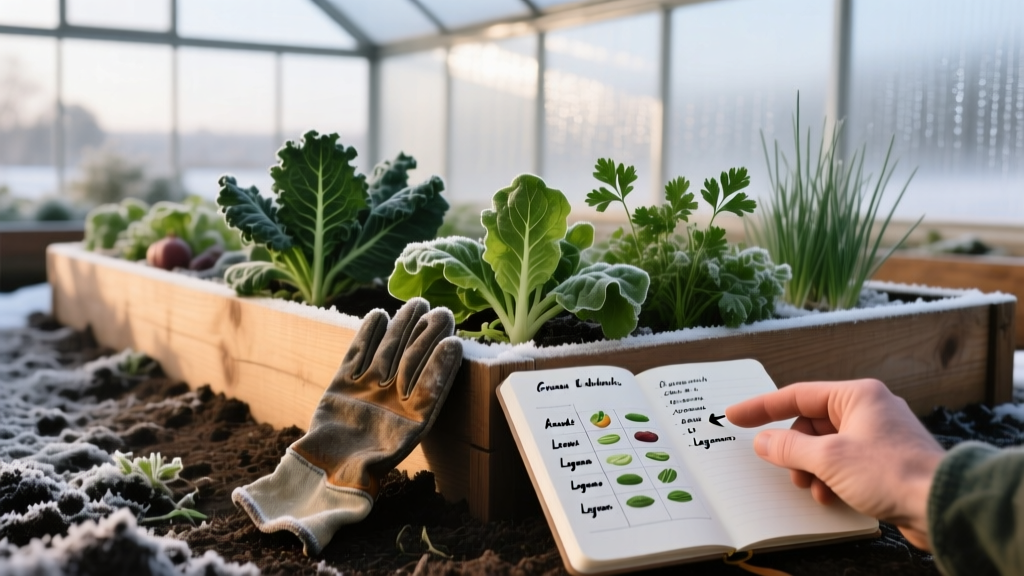
Winter Garden: Planning Crop Rotation Schedule
Winter is the narrow window when next season’s problems are still avoidable. Once spring planting starts, rotation mistakes—repeating the same crop family in the same bed, ignoring soil-borne disease history, skipping cover crops—lock in a year of extra pests, weaker plants, and disappointing yields. Right now, while beds are empty (or mostly empty) and you can still see the structure of your garden, you can design a crop rotation schedule that fits your space, your USDA hardiness zone, and your frost calendar.
If you do nothing else this week, do this: map your beds, list what grew where last season, and decide what cannot go back into the same spot for at least 2–4 years. Many pathogens and pests overwinter in crop debris and soil; rotation is one of the most reliable winter moves you can make because it reduces pressure before it starts.
Priority #1: What to prepare (this week) — build your rotation map
Step 1 (30 minutes): Draw your beds and label crop families
Sketch every growing area: raised beds, in-ground rows, big containers, and even perennial edges that shade annual beds. Assign each area a simple label (Bed A, Bed B, etc.). Then write down what grew there last season—tomatoes, peppers, potatoes, cucumbers, squash, beans, brassicas, onions, garlic, etc.—and group them by family.
- Solanaceae: tomatoes, peppers, eggplant, potatoes
- Cucurbitaceae: cucumbers, squash, pumpkins, melons
- Brassicaceae: broccoli, cabbage, kale, cauliflower, radish, turnip
- Fabaceae: beans, peas
- Alliums: onions, garlic, leeks
- Asteraceae: lettuce, endive
- Apiaceae: carrots, parsley, cilantro, dill
- Chenopodiaceae/Amaranthaceae (common garden grouping): beets, spinach, chard
Rotation rule of thumb: avoid planting the same family in the same bed in consecutive years; extend to 3–4 years if you’ve had serious soil-borne disease.
Step 2 (this weekend): Mark “no-repeat” beds based on disease history
Rotation is most powerful when it responds to what went wrong. Winter is the time to be honest about it. On your map, flag any bed that had:
- Tomato/pepper issues: early blight, Septoria leaf spot, bacterial spot, root-knot nematodes
- Cucurbit issues: powdery mildew, bacterial wilt, squash vine borer
- Brassica issues: clubroot, black rot
- Allium issues: white rot
Many extension services recommend rotation as a key management tool for soil-borne diseases and pests; for example, Cornell notes that crop rotation reduces pathogen buildup and can be essential for managing soil-borne diseases (Cornell Cooperative Extension, 2019). Similarly, University of Minnesota Extension emphasizes sanitation and rotation as core strategies in vegetable disease prevention (University of Minnesota Extension, 2020).
“Crop rotation is one of the most effective cultural practices for reducing soil-borne diseases because many pathogens survive in soil and crop debris for years.”
—Extension guidance summarized from land-grant university vegetable disease management publications
Step 3: Decide your rotation “engine” (3-bed, 4-bed, or 5-bed)
Pick a system that matches your number of beds and how intensively you grow.
- 3-bed rotation: (1) fruiting crops (Solanaceae/Cucurbits), (2) leafy/brassicas, (3) roots/alliums/legumes + cover crop.
- 4-bed rotation (classic): (1) Solanaceae, (2) Cucurbits, (3) Brassicas/leafy, (4) Legumes + roots/alliums.
- 5-bed rotation (best for disease-prone gardens): separate Solanaceae and potatoes; give brassicas a longer gap if clubroot risk exists.
Timing anchor: Build your plan backward from your average last spring frost date. Example benchmarks: March 15 (warm coastal), April 15 (mid-South), May 15 (Upper Midwest), June 1 (high elevations). Your dates will differ—use your local average and keep notes on outlier years.
Priority #2: What to plant (winter) — protect soil and set up next year’s rotation
Plant cover crops when soil is bare (or plan spring cover in unused beds)
If you still have open ground and daytime highs regularly stay above 45°F, you may be able to establish a winter cover crop. If your soil is already cold or frozen, plan a spring cover for any bed that won’t be planted until late.
Good winter options:
- Cereal rye: strong winter hardiness; great biomass for weed suppression.
- Winter wheat: easier to manage than rye in small gardens.
- Hairy vetch (mild zones): nitrogen fixer; can be aggressive—best if you can terminate on time.
- Crimson clover (zones 7–9, or protected areas): nitrogen fixer; winter survival depends on cold snaps.
Termination timing: plan to cut and incorporate or smother cover crops 2–4 weeks before planting that bed. For no-till gardeners, cut at flowering and tarp for 2–3 weeks to prevent regrowth.
Keep winter edibles in the rotation (where climate allows)
In USDA zones 7–10, winter planting can also serve rotation goals—filling beds with non-host crops that break pest cycles.
- Garlic: typically planted in fall; in milder winters, you may still plant by mid-December if soil is workable.
- Fava beans: a winter legume in zones 7–10; can help with nitrogen and rotation diversity.
- Spinach/kale under cover: extend harvest and keep soil occupied (reducing winter weeds that host pests).
If you’re in zones 3–6 with frozen ground, treat winter as your planning/soil-protection season rather than active planting time. Your “planting” task becomes ordering cover crop seed for spring and choosing varieties aligned with rotation constraints.
Priority #3: What to prune (winter) — clean up to reduce carryover disease
Remove and destroy diseased annual crop debris
Winter cleanup directly supports your rotation plan. If you rotate but leave infected debris, you keep inoculum in place. Pull and remove (do not compost at low temps) plant material from:
- tomatoes and peppers with leaf spot diseases
- cucurbits with powdery mildew and bacterial wilt history
- brassicas with black rot symptoms
Temperature cue: On a dry day above 40°F, do debris removal and bed raking so soil isn’t compacted and clods don’t smear.
Prune perennial fruit with rotation in mind (indirect, but important)
Perennial areas affect annual rotation because they cast shade and change airflow (which changes disease pressure). Winter prune apples/pears during dormancy (often late January to early March in many regions) and thin brambles to improve airflow. Better airflow reduces leaf wetness duration, which lowers fungal disease pressure in nearby annual beds.
Do not prune spring-flowering ornamentals now if it removes buds. Focus your limited winter pruning time on sanitation and airflow.
Priority #4: What to protect (winter) — reduce overwintering pests and soil loss
Mulch strategically—don’t give pests a free hotel
Mulch protects soil structure, but thick mulch directly against crowns can shelter slugs, sowbugs, and rodents. In winter:
- Keep mulch 2–3 inches away from the base of overwintering greens.
- Use chopped leaves as a light blanket on empty beds to reduce erosion, but avoid burying diseased debris.
- In vole-prone areas (often zones 4–7 with snow cover), avoid creating dense grass/mulch tunnels around beds.
Block winter weeds that host spring pests
Chickweed, henbit, and mustards can harbor aphids and diseases that jump to spring crops. If you can’t establish a cover crop, use:
- Occultation (tarping): black tarp for 4–6 weeks during mild winter spells.
- Sheet mulching: cardboard + leaves, especially in paths.
Soil protection threshold: don’t work wet soil
If a squeezed handful of soil forms a sticky ball that doesn’t crumble, stay out. Compaction in winter creates shallow rooting in spring—then your rotation “wins” are limited because plants are stressed from the start.
Build your crop rotation schedule (use this winter template)
This simple 4-bed model works for many home gardens. Adjust based on what you actually grow most (tomatoes-heavy gardens may need two “solanaceae beds” and a longer break for each).
| Bed | Year 1 | Year 2 | Year 3 | Year 4 |
|---|---|---|---|---|
| Bed A | Solanaceae (tomato/pepper) | Legumes (beans/peas) + quick greens | Brassicas + lettuce | Roots/Alliums (carrot/onion) + cover crop |
| Bed B | Cucurbits (squash/cucumber) | Brassicas + lettuce | Roots/Alliums + cover crop | Solanaceae |
| Bed C | Brassicas + lettuce | Roots/Alliums + cover crop | Solanaceae | Legumes + quick greens |
| Bed D | Roots/Alliums + cover crop | Solanaceae | Legumes + quick greens | Cucurbits |
Make it real: Write the specific crops you plan (e.g., “Cherry tomato + basil,” “Butternut squash,” “Broccoli + arugula,” “Carrots + onions”). Then pencil in succession plantings so you don’t accidentally break rotation mid-season (common mistake: following spring peas with fall peas in the same bed—still legumes).
Timing you can act on now: a winter planning timeline (by weeks)
Weeks 1–2 of winter planning (right now): inventory, map, and order
- Draw your bed map and write last year’s crop families.
- List disease/pest issues by bed (blight bed, mildew bed, etc.).
- Order seeds that match rotation constraints (don’t buy 30 tomato varieties if you have one safe solanaceae bed).
- Check your average last frost date; mark 6 weeks before and 2 weeks after for scheduling flexibility.
Weeks 3–4: soil test and nutrient strategy (without overcorrecting)
Winter is an ideal time to plan amendments based on evidence. Many labs accept soil samples year-round; collect when soil is workable. Avoid adding high-nitrogen fertilizers now; instead, use test results to decide where compost belongs.
- If a bed will host heavy feeders (tomatoes, squash), earmark it for compost in spring.
- If a bed will host legumes, avoid over-fertilizing nitrogen; focus on balanced minerals and organic matter.
Extension guidance commonly recommends soil testing every 2–3 years for home gardens to guide lime and nutrient additions (e.g., multiple land-grant university soil fertility publications; one example set is aligned with University of Massachusetts Extension home lawn & garden soil testing guidance, 2018).
Weeks 5–8: finalize your rotation and succession calendar
Lock in what goes where for spring, then add “if-then” backup plans. Example: if Bed B (cucurbits) is waterlogged in April, shift cucurbits to a warmer bed and place brassicas in the wetter bed.
Temperature thresholds to use:
- Peas and spinach germinate in cool soils; many gardeners plant when soil is around 40–45°F.
- Brassicas transplant well in cool weather; aim for consistent days above 45°F.
- Tomatoes and peppers prefer warmer soil; transplant after frost risk and when nights are consistently above 50°F (gardeners often use this as a practical benchmark).
Three real-world winter rotation scenarios (and how to adjust)
Scenario 1: Cold-winter gardens (USDA zones 3–5) with short seasons
If your ground freezes and your last frost is often around May 15 to June 1, rotation pressure is intense because you tend to plant the same “reliable” crops every year. Your best winter move is to expand the rotation categories without expanding space.
- Split “leafy” into two groups: brassicas vs. lettuces/spinach to avoid repeating brassicas too frequently.
- Use short-season legumes (bush beans, peas) as rotation tools, not just food crops.
- Plan at least one bed each year for a cover crop or a very light-feeding crop to rebuild soil.
Disease note: Cool, wet springs favor damping-off and certain leaf spots. Rotation plus clean debris removal reduces early inoculum when seedlings are most vulnerable.
Scenario 2: Mild-winter, long-season gardens (USDA zones 8–10) with multiple plantings per year
If you can grow nearly year-round and your first fall frost may be as late as December 1 (or you may have no hard freeze at all), your challenge is “rotation drift”—you plant continuously and lose track of families.
- Rotate by calendar blocks: cool-season (Oct–Feb) vs. warm-season (Mar–Sep).
- Don’t follow winter brassicas with spring brassicas in the same bed; that’s still repeating the family.
- Use summer cover crops (like sunn hemp or cowpeas) in at least one bed to break cycles and add organic matter.
Pest note: Mild winters can mean higher overwinter survival of aphids, whiteflies, and fungal spores. Sanitation and rotation matter more, not less.
Scenario 3: Wet winter climates (Pacific Northwest/coastal) vs. dry winter climates (interior West)
Wet winter: prioritize drainage and soil protection. Raised beds, tarps, and winter cover crops prevent nutrient leaching and compaction. Keep brassicas moving because wet conditions can amplify clubroot risk in susceptible soils.
Dry winter: use winter to fix irrigation and plan rotations around water needs. Group thirsty crops (cucurbits, tomatoes) so you can irrigate efficiently, and place drought-tolerant crops (many herbs, some roots) in lower-water zones. Rotation can be designed to match irrigation zones—this is a practical win in arid gardens.
Pest and disease prevention that fits a winter rotation plan
Target soil-borne disease: rotate and remove hosts
- Tomato/potato diseases: keep Solanaceae out of the same bed for 3 years if you had serious blight or wilt issues; remove volunteer potatoes (they carry disease and act as a “bridge”).
- Clubroot (brassicas): extend rotation to 4+ years where suspected; maintain soil pH per soil test recommendations.
- Onion white rot: lengthen allium rotation dramatically if confirmed; avoid moving contaminated soil on tools.
Reduce overwintering insect pressure with winter sanitation
- Remove old squash vines (can shelter squash bug eggs in protected regions).
- Clean stakes and tomato cages with a disinfectant wash and dry storage.
- Turn or replace mulch that harbored slugs, especially near lettuce beds planned for spring.
Plan resistant varieties into the rotation
Rotation is not a silver bullet if you plant highly susceptible varieties into a historically “hot” bed. While you’re ordering seeds, prioritize disease resistance where it matters:
- Tomatoes with resistance packages appropriate for your region (common codes include V, F, N, etc.).
- Cucurbits bred for powdery mildew tolerance if you’ve had annual outbreaks.
Quick checklists you can print and use today
Winter crop rotation checklist (60–90 minutes total)
- Map beds and containers; label A/B/C/D.
- Write last year’s crop families in each bed.
- Flag beds with disease/pest history (blight, mildew, clubroot, nematodes).
- Choose a 3-, 4-, or 5-bed rotation model you can maintain.
- Assign next season’s crop families—no repeats in the same bed.
- Add successions (spring/fall) and ensure they don’t repeat families.
- Designate at least one cover-crop or rest bed if space allows.
- Order seeds based on the plan (not wishful shopping).
Winter garden protection checklist (pick a dry day above 40°F)
- Pull and remove diseased plant debris.
- Rake beds smooth; top-dress with leaves/compost only where appropriate.
- Store stakes/cages clean and dry.
- Tarp or cover-crop bare soil.
- Inspect for vole runways; reduce dense mulch near crowns if needed.
A simple winter-to-spring schedule (tie rotation to frost dates)
| When | Action | Rotation payoff |
|---|---|---|
| By Jan 15 | Finalize bed map + family history | Prevents accidental same-family repeats |
| 6–8 weeks before last frost | Start seed inventory; plan transplants by bed | Keeps bed assignments realistic (space & timing) |
| 4 weeks before last frost | Terminate any overwinter cover (where applicable) | Allows residue to break down before planting |
| 2 weeks before last frost | Prepare early beds (peas/greens/brassicas) | Uses cool-season crops to avoid pressure on warm-season beds |
| After last frost + nights > 50°F | Transplant tomatoes/peppers into assigned beds | Reduces stress and disease susceptibility |
Once your plan is on paper, walk the garden and sanity-check it: Are tall crops (tomatoes, trellised cucumbers) shading beds that need spring sun? Are brassicas placed away from last year’s brassicas? Did you accidentally put potatoes near tomatoes (same family)? Fixing these now takes minutes; fixing them in May takes a shovel and a bad mood.
Keep the plan where you’ll use it—inside a shed door, on a clipboard, or in your phone—and update it after every planting. The winter win isn’t just designing a rotation schedule; it’s designing one you can follow when spring gets busy, weather turns unpredictable, and you’re tempted to put “just one tomato” wherever there’s room.
Citations: Cornell Cooperative Extension vegetable rotation and soil-borne disease management guidance (2019); University of Minnesota Extension vegetable disease prevention resources emphasizing rotation and sanitation (2020); soil testing frequency and amendment guidance consistent with University of Massachusetts Extension home garden soil testing publications (2018).