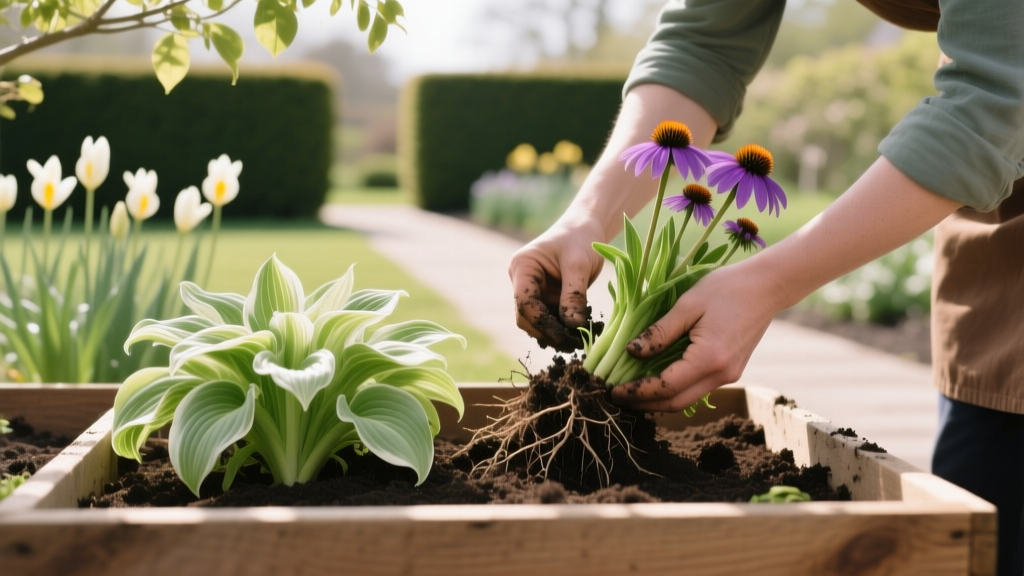
Spring Garden: Dividing Perennials for More Plants
The best window for dividing perennials is shorter than most gardeners think: a few cool weeks when the soil is workable, nights are still chilly, and plants are just waking up. If you divide too early, cold, wet soil can stall root recovery; too late, and spring heat forces stressed divisions to support full top growth before they’ve rebuilt roots. Right now—when daytime highs hover around 50–65°F and your last frost date is 2–6 weeks away—you can turn one crowded clump into three to five vigorous plants and reset the health of tired perennials.
This seasonal plan prioritizes what matters most in spring: divide and replant quickly, protect fresh divisions from temperature swings, and prepare beds so the new plants root fast. Keep your local average last frost date handy (often March 15–April 15 in many Zone 7–8 areas, April 15–May 15 in many Zone 5–6 areas, and May 15–June 15 in Zone 3–4). Use your region’s frost date to time tasks below.
Priority 1: Divide and replant (the “do it first” list)
When to divide: the spring timing that actually works
Aim to divide perennials when they’re just emerging or have 2–4 inches of new growth. This is the sweet spot: you can see where the crown is, but the plant hasn’t invested heavily in leaves and flowers yet. In many gardens, that’s roughly 2–4 weeks before the average last frost date through about 2 weeks after, as long as soil is not waterlogged.
- Soil temperature target: Many perennials root readily once soil is consistently above 45°F; growth accelerates closer to 55°F.
- Weather rule: Choose a stretch of 2–3 mild, cloudy days if possible. Avoid dividing right before a hard freeze (≤ 28°F) or sudden heat wave (≥ 80°F).
- Moisture rule: If you can form a soil ball that crumbles with a tap, it’s workable. If it smears like putty, wait.
Many extension services recommend dividing most perennials during active growth in spring or early fall, with spring favored for summer- and fall-bloomers. The University of Minnesota Extension notes that perennials are often divided “in early spring as growth begins” or in late summer/early fall depending on bloom time (University of Minnesota Extension, 2020).
“Divide perennials when they are not in bloom… early spring or late summer/early fall are generally best.” — University of Minnesota Extension (2020)
Which perennials to divide in spring (and which to leave alone)
Spring dividing is ideal for summer- and fall-blooming perennials. Spring bloomers generally prefer division right after flowering, so they can rebuild energy before winter.
Good spring candidates (divide now): daylily (Hemerocallis), hosta, coneflower (Echinacea), black-eyed Susan (Rudbeckia), sedum/stonecrop (Hylotelephium), ornamental grasses (warm-season types), yarrow (Achillea), bee balm (Monarda), Siberian iris, Shasta daisy, coreopsis.
Better after bloom (wait): peony (divide rarely, and usually in fall), bleeding heart (Dicentra), many spring ephemerals, most early spring bloomers (e.g., creeping phlox) unless absolutely necessary.
Woody-based perennials: Lavender, rosemary, and many subshrubs don’t respond well to division—propagate by cuttings instead.
Step-by-step: Divide perennials without setting them back
- Water the clump the day before if soil is dry. Hydrated roots recover faster.
- Cut back top growth by 1/3 for leafy perennials (hosta, daylily) if foliage is already tall. Keep enough leaves to power regrowth.
- Lift wide, not deep: Use a spade or fork 4–6 inches outside the crown to keep feeder roots intact.
- Shake or rinse soil lightly to expose natural divisions (fans, eyes, rhizomes). Don’t scrub roots clean—just make the structure visible.
- Split the clump: Pull apart with hands when possible; use a clean knife or spade for tight crowns. Target divisions with 3–5 shoots/eyes (smaller can work but establish slower).
- Trim damaged roots cleanly. Ragged tears invite rot.
- Replant immediately at the same depth as before. Crowns planted too deep are a common failure point.
- Water in thoroughly to settle soil around roots, then mulch lightly.
How many new plants can you realistically get?
A healthy 3–5-year clump of daylilies or hostas can often yield 3–10 divisions, but don’t chase quantity at the expense of vigor. For most beds, dividing into 3–5 strong pieces produces faster fill-in and fewer losses. If you’re expanding a border, plant larger divisions in “anchor” spots and smaller ones in a nursery row to grow on.
Quick comparison: division methods by plant type
| Plant type | Best tool | What you’re looking for | Spring tip |
|---|---|---|---|
| Clump-forming (hosta, daylily) | Garden fork + knife | Fans/crowns with roots attached | Divide when shoots are 2–4 in. tall for easiest handling |
| Rhizomatous (bee balm, some iris) | Knife/pruners | Firm rhizomes with buds | Discard soft/rotted rhizomes to reduce disease carryover |
| Fibrous-rooted (coreopsis, daisies) | Spade/serrated knife | Multiple growing points | Replant quickly—fibrous roots dry out fast |
| Ornamental grasses | Spade + saw (for big clumps) | Outer vigorous growth | Warm-season grasses: divide as new shoots show, before rapid growth |
Priority 2: What to plant (right after dividing, and what to add alongside)
Plant your divisions the same day
Divisions decline quickly if roots dry. If you must hold them, wrap roots in damp newspaper and keep them cool and shaded for no more than 24 hours. The best practice is to prepare planting holes first, then lift and divide.
Spacing and placement for faster fill
Use mature spread as your guide, but spring divisions can be planted slightly closer for a quicker look—then thinned later. A practical rule:
- Medium perennials: 12–18 inches apart
- Large clumpers (big hostas, tall rudbeckia): 24–36 inches apart
- Small edging perennials: 8–12 inches apart
Add “starter” companions that help this season
Fresh divisions benefit from stable soil moisture and reduced weed competition. Consider planting or sowing:
- Cool-season annuals (pansy, violas) as temporary fillers in Zones 5–8.
- Early nectar plants (alyssum, calendula) near divided perennials to boost pollinator activity without competing heavily.
- Living mulch edges (low thyme in warmer zones) only where water is reliable—don’t crowd new divisions in dry beds.
Priority 3: What to prune (and what not to touch yet)
Clean up winter stems—selectively
Spring cleanup supports disease prevention, but going too tidy too early can remove beneficial insect habitat. Aim for a targeted approach once you’re reliably above freezing most nights.
- Cut back last year’s perennial stems to 2–4 inches once you see new basal growth.
- Leave some hollow stems (8–12 inches) in pollinator zones until daytime highs are consistently near 50°F to protect overwintering natives.
- Do not shear spring bloomers that have already set buds (some creeping phlox, candytuft). Clean around them instead.
Sanitation: remove the disease “carryover” material
When dividing, discard these rather than composting them:
- Any crown section that is soft, brown, or foul-smelling (crown rot risk).
- Leaves with heavy spotting (possible overwintered fungal inoculum).
- Stems showing borer tunnels.
General plant disease sanitation—removing infected debris and avoiding overhead watering—is widely recommended by extension services as a foundational prevention practice (e.g., Penn State Extension, 2023).
Priority 4: What to protect (fresh divisions are vulnerable)
Frost protection for newly divided perennials
Divided perennials have fewer roots to buffer cold and dehydration. If a frost is forecast within 10 days of dividing, protect them:
- Cover on frost nights: Use frost cloth, sheets, or row cover when temperatures dip below 32°F. Remove in the morning.
- Mulch lightly: A 1–2 inch layer of shredded leaves or fine bark moderates swings without smothering crowns.
- Avoid heavy, wet mulch over crowns in cool, rainy springs—this can encourage rot.
Wind and sun protection: the overlooked spring stress
In many regions, spring sun is bright while roots are still sluggish in cold soil. Wind desiccation can be worse than frost. In exposed sites, use temporary windbreaks (burlap on stakes) for 7–14 days after dividing, especially in Zones 3–6 where spring winds are common.
Watering schedule that prevents both wilt and rot
Right after planting, water deeply. After that, use this simple check:
- Check moisture every 2–3 days for the first two weeks.
- Water when the top 1–2 inches are dry.
- Avoid keeping soil continuously saturated; cool wet conditions encourage crown and root rots.
Pest and disease prevention specific to spring dividing
Division can spread pests and diseases if you move contaminated roots or soil. Reduce risk with these spring habits:
- Tool hygiene: Disinfect blades between suspect plants. A 70% isopropyl alcohol wipe is fast and effective for knives and pruners.
- Slugs/snails: Fresh, tender growth attracts them. In rainy springs, scout at dusk and use iron phosphate bait as needed; keep mulch pulled back from crowns.
- Aphids: Check soft new tips weekly; knock off with a strong water spray early to avoid virus spread on susceptible plants.
- Powdery mildew setup: Crowded regrowth + dry leaves + warm days/cool nights invites mildew later. Division helps spacing now—one of the best long-game preventions.
- Iris borer and soft rot: If dividing bearded iris (often after bloom, but sometimes necessary), remove and destroy any rhizomes with tunneling; improve drainage and avoid burying rhizomes.
Prepare the bed like a pro (this determines success more than the dividing)
Soil prep in spring: do the least that works
Spring soil is easily compacted. Avoid aggressive tilling when wet. Instead:
- Loosen planting zones with a fork to 8–10 inches where you’re installing divisions.
- Add compost (about 1 inch worked into the top few inches) if your soil is sandy or low in organic matter.
- Hold off on high-nitrogen fertilizer at planting; it can push floppy top growth before roots establish. If you fertilize, use a light hand and favor slow-release.
For gardeners who want lab-level accuracy, do a soil test every 3–5 years to keep pH and phosphorus/potassium in range; spring is a fine time to sample once soil is workable.
Labeling and mapping: the task you’ll thank yourself for in June
As you create more plants, it’s easy to lose track of cultivars and bloom sequences. Label divisions immediately. If you’re reorganizing a bed, sketch a quick map and note spacing. This is especially useful for hosta varieties and named daylilies.
Regional scenarios: timing shifts that matter this month
Scenario 1: Cold spring in Zones 3–5 (late frosts, slow soil warm-up)
If your average last frost is around May 10–June 10, prioritize patience and drainage. Divide when shoots are visible but small, and only when soil is no longer sticky. Keep frost cloth ready through late spring; it’s common to get a dip to 28–30°F after a warm spell. Mulch lightly, and avoid overwatering—cold soil holds moisture longer than you expect.
Best candidates here: hosta, daylily, rudbeckia, coneflower, sedum. Avoid dividing plants that hate cold wet feet unless your drainage is excellent.
Scenario 2: Variable spring in Zones 6–7 (warm days, surprise freezes)
This is prime dividing territory—but the trap is a March heat wave followed by an April freeze. If you divide during a warm stretch and then get a hard freeze (≤ 28°F), cover divisions and delay fertilizing until the pattern stabilizes. Try to schedule divisions 3–4 weeks before your last frost or just after it, watching the 10-day forecast.
Also watch rainfall swings: dry wind can desiccate divisions quickly. A temporary shade cloth for 5–7 days can prevent wilting on sunny, breezy sites.
Scenario 3: Mild winter / early spring in Zones 8–10 (fast growth, early heat)
In warm zones, spring can jump to summer suddenly. Your dividing window may be late winter through early spring—often 6–10 weeks before your last frost date (or before heat becomes consistent). Once daytime highs regularly reach 80–85°F, divisions need more frequent watering and may struggle in full sun.
Shift tactics: divide earlier, plant in the evening, and use a thicker mulch (still keeping crowns clear). Consider dividing and potting up extras in a shaded area to grow on before transplanting.
Monthly schedule: what to do now, next, and after last frost
| Timing window | What to do | Conditions to watch | Fast success check |
|---|---|---|---|
| Weeks -6 to -4 before last frost | Scout crowded clumps; prep new bed space; gather tools and labels | Soil not frozen; workable moisture | You can insert a trowel easily without smearing soil |
| Weeks -4 to -2 before last frost | Divide early-emerging perennials (hosta, daylily) as shoots reach 2–4 in. | Forecast avoids ≤28°F events for 48–72 hours | Divisions stand upright and don’t wilt by afternoon |
| Weeks -2 to +2 around last frost | Main division window for many summer/fall bloomers; replant same day | Use frost cloth on nights <32°F | New leaves appear within 7–14 days |
| Weeks +2 to +6 after last frost | Mulch touch-up; light feeding if needed; weed control; monitor pests | Rising temps; rainfall patterns | Plants hold turgor through warm afternoons; no crown softening |
Timelines and checklists (print-and-go)
60-minute division checklist
- ☐ Check 10-day forecast (avoid hard freezes and heat spikes)
- ☐ Pre-dig planting holes and stage compost/mulch
- ☐ Water the donor clump if soil is dry
- ☐ Clean knife/spade; have alcohol wipes ready
- ☐ Lift clump wide; keep roots shaded while working
- ☐ Make divisions with 3–5 shoots/eyes
- ☐ Replant at original depth; firm soil gently
- ☐ Water in; label immediately
Two-week aftercare timeline (for highest survival)
- Day 0: Water deeply; apply 1–2 in. mulch, keep crowns clear.
- Days 1–3: Check moisture; protect if nights drop below 32°F.
- Days 4–7: Scout for slugs and aphids; remove weeds before they root.
- Days 8–14: Reduce watering frequency if roots are taking; look for fresh leaf expansion.
Common spring dividing mistakes (and quick fixes)
Mistake: Planting divisions too deep.
Fix: Replant with the crown at the same level it was growing—often the top of the crown is just at or slightly above soil level for many perennials.
Mistake: Leaving roots exposed to sun and wind while you work.
Fix: Keep divisions under a damp towel in the shade; work in batches of 2–3 plants.
Mistake: Over-mulching in a rainy spring.
Fix: Pull mulch back 2–3 inches from crowns; improve airflow and let the surface dry between waterings.
Mistake: Moving hidden problems to new beds (borers, rot, weeds).
Fix: Inspect crowns and roots; discard compromised sections; don’t transplant weedy soil attached to roots.
Expert notes to keep your divisions healthier all season
Division isn’t just propagation—it’s preventative care. Crowded perennials tend to develop weaker centers, reduced bloom, and higher disease pressure due to poor airflow. Splitting clumps restores spacing and vigor. Iowa State University Extension and Outreach emphasizes that many perennials benefit from division to maintain health and flowering performance (Iowa State University Extension and Outreach, 2019).
If you’re dividing in a bed that had disease issues last year (powdery mildew on bee balm, leaf spot on coneflower, botrytis on peony), take spring sanitation seriously: remove old debris, improve spacing, and water at the base. Those three steps prevent more problems than most sprays.
Use this season’s energy: divide a few clumps each weekend for the next 3–5 weeks rather than tackling the whole garden in one day. You’ll keep up with watering, you’ll make better placement decisions, and you’ll end up with a steadier supply of “extra” plants for gaps and gifts.
When you see new growth pushing up clean and strong within 7–14 days, you’ll know the timing was right. That’s the spring payoff: more plants, healthier clumps, and a garden that looks like it was planted on purpose—because it was.