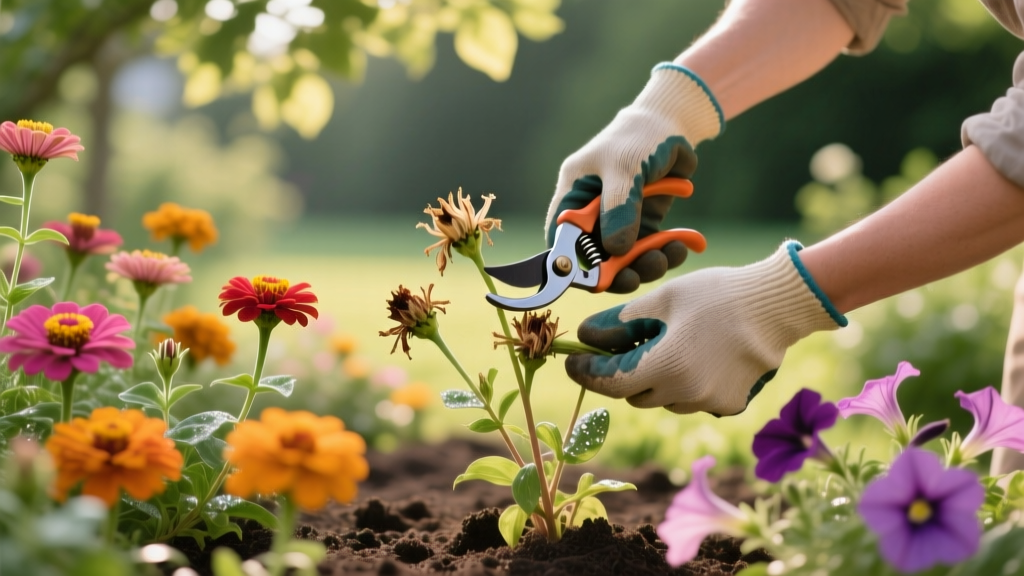
Summer Garden: Deadheading Annuals for Non-Stop Blooms
Right now is the hinge point of the summer flower season: the first big flush is fading, seed heads are forming, and many annuals are deciding whether to keep blooming or call it quits. Deadheading—removing spent flowers before they set seed—is the fastest way to push most annuals back into flower production within the next 7–14 days. Done well, it also cuts disease pressure, keeps containers tidy, and prevents reseeding where you don’t want it.
Use this as your “do it this week” field guide. The priorities below assume typical Northern Hemisphere timing, but the cues that matter most are heat and day length: when daytime highs hold at 80–90°F, nighttime lows stay above 55°F, and flowers begin transitioning to seed. If your first fall frost averages October 10 (common in many Zone 6 areas), you’ve got roughly 8–10 weeks to keep annuals blooming hard—if you deadhead consistently.
Priority #1 (This week): Deadhead hard, then feed and water correctly
What to prune: Deadheading methods that actually trigger new blooms
Not all “deadheading” is a pinch. The goal is to remove the plant’s signal to make seed, and that signal often sits below the flower—at a swollen seed pod or where the stem meets a set of leaves. If you only pull petals, you may leave the seed structure behind and get little rebloom.
- Pinch deadheading (thumb + forefinger): Best for soft stems like impatiens and some petunias. Pinch just above the next set of leaves or a branching point.
- Snip deadheading (hand pruners/scissors): Best for zinnias, marigolds, cosmos, salvia. Cut the stem back to a leaf node or strong side shoot.
- Shear deadheading (hedge shears/scissors): Best for “mounding” annuals that bloom in waves: calibrachoa, lobelia, alyssum. Shear off the top 1/3 lightly, then water and feed.
Timing that matters: Deadhead in the cooler part of day—before 10 a.m. or after 6 p.m.—especially when the heat index is above 90°F. Stressed plants seal cuts more slowly and wilt faster if you prune during peak heat.
“Removing spent flowers before seed develops encourages additional flowering for many annual ornamentals by redirecting plant energy from seed production to new growth and buds.” — University of Minnesota Extension (revised 2020)
Plant-by-plant deadheading cheat sheet (the “where to cut” reminders)
Use this list when you’re standing in the garden with pruners in hand:
- Petunia: Pinch off the whole flower and the sticky green base; if plants are leggy, cut stems back by 1/3 (yes, it looks drastic) and expect a rebound in 10–14 days.
- Calibrachoa (Million Bells): Mostly self-cleaning; do a light shear every 2–3 weeks to reset bloom and reduce fungal buildup in dense mats.
- Geranium (Pelargonium): Remove the entire flower stem (peduncle) down to the base where it meets the main stem; leaving a stub can rot.
- Marigold: Snip just above a leaf pair; deadhead weekly to prevent seed set and keep plants compact.
- Zinnia: Cut stems back to a leaf node; the cut point is where side shoots form and next blooms originate. Harvesting as cut flowers counts as deadheading.
- Cosmos: Remove spent flowers back to a main stem junction; if plants are floppy, stake and prune back 6–12 inches to force branching.
- Salvia (annual types): Cut flower spikes down to the next set of leaves or emerging side spike; rebloom often starts within 7–10 days in warm weather.
- Snapdragon: Remove individual spent blooms, or cut the whole spike down by 1/3–1/2 after a flush; performs best where nights are <65°F.
Immediate aftercare: Watering and fertilizer that keep blooms coming
Deadheading triggers new growth—but only if the plant has moisture and nutrients. Many annuals stall in mid-summer not from “old age,” but from a water-fertilizer mismatch.
- Containers: In sustained heat (85–95°F), expect daily watering; on windy patios, sometimes twice daily. Water until it runs from drainage holes.
- In-ground beds: Aim for 1 inch of water per week total (rain + irrigation), adjusting up during heat waves and for sandy soils.
- Feeding schedule:
- Liquid feed every 7–14 days for heavy bloomers in pots (petunias, calibrachoa).
- Slow-release granules can be “topped up” at mid-summer if your label allows (often around 8–10 weeks after planting).
Research-backed reminder: Excess nitrogen pushes leaves at the expense of flowers. Use a bloom-leaning fertilizer (for example, something in the range of 10-20-10) rather than a lawn-style high nitrogen product. For soil nutrient decisions, extension services consistently recommend soil testing as the most reliable approach (University of Massachusetts Amherst Extension, 2023).
Priority #2 (Next 7–14 days): Plant replacements and “gap fillers” that still pay off
What to plant: Quick annuals for late-summer color
If your beds have holes from early annuals fading or critter damage, you can still plant for strong color—especially if you’re in USDA Zones 4–8 with a frost date in late September through mid-October. The trick is choosing fast growers and planting during a cooler window.
- Best “right now” transplants: marigolds, zinnias, salvias, celosia, coleus (foliage color), alyssum (cooler nights), gomphrena.
- Direct sow (fast): cosmos and zinnias can still work if you have 60+ frost-free days left. If your average first frost is October 10, try sowing by about August 10 for a realistic bloom window.
Temperature thresholds: Planting is easiest when daytime highs are under 88°F and soil stays evenly moist for the first 5–7 days. If your forecast is a week of 95°F highs, wait, or plant in the evening and shade transplants for 2–3 days.
Regional scenario: Short-season northern gardens (Zones 3–5)
If your first frost runs September 15–30 (common in colder areas), prioritize deadheading and feeding over starting new seed. For “instant color,” buy transplants in bud. Focus on zinnias, marigolds, and salvia, and place them where they receive 6+ hours of sun but get afternoon shade if your garden bakes.
Regional scenario: Hot, humid summers (Southeast / Gulf Coast, Zones 8–10)
In hot-humid conditions, fungal pressure and plant stress often matter more than frost dates. Choose heat-tolerant gap fillers (vinca, angelonia, celosia) and deadhead to improve airflow. If nighttime lows stay above 75°F, some “cool-season annuals” (like lobelia and pansies) will simply decline—replace them rather than trying to nurse them through.
Regional scenario: Dry heat and high sun (Interior West / high desert, Zones 5–9)
Sunscald and irrigation management are the limiting factors. Deadheading helps, but only if roots stay cool and evenly moist. Add a 1–2 inch mulch layer in beds (keep mulch off stems), and consider afternoon shade cloth for containers during heat spikes above 95°F.
Priority #3 (Ongoing): Protect blooms from summer pests and diseases
What to protect: Prevent botrytis, powdery mildew, and root rot after deadheading
Deadheading opens small wounds; combined with wet foliage and still air, that can invite disease. Your prevention plan should match the weather.
- Botrytis (gray mold): Common on geraniums, petunias, and densely packed baskets during humid spells. Remove fading blooms promptly, increase spacing/airflow, and avoid overhead watering late in the day.
- Powdery mildew: Often hits zinnias and some salvias when nights cool and days stay warm. Water at the base, thin crowded stems, and avoid excess nitrogen. If you repeatedly see it, switch to mildew-resistant zinnia varieties next season.
- Root rot: The classic mid-summer container killer. Make sure pots drain freely; never let them sit in saucers of water. If foliage wilts even when soil is wet, suspect root issues.
Integrated pest management (IPM) guidance from extension services emphasizes correct identification before treatment and prioritizing cultural controls (NC State Extension, 2022). In practice: prune for airflow, water correctly, and only then consider targeted products.
Summer pest watch: aphids, thrips, mites, and caterpillars
Deadheading also removes hiding spots for pests. While you’re doing it, inspect the undersides of leaves and the newest growth.
- Aphids: Cluster on tender tips. Blast off with water early in the day; repeat every 2–3 days for a week. Follow with insecticidal soap only if needed.
- Thrips: Cause distorted blooms and streaked petals (common on petunias). Remove damaged flowers immediately and discard (don’t compost if infestation is heavy).
- Spider mites: Thrive when temps exceed 85°F and plants are drought-stressed. Look for stippling and fine webbing. Increase humidity locally with morning rinses (not at night), and reduce plant stress.
- Caterpillars/budworms: Holes in buds and blooms, especially in petunias and geraniums. Hand-pick at dusk; treat with Bacillus thuringiensis (Bt) when larvae are small, following label directions.
Quick checklist: Your 10-minute deadheading inspection loop
- Remove spent blooms and any swollen seed pods.
- Cut back to a leaf node to trigger branching.
- Strip yellowing leaves near the base to improve airflow.
- Check undersides of leaves for aphids/mites.
- Look for powdery mildew on zinnias and crowded plants.
- Water at the base; avoid wetting foliage after 6 p.m.
Priority #4 (Late summer prep): Set up the next bloom wave and protect the garden’s future
What to prepare: A deadheading-and-rebloom timeline (by month)
Use this schedule as a practical rhythm. Adjust forward or back by 2–4 weeks depending on your USDA zone and average first frost.
| Month / Window | Deadheading focus | Feeding & watering | Extra step that pays off |
|---|---|---|---|
| June (after first flush) | Start weekly deadheading; remove early seed heads | Begin regular feeding cycle (every 7–14 days in pots) | Stake zinnias/cosmos before storms bend them |
| July (heat sets in; highs 85–95°F) | Shear mounding annuals by 1/3; deep deadhead geraniums | Water containers daily; check drainage | Scout weekly for mites and budworms |
| August (rebloom push; 60–75 days before frost) | Deadhead twice weekly for fast rebloom; cut back leggy petunias | Light feed after pruning; avoid heavy N | Sow quick annuals only if 60+ frost-free days remain |
| September (cooler nights <65°F) | Keep removing seed heads to extend flowering | Reduce feeding as growth slows; keep even moisture | Collect seed from a few favorites (label!) after bloom peaks |
When to stop deadheading (and when to let a few plants set seed)
As you approach your local first frost date—say September 30 in colder regions or October 10 in many Zone 6 gardens—keep deadheading plants that are still actively budding. Stop only when new growth is clearly slowing and nights are consistently cool (often when nighttime lows fall below 50–55°F).
Make exceptions on purpose: if you want to save seed from open-pollinated zinnias or marigolds, pick 2–3 of the healthiest plants and stop deadheading those specific blooms. Keep deadheading the rest to maintain display quality.
By priority: What to plant, what to prune, what to protect, what to prepare (print-and-go)
What to plant (this week to next)
- Fill gaps with heat-tolerant annual transplants: marigold, zinnia, salvia, celosia, vinca (Zones 7–10).
- Direct-sow zinnias/cosmos only if you have 60+ days before first frost.
- Plant in the evening when temps are under 88°F; shade for 48–72 hours if heat is intense.
What to prune (every 5–7 days)
- Deadhead to a leaf node, not just petals.
- Shear mounding annuals lightly every 2–3 weeks to trigger a new bloom wave.
- Remove yellow leaves at soil line to reduce disease splash and improve airflow.
What to protect (all summer, especially after rain/humidity spikes)
- Water at the base; avoid late-day overhead watering after 6 p.m.
- Scout weekly for mites when highs exceed 85°F and plants look dull or stippled.
- Thin crowded stems to reduce powdery mildew risk on zinnias.
What to prepare (late summer)
- Plan your “final cutback” timing: prune leggy annuals 10–14 days before an event or peak viewing window.
- Note which varieties stayed clean (low mildew, strong rebloom) for next year’s shopping list.
- As frost nears (e.g., Sept 30 or Oct 10), keep deadheading anything still setting buds.
Practical deadheading timelines: Three real-world garden situations
Scenario 1: Containers on a sunny patio (Zones 5–9)
Containers bloom hard—and crash fast—because roots heat up and nutrients flush out with watering. If your petunias are sticky, leggy, and flowering only at the tips, do this:
- Day 1 (evening): Cut back stems by 1/3, removing all spent flowers and seed bases.
- Immediately after: Water deeply until it drains; apply liquid fertilizer at label rate.
- Days 2–4: Keep evenly moist (don’t let it dry completely).
- Days 7–14: Expect fresh buds and fuller bloom.
If daytime highs are above 95°F, add temporary afternoon shade; it can be the difference between recovery and burnout.
Scenario 2: Cut-flower row of zinnias and cosmos (Zones 3–8)
Here, deadheading is harvesting. The key is cutting long stems back to a node so plants branch and produce more cuttable stems.
- Harvest when zinnia blooms pass the “wiggle test” (stems stiff, bloom doesn’t flop).
- Cut above a leaf pair 8–16 inches down the stem to force strong branching.
- Remove any mildewed lower leaves promptly; don’t wet foliage late.
If powdery mildew appears by mid- to late summer, thin plants and improve airflow rather than fertilizing more. Overfeeding can make dense, mildew-prone growth.
Scenario 3: Mixed bedding annuals after a stormy, humid week (Zones 7–11)
After several rainy days, beds often look tired: mushy blooms, yellow leaves, and fungal spotting. Your order of operations matters.
- First pass: Remove all collapsed flowers and any gray, fuzzy tissue (likely botrytis). Bag it.
- Second pass: Open the canopy—thin a few stems to increase airflow.
- Third pass: Water only at the base for the next week; avoid splashing.
- Then: Light feed if plants are actively growing and not waterlogged.
This sequence is aligned with extension recommendations to prioritize sanitation and cultural controls before reaching for pesticides (NC State Extension, 2022).
Expert-level tips that separate “some blooms” from “non-stop blooms”
1) Don’t deadhead drought-stressed plants first—water first. If a plant is wilting at 2 p.m., irrigate in the evening and prune the next morning. Pruning a stressed plant can cause further setback.
2) Pair deadheading with selective pinching. If one stem is racing ahead, pinch it back to match the others. Uniform canopy = more even flowering.
3) Clean tools fast. If you’re moving through plants with visible disease, wipe blades with 70% isopropyl alcohol between problem plants to reduce spread.
4) Leave a few flowers for pollinators—strategically. Deadhead most of the plant, but allow a small section to flower continuously without heavy shearing. It keeps nectar available while you manage the overall look.
Sources (Extension and research-based guidance)
University of Minnesota Extension. 2020. Guidance on deadheading and encouraging repeat bloom in ornamentals (revised 2020).
NC State Extension. 2022. Integrated pest management principles for home landscapes and ornamentals (2022).
University of Massachusetts Amherst Extension. 2023. Soil testing and nutrient management recommendations for home gardens (2023).
Walk your beds today with pruners and a bucket, hit the heavy bloomers first, then water and feed with intent. The payoff is quick: in most gardens, a focused deadheading session now is what turns late-summer annuals from tired and seedy into fresh, branching, and blooming right up until frost threatens.