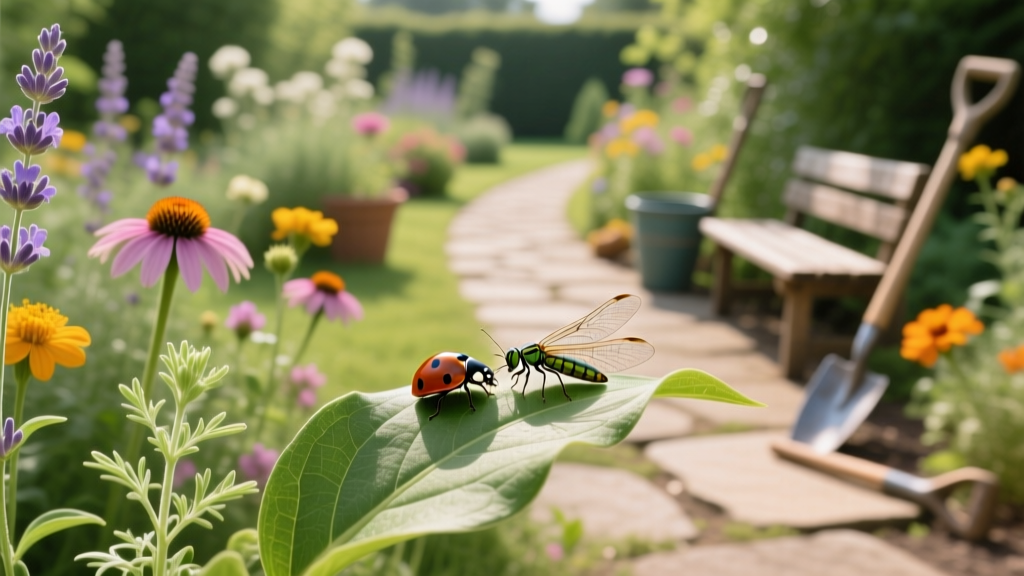
Summer Garden: Managing Garden Pests with Beneficial Insects
Summer pest pressure can shift from “a few chewed leaves” to a full-blown outbreak in a single hot week. When daytime highs sit above 85°F and nights stay warm, aphids, mites, whiteflies, and caterpillars reproduce fast—often faster than you can spray. The opportunity right now is to recruit a living workforce: beneficial insects that hunt, parasitize, or outcompete garden pests. If you act early (or at the first sign of trouble), you can keep damage below the threshold where plants stall, bolt, or drop fruit.
This seasonal guide is organized by priority: what to plant, what to prune, what to protect, and what to prepare. Use it like a summer almanac—scan the tasks, pick what matches your USDA zone and current weather, and execute this week.
Priority 1: What to Plant (This Week) to Attract and Hold Beneficial Insects
If you want beneficials to stay, give them two things: nectar/pollen and habitat. Many adult predators (like hoverflies and lacewings) need nectar even though their larvae hunt pests. Planting a tight rotation of small-flowered blooms is the fastest way to increase beneficial activity within 7–21 days.
Quick-win plants for summer beneficials (best planted when soil is warm)
Plant these now if your soil is consistently above 65°F and you can irrigate through establishment. In many areas, that’s late May through July; in cool-summer regions, it may be June through early August.
- Sweet alyssum (Lobularia maritima): Top-tier for hoverflies (syrphids) that attack aphids. Tuck into bed edges and between brassicas.
- Dill, fennel, cilantro (let some bolt): Umbel flowers feed tiny parasitoid wasps that target aphids and caterpillars.
- Buckwheat: Fast cover bloom in 3–5 weeks; great in empty beds to support beneficials while smothering weeds.
- Cosmos, zinnia, sunflower: Reliable midsummer nectar/pollen; draw in minute pirate bugs, lacewings, and predatory wasps.
- Basil, thyme, oregano (flowering): Let a few plants flower; they’re dependable in containers and near patios.
Timing targets: If your average first fall frost date is around October 15, count back 60–75 days for last plantings of quick-bloom insectary strips (like buckwheat or alyssum) so they flower before cool weather slows insect activity.
Planting placements that make beneficials more effective
Placement matters more than perfection. Beneficial insects often work best within short distances of nectar and refuge.
- Border strips: Plant a 12–18 inch strip of alyssum or dill along one long edge of each bed.
- In-row companions: Add a small clump of alyssum every 4–6 feet in brassica and lettuce beds to intercept aphids.
- “Banker zones”: Keep one perennial corner (yarrow, coneflower, native asters) as a stable habitat that isn’t ripped out mid-season.
Research consistently shows that flowering resources can increase natural enemy abundance and improve biological control in cropping systems; conservation biocontrol is most effective when food and habitat are continuous through the season (Landis, Wratten & Gurr, 2000).
Priority 2: What to Prune (and What to Leave Alone) to Reduce Pest Surges
Summer pruning is less about shaping and more about airflow, light, and removing pest reservoirs—without destroying the beneficials you’re trying to build.
Do now: targeted pruning to break pest cycles
- Tomatoes: Remove lower leaves touching soil once plants are 18–24 inches tall; keep leaves off the ground to reduce splash-borne disease and hiding spots. Prune only in dry weather; avoid heavy pruning during heat waves above 90°F.
- Squash and cucumbers: Remove leaves that are more than 50% damaged by powdery mildew or squash bug feeding—bag and trash, don’t compost if disease is present.
- Roses: Deadhead and remove congested inner growth to reduce aphid and mildew pressure; keep a few small aphid colonies if you’re trying to build lady beetle larvae (more on that below).
Leave alone: “beneficial nurseries” you might be tempted to remove
Not every pest sighting warrants removal. Beneficials need prey to reproduce.
- Light aphid presence on non-critical plants (like nasturtiums or a sacrificial kale): this can function as a banker plant, sustaining hoverfly larvae and lady beetle larvae.
- Flowering herbs that look “messy”: dill and cilantro gone to seed are parasitoid-wasp magnets.
“Most garden insect problems can be managed by using integrated pest management (IPM) tactics and conserving natural enemies rather than relying solely on insecticides.” — UC Statewide IPM Program (UC ANR), guidance on biological control and conserving beneficials (updated resource commonly used in extension education)
Priority 3: What to Protect (Right Now) — Match Beneficial Insects to Summer Pests
This is the make-or-break summer task: identify the pest, then decide whether to conserve existing beneficials, augment with releases, or interrupt with a least-toxic tactic that preserves your allies. Start with weekly scouting—twice weekly if temperatures are consistently above 85°F.
Weekly scouting checklist (10 minutes per bed)
- Check undersides of 10 leaves per bed (aphids, mites, whitefly eggs/nymphs).
- Inspect new growth on peppers, roses, milkweed (aphids cluster there first).
- Look for stippling and fine webbing (spider mites) during hot, dry spells.
- Scan for frass (caterpillar droppings) on brassicas and under tomato foliage.
- Note beneficial presence: lady beetle larvae (alligator-like), lacewing eggs (on stalks), hoverflies (bee-mimics hovering), tiny parasitoid wasps (pinhead-sized).
Fast match-ups: common summer pests and their beneficial insect “team”
| Pest (summer peak) | Best beneficial allies | What you’ll see if control is working | Garden-friendly support actions |
|---|---|---|---|
| Aphids (May–Aug) | Hoverfly larvae, lady beetle larvae, lacewing larvae, parasitoid wasps (Aphidius spp.) | “Mummified” aphids (tan/brown swollen shells), fewer ants, new growth clean | Plant alyssum/dill; control ants; avoid broad-spectrum sprays |
| Spider mites (hot/dry weeks > 85°F) | Predatory mites (Phytoseiulus/Neoseiulus spp.), minute pirate bugs | Reduced stippling; webbing stops expanding | Hose-dust off leaves; increase humidity with early watering; avoid pyrethroids |
| Whiteflies (greenhouse/high tunnels; hot spells) | Encarsia formosa (parasitic wasp), lacewing larvae | Blackened/parasitized whitefly pupae; fewer adults when plants disturbed | Yellow sticky cards for monitoring; remove heavily infested leaves |
| Cabbage worms/loopers (Jun–Sep) | Parasitic wasps (Cotesia spp.), paper wasps, birds | Small larvae disappear; “rice-like” cocoons near caterpillars | Use row cover early; spot-treat with Bt only if threshold exceeded |
| Thrips (hot, dry; onions, peppers) | Minute pirate bugs (Orius), predatory mites | Less silvery scarring; improved flower/fruit set | Keep flowers available; avoid mowing all blooms at once |
Conserve beneficials first: the “spray last” summer rule
Many common insecticides—including some organic options—harm beneficial insects. Oregon State University Extension emphasizes that broad-spectrum insecticides can kill natural enemies and worsen pest outbreaks (OSU Extension, 2019). If you must intervene, use the least disruptive method that fits the pest and timing.
- Mechanical: pinch aphid clusters, hose off pests early morning, remove egg masses.
- Barriers: insect netting/row cover for brassicas (install before moths lay eggs; remove during flowering for pollination).
- Selective biologicals: Bt (Bacillus thuringiensis kurstaki) for young caterpillars; spinosad only as a last resort and applied at dusk to reduce pollinator exposure.
- Soaps/oils: insecticidal soap or horticultural oil for aphids/whiteflies; avoid application when temps exceed 85–90°F to reduce plant burn and beneficial contact.
Augmenting with beneficial insect releases: when it makes sense
Buying beneficial insects can work, but it’s not a shortcut. Releases are most useful in enclosed or semi-enclosed spaces (greenhouses, high tunnels) or when you catch an outbreak early.
- Greenhouse/high tunnel whiteflies: Encarsia formosa can establish if you release early and repeatedly (weekly for several weeks) while populations are low.
- Spider mites in hoop houses: Predatory mites perform best when you release at first stippling, not after webbing covers plants.
- Aphids outdoors: Focus on habitat and ant control; purchased lady beetles often disperse quickly unless conditions are right.
Important: If you’re releasing beneficials, stop broad-spectrum sprays for at least 2–3 weeks beforehand and afterward (read labels—residual toxicity varies widely).
Priority 4: What to Prepare (Late Summer Setup That Prevents Next Month’s Problems)
Summer biological control is a chain reaction. What you set up now determines whether beneficial populations rise with pest populations—or lag behind.
Monthly schedule (June–August) for beneficial-based pest control
| Month | What to do first | What to watch | Trigger to act |
|---|---|---|---|
| June | Plant alyssum/dill strips; install row covers on brassicas; begin weekly scouting | Aphids on new growth; cabbage moth activity at dusk | If you find >10 aphids per growing tip on multiple plants and no beneficials present, start mechanical control + ant management |
| July | Keep flowers blooming; thin dense foliage for airflow; water to reduce drought stress | Spider mite stippling; whiteflies in protected areas | If mites show webbing or spread to >25% of plants, release predatory mites (protected culture) or use strong water sprays outdoors |
| August | Seed buckwheat in empty beds (3–5 week bloom); plan fall crops; remove heavily diseased leaves | Caterpillar surge; hornworms; late aphid flare-ups | If caterpillars are small and increasing weekly, use Bt in the evening and recheck in 3–5 days |
Build habitat that survives heat and mowing schedules
- Leave a refuge strip: a 2–3 foot unmowed/undisturbed strip near the garden can shelter predators.
- Provide water: a shallow dish with stones can help beneficials during weeks above 90°F.
- Mulch thoughtfully: organic mulch moderates soil temps and reduces plant stress (stressed plants attract pests). Keep mulch a few inches away from stems to prevent rot and slug shelter right at the crown.
Regional Scenarios: What to Do Right Now Where You Garden
Summer is not one season everywhere. Use these scenarios to adjust timing, pest expectations, and beneficial strategies.
Scenario 1: Hot-humid summers (Southeast, lower Midwest; USDA zones 7–9)
When nights stay above 70°F, insect reproduction accelerates and fungal diseases follow. Your summer strategy is to push airflow and avoid plant stress so pests don’t gain traction.
- Best move this week: prune for airflow in tomatoes and cucurbits on a dry morning; remove diseased leaves promptly.
- Beneficial focus: parasitoid wasps and hoverflies—keep dill/fennel blooming continuously.
- Watch-outs: frequent rain washes off soap/oil sprays; rely more on mechanical control and habitat than repeated applications.
Disease tie-in: Powdery mildew and downy mildew can surge during humid stretches—manage with spacing, morning watering at soil level, and removing heavily infected leaves before spores spread.
Scenario 2: Hot-dry summers (Intermountain West, inland California; USDA zones 5–9)
Hot, dusty conditions are ideal for spider mites. Once webbing appears, plants decline fast. You’ll get better results by acting at the first stippling during weeks above 85°F.
- Best move this week: rinse dust from leaf undersides with a strong stream of water every 2–3 days for a week; dust favors mites and hinders predators.
- Beneficial focus: predatory mites (especially in greenhouses) and minute pirate bugs; keep small flowers available even in heat (basil, thyme, alyssum with afternoon shade).
- Watch-outs: avoid applying oils when temps exceed 90°F; phytotoxicity risk climbs.
Scenario 3: Cool-summer coastal or high-elevation gardens (Pacific Northwest coast, mountains; USDA zones 4–8)
In cooler summers, pests may build more slowly—but when a warm spell hits, aphids and caterpillars can jump. Beneficial populations may lag if you don’t have steady bloom.
- Best move this week: plant fast-blooming insectary plants (buckwheat, alyssum) as soon as soil is above 60–65°F.
- Beneficial focus: hoverflies for aphids; parasitoid wasps for cabbage pests.
- Watch-outs: slugs can be a bigger issue than insects—use iron phosphate baits strategically and reduce ground-level hiding spots.
Summer Pest Prevention That Keeps Beneficials Working
Preventing outbreaks is easier than reversing them. The goal is to keep plants vigorous and avoid disrupting beneficials.
Ant control: the overlooked step that unlocks aphid control
If you see ants “farming” aphids, beneficial insects struggle. Ants protect aphids from predators in exchange for honeydew. Break the partnership.
- Use sticky barriers on stems of fruit trees or trellises (keep off tender bark; use a wrap).
- Bait ants away from beds (follow label directions; place where pets and kids can’t access).
- Prune bridges: keep foliage from touching fences or walls that ants use as highways.
Irrigation and fertility: avoid the pest-magnet growth flush
Over-fertilized, fast, sappy growth is aphid-friendly. Under-watered plants also emit stress signals that can attract pests.
- Water early: aim for morning watering to reduce disease; keep foliage dry when possible.
- Fertilize modestly: if you must feed, use smaller doses more often rather than a heavy nitrogen hit in mid-summer.
- Heat threshold rule: when forecasts call for 3+ days over 95°F, pause heavy pruning and fertilizing; focus on shade cloth, consistent moisture, and pest scouting.
Selective intervention timeline (when you’re losing the battle)
Use this escalation ladder to protect yield while preserving beneficials:
- Day 0: Identify pest; remove hotspots by hand; blast with water (aphids/mites/whiteflies).
- Day 3: Re-scout. If pest numbers are stable or falling and beneficials are present, do nothing else.
- Day 5–7: If pest numbers rise and beneficials are absent, use a targeted approach: Bt for small caterpillars; soap for aphids/whiteflies (apply at dusk, below 85°F).
- Week 2: If the same pest rebounds repeatedly, change the system: add flowering resources, address ants, reduce dust, or consider a controlled beneficial release (especially in protected culture).
UC IPM guidance consistently emphasizes correct identification, monitoring, and using the least-disruptive tactic first as the backbone of IPM programs (UC ANR IPM resources widely used in California extension education). For home gardens, the same principle holds: protect the natural enemies you already have before you buy or spray.
Do-This-Now Checklist (Pick the items that match your garden this week)
- Plant at least 2 nectar sources in bloom within 10 feet of problem crops (alyssum + dill is a strong combo).
- Scout leaf undersides on 10 plants per bed; write down what you find.
- Control ants where aphids are present (barriers/baits/pruning bridges).
- Prune only what improves airflow or removes heavily infested/diseased tissue; avoid pruning during heat spikes above 90°F.
- If caterpillars are present, act when they’re small; consider Bt and recheck in 3–5 days.
- Start one “banker” patch: flowering herbs or a small strip of buckwheat to carry beneficials through late summer.
Notes on timing by USDA zone (so you don’t miss the window)
Use your zone and average frost date to set your summer biological control calendar:
- USDA zones 3–5: pest surges often hit later; aim to have insectary plants blooming by late June to mid-July. Plan your last buckwheat sowing about 45–60 days before first frost.
- USDA zones 6–7: steady beneficial bloom from June through September prevents the common late-July aphid spike. If your first frost is near October 15, late insectary sowings can run into mid-August.
- USDA zones 8–10: heat can suppress some beneficial activity midday; focus on morning/evening bloom, shallow water sources, and shade cloth during multi-day runs above 95°F.
When you walk the garden at dusk and see hoverflies over alyssum, tiny wasps working umbel flowers, and lady beetle larvae hunting on the underside of leaves, you’re not just “letting nature handle it”—you’re managing a system. Keep blooms coming, keep sprays selective, and respond early to hotspots. That’s how summer gardens stay productive when pests are at their fastest.
Sources: Landis, D.A., Wratten, S.D., & Gurr, G.M. (2000). Habitat management to conserve natural enemies of arthropod pests in agriculture. Annual Review of Entomology. Oregon State University Extension (2019) educational materials on conserving natural enemies and avoiding broad-spectrum insecticides in garden IPM. UC Agriculture and Natural Resources Statewide IPM Program (UC ANR) biological control and natural enemies guidance (extension education resource used across California).