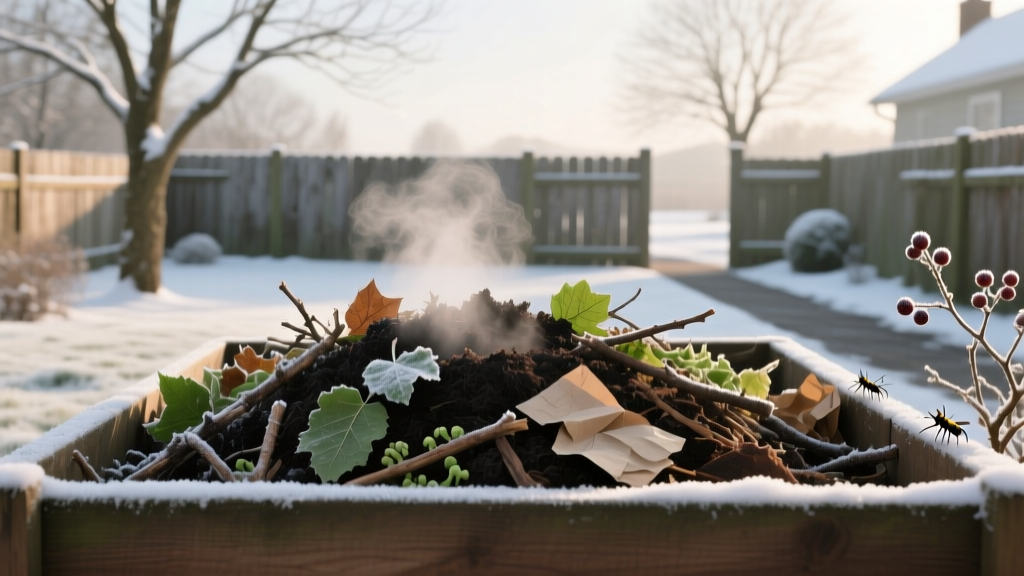
Winter Composting: Keeping the Pile Active
The window between the first hard freeze and spring thaw is when compost piles either stall into a frozen lump—or quietly keep working while you bank finished compost for early planting. If your daytime highs are hovering around 35–45°F and nights dip below 32°F, you’re at the pivot point: a few timely moves now can keep microbial activity going, prevent nutrient loss, and reduce spring backlog.
This is a seasonal, do-it-now plan for keeping your compost active through winter, organized by priority: what to plant (yes, even in winter), what to prune (and what not to compost), what to protect (pile, tools, and microbes), and what to prepare for the first mild spell. Use USDA hardiness zones and local frost dates to time tasks—especially if you’re in zones 3–5 (long freezes), 6–7 (freeze-thaw), or 8–10 (milder winters with steady decomposition).
Priority 1: Protect the pile so it doesn’t freeze solid
Compost doesn’t need tropical temperatures, but it does need insulation, moisture control, and the right size to keep a warm core. Your goal in winter is not “hot compost perfection,” it’s keeping the biology alive so materials break down steadily and don’t turn anaerobic.
Hit the winter-ready pile size (and rebuild if needed)
If your pile is too small, it will match air temperature quickly and freeze. Aim for a minimum of 3 ft x 3 ft x 3 ft (about 1 cubic yard). Many extension programs cite this as a practical minimum mass for heat retention in active composting. The University of Illinois Extension notes that a pile about 3 feet in each dimension is a good size for effective composting because it holds heat yet remains aerated (University of Illinois Extension, 2019).
Do this this week (before your next hard freeze): combine smaller piles into one insulated mass. If you only have kitchen scraps in winter, switch to a contained system (see regional scenarios below) and stockpile browns.
Insulate with what you already have
Insulation is about slowing heat loss and buffering freeze-thaw swings. Wrap the sides, not the top alone.
- Leaf-bale jacket: stack bagged leaves or straw bales around the pile. Even a 12–18 inch thick “jacket” makes a difference.
- Cardboard windbreak: surround with flattened boxes to block wind; weight with stones.
- Snow is insulation: if you get consistent snow cover, don’t clear it off the pile. A 6–12 inch snow cap helps retain heat.
Keep the moisture in the “wrung-out sponge” zone
Winter air can be dry, and covered piles can also dry out under a tarp if precipitation can’t enter. Microbes need moisture; frozen-dry compost is slow compost.
- Target moisture is roughly 50–60%—damp like a wrung-out sponge.
- If the pile is dusty when you pull back the cover, water it on a day above 40°F so it soaks in before refreezing.
- If it smells sour or looks slick, it’s too wet and likely anaerobic—add dry leaves/shredded paper and open air channels with a fork on the next mild day.
“The primary causes of compost odors are too much moisture and not enough air. Correct by adding dry, carbon-rich materials and turning or aerating the pile.” (Cornell Waste Management Institute, 2020)
Use a breathable cover (and vent it)
A tarp is useful, but a tightly sealed tarp can trap excess moisture and create anaerobic pockets. Secure a cover so rain/snow can’t saturate the pile, but leave small gaps at the sides for air exchange. In wet winter regions, elevate the tarp slightly with a few sticks under it to form a ridge vent.
Winter turning: fewer, smarter turns
Turning dumps heat. In zones 3–5, turning in midwinter can chill the pile for weeks. Instead:
- Turn only when: daytime highs are forecast above 40°F for 2–3 days and the pile is getting soggy or smelly.
- Otherwise: “core-feed” by pulling back the top, burying new scraps in the warm center, and re-covering.
- Temperature goal: If you can keep the core at 90–120°F, decomposition continues strongly. Even 50–80°F means you’re still making progress.
Priority 2: Prepare the recipe—winter inputs that actually work
Winter composting fails more often from an unbalanced recipe than from cold. Kitchen scraps are wet and nitrogen-rich; winter yards often lack fresh greens. Your job now is to stockpile browns and chop inputs smaller.
Stockpile browns before you need them
Make a “brown bank” that stays dry and accessible.
- Best browns: dry leaves, shredded cardboard, shredded paper (non-glossy), straw (not hay), untreated wood shavings.
- Storage: keep in a lidded bin or contractor bag under cover so it’s not frozen into a block.
- Rule of thumb: add 2–3 buckets of browns for every 1 bucket of kitchen scraps in winter, because scraps are wetter and you’re turning less.
Chop scraps smaller (it matters more in cold)
In warm seasons, a melon rind eventually breaks down. In winter, it can sit for months. Chop scraps into 1–2 inch pieces. Freeze-thaw helps rupture cells, so if you’re collecting scraps in a sealed bucket outdoors, the freezing can actually help—as long as you bury them in the pile’s core when you add them.
Add “hot boosters” strategically
If you want to keep a warm core without constant turning, add concentrated nitrogen in thin layers:
- Coffee grounds (mix with browns to prevent clumping)
- Fresh manure from herbivores (if available; avoid dog/cat manure due to pathogens)
- Green plant trimmings from indoor starts or greenhouse cleanups
Washington State University Extension emphasizes that composting is driven by the balance of carbon (“browns”) and nitrogen (“greens”), moisture, and oxygen; when one is off, decomposition slows (WSU Extension, 2021).
Keep a winter “add protocol” to avoid pests
Winter pests are different: rodents seek warmth, and flies can persist in mild spells. Use this protocol every time you add scraps:
- Pull back the cover.
- Dig a hole 8–12 inches into the warm center.
- Add scraps, then immediately cover with at least 2–3 inches of browns.
- Replace the cover tightly and secure edges.
Priority 3: What to plant right now (to feed compost and soil)
Even in winter, planting can support composting—either by providing future carbon sources or by protecting soil so your finished compost has a place to go. What you can plant depends on your USDA zone and how many weeks remain until your average last frost.
Mild-winter zones (USDA 8–10): plant cover crops on open beds
If your soil isn’t frozen and daytime highs are consistently above 45°F, you can still sow cool-season cover crops to protect beds and add biomass for compost or mulch.
- Good options: cereal rye, crimson clover, field peas (timing depends on region).
- Timing target: aim to establish at least 4–6 weeks before your typical last frost window to get meaningful growth.
- Use case: cut and drop in late winter, or compost if you need more greens.
Cold-winter zones (USDA 3–7): plant indoors to reduce spring waste
Start a small tray of greens (like wheatgrass, pea shoots, or microgreens) 6–10 weeks before your last frost date. The trimmings become a steady winter “green” input. This is especially useful when your outdoor greens are nonexistent and you’re relying on kitchen scraps.
Plant trees and shrubs only when soil is workable
In many regions, late winter thaws create a brief “workable soil” window. If your ground isn’t frozen and you can dig without smearing clay, dormant planting may be possible. But don’t force it—compaction and root damage set plants back. Use this as a reminder to have compost ready for spring planting holes rather than rushing winter installs.
Priority 4: What to prune (and what not to compost)
Pruning and cleanup generate valuable carbon—but winter is also when disease management matters. Compost can inactivate many pathogens if it reaches sustained high temperatures, but winter piles often run cooler. Be selective.
Prune for structure; save the chips
On mild days above 35°F, prune for structure (especially on apples/pears and many dormant shrubs). Chip or shred healthy twigs into 1/2–1 inch pieces for excellent carbon. Smaller particle size breaks down faster and reduces air gaps that chill the pile.
Do not compost these in a low-heat winter pile
- Diseased leaves (apple scab, rose black spot, fire blight strikes)
- Weeds with mature seeds
- Invasive plant parts that resprout from fragments
If you have a hot compost system that reliably reaches 131°F for several days, you have more options. But most winter piles won’t consistently hit pathogen-killing ranges, so default to trashing, municipal yard waste programs, or separate high-heat composting in warmer months.
Winter tool sanitation = spring disease prevention
After pruning, sanitize tools—especially if you removed cankers or blighted wood. A quick routine now prevents spreading problems later when sap flow starts.
- Wipe blades clean.
- Disinfect with 70% isopropyl alcohol (spray/wipe) and let air dry.
- Oil pivot points to prevent rust during winter storage.
Priority 5: Pest and disease prevention specific to winter composting
Winter compost piles can become ideal shelter. Your objective is to eliminate access to food and nesting, while keeping airflow.
Rodents (mice, rats, voles): reduce attractants and shelter
- No exposed scraps: always bury food waste 8–12 inches deep and cap with browns.
- Avoid meat, dairy, oils in open piles year-round; in winter they’re especially attractive and slow to break down.
- Elevate bins slightly (hardware cloth base) if rodents are persistent.
- Keep a 2–3 ft vegetation-free perimeter around the pile so rodents feel exposed.
Fungus gnats and flies during warm spells
In zones 8–10 or during a midwinter thaw above 50°F, flies can appear if scraps are near the surface. Increase your browns cap to 4–6 inches and keep a tight cover. If gnats persist, stop adding fruit scraps for 2 weeks and use only coffee grounds + browns until the population drops.
Anaerobic “slime” and winter stink
Smell is not a winter inevitability—it’s a recipe problem. If you smell ammonia, you likely have too much nitrogen; add shredded leaves/cardboard and avoid adding large amounts of coffee grounds at once. If it smells like rotten eggs, you have anaerobic zones; gently aerate with a compost fork on the next 40°F+ day and add coarse browns to restore structure.
Monthly winter composting schedule (adjust by zone)
Use this schedule as a baseline; shift a month earlier in zones 8–10 and a month later in zones 3–4. The key is responding to temperature and freeze depth rather than the calendar.
| Month | What to do (highest impact first) | Weather trigger | What you’re aiming for |
|---|---|---|---|
| December | Combine piles to 1 cubic yard; build leaf/straw insulation; start brown stockpile | Before sustained nights < 25°F | Warm core + protected sides |
| January | Core-feed scraps; keep browns dry; minimal turning | Turn only if 2–3 days > 40°F | Avoid freezing solid; avoid odors |
| February | Moisture check; optional light turn on mild spell; prep spring screening area | Thaws > 45°F; rain-on-snow events | Prevent waterlogging; keep air channels |
| March | First real turn; add greens if available; start curing a finished batch | Soil thaw begins; days > 50°F | Ramp activity for spring planting |
Three real-world winter composting scenarios (and what to do this week)
Winter composting isn’t one-size-fits-all. Use the scenario closest to your conditions.
Scenario A: Zone 3–5, long freeze, pile turns into an ice block
If your ground is frozen for months and you routinely see lows below 10°F, accept that decomposition will slow sharply. The win is preventing a messy spring and keeping a usable core.
- This week: insulate heavily (leaf bags/straw bales), and stop turning entirely.
- All winter: “core-feed” only—dig into the center on any day above 20–30°F when the outer crust is workable.
- If the pile is inaccessible: switch to a sealed scrap bucket outdoors and store browns dry; add everything when a thaw arrives.
Timing anchor: plan your first major turn about 4–6 weeks before your average last frost date, when daytime highs begin reaching 45–55°F. That’s when you can restart activity without losing all heat immediately.
Scenario B: Zone 6–7, freeze-thaw winter with wet spells
This is the hardest pattern for compost: cycles of saturation and refreezing can create anaerobic pockets. Your main job is moisture management and airflow.
- This week: check the base—if the pile sits on clay and puddles form, lift it onto a coarse twig layer or pallet to improve drainage.
- During wet weeks: add extra shredded cardboard with each scrap addition; keep the tarp angled to shed rain.
- On the next 2–3 day mild window (> 40°F): do a partial turn—mix only the wet outer layer inward and rebuild the insulation jacket.
Timing anchor: if your last frost is around April 15, plan a real turn in early March and start “finishing” a batch by late March so you have compost for early beds.
Scenario C: Zone 8–10, mild winter, pests are the bigger issue
In mild climates, compost can stay active all winter—but pests can too. Keep the system secure and balanced.
- This week: tighten your pest protocol (bury scraps deep, cap with browns, secure lid/cover).
- Ongoing: turn more often than cold climates—about every 2–4 weeks if the pile isn’t soggy.
- After heavy rains: add dry browns immediately to prevent anaerobic odor and flies.
Timing anchor: if your last frost is February 1 (or you have no true frost), you can aim for finished compost by late winter for early spring planting and topdressing.
What to prepare for the first spring-thaw push
Winter is when you set up the spring compost surge. When temperatures rise, your pile will respond fast—if you’ve staged materials and kept it healthy.
Set up a “thaw-day workflow” now
On the first mild weekend above 50°F, you’ll want to move quickly. Prep these items before that day arrives:
- A dry bin of shredded leaves/cardboard
- A compost fork (not a shovel) for aeration
- A thermometer (optional but helpful)
- A curing area (a spare bin or a section of the pile)
- Hardware cloth screen if you like sifted compost
Plan your spring compost allocation by garden priority
Compost disappears fast in spring. Decide now where it will matter most:
- Top priority: vegetable beds and seed-starting mixes (only use finished, mature compost)
- Medium priority: around perennials and shrubs as a topdress (1–2 inches, kept off stems)
- Lower priority: lawns (thin topdressing; avoid smothering grass)
Winter checklist (printable-style)
- Build/maintain pile at least 3x3x3 ft
- Insulate sides with 12–18 inches of leaves/straw
- Keep browns dry and accessible
- Bury scraps 8–12 inches deep and cap with browns
- Check moisture on a mild day; water only if dusty and above 40°F
- Turn only during a 2–3 day mild stretch
- Keep diseased plant material out of low-heat winter compost
- Maintain a clean perimeter to deter rodents
Quick timeline: what to do in the next 14 days
If you do nothing else, follow this two-week plan to stabilize winter composting.
Days 1–3 (first available dry day)
- Measure your pile; combine materials to reach 1 cubic yard if possible.
- Add a thick outer layer of dry leaves/straw as insulation.
- Set up a covered brown stockpile next to the compost area.
Days 4–7 (next mild day above 35–40°F)
- Moisture test: squeeze a handful from the center; adjust with water or browns.
- Core-feed kitchen scraps; cap with 2–3 inches browns.
- Check for rodent access points and secure the base/edges.
Days 8–14 (watch the forecast)
- If you get 2–3 days above 40°F and the pile is wet or smelly, do a light aeration/partial turn.
- If it’s staying frozen, stop turning and focus on capped additions only.
- Log one data point: pile warmth (hand test or thermometer) and odor status—this helps you adjust quickly.
Winter composting rewards consistency more than intensity. Keep the pile big, insulated, and balanced; feed the core, not the edges; and treat every thaw as a short work window. When your garden hits that first stretch of 50°F days near the approach of your last frost date, you’ll have a living pile ready to surge—and compost ready when beds and borders need it most.
Sources: University of Illinois Extension (2019), compost pile sizing and management guidance; Cornell Waste Management Institute (2020), odor causes and corrections in compost systems; Washington State University Extension (2021), composting fundamentals (carbon/nitrogen balance, moisture, oxygen).