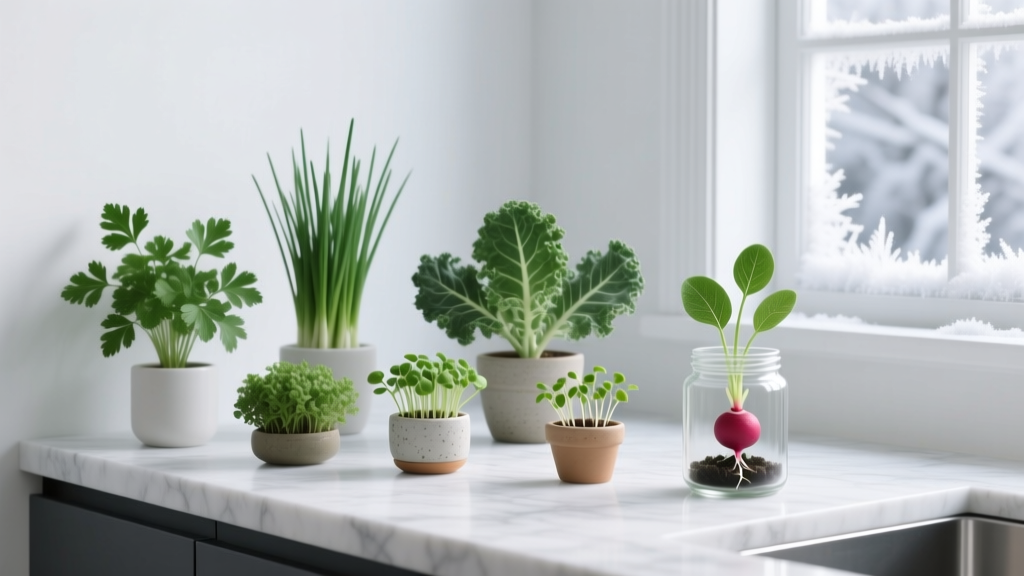
What to Plant in Winter for Indoor Growing
Winter indoor growing isn’t a “someday” project—if you want fresh herbs, salad greens, and sturdy seedlings ready for spring, the clock starts now. Once daylight drops under about 10 hours (common from late November through January in much of the U.S.), growth slows unless you compensate with lights and warmth. The opportunity: winter is the calm window when you can set up a reliable indoor rhythm, knock out pest prevention, and start crops that would be months away outdoors.
This guide is organized by priority—what to plant first for quick wins, then what to prune, what to protect, and what to prepare—so you can take action this week. Timing notes use frost dates and temperature thresholds so you can plug them into your local calendar.
Priority #1: What to plant (start these first)
Pick plants that match your setup. A bright south window is enough for microgreens and some herbs; to grow fruiting crops or stocky seedlings, plan on a simple LED shop light or grow light. Most indoor edibles perform best with 65–75°F daytime temperatures, and many seedlings stall below 60°F.
1) Fastest payoff (7–21 days): microgreens, shoots, and baby greens
If you want something harvestable before the month is out, start here. Microgreens tolerate winter’s low ambient light better than fruiting plants because you harvest them young.
- Microgreens: radish, broccoli, kale, mustard, arugula, peas, sunflower (harvest in 7–14 days, peas often 10–21 days).
- Shoots: pea shoots, sunflower shoots (best flavor at 2–4 inches tall).
- Baby salad greens: cut-and-come-again lettuce mixes (first cut often 21–35 days indoors depending on light).
Actionable setup: Use a shallow tray with drainage holes, sterile seed-starting mix or coconut coir, and sow thickly. Keep medium evenly moist (not soggy). Add a small fan on low to reduce damping-off and fungus gnat pressure.
“Good sanitation and a clean, soilless medium are key steps to reduce damping-off in seedlings.” — Extension guidance summarized from seedling disease management recommendations (e.g., Purdue Extension, 2019)
2) Winter-proof windowsill staples (start any week): herbs that tolerate indoor life
Herbs give the best return per square inch in winter. Start from seed for volume, or buy small plants for immediate harvest.
- Best from seed in winter: basil (with lights and warmth), chives, parsley, cilantro, dill.
- Easiest from plants/cuttings: mint, rosemary, thyme, oregano (these are slower from seed).
Temperature thresholds: Basil sulks below 65°F and blackens with cold drafts. Keep basil away from windows that drop below 55–60°F at night.
Lighting target: For herbs under LEDs, aim for 12–14 hours/day during December–February. If you’re relying on a window only, keep expectations realistic: herbs will survive, but harvest slowly.
3) Real indoor vegetables (4–12 weeks): scallions, carrots-in-containers, dwarf tomatoes (with lights)
These take more patience but are doable with the right conditions.
- Regrow now (1–3 weeks): scallions/green onions from roots in water, then pot up for longer harvest.
- Container roots: baby carrots or round types in 8–10 inch deep pots; keep soil evenly moist to prevent splitting.
- Fruiting indoors (8–12+ weeks): dwarf tomatoes or compact peppers only if you can provide strong light (14–16 hours/day) and warmth (70–75°F days).
Pollination note: Fruiting plants indoors need help. Tap flower clusters daily or use a small brush. Keep humidity moderate (40–60%) to reduce disease while allowing pollen to move.
4) Seed-starting for spring transplanting (timed to your last frost date)
This is where winter indoor growing pays off outdoors later. Use your local last frost date and count backward. For many U.S. locations, last frost ranges from March 15 (warmer zones) to May 15 (colder zones). Don’t guess—look up your date, then use these windows:
- Onions from seed: start 10–12 weeks before last frost (often January in Zones 5–7).
- Leeks: 10–12 weeks before last frost.
- Brassicas (broccoli, cabbage, kale): 6–8 weeks before last frost.
- Tomatoes: 6–8 weeks before last frost (starting too early creates leggy plants).
- Peppers/eggplant: 8–10 weeks before last frost; germinate warm at 80–85°F.
Citation-backed timing: Seed-starting calendars and recommended weeks-before-frost windows are widely published by land-grant extension programs (e.g., University of Minnesota Extension seed starting guidance, 2020; Utah State University Extension indoor seed starting, 2021).
Monthly schedule (so you know what to do this week)
| Month | Plant Now (Indoor) | Seed-Starting (Based on Last Frost) | Critical Conditions |
|---|---|---|---|
| December | Microgreens; lettuce/baby greens; parsley; chives | Zones 8–10: brassicas 6–8 weeks before a Feb–Mar last frost | Supplement light to 12–14 hrs/day; keep seedlings 65–75°F |
| January | Microgreens succession every 7–10 days; cilantro/dill; scallions | Zones 5–7: onions/leeks (10–12 weeks before Apr–May last frost) | Germination mats for peppers at 80–85°F; fan for airflow |
| February | Basil (with heat/light); more salad trays; pot up herbs | Most zones: brassicas (6–8 weeks); start peppers (8–10 weeks) | Aim for 14–16 hrs/day under LEDs for stocky starts |
| March | Herb refresh; indoor carrots; last big microgreen push | Tomatoes (6–8 weeks before last frost); herbs for transplanting | Harden off seedlings 7–14 days before planting out (above 45–50°F) |
Timelines and checklists (printable, practical)
Use these to keep winter growing from turning into a cluttered science experiment.
This week (next 7 days)
- Start 2 trays of microgreens (one spicy mix, one mild) for staggered harvest.
- Start 1 flat of lettuce/baby greens for cut-and-come-again.
- Pot up one supermarket herb plant (mint or rosemary) into fresh mix.
- Set a light timer to 12–14 hours/day (or 14–16 for seedlings).
- Place a small fan on low for airflow 2–6 hours/day.
Within 2–4 weeks
- Start succession microgreens every 7–10 days.
- Inspect and refresh sticky traps for fungus gnats.
- Start onions/leeks if you are 10–12 weeks from last frost.
- Begin bottom-watering routine for seedlings to reduce algae and gnats.
Within 6–10 weeks (late winter into early spring)
- Start tomatoes 6–8 weeks before last frost.
- Start peppers/eggplant 8–10 weeks before last frost (warm germination).
- Plan hardening-off window: 7–14 days before transplanting when days are reliably above 45–50°F.
Priority #2: What to prune (indoors and overwintered plants)
Indoor pruning is less about shaping and more about preventing pests and keeping plants productive in low light.
Herbs: pinch for branching, prune to prevent collapse
Pinch basil and mint back to a node every 7–10 days once established. This keeps stems from stretching toward light (leggy growth). Remove any yellowing leaves immediately—they’re magnets for fungus and gnats.
Overwintering peppers or geraniums indoors: reduce stress
If you brought peppers indoors from the garden (common in Zones 6–8), prune back by about 1/3 and remove weak interior shoots. The goal is to reduce leaf mass so the plant can match winter light levels. Keep them cooler and bright (around 60–70°F) to slow growth and pest pressure.
Houseplants near edibles: prune and isolate
Many winter pest outbreaks start on houseplants, then spread to edible seedlings. Prune dense houseplants to improve airflow, and keep edibles on a separate shelf when possible.
Priority #3: What to protect (cold, low light, pests, and disease)
Winter indoor growing fails for predictable reasons: cold window drafts, inconsistent watering, and pests that explode in warm, still air. Handle these early.
Protect from cold drafts and temperature swings
Nighttime glass can be much colder than room air. If leaves touch cold windows, you’ll see dark, water-soaked patches. Move plants 6–12 inches back from the glass at night or add an insulating curtain. Keep germinating trays away from exterior doors and heat vents.
Light protection: stop seedlings from getting leggy
If seedlings lean hard toward the window or develop long stems with small leaves, they need more light. Position LEDs 2–4 inches above seedlings and raise as they grow. Rotate window-grown pots every 2–3 days.
Pest prevention that matters in winter (fungus gnats, aphids, mites, mold)
Fungus gnats are the #1 winter indoor annoyance. They thrive in constantly wet media.
- Let the surface dry slightly between waterings (without wilting seedlings).
- Bottom-water seedlings when possible.
- Use yellow sticky cards to monitor adults.
- For persistent infestations, consider Bti (Bacillus thuringiensis israelensis) drenches labeled for gnats.
Aphids hitchhike on store-bought herbs and houseplants.
- Quarantine new plants for 7–10 days.
- Rinse foliage under lukewarm water weekly.
- Use insecticidal soap if needed, following label directions for edibles.
Spider mites spike when indoor air is dry (often when humidity drops below 35–40%).
- Increase humidity modestly (pebble tray or humidifier), but keep airflow moving.
- Inspect undersides of leaves weekly; look for stippling and fine webbing.
- Rinse plants and remove heavily infested leaves early.
Damping-off disease (seedling collapse) is most common when trays are overly wet, crowded, and unventilated. University extension guidance emphasizes sterile media, clean containers, and careful watering to prevent seedling losses (e.g., University of Minnesota Extension, 2020; Purdue Extension, 2019).
Food safety note for indoor edibles
Harvest microgreens with clean scissors, avoid splashing soil onto leaves, and refrigerate promptly. Sanitize trays between rounds with hot soapy water, then a dilute disinfectant rinse if desired; rinse well and dry.
Priority #4: What to prepare (setups, supplies, and spring readiness)
Preparation is what makes winter growing sustainable. A simple, repeatable setup beats a complicated one that you dread maintaining.
Indoor growing station: the minimal kit that works
- Lights: LED shop light or grow light with timer (target 12–16 hrs/day depending on crop).
- Shelf: wire rack or sturdy table; keep plants off cold floors.
- Airflow: small fan on low to reduce fungal issues.
- Trays & pots: seedling flats, 2–4 inch pots, and one deeper container for roots.
- Medium: sterile seed-starting mix; avoid reusing old mix for seedlings.
- Monitoring: thermometer at plant level; optional hygrometer.
Soil and fertility: don’t overfeed in low light
In winter, plants use less water and fertilizer. For herbs and greens, use a half-strength balanced fertilizer every 2–3 weeks only after plants have true leaves and are actively growing. Overfertilizing in low light produces weak, soft growth that attracts aphids.
Labeling and records (it matters more than you think)
Write sowing dates on painter’s tape. Track “days to harvest” for microgreens and note which trays got gnats or mold. Within one winter, you’ll have your own reliable indoor calendar.
Regional scenarios: what to do right now where you live
Indoor growing is universal, but your best winter moves change depending on daylight, heating, and when spring arrives.
Scenario 1: Cold winter, late spring (USDA Zones 3–5)
If your last frost is around May 10–May 30, winter is long and indoor light is weak. Focus on:
- Microgreens and baby greens from December through March with steady succession.
- Onions/leeks starting in January–February (10–12 weeks before last frost).
- Brassicas in March (6–8 weeks before last frost).
Watch for: cold window drafts and very dry indoor air; spider mites can be a bigger issue when furnaces run nonstop.
Scenario 2: Moderate winter, spring comes fast (USDA Zones 6–7)
Many gardens here have last frost around April 10–April 30. Your indoor window is shorter, so timing matters:
- Start onions/leeks in January.
- Start brassicas in February.
- Start tomatoes in late February to mid-March (6–8 weeks pre-frost).
Watch for: seedlings outgrowing space before outdoor conditions settle. Plan a hardening-off routine and avoid starting tomatoes too early.
Scenario 3: Mild winter, early outdoor planting (USDA Zones 8–10)
If your last frost is as early as February 1–March 15, indoor growing is less about waiting out snow and more about controlling pests and getting jump-started:
- Start brassicas indoors in December–January for quick transplanting.
- Grow herbs indoors to avoid outdoor pest surges and heavy rains.
- Use indoor lights to produce compact tomato/pepper starts if outdoor nights still dip near 40–45°F.
Watch for: aphids and whiteflies that remain active all winter in warm regions—quarantine any new plants before they join your indoor station.
Scenario 4: Apartment gardeners with only a bright window
If you don’t have lights, still grow productively by choosing the right crops:
- Microgreens (the most reliable).
- Scallions, chives, parsley (slow but steady).
- Mint and rosemary from small plants (not from seed).
Skip fruiting plants unless you can add a light. Your winter win is consistent harvest, not maximum size.
Quick comparison: what’s worth growing indoors in winter?
| Crop | Time to Harvest Indoors | Light Need | Best Winter Use | Common Winter Problem |
|---|---|---|---|---|
| Radish microgreens | 7–10 days | Low–Moderate | Fastest fresh greens | Mold if overcrowded |
| Lettuce (baby leaf) | 21–35 days | Moderate | Salads all winter | Leggy growth in low light |
| Parsley | Slow (6–10 weeks to steady picking) | Moderate | Soup and garnish staple | Slow germination below 65°F |
| Basil | 4–6+ weeks | High | Big flavor with lights | Chilling injury below ~60°F |
| Dwarf tomato | 10–16+ weeks | Very High | Project plant, not a quick win | Low yield without strong light/pollination |
Winter indoor growing: a tight routine that prevents problems
Indoor gardens succeed when you treat them like a weekly system. Use this simple cadence:
- Twice a week: water check (lift pots), rotate window plants, remove yellow leaves.
- Once a week: pest inspection (undersides of leaves), rinse herbs, refresh airflow path.
- Every 7–10 days: sow a new microgreen tray for steady harvest.
- Every 2–3 weeks: light feeding for actively growing greens/herbs (half-strength).
If you do nothing else today, sow one tray of microgreens and set a light timer. In the dead center of winter, that single move creates momentum—and it’s the same habit that makes spring seed-starting calmer, cleaner, and far more successful.
Sources referenced: University of Minnesota Extension indoor seed starting and seedling care resources (2020); Purdue Extension seedling disease/damping-off prevention guidance (2019); Utah State University Extension indoor seed starting recommendations (2021).