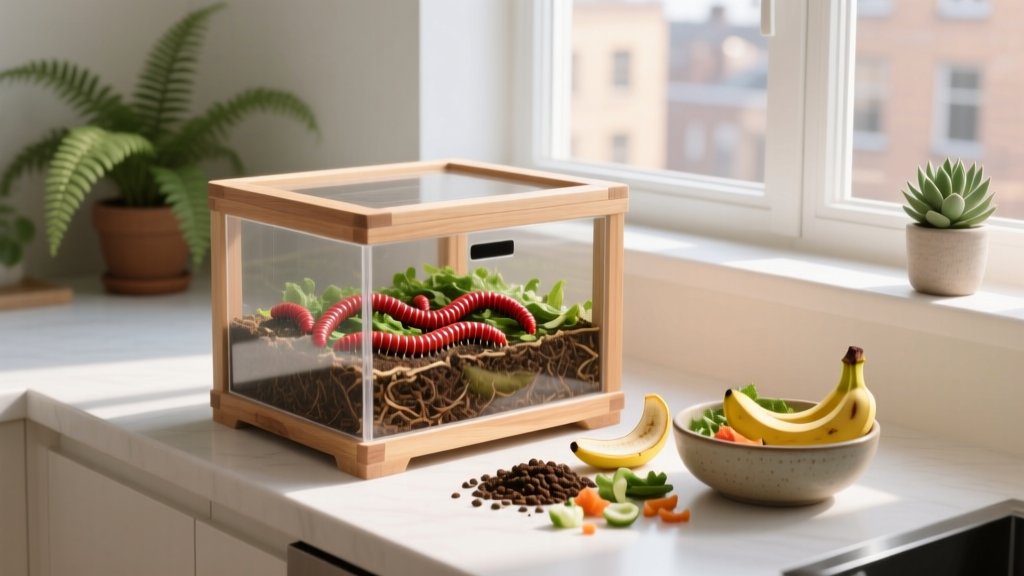
Winter Garden: Maintaining Worm Bins Indoors
The outdoor garden may be locked up by hard freezes, but your soil-building doesn’t have to stop. Winter is the make-or-break season for indoor worm bins: a few nights below 55°F inside the bin can slow reproduction and processing, while sustained warmth above 85°F risks stress and die-off. The opportunity right now is to keep worms steadily converting kitchen scraps into castings so you’re ready to top-dress seedlings, charge potting mixes, and jump-start beds the moment your last frost date passes.
This guide focuses on what to do this week, what to adjust month-by-month, and how to prevent the most common winter problems—odors, fruit flies, soggy bedding, and slow breakdown—using specific temperature targets, timelines, and regional realities.
Priority 1 (This Week): Stabilize Heat, Moisture, and Airflow
Hit the temperature window (and measure it)
Your first winter job is to keep the bedding zone between 60–75°F. Red wigglers (Eisenia fetida) remain active in that range, and most household basements/utility rooms can be tuned to it with minimal fuss.
- Check bin temperature today using a compost thermometer or an instant-read probe inserted into the bedding core.
- Action thresholds:
- If bedding is below 55°F for more than 48 hours, reduce feeding and move the bin to a warmer location.
- If bedding is below 50°F, worms will slow dramatically; expect uneaten food and increased risk of sour odors.
- If bedding rises above 80°F, increase ventilation and stop adding fresh food until temperature settles.
- If bedding hits 90°F, treat it as an emergency: cool immediately (remove lid, add dry bedding, move to a cooler room).
Regional reality: In USDA Zones 3–5, garages and unheated mudrooms commonly dip under 40°F overnight in January. A bin sitting on a concrete slab can run 5–10°F colder than the room air. Place the bin on rigid foam insulation or a wooden board to reduce heat loss.
“Earthworms are most active at moderate temperatures; extremes reduce feeding and reproduction.”
—USDA NRCS Soil Biology notes (USDA-NRCS, 2011)
Moisture: aim for “wrung-out sponge,” not “mud”
Indoor winter air is often dry from heating systems, but bins can still turn anaerobic if you overcompensate with wet foods. The correct moisture feel is a wrung-out sponge: damp, with only a drop or two when squeezed hard.
- Do the squeeze test twice weekly during winter (every 3–4 days).
- If bedding drips when squeezed: mix in 2–4 cups of dry shredded cardboard/paper and fluff.
- If bedding feels crispy or dusty: mist with dechlorinated water (1–2 cups at a time) and mix gently.
Extension-backed principle:2019).
Airflow and odor control (fix smell in 15 minutes)
Winter odor complaints usually come from overfeeding plus compacted bedding, not “bad worms.” Correct it quickly:
- Stop feeding for 7–10 days if you smell ammonia or sour rot.
- Remove any visible, slimy food and discard or freeze it for later use.
- Add dry bedding (shredded cardboard, newspaper, or aged leaves stored dry) and fluff to reintroduce oxygen.
- Bury food at least 3–4 inches deep when you resume feeding.
Keep a small bucket of dry bedding next to the bin. Each time you add food, add an equal volume of bedding. That single habit prevents most winter bin failures.
Priority 2 (Next 2 Weeks): Feed for Winter—Slow and Steady
Winter feeding rate: cut back, then earn your way up
In winter, worms often process food 25–50% slower, especially if the bin sits below 65°F. The fastest way to invite pests is to keep feeding at summer rates.
- Start with 1/2 your normal weekly volume for 14 days.
- If food disappears in 3–5 days, increase by 10–20%.
- If food remains after 7 days, reduce again and add more bedding.
Best winter inputs (and what to pause)
Focus on scraps that break down cleanly and don’t turn the bin into a wet, acidic mess.
- Best winter staples: coffee grounds (sparingly), tea leaves, crushed eggshells, chopped vegetable scraps, thawed freezer scraps, oatmeal, aged leaf mold (stored dry).
- Use caution: citrus, onions, spicy foods—small amounts only, chopped fine, well buried.
- Pause in winter: large quantities of melon rinds, pumpkin pulp, and watery fruits (they spike moisture and fruit flies indoors).
Pro move for January–February: Freeze scraps, then thaw and drain before feeding. Freezing ruptures cell walls and speeds decomposition while reducing odor intensity.
Add grit and buffering support
Worm bins drift acidic in winter because decomposition slows and food sits longer. Keep pH and digestion stable with:
- Crushed eggshell powder (1–2 tablespoons per feeding zone weekly).
- A handful of finished compost (if pest-free) to inoculate microbes.
Avoid adding lime unless you know what you’re doing; too much can swing pH and stress worms.
Priority 3 (Plant): What to Plant Now—Using Castings Indoors
Your worm bin’s winter output is most valuable for indoor seed-starting and early transplants. Don’t dump castings straight into seed trays at high percentages; they’re potent and can hold extra moisture. Use them as an amendment.
Seed-starting mix booster (late winter timing)
Count backward from your average last frost date and your crop’s indoor start window:
- Tomatoes and peppers: start 6–8 weeks before last frost.
- Brassicas (broccoli, cabbage): start 4–6 weeks before last frost.
- Onions/leeks (from seed): often 10–12 weeks before last frost.
Mix castings at 10–20% by volume into seed-starting media for transplants (not for germination trays if you struggle with damping-off). If your home is cool and trays stay wet, keep castings closer to 10%.
Houseplants and microgreens
For winter growing on a windowsill or under lights:
- Top-dress houseplants with 1/4 inch castings, then cover with mulch or coir to discourage fungus gnats.
- For microgreens, avoid heavy castings; use a thin layer (1/8 inch) under a sterile seed-starting medium if you’ve had mold issues.
Priority 4 (Prune): What to Prune Now—In and Around the Worm Bin
Winter pruning isn’t only for trees. “Pruning” your vermicompost system means removing problem inputs and trimming back conditions that invite pests.
Prune the feedstock stream
- Stop adding bread, oily foods, and salty leftovers—they go rancid indoors.
- Chop scraps to 1/2–1 inch pieces for faster processing when bins run cool.
- Limit coffee grounds to no more than 20% of weekly inputs by volume; mix thoroughly with bedding.
Prune “hot spots” and compacted zones
If you see a dense mat or a soggy pocket, open it up:
- Fluff only the top 2–3 inches weekly (don’t churn the whole bin—worms like stability).
- Break up clumps and mix in dry bedding.
Priority 5 (Protect): Keep Worms and Your Home Pest-Free
Fruit flies and fungus gnats: winter’s #1 indoor complaint
These pests thrive when scraps sit exposed. Your protection plan is simple and consistent:
- Freeze scraps for at least 48 hours to kill fly eggs, then thaw and drain.
- Bury all food and cap feeding zones with 2 inches of damp cardboard or finished bedding.
- Use a fitted lid with ventilation holes covered by fine mesh.
- Set vinegar traps nearby for 7 days if adults are already present.
If gnats persist, reduce moisture and avoid overwatering nearby houseplants. They often shuttle between potting soil and worm bedding.
Mites, pot worms, and springtails: when to intervene
Most tiny bin critters are decomposers, not enemies. The problem is imbalance.
- If you see many mites and the bin smells sour: you’re overfeeding or too wet. Add dry bedding and pause feeding 7–10 days.
- If pot worms (tiny white threads) explode: conditions are acidic and wet. Add eggshell powder and bedding; improve airflow.
- If springtails are abundant: usually harmless; treat only if the bin is waterlogged.
Rodents (rare indoors, real in garages)
In Zones 6–8, worm bins often overwinter in garages where mice seek warmth. Use a bin with a tight lid, avoid leaving scraps exposed, and keep the area clean. If rodents are active, move the bin fully indoors immediately.
Priority 6 (Prepare): Set Up for Spring Casting Harvest and Garden Use
Choose a winter harvesting method (low-mess)
Winter is not the time for a giant sorting project in the living room. Use controlled, small-batch methods.
Method A: Side-feeding migration (best for winter)
- For 2–3 weeks, feed only on one side of the bin.
- When the fed side is dense with worms, scoop finished material from the opposite side in small amounts.
Method B: Light separation (fast, but needs space)
- Dump small piles onto a tarp under bright light.
- Wait 5–10 minutes for worms to burrow down, then skim off castings repeatedly.
Storage rule: Keep harvested castings slightly moist and breathable (paper bag inside a tote with holes). Don’t seal them wet in an airtight container.
Build your winter “inputs bank”
One of the best winter preparations is gathering bedding before you need it.
- Shred and store two full paper grocery bags of cardboard per bin as a minimum reserve.
- Save fall leaves dry in a lidded bin (excellent carbon bedding).
- Keep eggshells drying near the stove; grind weekly.
Seasonal Schedule: What to Do Each Month (Indoor Worm Bin)
| Month | Bin Focus | Feeding & Bedding | Red Flags to Watch |
|---|---|---|---|
| December | Stabilize temperature (aim 60–75°F) | Reduce feed to 50–75% of fall rate; add equal bedding volume | Condensation under lid, sour smell, food lingering >7 days |
| January | Moisture control + pest prevention | Freeze scraps 48 hours; cap feeding zones with 2" bedding | Fruit flies/gnats, soggy corners, mites increasing |
| February | Prepare for seed-starting castings | Side-feed 2–3 weeks to harvest small batches; keep eggshell powder steady | Bin runs cool (<55°F), slow processing, compaction |
| March | Gradually increase feed as indoor temps rise | Increase 10–20% if food disappears in 3–5 days | Overconfidence feeding spike → odors and gnats |
Real-World Scenarios: Adjust for Your Region and Setup
Scenario 1: Cold-climate homes (USDA Zones 3–5) with cool basements
If your basement runs 55–62°F in January, your bin will be sluggish but workable.
- Place the bin on 1–2 inches of foam board insulation.
- Feed smaller amounts more often: a “snack” every 3–4 days instead of a big weekly dump.
- Use more bedding than usual to prevent wet spots.
Timing tip:If your average last frost is around May 15, plan to harvest a small batch of castings by March 15–April 1 for potting mixes and early starts.
Scenario 2: Mild-winter regions (USDA Zones 8–10) where the house stays warm
In warm climates, the risk flips: bins can run too warm and too fast, especially in laundry rooms near water heaters.
- Keep bin temperatures below 80°F—move away from appliances that radiate heat.
- Increase airflow (more ventilation holes with mesh) and monitor moisture; warm bins dry out faster.
- Harvest more frequently; castings can accumulate quickly and reduce aeration.
Timing tip: If your last frost date is February 1 (common in parts of Zone 9), you may be starting spring planting now while maintaining the bin indoors for convenience and pest control.
Scenario 3: Apartment or small-space vermicomposting (kitchen closet, under sink)
Small bins swing in temperature and moisture faster. Your win is consistency.
- Use a tighter feeding routine: 2 feedings per week, both small.
- Always cap with cardboard and keep a dedicated container of dry bedding nearby.
- If odor appears, assume overfeeding first and pause for 7 days.
Timing tip: Mark a repeating calendar reminder every Wednesday/Sunday for “check moisture + bury scraps + add bedding.” Small actions prevent big problems.
Pest and Disease Prevention: Winter-Specific Risks
Mold blooms on food
White mold on bread or produce is common in cool bins. It’s usually not dangerous to worms, but it signals food is sitting too long.
- Chop scraps smaller and bury deeper (3–4 inches).
- Reduce feeding volume for 2 weeks.
- Increase bedding to balance moisture.
Anaerobic “sour bin” (the winter crash)
If your bin smells like vinegar, sewage, or ammonia, treat it as a winter emergency. Anaerobic conditions can crash worm health quickly indoors.
- Remove wet, rotting pockets immediately.
- Add 3–6 cups of dry bedding and fluff the top layers.
- Leave the lid ajar (with a breathable cloth barrier) for 24–48 hours in a safe indoor spot.
Washington State University Extension emphasizes that composting systems (including small-scale ones) need oxygen and balanced moisture to prevent odors and anaerobic conditions (WSU Extension, 2020).
Winter Worm Bin Checklist (Print-and-Go)
Weekly (10 minutes)
- Measure bedding temperature (target 60–75°F).
- Do the squeeze test; adjust with dry bedding or light misting.
- Bury food and cap with 2 inches of bedding/cardboard.
- Check lid/vents for condensation; wipe and improve airflow if needed.
Every 2 weeks
- Inspect corners for soggy zones; add dry bedding where needed.
- Grind eggshells and add a small amount to the active feeding area.
- Evaluate feeding rate: food gone in 3–5 days = OK; lingering >7 days = reduce.
Monthly
- Side-feed to prepare for a small casting harvest.
- Restock bedding reserve (aim for at least 2 bags shredded cardboard per bin).
- Clean the area around the bin (crumbs attract pests).
Timeline: The Next 30 Days Indoors (Actionable Plan)
- Day 1–2: Take bin temperature; move bin if below 55°F. Add insulation under bin if on concrete.
- Day 3–4: Freeze future scraps (start a freezer container). Prepare one bag of dry bedding beside the bin.
- Day 5–7: Feed half your usual amount; bury and cap. Add a small dusting of eggshell powder.
- Week 2: Recheck how much food remains. If most is gone by day 5, increase feed 10–20%. If not, pause feeding 7 days and add bedding.
- Week 3: Begin side-feeding only on one side to stage a small harvest.
- Week 4: Harvest a small amount of finished castings from the opposite side; store breathable and moist (not sealed wet).
By keeping the bin in its comfort band (60–75°F), feeding at a winter-appropriate pace, and using bedding as your main control lever, you’ll enter spring with a steady supply of castings and a thriving worm population—ready to scale up as soon as your indoor seed-starting ramps and outdoor soil wakes up.
Sources: University of Minnesota Extension (2019) vermicomposting guidance on bedding moisture and aeration; USDA NRCS Soil Biology materials (2011) on earthworm activity and temperature; Washington State University Extension (2020) compost system management principles related to oxygen and moisture balance.