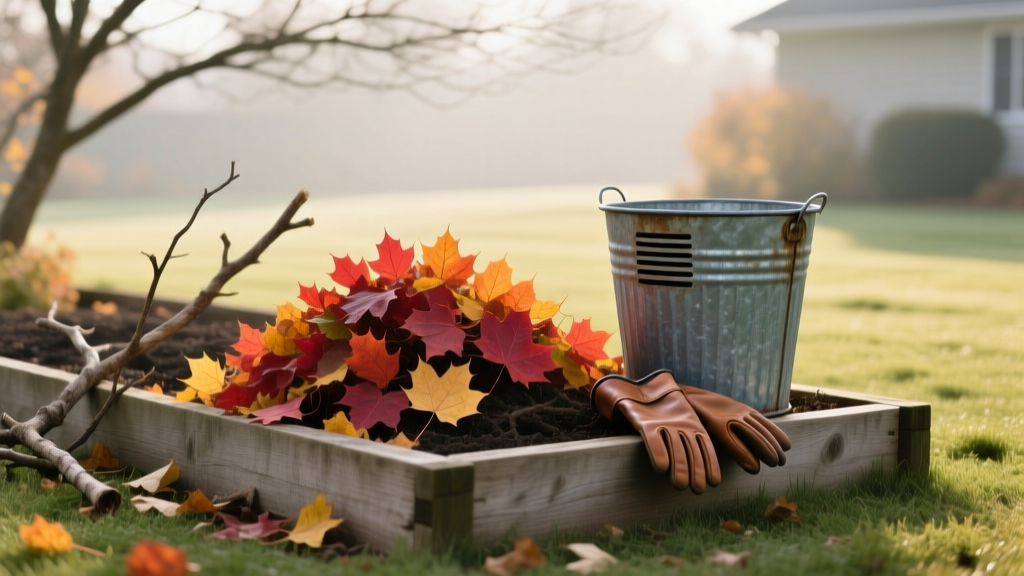
Fall Composting: Managing Leaf Drop and Yard Waste
The next 4–8 weeks decide whether your fall yard waste becomes next year’s best soil—or a soggy, smelly pile you’ll avoid all winter. As soon as nights start dipping into the 40–50°F range and trees begin shedding, you’re on a clock: leaves mat down fast, microbial activity slows as temperatures fall, and early frosts can freeze a pile in place. Treat fall composting like harvest season: move materials while they’re dry, build heat while you still can, and bank finished compost before consistent freezes.
Use this guide as a “do it this week” plan for leaf drop, garden clean-up, and carbon-heavy yard waste—organized by what matters most right now.
Priority 1: Prepare your compost system for a leaf surge (do this in the next 7 days)
Set up three zones: collect, shred, and build
Fall is not the time for a single messy pile. You want a flow.
- Collection zone: tarp or wire leaf corral near where you rake. Keep leaves dry; wet leaves are harder to shred and tend to mat.
- Shredding zone: mower-over-leaves on the lawn, a leaf vacuum, or a chipper/shredder. Shredded leaves compost dramatically faster because they pack less and expose more surface area.
- Building zone: your compost bin/pile. Aim for at least 3 ft x 3 ft x 3 ft to retain heat; smaller piles cool quickly once nights drop below 45°F.
Hit the “heat window” before hard frost
If your first hard freeze (28°F) is typically in mid-October (many USDA Zones 4–5) or mid-November (Zones 6–7), you have limited time to get a hot pile established. A pile that reaches 130–160°F will keep cooking even as air temperatures dip, but a cold pile often stays cold until spring.
“Composting is most rapid when temperatures are between 90°F and 140°F; hot composting can reach 160°F, which helps destroy weed seeds and pathogens.” — University of Illinois Extension (2021)
Stockpile “greens” now to balance all those “browns”
Leaves are carbon-heavy “browns.” Without nitrogen (“greens”), your pile will crawl. Save these fall greens:
- Fresh grass clippings (use thin layers; don’t add clumps)
- Spent annuals (disease-free), green plant trimmings
- Kitchen scraps (bury to deter pests)
- Coffee grounds (excellent fall nitrogen boost)
Rule of thumb: build with roughly 2–3 parts shredded leaves to 1 part greens by volume, then adjust based on smell and moisture.
Moisture target: “wrung-out sponge”
Dry fall air can desiccate piles—then a cold rain saturates them. Your compost should be damp but not dripping. If you squeeze a handful and get 0–2 drops, you’re in range. If water streams out, mix in dry leaves or shredded cardboard immediately.
Fast checklist (this weekend)
- Set up a leaf corral/tarp and keep it out of the low spot where water collects
- Sharpen mower blade for leaf shredding
- Gather bulking agents: small twigs, wood chips, coarse stems (prevents matting)
- Place a compost thermometer where you’ll actually use it
- Designate a lidded bucket for kitchen scraps so you don’t “lose” nitrogen inputs
Priority 2: What to prepare (compost recipes for common fall yard waste)
Leaf drop: composting strategy by leaf type
Not all leaves behave the same. Use this to avoid slimy layers and stalled piles:
| Leaf type | Common issue | Best move | Expected composting speed (fall-built hot pile) |
|---|---|---|---|
| Oak, beech (tough, waxy) | Slow to break down | Shred; mix with coffee grounds or grass; keep pile warm | 3–6 months |
| Maple, birch | Matting if left whole | Shred and fluff with coarse stems/twigs | 2–4 months |
| Walnut | Concern about juglone | Compost separately and let it fully finish before use | 6+ months |
| Pine needles | Slow, airy, acidic reputation | Use as mulch or add sparingly; shred if possible | 6–12 months |
How to build a hot fall pile that actually heats
Use a simple layering method you can repeat as leaves keep coming:
- Start with 4–6 inches of coarse browns (small twigs, chopped stems) for airflow.
- Add 8–12 inches shredded leaves.
- Add 2–4 inches greens (grass clippings, fresh plant trimmings, kitchen scraps buried in the center).
- Sprinkle water if the layer is dry.
- Repeat until the pile is at least 36 inches tall.
Then cap the pile with 2–3 inches of finished compost or garden soil to inoculate microbes and reduce odors.
Turning schedule keyed to temperature
A compost thermometer turns guesswork into timing:
- Day 3–7: If the core hits 130–160°F, you’re cooking. Don’t turn yet.
- When temp drops below 120°F: Turn once to re-oxygenate and remix wet/dry pockets.
- After turning: If it rebounds to 130°F within 24–48 hours, you have the right moisture and nitrogen.
- If it never rises above 100°F: Add nitrogen (coffee grounds/grass), shred more, and check moisture.
Washington State University Extension notes that oxygen and moisture are key drivers of composting rate and odor control; turning and proper moisture management prevent anaerobic conditions (WSU Extension, 2020).
Monthly fall composting schedule (adjust to your frost date)
Use this timeline as a framework. Shift earlier by 2–4 weeks for USDA Zones 3–5, and later for Zones 8–10.
| Timing | Primary goal | Actions |
|---|---|---|
| Late Sept–early Oct (or 6–8 weeks before first hard frost) | Build heat | Start a 3x3x3 pile; shred first leaf drop; add greens; water to wrung-sponge |
| Mid Oct (or 3–5 weeks before hard frost) | Maintain momentum | Turn when temps fall below 120°F; keep adding shredded leaves in thin “blanket” layers |
| Late Oct–Nov (or after first 32°F frost) | Insulate & store | Stop frequent turning; cap with leaves/straw; cover from heavy rain; stockpile extra leaves dry |
| Dec (or when highs stay below 40°F) | Winter mode | Let it cure; add kitchen scraps only if you can bury deep and deter pests; focus on keeping pile from waterlogging |
Priority 3: What to prune (and what to keep out of compost to prevent disease)
Prune for sanitation—avoid “late-growth” mistakes
Fall pruning is mostly about removing problems, not shaping everything. As a rule, skip heavy pruning of woody plants within 4–6 weeks of your average first frost (often around Oct 10 in colder Zone 4 sites, Nov 15 in many Zone 7 gardens). Late pruning can push tender regrowth that’s easily damaged.
Do prune now:
- Dead, broken, or diseased branches (any time)
- Tomato, squash, and bean vines at season’s end (especially if disease-free)
- Perennials with clear disease symptoms (bag and trash, don’t compost)
Keep these OUT of your compost (fall is when they spread)
Autumn clean-up is prime time for accidentally overwintering pests and pathogens. Do not home-compost:
- Rose leaves with black spot (fungal spores persist)
- Powdery mildew-covered squash vines (especially if your pile won’t hit 130°F)
- Apple leaves with scab or mummified fruit
- Weeds with mature seed heads
- Plants with viral symptoms (mosaic, severe distortion)
Research and extension guidance consistently emphasize that many pathogens survive in undecomposed debris unless compost reaches and maintains high internal temperatures (Cornell Cooperative Extension, 2019).
Pest prevention tied to composting habits
Fall pests look for winter shelter. Your compost can either help them—or shut them down.
- Rodents: Avoid adding bread, meat, oily foods. Bury kitchen scraps 8–12 inches deep in the hot center. Use a lidded bin if rodents are persistent.
- Overwintering insects: Don’t leave thick, wet leaf mats against foundations; shred and compost or use as managed mulch.
- Slugs: Keep compost areas tidy; don’t let boards/tarps sit directly on soil without airflow.
Priority 4: What to plant (use composting to support fall planting and spring prep)
Plant garlic and cover crops while you have workable soil
Fall composting pairs well with planting because you’re generating organic matter and freeing up beds.
- Garlic: Plant about 2–4 weeks before the ground freezes. In many Zone 5 gardens that’s late October; Zone 7 often mid-November. Add finished compost (not raw, heating compost) to planting rows.
- Cover crops: If you’re within 4–6 weeks of your first hard frost, choose faster-establishing options (like oats/peas in some regions). Use shredded leaves as a light mulch after germination.
Where fresh fall compost belongs (and where it doesn’t)
Fresh, actively decomposing compost can tie up nitrogen and create heat—bad for seeds and transplants. Use it strategically:
- Good uses now: top-dressing around shrubs/trees (thin layer), building new beds for spring, filling low spots, sheet-mulching layers
- Wait for finished compost: seed-starting mixes, planting into containers, direct seeding fall greens
What to protect (your compost pile, soil, and beneficials) as temperatures drop
Protect the pile from rain and early snow without smothering it
As storms pick up, your biggest risk is waterlogging. A soaked pile turns anaerobic and stinks.
- Cover with a tarp loosely or use a compost cover that sheds rain while leaving side airflow.
- Build a slight dome shape so water runs off.
- Add a 4–6 inch “thatch” cap of dry leaves or straw to buffer temperature swings.
Protect your lawn and beds from leaf matting
Leaves left whole can smother grass and invite snow mold in colder regions. If leaf drop is heavy, mow-shred weekly until leaf fall ends.
Timing cue: when you’re consistently seeing nighttime lows under 45°F, your lawn growth slows—so don’t wait for the “last big rake.” Keep up with shredding as leaves fall.
Protect beneficial insects without hoarding disease
Some gardeners leave stems and leaves for overwintering beneficials. You can do that and still compost responsibly:
- Leave healthy perennial stems standing until spring (especially hollow stems) in a designated area.
- Compost only clean debris; remove diseased material promptly.
- Create a separate “habitat pile” of sticks and stems away from vegetable beds to reduce pest carryover.
Regional scenarios: adjust your fall composting plan to your weather
Scenario 1: USDA Zone 3–5 (Upper Midwest, Northern New England) — early freezes, fast decisions
If your first frost (32°F) often hits in late September to early October and hard frost (28°F) follows soon after, prioritize a single large hot pile rather than frequent small additions.
- Build one “batch” pile as soon as you have enough material (aim for 1 cubic yard minimum).
- Turn once or twice before consistent daytime highs fall below 45°F.
- Stockpile extra shredded leaves dry (bags or covered bin) for spring mixing.
Scenario 2: USDA Zone 6–7 (Mid-Atlantic, lower Midwest) — long leaf season, lots of volume
You may get frost around Oct 15–Nov 15 but still have warm spells. This is ideal for a “continuous add” system with a finishing pile.
- Keep two bins: Active (new inputs) and Finishing (turned and capped).
- Turn after big leaf additions or heavy rains.
- Use shredded leaves as winter mulch once soil cools below 50°F (helps suppress winter weeds).
Scenario 3: USDA Zone 8–10 (South, coastal West) — mild fall, pests stay active
Warm soils and slow leaf drop can make composting easy—but pests and odors are more likely if you add kitchen scraps carelessly.
- Keep food scraps buried deep and maintain a dry-leaf cap.
- Turn more often to prevent gnats/flies; warm nights can keep a pile active well into December.
- Watch moisture: fall rains can be intense, and warm, wet piles go anaerobic fast.
Timelines you can follow this week (and next)
7-day action plan (do these in order)
- Day 1: Set up collection + shredding area. Start keeping leaves dry.
- Day 2–3: Shred leaves (mow over them) and build the base with coarse browns.
- Day 3: Add greens and water lightly if needed. Cap with finished compost/soil.
- Day 4–7: Check temperature daily. If it reaches 130°F, leave it alone to build momentum.
2–4 week checklist (your “leaf peak” playbook)
- Shred and add leaves in layers; avoid dumping a full bag of whole leaves into the center
- Turn when temps fall below 120°F or after a soaking rain
- Add nitrogen weekly (coffee grounds, grass, green trimmings)
- Remove and trash diseased foliage and mummified fruit
- Keep the pile covered during multi-day rain events
Fall composting troubleshooting (fix problems before winter locks them in)
If your pile smells like ammonia
You have too much nitrogen or too little carbon/air. Mix in shredded leaves or cardboard and turn to introduce oxygen.
If your pile smells sour or rotten
It’s anaerobic—usually too wet or compacted. Turn immediately, add dry shredded leaves, and add coarse material for airflow.
If the pile won’t heat
Common fall causes: leaves are whole, pile is too small, or it’s too dry. Shred, build bigger (at least 3 ft in each dimension), and moisten layers as you rebuild. If your nights are already dropping below 40°F, insulation (leaf cap + tarp) helps retain what heat you can generate.
If you’re drowning in leaves
Don’t force everything into one pile. Use a three-part solution:
- Hot compost the best mix (shredded leaves + greens) while you still have warmth.
- Leaf mold the surplus: bag or bin shredded leaves alone; keep damp; expect 6–12 months for crumbly leaf mold.
- Mulch with shredded leaves after the first few frosts, once soil cools (around 50°F) to avoid inviting voles into warm, protected zones too early.
One last practical move that pays off: save a few bags of dry shredded leaves in a shed or under cover. In spring, when your compost is wet and nitrogen-rich, those leaves become the perfect balancing carbon—no last-minute scrambling.