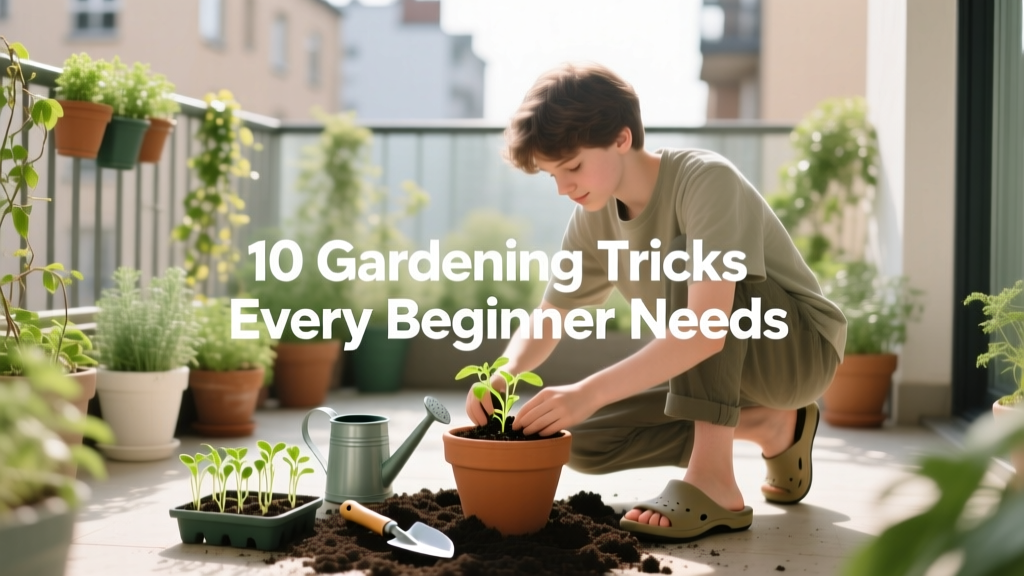
10 Gardening Tricks Every Beginner Needs
Most beginner gardens don’t fail because people “forget to water.” They fail because the soil is treated like dirt, seeds are planted at the wrong depth, and watering is done on a schedule instead of based on what the plant and weather are actually doing. Fix those three things and you can often double your odds of success without buying a single fancy tool.
Below are ten shortcuts I wish someone had handed me on day one—grouped so you can plug them into your garden right away.
Start with Soil (Because Soil Fixes Everything Else)
1) The “Jar Test” Trick: Find Out What You’re Actually Planting In
Headline: Don’t guess your soil type—test it in 10 minutes with a jar and water.
Fill a clear jar about 1/3 with soil, top it up with water, add a drop of dish soap, shake hard for 30 seconds, then let it settle overnight. Sand drops fast, silt sits in the middle, and clay forms the top layer—so you’ll know if you’re dealing with a bathtub (clay) or a sieve (sand). That one clue tells you whether to add compost for structure, mulch for moisture, or drainage changes before you waste money on plants.
Real-world example: A new gardener in a rental thought they had “nice black soil,” but the jar test showed nearly half clay. They stopped watering daily (which was suffocating roots) and instead added a 2-inch compost layer plus mulch—suddenly tomatoes stopped yellowing and perked up within two weeks.
2) Compost Like a Pro Without Composting: The 2-Inch Topdress
Headline: The fastest soil upgrade is adding compost on top, not digging it in.
Spread 2 inches of finished compost over beds in spring (or fall) and let worms and weather do the mixing. It improves texture, water-holding, and plant nutrition without wrecking soil structure by tilling. If compost costs too much, use a DIY blend: half shredded leaves + half grass clippings (let clippings dry for a day so they don’t mat).
Cost shortcut: Bagged compost can run $6–$10 per 1.5 cu ft. A municipal compost pile (if your town has one) is often $0–$30 per truckload—call and ask before you buy bags.
3) Mulch to Cut Weeding in Half (and Keep Moisture In)
Headline: A 2–3 inch mulch layer is basically a cheat code for beginners.
Mulch blocks light from weed seeds and slows evaporation so your watering becomes forgiving instead of stressful. Keep mulch a couple inches away from plant stems to prevent rot. The best beginner mulch is shredded leaves (free) or straw (clean, seed-free straw—avoid “hay,” which is basically weed confetti).
Expert-backed: The University of California Agriculture & Natural Resources notes that mulches reduce evaporation and suppress weeds when applied at adequate depth (UC ANR, 2017).
Planting Shortcuts That Prevent Rookie Mistakes
4) Seed Depth Rule: Plant Too Deep and Nothing Happens
Headline: Most seeds fail because they’re planted too deep—use the “2x rule.”
Plant seeds about 2 times as deep as their diameter (tiny seeds barely need covering). Firm the soil gently so seeds contact moisture, then water with a soft spray so you don’t wash them away. If you’re direct-sowing carrots or lettuce, mix seeds with dry sand at a 1:10 ratio (1 part seed to 10 parts sand) so you can sprinkle evenly instead of dumping a clump.
Case example: A balcony gardener couldn’t get basil to sprout—turns out they buried it nearly an inch. Basil wants a dusting of soil (about 1/8 inch). Once they corrected depth, sprouts appeared in under a week.
5) The “Hardening Off” Timer: 7 Days That Save Your Seedlings
Headline: Don’t move seedlings from indoors straight to full sun—ease them in for 7 days.
Start with 1–2 hours of outdoor shade on day one, then add time and sunlight daily until plants can handle a full day outside. Wind and UV are brutal if seedlings haven’t built thicker leaves and stronger stems. Skip this step and you’ll watch perfectly healthy starts get scorched in one afternoon.
Expert-backed: Extension guidance commonly recommends gradual acclimation to outdoor conditions to prevent transplant shock; for example, University of Minnesota Extension describes hardening off as a staged process over about a week (University of Minnesota Extension, 2020).
6) “Right Plant, Right Spot” in One Minute: Track Sun with Your Phone
Headline: Before buying plants, map your sunlight for one day so you stop planting tomatoes in shade.
Take quick photos of your garden at 9 a.m., noon, and 3 p.m. and note which areas get 6+ hours of direct sun (good for tomatoes/peppers), 3–5 hours (many greens), or less (herbs like mint, some ornamentals). This avoids the classic “healthy plant, no harvest” problem caused by insufficient light.
Real-world scenario: In a small suburban yard, the “sunny” bed turned out to get only 4 hours because a fence shaded it after lunch. The gardener moved tomatoes to containers on the driveway and planted spinach where the bed was—both improved immediately.
Watering & Feeding Hacks (Without Overdoing It)
7) Water Deep, Not Often: The Screwdriver Test
Headline: Use a screwdriver to check real soil moisture—no guesswork.
Push a long screwdriver into the soil; if it slides in easily to 6 inches, moisture is good. If it stops at 2–3 inches, it’s time to water deeply. Deep watering encourages deeper roots, which makes plants tougher during heat waves.
DIY upgrade: Place a cheap rain gauge (often $5–$10) in the garden. Many beds do well with roughly 1 inch of water per week (from rain + irrigation), but the screwdriver tells you if your soil is actually holding it.
8) Fertilizer Shortcut: Feed Containers Differently Than Beds
Headline: Containers lose nutrients fast—use lighter, more frequent feeding.
For in-ground beds, compost plus a slow-release organic fertilizer at label rates usually works for the season. For containers, use a diluted liquid feed at about 1/2 strength every 7–14 days once plants are actively growing (especially tomatoes, cucumbers, peppers). This prevents the “lush leaves, no fruit” problem that happens when people dump high-nitrogen fertilizer all at once.
Cost comparison: A small bottle of liquid fertilizer might cost $12–$20 but can last a season when diluted; a big bag of granular fertilizer can be $15–$35 and is better value for beds. If you’re keeping it super DIY, a worm bin (even a tote with holes) turns kitchen scraps into a mild, plant-friendly topdress.
“Most plant problems I see in home gardens trace back to soil moisture mismanagement—either too wet for too long or cycles of drought and flood.”
—Extension horticulture guidance summarized from common diagnostic recommendations (e.g., university extension moisture management resources)
Weeds, Pests & Disease: Stop Problems Before They Start
9) Cardboard Sheet Mulch: Instant Bed, Fewer Weeds, Less Digging
Headline: Turn lawn or weedy ground into a bed using cardboard + compost—no tiller needed.
Lay plain cardboard (remove tape), overlap edges by 6 inches, soak it, then add 3–4 inches of compost or a compost/topsoil blend on top. Plant into the top layer and let the cardboard smother weeds underneath. It’s beginner-friendly because it reduces weeds dramatically and keeps moisture stable.
Case example: A family wanted a quick veggie patch without renting a rototiller ($60–$100/day in many areas). They used free appliance-store cardboard, spent $40 on bulk compost, and planted squash and beans the same weekend—with far fewer weeds than their dug bed from the previous year.
10) The “Water at the Soil Line” Rule + Spacing: Your Cheapest Disease Prevention
Headline: Keep leaves dry and airflow high—two habits that prevent a ton of disease.
Avoid overhead watering late in the day; wet leaves overnight are an open invitation for fungal issues. Water at the base in the morning, and space plants so air can move (tomatoes often want 18–24 inches between plants depending on variety/support). If you only do one “grown-up” gardening thing this season, do this—it’s cheaper than sprays and more reliable.
Expert-backed: Cornell University’s vegetable disease management guidance emphasizes moisture and leaf wetness duration as key factors in many fungal diseases, with cultural practices like spacing and watering practices as primary prevention tools (Cornell Cooperative Extension, 2019).
Quick Comparison Table: Easy Upgrades That Pay Off
These are the beginner moves that give the biggest return for the least effort. Pick one or two to start—then stack them as you go.
| Garden Task | Method A (Common Beginner Move) | Method B (Smarter Shortcut) | Typical Result | Cost Notes |
|---|---|---|---|---|
| Weed control | Hand-weed weekly | 2–3 in mulch or cardboard + 3–4 in compost | Less weeding, steadier moisture | Leaves = free; straw often $8–$15/bale |
| Watering | Daily light sprinkling | Deep watering when soil is dry at 6 in (screwdriver test) | Deeper roots, fewer stress problems | Rain gauge $5–$10; screwdriver you already have |
| Soil improvement | Till in amendments once | Topdress 2 in compost yearly | Better soil structure over time | Bulk compost often cheaper than bags |
| Disease prevention | Spray after symptoms | Water at soil line + spacing 18–24 in | Fewer outbreaks to begin with | Costs $0 if you change habits |
Three Beginner Scenarios (And the Trick That Fixes Each One)
Scenario #1: “My plants look fine, but they don’t produce.”
Check sunlight first with the 9/noon/3 photo trick. Most fruiting crops need 6+ hours of direct sun; if you only have 4 hours, switch to greens, herbs, and some root crops—or move containers to the brightest hardscape area.
Scenario #2: “I water all the time and my plants still wilt.”
Do the screwdriver test. In heavy clay, roots can suffocate even when the surface looks dry; in sand, water drains too fast. The jar test tells you which you have, and mulch plus compost gets you out of the constant-watering loop.
Scenario #3: “Weeds are taking over and I’m losing motivation.”
Sheet mulch a problem area with cardboard overlapped by 6 inches and top with 3–4 inches compost. You’ll go from endless pulling to occasional touch-up, which is usually the difference between “I quit” and “I can handle this.”
Sources You Can Trust (and Actually Use)
If you like to verify advice (good instinct), these are solid, practical references written for real gardeners:
- University of California Agriculture & Natural Resources (UC ANR). Mulching and water conservation guidance, 2017.
- University of Minnesota Extension. Seedling hardening-off recommendations and transplant shock prevention, 2020.
- Cornell Cooperative Extension. Vegetable disease prevention via cultural practices (watering practices, spacing, leaf wetness), 2019.
Pick just two tricks to try this week—my vote is 2 inches of compost plus 2–3 inches of mulch. Those two alone make watering easier, weeding less frequent, and plants noticeably sturdier, which is exactly what beginners need: results that show up fast enough to keep you going.