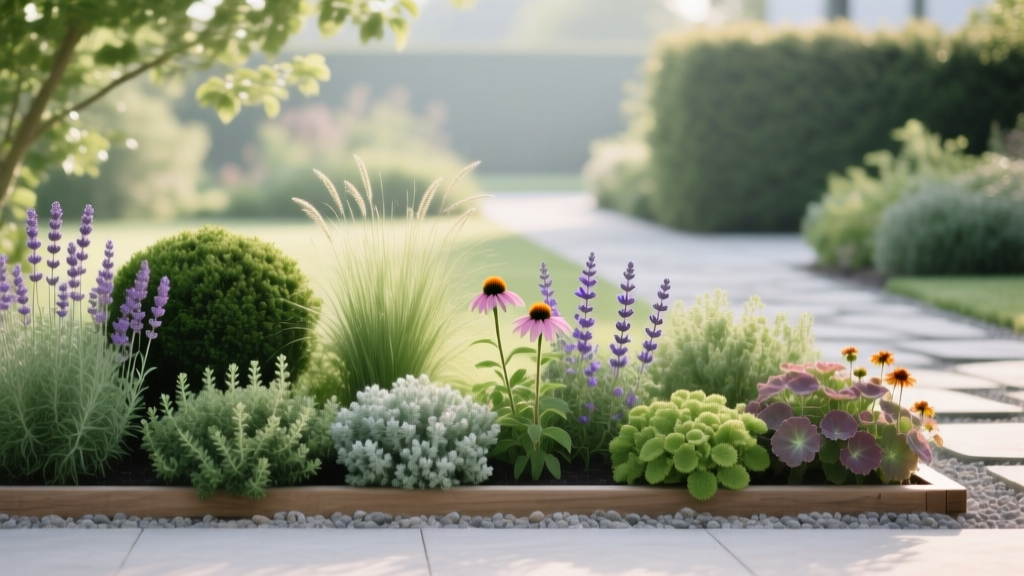
10 Garden Hacks for Beautiful Borders
The fastest way to make a garden look “messy” isn’t weeds—it’s a border that slowly disappears. A surprising amount of border blur happens because soil and mulch creep outward just a half-inch at a time, and by midsummer your crisp edge is gone, grass is sneaking in, and plants look like they’re floating in a brown moat.
Good news: you don’t need fancy materials or a landscape crew to get magazine-worthy borders. The best-looking edges come from a few smart shortcuts—most of them taking under an hour per bed—and a couple of “set-it-and-forget-it” systems that keep working for you all season.
Group 1: Shape & Structure (the stuff that makes borders look intentional)
1) Cut a “negative space” trench edge (and it stays sharp longer)
Instead of relying on plastic edging, carve a shallow trench along the bed line: about 4–6 inches wide and 3–4 inches deep, with the bed side sloped and the lawn side vertical. That little shadow line reads as “clean” from across the yard and buys you time because mulch can’t easily roll into the grass. Refresh it with a flat spade in 10 minutes per 20 feet every few weeks.
Real-world example: On a 30-foot front bed, a trench edge kept the line crisp through a rainy spring when bark mulch usually migrates—no extra edging needed.
2) Use a hose-first layout to dodge the “wavy edge” mistake
If you freehand an edge with a spade, you’ll almost always create accidental squiggles. Lay a garden hose (or thick rope) on the ground first and step back 15–20 feet to check the curve; adjust until it looks calm and intentional. Then cut along the hose line—one clean cut beats five “fix-it” cuts that turn a gentle curve into a jittery mess.
DIY alternative: For tighter curves, use a length of old drip tubing; it holds shape better than a floppy hose.
3) Go wider than you think: the “18-inch rule” for borders that don’t feel cramped
Skinny borders are hard to keep pretty because plants overlap, flop, and crowd out mulch. As a shortcut, aim for at least 18 inches of bed depth for small foundation borders, 24–36 inches for mixed perennials, and 48+ inches if you want layering (tall in back, low in front) without constant pruning. Wider beds also hold moisture more evenly, which reduces crispy edges and patchy growth.
Case example: A homeowner expanded a 12-inch strip along a walkway to 30 inches by shaving a little lawn; the same plant list suddenly looked designed instead of squeezed.
Group 2: Weed Control That Doesn’t Look Like Plastic
4) Cardboard sheet-mulch the border line (and skip digging)
For a new edge—or a weedy old one—lay plain cardboard (remove tape), overlap seams by 6 inches, wet it, then add 2–3 inches of compost and 2–3 inches of mulch on top. This blocks light to weeds while breaking down into soil, and it’s one of the quickest ways to reset a border without turning your weekend into a trenching marathon. University of Minnesota Extension notes that organic mulches suppress weeds and conserve soil moisture when applied at appropriate depths (University of Minnesota Extension, 2023).
Cost hack: Cardboard is often free from appliance stores; compare that to landscape fabric at roughly $0.20–$0.60 per sq. ft. plus pins.
5) Mulch to the sweet spot: 2–3 inches, not 6
Deep mulch looks tidy at first, then it compacts, sheds water, and becomes a weed nursery—plus it can stress plants if piled against stems. Keep mulch at 2–3 inches deep (measure with a trowel) and pull it back 2 inches from crowns and trunks. Washington State University Extension warns that excessive mulch can reduce oxygen and encourage rot around plants when piled too high (WSU Extension, 2020).
Real-world example: A border with 5–6 inches of mulch had shallow-rooted perennials that kept flopping; after removing the extra mulch and topping with 2 inches, the plants stood better and weeds dropped noticeably.
6) Pre-emergent—only where it makes sense (and only once)
If crabgrass and annual weeds are your border’s recurring nightmare, a pre-emergent can be a surgical tool—especially in gravel strips or between stepping stones. Apply once at the right timing: generally when soil temps hit about 55°F for several days (often early spring), then water it in with 0.5 inch of irrigation. Don’t use it where you plan to seed flowers; it can block desirable germination too.
DIY alternative: In planted borders, rely on cardboard + mulch instead of chemicals; it’s slower to install but doesn’t interfere with seeds and self-sowers.
Group 3: Planting Tricks That Make Borders Look “Designed”
7) Repeat plants in 3s and 5s (and keep spacing honest)
The quickest design cheat is repetition: pick 1–2 “anchor” plants and repeat them along the border in groups of 3 or 5. Keep spacing close to the plant’s mature width—if a perennial tags says 18 inches wide, space it about 16–18 inches apart so it knits together without turning into a traffic jam. This creates rhythm and keeps the border looking intentional even when some plants are between bloom cycles.
Case example: In a 20-foot sunny border, repeating dwarf catmint in three clumps (each clump 3 plants) made the entire bed look cohesive, even though the rest of the plants were a mix of hand-me-down perennials.
8) Put “leaners” behind “stiffeners” to stop flopping without staking
Many border favorites (coneflowers, tall sedums, daisies) lean outward toward light, especially after heavy rain. Instead of staking, place sturdy, upright plants (ornamental grasses, compact shrubs, or stiff-stem perennials) in front or slightly to the side so leaners can rest against them naturally. Think of it like a living plant brace—no twine, no cages, and it still looks relaxed.
Real-world example: A clump of ‘Karl Foerster’ feather reed grass placed near coneflowers reduced flopping after storms, and the grass also hid coneflower stems once blooms faded.
9) Create a “clean front” with a low evergreen or grass strip
That crisp border look usually comes from one consistent, low element at the edge: a strip of mondo grass, liriope, thyme, sedge, or a tight dwarf evergreen. Keep the front band about 8–12 inches deep and shear or trim it 2–3 times per season for a tidy line that frames everything behind it. This one move makes even a mixed, cottagey border read as organized.
Money-saving option: Divide clumping grasses or liriope in spring—one mature clump can yield 6–10 divisions, enough for a surprising stretch of edging without buying new plants.
Group 4: Water & Soil Hacks (so the border stays lush, not patchy)
10) Bury a simple drip line and water deeply on a timer
Hand-watering borders is where good intentions go to die—edges dry out first, and you end up chasing wilt. Run a 1/2-inch poly line along the back of the border with 1 GPH emitters (or inline drip) and set a timer for deeper, less frequent watering (for example, 45–60 minutes early morning, 1–2x/week depending on heat and soil). Drip reduces evaporation and keeps foliage drier, which can lower disease pressure compared with overhead watering.
Cost reality: A basic DIY drip kit for a small border is often $30–$60, and it pays back quickly if it saves even a few replacement plants and a season of frustration.
| Border watering method | Upfront cost | Water efficiency | Best use case | Main drawback |
|---|---|---|---|---|
| Hand-watering with a hose | $0–$20 (nozzle) | Low–Medium (easy to under/over water) | Small pots, spot-fixing new plants | Inconsistent; time-consuming |
| Soaker hose under mulch | $15–$40 per 50 ft | Medium | Simple, straight borders | Can clog; uneven on slopes |
| Drip line with emitters + timer | $30–$60 starter setup | High | Mixed borders, targeted watering | Setup takes an hour or two |
“Mulch moderates soil temperature, conserves moisture, and can suppress weeds when applied at the proper depth and kept away from plant crowns.” — Extension guidance summarized from University of Minnesota Extension resources (2023)
Three quick scenario fixes (when life happens and borders go sideways)
Scenario A: A sloped front yard where mulch keeps washing out
On slopes, switch from chunky bark to a “knitting” mulch like shredded hardwood, and keep it at 2 inches so it locks together rather than sliding. Add a subtle lip: a trench edge on the downhill side helps catch movement. If you need extra reinforcement, lay jute netting under the mulch for the first season; it’s biodegradable and far less annoying than plastic.
Scenario B: A shady border that looks sparse and weedy by July
Shade borders often fail because the ground stays open—sun plants thin out, and weeds take the invitation. Use the repetition trick with shade workhorses (ferns, hosta, epimedium, sedges) and aim for canopy closure: space plants so leaves touch by midseason, usually 12–18 inches for many shade perennials. Top-dress with 1 inch of compost each spring before mulching to keep soil life humming.
Scenario C: A busy gardener who wants “tidy” with minimal maintenance
Pick a clean front band (Tip #9) and pair it with drip (Tip #10)—those two alone do most of the visual heavy lifting. Then limit your plant palette: choose 5–7 reliable plants and repeat them instead of collecting one of everything. You’ll spend less time editing and more time enjoying the border, which is the whole point.
Little extras that make borders look professionally finished
Keep a dedicated border spade. A half-moon edger or sharp spade used only for edges stays cleaner and sharper; a quick file sharpen every 4–6 weeks makes edging faster and less ragged.
Snap a seasonal photo from the same spot. Stand in the same place and take a picture once a month; you’ll catch border creep, gaps, and flop early—before it becomes a big fix.
Label what worked. If a plant holds its shape and behaves, tag it (even with a cheap plastic label) so you remember what to repeat next year. Borders get beautiful when you stop reinventing the wheel every season.
If you steal just two hacks: carve the trench edge and set up simple drip. You’ll get that clean, framed look right away—and your border will keep it even when the rest of the garden is doing its midseason chaos thing.
Sources: University of Minnesota Extension (2023) guidance on mulching benefits and best practices; Washington State University Extension (2020) notes on mulch depth and risks of over-mulching around plants.