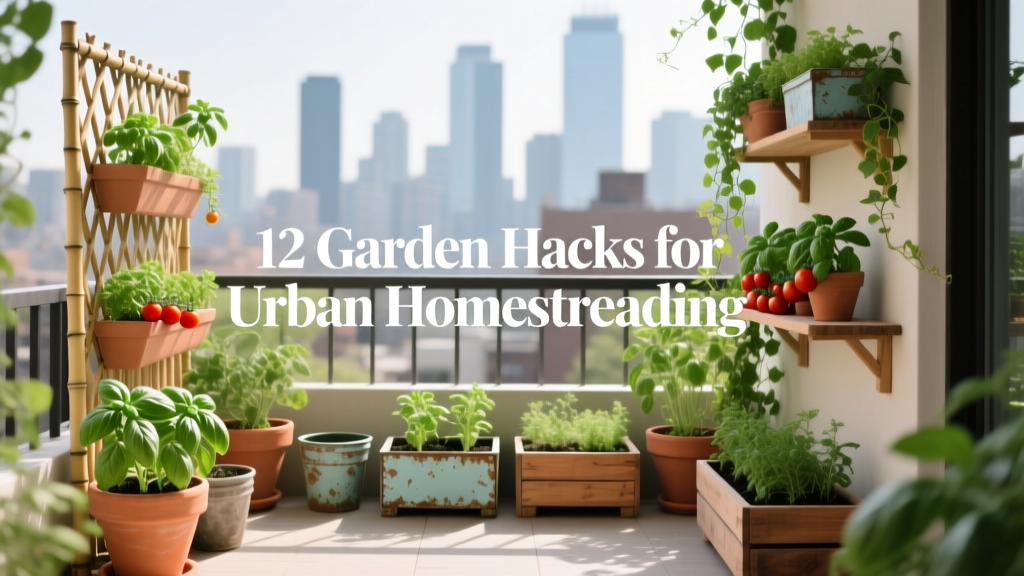
12 Garden Hacks for Urban Homesteading
The biggest urban homesteading mistake isn’t “not enough sun” or “not enough space”—it’s trying to garden like you have a backyard. On balconies and tight side yards, the usual tricks (big raised beds, daily hand-watering, sprawling compost piles) can quietly waste money, time, and your limited square footage. The good news: a handful of smart hacks can make a 6-foot fence line or a 40-square-foot patio feel like a mini farm.
Below are the shortcuts I’ve seen work over and over in apartments, row homes, and postage-stamp yards—specific, practical, and designed for people who want real food (and less fuss).
Space-Squeezing Setups (Big Harvests in Small Footprints)
1) Grow “up” with a $15 trellis and 6-inch planting strip
If you only have a narrow bed, stop planting everything in rows and start building vertical lanes. A simple 5–6 ft trellis (cattle panel piece, nylon netting, or even a bamboo A-frame) lets cucumbers, pole beans, and small melons use air instead of ground. Plant a single row just 6 inches from the trellis, then keep the rest of the bed for compact crops like lettuce or scallions.
Real-world example: In a 2 ft x 8 ft side-yard strip, one trellis lane of pole beans can replace the space you’d need for multiple bush bean rows—and you can still tuck basil and arugula along the sunny edge.
2) Use “salad gutters” for renters: 10-foot vinyl channels that hook onto railings
If your landlord hates planters on the ground, think like a roofer. A 10 ft length of vinyl rain gutter (with end caps and brackets) becomes a slim lettuce and herb bed that’s easy to remove at move-out. Drill drainage holes every 6–8 inches, fill with potting mix, and keep to shallow-rooted crops: cut-and-come-again greens, cilantro, and strawberries.
Cost hack: New gutters can run $12–$25 for 10 ft, but reclaimed pieces from salvage yards are often half that. You’ll harvest more per inch than most pots because the root zone stays evenly moist.
3) Plant in “modules” so you can rotate shade and sun like furniture
Urban light changes by season—trees leaf out, neighbors add awnings, buildings cast longer shadows. Use matching containers (like three 5-gallon fabric pots for tomatoes, four 2-gallon for peppers, and a few 1-gallon for herbs) so you can swap positions weekly. This prevents the classic mistake of leaving your fruiting crops stuck in the one corner that turns shady in July.
Case scenario: A balcony gardener in Chicago keeps tomatoes in 5-gallon fabric pots on rolling plant caddies ($8–$12 each). When afternoon shade hits in midsummer, the pots slide 3 feet to the brighter rail edge—no repotting, no heartbreak.
4) Build a “milk-crate bed” for roots: deep, movable, and cheap
Root crops fail in shallow pots, and large containers get pricey fast. Line a milk crate with burlap or landscape fabric, add 10–12 inches of soil mix, and you’ve got a deep planter for carrots, beets, and potatoes that drains well. It’s also easy to dump and refresh at the end of the season.
DIY soil mix: 2 parts potting mix + 1 part compost + 1 part coco coir (or shredded leaves). For potatoes, mound extra mix halfway through the season to encourage more tubers.
Water & Fertility Hacks (Less Work, More Consistency)
5) Install a gravity drip bucket: $20, no plumbing, no excuses
Hand-watering is the fastest way to swing between soggy and bone-dry containers. A 5-gallon bucket set on a stool, fitted with a cheap drip kit, can run two to four containers with steady moisture. Punch a hole near the base, add a barbed connector, and run 1/4-inch tubing to your pots.
Timing tip: Start drip for 10–15 minutes in early morning; adjust until the bottom of the pot just begins to drip. This hack is especially useful if your outdoor faucet is inside a shared laundry room or you don’t have one at all.
6) Use the “1-inch rule” with mulch—measured, not guessed
Mulch isn’t just for looks; it’s a water-stability tool. Spread 1 inch of shredded leaves or straw over containers and beds (keep it 1 inch away from stems). This reduces evaporation and buffers heat, which matters on concrete patios that cook roots.
Research-backed note: Mulches are widely documented to reduce soil moisture loss and moderate soil temperature—core reasons they improve plant performance in hot, exposed sites (USDA NRCS guidance, 2011).
7) Fertilize containers with a repeatable schedule: “weekly weakly” at 1/4 strength
Container soil nutrients wash out faster than in-ground beds, especially with frequent watering. Instead of occasional heavy feeding (which can burn plants), mix a liquid fertilizer at 1/4 the label rate and apply weekly. Tomatoes and peppers respond best when feeding is consistent—think steady snacks, not a buffet once a month.
Example: If the label says 1 tablespoon per gallon, use 3/4 teaspoon per gallon weekly. This keeps growth even and reduces blossom-end rot risk tied to stress swings.
8) Turn kitchen scraps into worm “tea” without stink: the 2:1 bedding rule
Urban compost piles can be a neighbor-drama magnet. A small worm bin under the sink or on a shaded balcony works cleanly if you keep 2 parts dry bedding (shredded cardboard, newspaper) to 1 part food scraps by volume. Bury scraps, avoid meat/dairy, and you’ll get castings for seed-starting and houseplants without odor.
Expert-backed: Many extension services recommend vermicomposting as an effective small-space method when traditional composting isn’t feasible (University of California Agriculture and Natural Resources, 2018).
“In small spaces, consistent moisture and a steady nutrient supply matter more than sheer soil volume. Containers can be wildly productive when you control those two levers.”
—Extension horticulture educator (summarized from container-vegetable guidance), 2019
Planting Tricks That Stack the Odds in Your Favor
9) Use succession planting by calendar, not vibes: every 14 days for greens
If you plant all your lettuce at once, you’ll get a one-week salad party followed by nothing. Sow a small pinch every 14 days in a 1–2 ft section (or one gutter channel) to keep harvests steady. For hot weather, switch to heat-tolerant greens like Malabar spinach and amaranth once nighttime temps stay above 70°F.
Case scenario: A family in Phoenix keeps three shallow tubs: one seeded every two weeks, one in mid-growth, and one harvesting. The result is consistent greens even when summer stress makes “one big planting” crash.
10) “Cut, don’t pull” herbs to triple yields (and prevent bolting)
Most people harvest basil and cilantro by yanking whole stems, which stunts the plant and triggers flowering. Instead, cut stems 1/4 inch above a leaf node so the plant branches into two shoots. Do this weekly and you’ll get a bushy herb plant rather than a sad stick.
Real-life example: One $3 basil start, pinched weekly, can fill a quart jar of pesto greens several times over a season—especially in a sunny window box.
11) Pollination hack for balconies: a $5 makeup brush beats “hoping”
Tomatoes and peppers usually self-pollinate, but balcony wind patterns can be weirdly still, and bees may be scarce 10 stories up. Use a small makeup brush or electric toothbrush to gently buzz flower clusters 2–3 times per week mid-morning. You’ll see more consistent fruit set, especially on sheltered balconies.
Comparison tip: If you’re growing in a screened porch or enclosed patio, hand-pollination is often the difference between pretty flowers and actual produce.
Protection & Problem-Solving (Because City Gardens Get Weird)
12) Control pests with “physical first”: mesh bags, collars, and timing
Sprays are messy in tight quarters—and drift is real when neighbors are close. Start with physical barriers: organza bags over brassica seedlings stop cabbage moths; cardboard collars around stems discourage cutworms; and fine insect netting over a hoop frame blocks flea beetles. Put barriers on at planting, not after you spot holes.
Specific timing: Cover brassicas immediately and keep covered until harvest; open only to weed or water. This aligns with integrated pest management approaches promoted by extension programs (Colorado State University Extension, 2020).
Quick Comparison: High-Yield Urban Methods (Pick What Fits Your Space)
| Method | Best for | Typical footprint | Watering effort | Approx. cost to start |
|---|---|---|---|---|
| 5-gallon fabric pots | Tomatoes, peppers, eggplant | 1.5–2 sq ft per pot | Medium (daily in heat) | $5–$10 per pot |
| Gutter “salad rails” | Lettuce, herbs, strawberries | 4–6 inches deep, 10 ft long | Low-medium (even moisture) | $12–$25 per 10 ft section |
| Gravity-fed drip bucket | Any container garden | Bucket + tubing | Low (set-and-check) | $15–$30 |
| Milk-crate planters | Carrots, beets, potatoes | 1–1.5 sq ft per crate | Medium | $0–$8 (often free crates) |
Three Urban Homesteading Setups That Actually Work
Scenario A: The 40-square-foot balcony (mostly sun). Use two 5-gallon fabric pots for tomatoes, one trellis pot for cucumbers, and two gutter rails for greens. Add a gravity drip bucket so you’re not hauling watering cans through your living room; it’s the difference between “fun hobby” and “daily chore.”
Scenario B: The shady side yard (3–4 hours of light). Skip fruiting crops and lean into leafy production: gutters for lettuce, milk crates for beets, and a vertical wall of shade-tolerant herbs (mint in its own pot, parsley, chives). Use a reflective surface (white fence panel or light-colored wall) to bounce light—small boost, but it adds up in narrow corridors.
Scenario C: The community-garden plot you only visit twice a week. Go vertical with trellises so harvesting is fast, mulch at a measured 1 inch to slow drying, and plant in modules (clusters) so drip lines or soaker hoses hit roots efficiently. Add succession planting for greens every 14 days so you’re not stuck processing 12 heads of lettuce at once.
Sources You Can Trust (and Use to Set Expectations)
Two resources worth keeping bookmarked for urban-scale decisions:
University of California Agriculture and Natural Resources (UC ANR), 2018 — practical guidance on composting and vermicomposting for small spaces and odor control.
Colorado State University Extension, 2020 — integrated pest management approaches emphasizing prevention and physical barriers, especially useful when spraying isn’t ideal in close quarters.
USDA Natural Resources Conservation Service (NRCS), 2011 — mulch and soil-cover principles that explain why measured mulch layers reduce evaporation and stabilize soil temperature.
Urban homesteading gets dramatically easier when you stop trying to out-muscle your space and start engineering it. Pick two hacks that solve your biggest pain points (usually watering and light), get those running smoothly, and the rest of the garden suddenly feels like it has breathing room—even if it’s perched on a third-floor balcony.