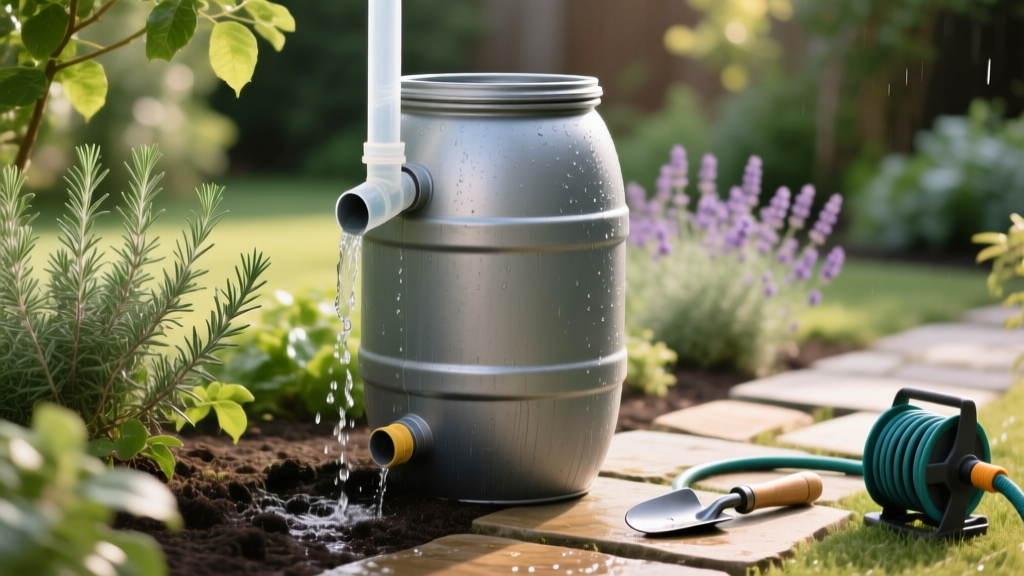
DIY Rain Barrel Setup for Water Conservation
A 1/2-inch rain on an average roof can dump hundreds of gallons of water you already paid to treat—then it disappears down the storm drain. The common mistake I see: people buy a barrel first, then try to “make it work” under a downspout that can’t feed it fast enough, overflows in the wrong place, or sits too low to be useful without a pump.
Let’s fix that with a setup that’s simple, reliable, and actually makes watering easier (not another chore). I’ll walk you through proven tricks I’ve used in real gardens—plus a few cheap DIY alternatives when the store-bought parts feel overpriced.
Plan the System Before You Buy Anything
Tip: Do the 5-minute roof math so you don’t undersize the barrel
Rain barrels fill fast—usually faster than people expect. A widely used rule of thumb is ~0.62 gallons per square foot per inch of rain, so a 500 sq ft roof section can shed about 310 gallons from a 1-inch rain (500 × 0.62). That means a single 55-gallon barrel can overflow in minutes during a decent storm, so plan overflow from day one.
Real-world example: If your downspout drains half your roof (say 600 sq ft), then 0.5 inches of rain is roughly 186 gallons—enough to fill three barrels back-to-back if you link them.
Tip: Pick the downspout that gives you “cleaner” water with less headache
Choose a downspout that drains a roof section away from overhanging trees and heavy leaf drop—less gunk means less clogging and less stink. If you can, avoid capturing runoff from roofs treated with moss killer, or from old roofing materials that shed grit. Also double-check local guidance: many extension services recommend using rain barrel water on ornamentals and gardens, not for drinking.
Case example: One suburban gardener I worked with moved their barrel from the “front” downspout (under a maple) to the “side” downspout (no trees). They stopped cleaning the screen every week and switched to once a month.
Tip: Put the barrel where gravity can do the work
Every foot of height adds usable pressure. A barrel sitting on the ground often gives a sad trickle; raise it 12–18 inches on a sturdy base so a watering can fills quickly and a hose has a chance. A typical full 55-gallon barrel weighs about 460 lb (55 × 8.34 lb/gal), so build the stand like it matters.
DIY alternative: A simple stand made from two layers of cinder blocks topped with a pressure-treated 2x10 platform is cheap and stable—just make sure the ground is level and compacted.
Parts That Actually Matter (and the Cheap Swaps)
Tip: Choose barrel material based on sun exposure (not just price)
Food-grade HDPE barrels (often blue) handle sun better than thin decorative barrels that go brittle. If it’ll sit in full sun, plan to paint it or wrap it to reduce algae and UV damage. You can often find used food-grade barrels for $20–$60, while decorative “rain urns” can hit $120–$250 for less capacity.
Real-world example: A community garden saved money by buying four used 55-gallon barrels at $35 each and spray-painting them dark green—same total storage as two fancy urns, for about half the cost.
Tip: Don’t skip a real spigot—upgrade the outlet size
Most kits come with a small plastic spigot that clogs and flows slowly. Install a 3/4-inch brass hose bib (or at least 1/2-inch) using a bulkhead fitting and washers so you can connect standard hoses. Put the spigot a few inches above the bottom (like 2–3 inches) to leave sediment behind.
DIY alternative: If bulkhead fittings feel pricey, you can use an electrical conduit locknut + rubber washers combo, but test for leaks with a full barrel before you trust it near a foundation.
Tip: Build in overflow like it’s the main feature
Overflow is not optional; it’s how you prevent erosion and basement leaks. Use a 1.25-inch or 1.5-inch overflow outlet near the top, then send that water via hose to a safe discharge area—ideally 6–10 feet from your house. If you’re linking barrels, route overflow from barrel #1 into barrel #2, and overflow from #2 to the yard or rain garden.
Case example: A townhouse owner had water pooling against the foundation every storm. Adding a 1.5-inch overflow hose aimed at a mulched bed fixed it immediately—no more muddy splash zone.
Installation Tricks That Prevent Leaks, Mosquitoes, and Clogs
Tip: Cut the downspout high enough to fit a diverter (and still clean it)
Measure twice: the barrel lid needs clearance, and you need room to remove the screen for cleaning. Most downspout diverters sit best when the cut is roughly 8–12 inches above the barrel inlet, depending on the model. Keep the cut accessible so you’re not fighting it with a ladder every time leaves pile up.
Real-world example: If your barrel top is 28 inches high and your stand is 16 inches, your barrel rim is 44 inches—cut the downspout around 52–56 inches so the diverter and elbow fit comfortably.
Tip: Use a first-flush approach—DIY is fine
The first water off the roof carries the most dust, pollen, and bird droppings. A first-flush diverter can improve barrel water quality by discarding the initial runoff—many DIY setups use a vertical PVC pipe that fills first, then a ball floats up to seal it. A practical sizing trick is 0.5–1.0 gallon per 100 sq ft of roof area feeding that downspout.
DIY alternative: For a 500 sq ft roof section, aim for 2.5–5 gallons of first-flush capacity (a 3-inch PVC pipe about 3–6 feet long depending on fittings). It’s not perfect science, but it’s a big step up from “straight into the barrel.”
Tip: Screen every opening like you mean it (mosquitoes will find it)
Use fine mesh screen (window screen or stainless mesh) over the inlet and any gaps around diverters. A single uncovered opening can become a mosquito factory within a week in warm weather. If you need an extra layer of protection, some gardeners use Bacillus thuringiensis israelensis (Bti) mosquito dunks—commonly used in rain barrels—following label directions.
Expert-backed note: Many extension services emphasize tight-fitting lids and screened openings as the first line of defense against mosquitoes.
Tip: Seal threaded fittings with the right tape and the right direction
Wrap Teflon tape clockwise (the same direction you’ll tighten the fitting), usually 6–10 wraps for coarse plastic threads. Hand-tighten, then snug gently—over-tightening cracks plastic and creates leaks that show up only when the barrel is full. If a fitting drips, drain below the fitting and redo it; don’t smear random caulk and hope.
Real-world example: A slow drip at the spigot can dump several gallons per day—enough to defeat the whole point of capturing rain.
Make the Water More Useful (Pressure, Hoses, and Distribution)
Tip: Skip the long hose run—use short, high-impact watering habits
Rain barrel pressure is limited, so long hoses and spray nozzles can be disappointing. Keep a 6–10 foot hose just for filling watering cans, then carry the can to beds—it’s often faster than wrestling with a limp hose stream. If you do want a hose, use 1/2-inch or larger, keep it short, and avoid restrictive quick-connects.
Case example: A patio gardener used barrel water to fill a 2-gallon watering can twice a day during a heat wave—quick, no pressure drama, and their containers never wilted.
Tip: For drip irrigation, plan on a pump (gravity rarely cuts it)
Most drip systems want stable pressure (often 10–25 psi depending on components), and gravity-fed barrels usually can’t supply it unless elevated significantly. A small utility pump can turn your barrel into a real irrigation source—budget $60–$140 for a basic pump. If you go this route, add a simple inline filter to protect emitters from roof grit.
Real-world example: A raised-bed gardener ran a small pump to feed a 1/2-inch mainline with drip tape; they watered three 4x8 beds in 20 minutes, twice a week, without touching the hose bib.
Tip: Link barrels at the bottom (equalization) or at the top (overflow)—choose intentionally
Bottom linking (a hose between spigots or lower bulkheads) equalizes water levels, so both barrels fill together—nice, but leaks can drain both. Top linking (overflow from #1 into #2) is simpler and keeps one barrel “primary.” If you’re a set-it-and-forget-it gardener, top linking is usually less fussy.
| Setup Choice | What It’s Best For | Watch-Out | Typical Cost (parts only) |
|---|---|---|---|
| Top-linked barrels (overflow into next) | Simple expansion, fewer fittings, easy troubleshooting | Barrel #2 fills only after #1 is full | $15–$35 (overflow hose + fittings) |
| Bottom-linked barrels (equalizing) | Max storage access, both barrels fill together | A leak can drain all linked barrels | $25–$60 (bulkheads + hose + clamps) |
| Pump-assisted irrigation | Drip lines, longer hoses, consistent watering | Needs power + filtration + winterizing | $60–$140 (pump) + $10–$25 (filter) |
Keep It Clean Without Babying It
Tip: Add a “calm inlet” to reduce stirred-up sediment
When water splashes in from the top, it churns sediment and sends it right toward your spigot. A calm inlet is just a short piece of tubing or an elbow that directs incoming water downward gently. Even a 1-inch flexible tube attached under the inlet screen can help keep the bottom sludge settled.
Real-world example: If you’ve ever filled a watering can and seen floating grit, a calm inlet plus a higher spigot placement usually clears it up.
Tip: Clean on a schedule tied to seasons, not guilt
Put barrel maintenance on the calendar: a quick screen check every 2–4 weeks during leaf season, and a full rinse-out 1–2 times per year. The fastest clean is right after you’ve emptied the barrel—swish with a broom and hose it out before the next rain refills it. Don’t use harsh cleaners; plain water and a scrub are enough for garden-use water storage.
Tip: Deal with algae by blocking light, not by fighting it later
If sunlight hits the water, algae will show up. Paint translucent barrels with dark exterior paint, wrap them with leftover landscape fabric, or build a simple wood slat screen around them with a few inches of airflow. Blocking light is cheaper than constantly unclogging green slime from screens and hoses.
Cost hack: A $10 can of exterior spray paint is often cheaper than replacing a $20–$30 screen kit you keep gumming up.
Safety, Rules, and “Don’t Learn This the Hard Way” Notes
Tip: Keep the barrel stable and away from foot traffic
A full barrel is heavy enough to hurt someone or crush plants if it tips. Place it on a flat, compacted base, keep it out of narrow walkways, and strap it to a wall or post if kids or pets barrel through the area. If your stand rocks at all when empty, it’s not safe when full.
Tip: Use captured rainwater appropriately
Rain barrel water is great for ornamentals, lawns, and most garden beds, but it’s not treated. Many university extension resources recommend using it for non-potable purposes and avoiding direct contact with edible portions of crops (especially leafy greens) close to harvest. If you want to use it in the veggie garden, aim it at the soil, not the leaves, and consider timing it earlier in the growth cycle.
“A rain barrel should always have a secure lid and screened openings to prevent mosquitoes, and the water collected should be used for non-potable purposes.” — University of Rhode Island Cooperative Extension, 2019
Citation: University of Rhode Island Cooperative Extension (2019), rain barrel guidance on mosquito prevention and non-potable use.
Citation: U.S. Environmental Protection Agency (EPA) (2023), watershed-friendly rainwater harvesting/stormwater reduction guidance and benefits of capturing roof runoff for reuse.
Three Real-World Setups You Can Copy
Scenario: Small patio garden (tight space, no hose pressure needed)
Use one 40–55 gallon barrel on a 12-inch stand, with a 3/4-inch spigot for fast watering-can fills. Add a simple inlet screen and route overflow into a nearby shrub bed with a 1.25-inch hose. The shortcut: keep a dedicated 2-gallon watering can next to the barrel so you actually use the water instead of dragging out a hose.
Scenario: Suburban backyard beds (you want real capacity)
Set up two used 55-gallon barrels: one primary under the downspout, the second fed by the first barrel’s overflow. Put both on level bases, and point final overflow to a mulched area 8 feet from the house. This setup often costs $120–$220 total using used barrels and DIY fittings, compared to $300+ for two decorative units plus kits.
Scenario: Raised-bed grower (drip irrigation goal)
Start with one barrel, but plan the pump and filter from the start: a small utility pump ($60–$140) + inline filter ($10–$25) + short hose run to a manifold. Put the pump on a paver next to the barrel so it stays dry, and use a timer if you want hands-off watering. The trick is accepting that gravity alone usually won’t make drip satisfying unless you can elevate the barrel significantly.
Smart Money-Savers That Don’t Cut Corners
Tip: Buy used barrels locally, but verify what was inside
Food-grade barrels are the sweet spot for price and safety. Ask what they previously held (common safe options include pickles, olives, syrups), and avoid anything that stored chemicals. A quick sniff test and a thorough rinse go a long way, but if the history is sketchy, walk away—another listing will appear.
Tip: Use downspout cleanouts to reduce maintenance time
If your downspout clogs often, add a removable section or cleanout near the barrel connection so you can pull debris without dismantling everything. This can be as simple as a short slip-joint section you can pop off. It turns an annoying 30-minute fix into a 2-minute shakeout after storms.
Tip: Spend your dollars on the fittings, not the decoration
The parts that prevent leaks and frustration are the bulkhead fitting, spigot, overflow outlet, and a solid screen. If you’re choosing where to spend, prioritize a good 3/4-inch spigot and reliable overflow routing over a fancy barrel shape. You can always dress up an ugly barrel with a quick wood screen or planter boxes later.
If you build your rain barrel like a system—roof math, stable stand, screened inlet, generous overflow, and a spigot that doesn’t annoy you—you’ll actually use it. The best setups aren’t complicated; they’re the ones that keep working through the first hard rain, the first leaf drop, and the first week you forget about it because the garden’s already getting watered for free.