5 Garden Hacks for Garden Safety
The fastest way to ruin a good gardening day isn’t a surprise weed jungle—it’s a “quick” task done without thinking. A huge share of garden injuries happen during routine chores (lifting a bag of soil, trimming a shrub, spraying a pest), not during dramatic mishaps. The good news: you don’t need expensive gear or a total yard makeover. A handful of small, repeatable hacks can cut the most common risks—strains, cuts, chemical exposure, heat issues, and tool accidents—without slowing you down.
Below are five safety hacks I’ve seen work in real backyards, community gardens, and small farms. Each one is designed to be practical: simple setup, obvious payoff, and easy to keep doing once you start.
Group 1: Tool & Workstation Safety (the stuff that bites back)
Hack #1: The “Two-Minute Tool Reset” (clean, sharpen, and park tools the same way every time)
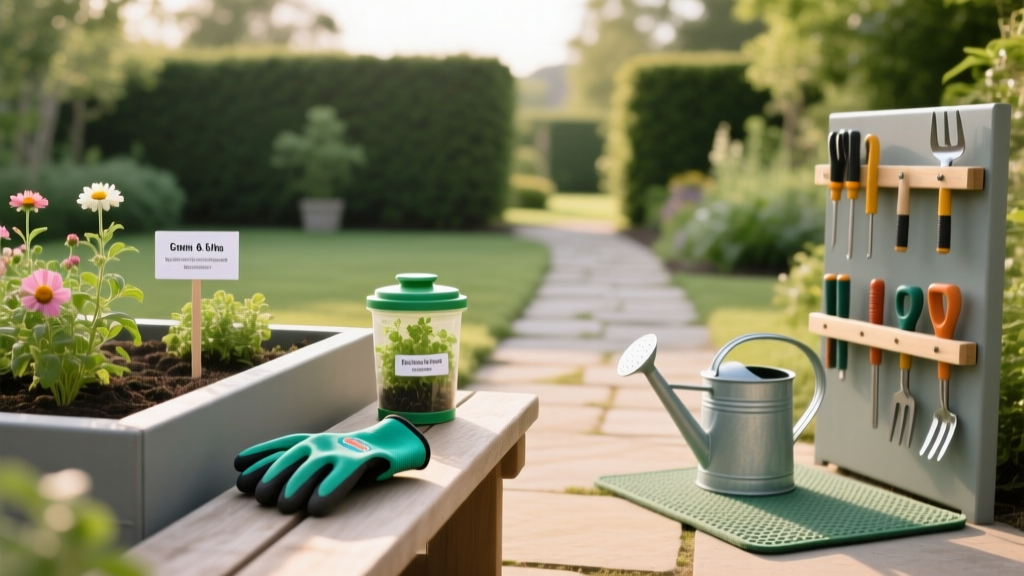
What to do: Keep a small “reset station” at the edge of the garden: a stiff brush, a rag, a spray bottle of 70% isopropyl alcohol, and a bright bucket or wall hook. After each session, brush off soil, wipe blades, spritz alcohol, then park tools in the same spot—handles up, blades down or sheathed. It takes about 2 minutes and prevents both infections (dirty tools) and injuries (stepping on a hidden rake).
Why it works: Soil and sap make tools slip; dull blades force you to push harder and lose control. Alcohol at 70% is widely recommended for disinfecting because it penetrates cell walls better than higher concentrations. For pruners, wiping between plants is especially helpful when you’re cutting anything that looks diseased.
Real-world example: A community garden plot I helped manage had “mystery punctures” from half-buried trowels and hand forks. After we added one neon bucket labeled “TOOLS LIVE HERE,” the incidents basically stopped—people weren’t setting tools in tall grass anymore.
Hack #2: The “Cut-Down Zone” for power tools (a 10-foot safety bubble plus a no-drop rule)
What to do: Before using a string trimmer, hedge trimmer, or chainsaw, place two cones, buckets, or bright flags to create a 10-foot radius “cut-down zone.” Nothing and no one enters that circle—especially kids and pets. Then add a “no-drop rule”: if you need to move something, you power down first; don’t set a running tool on the ground “for a second.”
Why it works: Most yard power-tool injuries come from small lapses—turning your head, backing up, or working too close to someone. A visible boundary turns “I think they’re far enough away” into a clear yes/no check.
Real-world example: One homeowner I know kept nicking irrigation tubing with a trimmer while edging. The safety bubble plus a quick walk-through (spot the drip lines first) prevented both injuries and a surprisingly expensive repair cycle (those tiny line fittings add up fast).
Group 2: Chemical & Exposure Safety (what gets on your skin and in your lungs)
Hack #3: Mix-and-label like a bartender: the “1-gallon rule” + a laminated recipe card
What to do: If you use any sprays—organic or synthetic—commit to mixing only what you’ll use in one session, and default to 1 gallon (3.8 L) batches unless you truly need more. Tape a laminated card to the shelf with your most common mixes (example: insecticidal soap, horticultural oil, herbicidal spot treatments) and the PPE required for each. Label every sprayer with the product name and date using painter’s tape.
Why it works: Over-mixing creates leftovers, and leftovers are where accidents happen: mystery liquids, wrong sprayer grabs, spills, and “I’ll just use this up” overapplication. Extension services consistently emphasize reading and following label directions for pesticide safety, including correct dilution, protective equipment, and storage (University of California Agriculture and Natural Resources, 2021).
DIY alternative: Instead of a dedicated labeled sprayer for every product, use one quality pump sprayer and a set of color-coded zip ties on the handle (red = herbicide only, blue = insect control, green = foliar feed). Costs about $3–$6 for a bag of ties and prevents cross-contamination.
Real-world example: A gardener I worked with accidentally used an herbicide sprayer on tomatoes because the bottle “looked like the other one.” After switching to painter’s tape labels + a red zip tie on the herbicide sprayer, they never repeated the mistake—saving a full season of plants.
“The label is the law. Most pesticide injuries come from not following label directions for mixing, application, and protective equipment.” — Extension pesticide safety guidance (University of California ANR, 2021)
Hack #4: The glove system that actually gets used (and costs less than replacing plants)
What to do: Stop relying on one “do-everything” glove. Keep three glove types in a small tote: nitrile disposables (chemicals/wet jobs), snug synthetic grip gloves (general weeding), and leather or thorn-resistant gloves (roses/brambles). Put them where you naturally exit—by the back door or shed latch—so you don’t have to “go find them.”
Why it works: People skip gloves when they’re uncomfortable or hard to grab. A simple system increases compliance, and that matters because cuts + soil exposure can lead to infection. The CDC notes that tetanus spores live in soil and can enter through breaks in the skin; keeping vaccinations up to date and preventing wounds are key prevention steps (CDC, 2020).
Cost reality: A box of 100 nitrile gloves often runs about $10–$18, and one pair can handle an entire spray session. Compare that to the cost of replacing just one shrub damaged by accidental overspray—or a medical copay from a preventable hand injury.
Quick comparison: safer spray handling choices
| Approach | Upfront cost | Leftover risk | Best for | Common mistake it prevents |
|---|---|---|---|---|
| Mix small batches (1-gallon rule) | $0 (behavior change) | Low | Most home gardens | Mystery leftover sprays |
| Dedicated sprayer per product | $15–$40 each | Very low | Frequent sprayers | Cross-contamination |
| One sprayer + color-coded ties/labels | $3–$6 + sprayer | Medium-low | Budget setups | Grabbing the wrong bottle |
Group 3: Body & Heat Safety (the slow injuries you feel later)
Hack #5: Set up a “no-lift garden” workflow with a $12 tarp and a 3-2-1 carry rule
What to do: Use a cheap tarp (often $10–$15) as a drag sled for mulch, soil, and debris. Instead of lifting and carrying bags repeatedly, slide them: place the bag on the tarp, fold one edge over the top like a taco, then pull. Add a simple “3-2-1 carry rule” for anything you must lift: 3 seconds to plan the path, 2 hands on the load, 1 smooth lift (no twisting).
Why it works: Twisting while carrying is where backs get cranky. Dragging keeps the load on the ground and reduces awkward repositioning. For bagged materials, it also prevents a common foot injury: dropping a 40-lb bag of soil on your toes because the plastic handle tore.
Real-world scenario: A small backyard gardener with a steep side gate was making three trips per mulch bag, fighting the wheelbarrow. Switching to a tarp drag reduced the whole job from “I’m sore for two days” to “just tired,” and it also kept mulch from spilling all over the pavers (less slipping hazard).
Extra safety boosters (small add-ons that make the five hacks stick)
Make “trip hazards” visible with a 5-minute neon audit
What to do: Walk your garden once a month with a roll of neon flagging tape or landscape marking paint. Mark anything you regularly trip over: low drip lines, rebar stakes, hose ends, uneven pavers, the edge of a raised bed. Then fix one item immediately (even if the rest wait), so the audit turns into action.
Example: In a school garden, we marked two sneaky offenders: a green hose crossing grass and a barely visible edging strip. A $4 pack of flagging tape reduced falls enough that volunteers stopped “joking” about the garden being an obstacle course.
Time your work like a pro: a “heat rule” that prevents dizziness and mistakes
What to do: In hot weather, do the risky tasks (ladder work, power tools, hauling) before 11 a.m., then switch to low-risk jobs (hand weeding, harvesting) later. Take a 10-minute shade-and-water break every 45 minutes when it’s truly hot and humid. Heat stress makes you clumsy—and clumsy is when blades, thorns, and chemicals win.
Real-world scenario: A gardener I know always edged the lawn in the late afternoon sun. After one near fall (dizzy + trimmer), they switched to early morning edging and kept afternoons for drip checks and picking. Same productivity, fewer “whoa” moments.
Use the “ladder alternative” rule for pruning: if it’s above your shoulders, switch tools
What to do: If a branch is above shoulder height, avoid stretching with hand pruners while on uneven ground. Use a pole pruner or pruning saw instead, or cut from the ground in smaller pieces. If you must use a ladder, place it on firm soil (not mulch), and keep your belt buckle between the rails—no side reaches.
DIY alternative: For small fruit trees, train branches lower over time with soft ties or weights so next year’s pruning stays within easy reach. This reduces ladder time to near zero.
Keep a “garden first-aid micro-kit” in the shed, not the house
What to do: Put a small waterproof container in the shed with: bandages, gauze, saline pods, tweezers, antiseptic wipes, and a pair of nitrile gloves. Add a tick remover if you’re in tick country. The trick is location: if supplies are indoors, people “finish the task” while bleeding or ignore a splinter until it’s a problem.
Cost reality: You can build a solid micro-kit for $15–$25, often less if you already have basics. It’s cheaper than replacing a ruined glove stash or losing a weekend to an infected thorn puncture.
Three quick case snapshots (how these hacks play out in real life)
Scenario 1: The rose-pruning puncture that turned into a week-long hassle
A gardener pruned roses bare-handed “just for a minute,” got a thorn puncture, and kept working in damp soil. Switching to the three-glove system (thorn gloves for roses, nitrile for wet cleanup) and keeping the first-aid micro-kit in the shed stopped that pattern—minor cuts got cleaned immediately instead of ignored.
Scenario 2: The sprayer mix-up that killed half a bed
One shared household sprayer was used for herbicide one weekend and “something for bugs” the next, with no label. Painter’s tape labels plus a dedicated red zip tie for herbicide-only use fixed it permanently. The extra cost was under $5; the savings was a whole season of avoided replanting.
Scenario 3: The back strain from “just one more bag”
A weekend mulch job turned into a back strain because bags were carried and twisted through a narrow gate. The tarp drag method plus the 3-2-1 carry rule reduced lifting dramatically, and the gardener started staging materials closer to the beds before opening bags. The result: fewer trips, less fatigue, and better footing.
A few final “insider” reminders that keep you safe without killing the fun
If you only adopt one habit, make it the tool reset station. Clean tools are safer tools, and parking them in one predictable place prevents the classic rake-to-the-shin moment.
If you use sprays, treat mixing like cooking: measure carefully, make small batches, label everything, and don’t rely on memory. The label directions exist for a reason, and extension guidance is consistent that correct mixing and PPE are central to preventing injuries (University of California ANR, 2021).
And don’t underestimate the slow stuff—heat, fatigue, and repetitive lifting are what turn a normal day into a painful week. A tarp, a simple timing rule, and gloves that are actually comfortable will do more for safety than buying a fancy gadget you won’t use.
Sources: Centers for Disease Control and Prevention (CDC), tetanus prevention guidance, 2020. University of California Agriculture and Natural Resources (UC ANR), pesticide safety and label guidance, 2021.