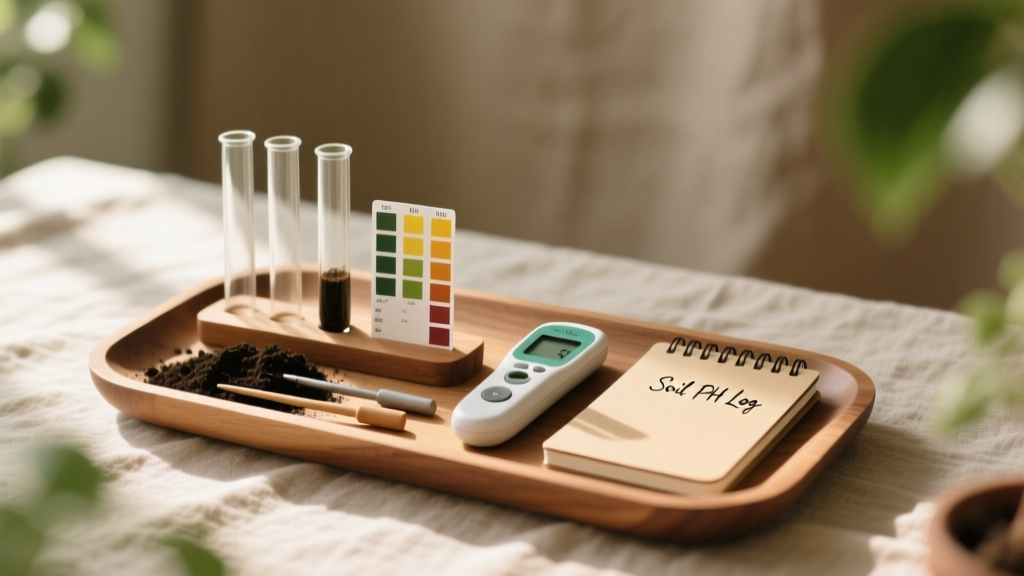
Making a Garden Soil pH Testing Log
A lot of gardeners spend money “fixing” pH that was never actually a problem—because they tested once, in one spot, on one day, and assumed it represented the whole yard. Soil pH can swing across a single bed by a full point (say 5.5 in one corner and 6.5 in the other) thanks to compost piles, old concrete, irrigation patterns, and even where the dog likes to hang out. The shortcut isn’t buying a fancier meter—it’s keeping a simple pH testing log that turns scattered readings into a pattern you can act on.
Think of your log as a garden’s medical chart: it tracks trends, not just “one-off” numbers. Once you’ve got a season of notes, you’ll know exactly which beds need lime, which need sulfur, and which just need you to stop messing with them.
Set Up a Log You’ll Actually Use
Tip: Pick one “master format” and stick to it
The best log is the one you’ll update when you’re tired, muddy, and rushing to dinner. Choose either a notebook, a printed sheet on a clipboard, or a spreadsheet—then commit for a full season so your data stays consistent. A simple one-page template per bed is plenty, especially if you include date, location, method, pH, and what you applied afterward.
Example: Keep a $2 spiral notebook in the shed and label a page “Raised Bed 1.” Every time you test, add one line: “4/18 — north end — slurry test — pH 6.2 — added 1” compost.”
Tip: Give every bed a name, not a vibe
“The tomato bed” stops being helpful the moment you rotate crops. Assign stable names like “Bed A,” “Bed B,” “Front Border 1,” or “Blueberry Row.” If you’ve got more than 6 areas, add a quick sketch map once and reference it in your log.
Example: “FB-2” might mean the second 20-foot front border; you’ll thank yourself next spring when you’re trying to remember which side hit pH 7.4 near the sidewalk.
Tip: Log the testing method every time (it matters more than people think)
Different testing methods can disagree by 0.2–0.5 pH units, which is the difference between “fine for peppers” and “iron chlorosis risk” for some plants. Record whether you used a mail-in lab, a colorimetric kit, a digital pen meter, or a probe meter. That way you’re comparing apples to apples across the season.
Example: If your cheap probe reads 7.0 but your extension lab report reads 6.4, your log will show the probe consistently runs 0.6 high—so you stop “correcting” a problem you don’t actually have.
Sampling Like a Pro (Without Turning It Into a Science Project)
Tip: Sample at the right depth for what you’re growing
Most vegetables feed heavily in the top 6 inches, so that’s your standard sampling depth for beds and borders. Trees and shrubs can justify a deeper composite sample (down to 8–10 inches) if you’re trying to diagnose ongoing issues. Write the sampling depth in your log so seasonal comparisons are fair.
Example: “Bed C — 6-inch depth composite.” If you only scraped the surface one day, you’ll know why that reading came back weird.
Tip: Take a composite sample, not a “one scoop truth”
For each bed or zone, collect 5–10 small subsamples, mix them in a clean bucket, then test that blended soil. This smooths out tiny hotspots (fertilizer bands, urine spots, compost pockets) that can throw your pH off. In your log, note the number of subsamples so you can trust the result.
Example: For a 4’ x 8’ raised bed, take 6 subsamples: four corners + two in the center strip, then mix.
Tip: Avoid testing right after you’ve applied amendments
If you test right after liming, fertilizing, or adding composted manure, your reading can reflect the amendment more than the soil’s settled condition. As a rule of thumb, wait 2–4 weeks after applying lime or sulfur before testing again, and log the waiting period. This is especially important if you irrigate heavily, which can move materials through the root zone faster.
Example: “5/1 applied pelletized lime; retest scheduled 5/29.” That one line prevents panic-testing every weekend.
Tip: Keep soil moisture consistent for repeatable readings
Many DIY kits and probe meters read differently in bone-dry soil versus evenly moist soil. Aim to test when soil is slightly damp (think “crumbly brownie,” not mud), or bring air-dried soil inside and test it the same way every time. Log the moisture condition: dry, moist, or wet.
Example: If July readings always look higher, your log might reveal you tested during drought—useful context before you start adding sulfur.
Choose Your Testing Method (And Track the Tradeoffs)
You don’t need lab testing every time, but you do need to know what your tool can and can’t do. The trick is mixing “cheap and frequent” checks with “accurate and occasional” lab baselines.
| Method | Typical cost | Time to result | Best use | What to log |
|---|---|---|---|---|
| Extension/soil lab test (mail-in) | $15–$40 per sample | 1–3 weeks | Baseline + lime requirement recommendations | Lab name, sample ID, buffer pH if provided |
| Colorimetric kit (liquid or strips) | $10–$20 | 5–15 minutes | Seasonal checks and quick comparisons between beds | Kit brand, color reading, lighting conditions |
| Digital pH pen (soil slurry) | $20–$80 | 2–10 minutes | Repeatable logging if calibrated | Calibration date, buffer values (pH 7.00/4.01) |
| Metal probe “stick in soil” meter | $8–$25 | 1–2 minutes | Rough trend only; not for decisions | Soil moisture level, probe cleaning notes |
Tip: Get a lab baseline at least once every 2–3 years
Home tests are great for trends, but labs give you the reference point—and often include buffer pH and lime requirement guidance that DIY kits can’t. Many gardeners waste money adding lime because they chase a number instead of following the soil’s buffering needs. Log lab results as “baseline,” then use cheaper tests to monitor drift.
Source note: University extension soil testing programs commonly recommend periodic lab testing to guide lime applications; for example, Penn State Extension emphasizes soil testing to determine lime needs rather than guessing (Penn State Extension, 2023).
Tip: If you use a digital pen, log calibration like it’s part of the reading
Digital pH pens are only as good as their calibration. Calibrate with pH 7.00 and pH 4.01 buffers every 2–4 weeks during the growing season (or any time readings seem “off”), and record the date in your log. Buffer powders are cheap—often around $10–$15 for a set that lasts months—and they save you from chasing phantom pH problems.
Example: “6/10 calibrated (7.00/4.01), slope OK.” Now you can trust the 6/12 reading enough to make a decision.
Tip: Use a soil slurry method for consistency (DIY-friendly)
For repeatable results with strips or a digital pen, mix 1 part soil with 1 part distilled water by volume (a 1:1 slurry), stir, wait 5 minutes, then measure. Distilled water costs about $1–$2 per gallon and removes the “my tap water is alkaline” variable. Record the ratio (1:1) and wait time so future tests match.
Example: If your tap water is pH 8.2, a slurry made with tap can read higher than reality; using distilled water keeps your log clean.
“Soil pH is one of those numbers people chase without context. The value of testing isn’t the single reading—it’s pairing pH with recommendations and tracking change over time.” — Extension soil testing guidance (University extension soil testing programs; see also Ohio State University Extension, 2019)
Log the Details That Explain the Number
Tip: Record what you added, how much, and exactly where
A pH log becomes powerful when it’s also an amendment log. Write down the product (dolomitic lime, pelletized sulfur, compost), the rate (cups, pounds, or scoops), and the bed section (“south half,” “along fence”). Without that, you’ll never know what actually worked.
Example: “Bed D, 4/2: 2 cups pelletized sulfur over 16 sq ft (north half only).” When the north half drops from pH 7.3 to 6.7, you’ll know why.
Tip: Track crop sensitivity right next to pH
Not all plants care equally. Blueberries want roughly pH 4.5–5.5; many vegetables do well around pH 6.0–7.0; lavender and many Mediterranean herbs tolerate higher pH. Add a “crop note” column so you don’t overcorrect soil that’s already fine for what you’re growing.
Example: If “Bed A” is carrots and beans, pH 6.8 may be perfectly workable; if it’s potatoes, you might aim closer to 5.2–6.0 to reduce scab pressure.
Tip: Note irrigation water source (it can quietly push pH up)
Well water in many areas is alkaline and high in bicarbonates, which can gradually raise soil pH—especially in containers and raised beds. Log whether you’re using rainwater, municipal water, or well water, and if you know it, jot down water pH or hardness. This turns “my bed keeps drifting up” from a mystery into a predictable trend.
Example: “Raised beds watered with well water all summer” is the breadcrumb you’ll want when pH creeps from 6.6 to 7.2 over two seasons.
Tip: Include a quick texture/organic matter note for better decisions
Sandy soils change pH faster than clay soils because they buffer less; high-organic soils can behave differently than mineral soils. You don’t need lab-grade texture analysis—just mark “sandy,” “loamy,” or “clayey,” plus “heavy compost” if the bed is basically half compost. This helps explain why the same lime rate worked in one bed but barely moved the needle in another.
Example: “Container mix (peat-based)” will respond faster to sulfur than “native clay with compost topdress.”
Timing Tricks That Make Your Log More Useful
Tip: Test on a schedule, not when something looks sad
Problem-based testing is how gardeners end up with random, unhelpful data. Pick two consistent windows: early spring (before major amendments) and fall (after the season settles). If you want a tighter loop, add a mid-summer check, but keep the dates roughly consistent year to year.
Example: “April 10 / July 15 / October 1” becomes your routine—three snapshots that reveal drift without obsessing.
Tip: Retest 8–12 weeks after big pH changes—not 8–12 days
Lime and sulfur don’t fully react overnight, especially in cool soil. If you retest too soon, you’ll see partial movement and be tempted to double-dose. Log the “retest date” when you record an application so you don’t sabotage your own results.
Example: You apply lime on March 20; schedule the next pH check for late May (about 10 weeks). That’s when you’ll see the real direction of travel.
Tip: Photograph the test result and store it with the log
Color charts can be subjective under different lighting. Snap a quick phone photo of the strip next to the chart in the same frame, then name it “BedB_2026-04-18_pH.” It’s a free, surprisingly effective way to reduce “I think it was greener last time?” arguments with yourself.
Example: If two readings look different on paper, the photos often reveal that one test was read under yellow porch light.
Three Real-World Scenarios (And How a Log Saves You)
Scenario: The concrete-edge bed that keeps turning alkaline
You’ve got a narrow border along a driveway or an old foundation, and chlorosis shows up on acid-loving plants. A pH log often reveals a consistent pattern: readings near the concrete are higher by 0.5–1.0 pH units compared to the center of the bed. Instead of acidifying the entire garden, you target just the affected strip and choose tolerant plants for the rest.
Example: Log shows “Border 1: 12 inches from sidewalk pH 7.6; 36 inches away pH 6.8.” You stop trying to grow blueberries in the hot zone and plant yarrow or salvias there instead.
Scenario: The raised bed that “mysteriously” swings every year
Raised beds built with fresh compost and peat-heavy mixes can drift as materials break down and as irrigation water accumulates minerals. With a log, you’ll see if pH trends up (common with alkaline water) or down (common with heavy ammonium-based fertilization). The fix becomes simple: adjust inputs, not panic-apply amendments.
Example: Your log shows pH 6.3 in April, 6.8 in October, repeating two years in a row. You switch to rainwater collection for half the season and the next year’s October reading lands at 6.5—problem solved without buying “pH down” products.
Scenario: The blueberry patch that never thrives
Blueberries are the classic pH trap: gardeners read “acid soil” and start dumping sulfur, but the patch still struggles because the pH never actually reached the right range—or it did briefly, then bounced. A log forces you to measure before and after, and to separate soil pH from issues like poor drainage or low organic matter.
Example: You test three spots in the row and log pH 6.4, 6.0, and 5.8. Instead of treating the whole row the same, you amend the high spot only and add 2–3 inches of pine bark mulch; next season, you log better growth where pH is consistently 5.2–5.5.
Money-Saving Moves (Because pH Fixes Can Get Expensive Fast)
Tip: Don’t buy “pH up/down” liquids for garden beds
Those products are often marketed for hydroponics or containers and get pricey when scaled to soil. For in-ground and raised beds, lime and elemental sulfur are usually the economical tools, applied based on testing and soil type. Your log helps you avoid repeat purchases by showing whether you’re actually moving the needle.
Cost reality check: A $20 bottle that treats a few gallons of solution is a poor deal compared to a $15–$25 bag of pelletized lime or sulfur that can treat hundreds of square feet, depending on rate and soil needs.
Tip: Use one lab test to calibrate your cheap method
If you love quick strip tests, great—just “anchor” them once with a lab result. When you run your strip test on the same composite sample you send to the lab, you’ll learn your kit’s bias (for example, it reads 0.3 high). Record that offset in the front of your log, and suddenly a $15 kit becomes a reliable trend tool.
Example: Lab says 6.2, strips say 6.5. You write: “Strip offset: +0.3.” Now your future strip reading of 6.8 likely means about 6.5.
Tip: Log “no action needed” as a win
The cheapest amendment is the one you don’t apply. If a bed tests pH 6.5 and your crops are thriving, write “No change” and move on—your log becomes proof that restraint works. This prevents the classic cycle of over-liming, then over-acidifying, then wondering why plants are stressed.
Example: “Bed F: pH 6.6, peppers healthy, no amendment.” That one line can save you $30 in unnecessary inputs over a season.
Make the Log Do the Thinking for You
Tip: Add a simple “action trigger” line for each crop group
Create a tiny rule set at the top of your log page so decisions are automatic. For example: “Vegetable beds: act only if pH < 5.8 or > 7.2. Blueberries: act if pH > 5.5.” These triggers stop you from reacting to normal variation.
Example: You see pH 6.9 in a tomato bed—your trigger says “no action,” so you don’t waste a Saturday spreading sulfur for no reason.
Tip: Mark results with a confidence score
Not every reading deserves equal trust. Add a quick “confidence” tag: High (lab), Medium (calibrated pen + slurry), Low (probe meter in dry soil). When you’re scanning old notes, you’ll know which readings should drive decisions.
Example: “pH 7.4 (Low—probe, very dry)” reminds you not to lime based on that number.
Tip: Review your log twice a year with one question: “Is this drifting?”
Trends are the whole point. In spring and fall, scan each bed’s last 3–5 readings and look for steady movement of 0.3 pH units or more in one direction. If it’s stable, celebrate and stop tinkering; if it’s drifting, match the drift to likely causes (water source, amendments, heavy fertilizer use).
Example: A bed that went 6.4 → 6.7 → 7.0 across 18 months is giving you an early warning—long before plants start yelling.
Soil pH testing gets a lot less confusing when your garden stops being “one number” and becomes a set of tracked zones with a history. Your first log page might feel almost too simple, but give it one season: you’ll start predicting what the next test will say, you’ll spend less on random fixes, and you’ll make amendments with the calm confidence of someone who’s seen the pattern before.
Sources: Penn State Extension soil testing guidance and lime recommendations (2023); Ohio State University Extension soil pH and nutrient availability resources (2019). For region-specific sampling procedures and interpretation ranges, check your local cooperative extension soil testing program, since recommended targets and methods can vary by state and soil type.