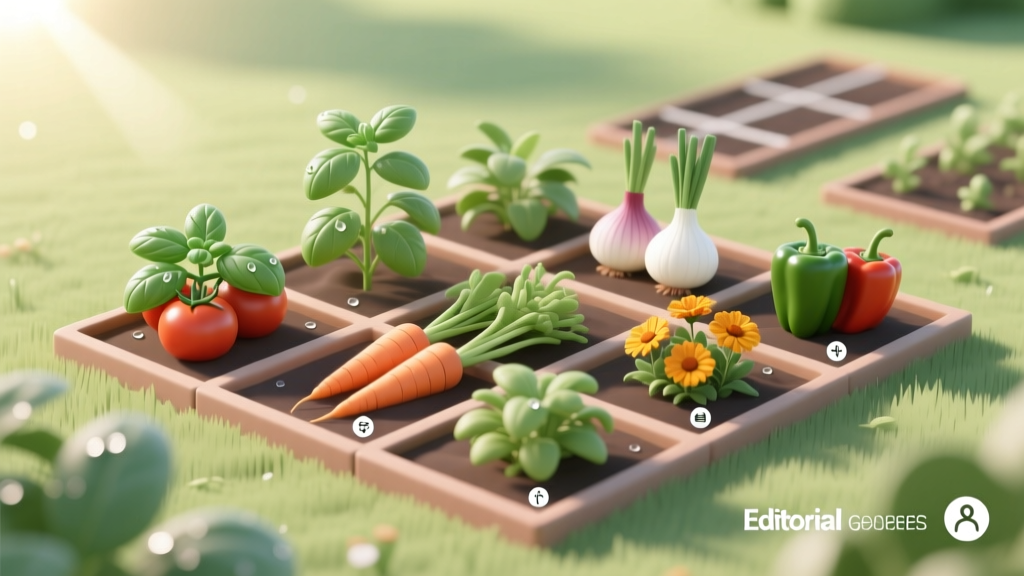
10 Garden Hacks for Companion Planting
Most companion planting “fails” for one boring reason: people plant the right partners at the wrong distance. A basil plant that’s 2 feet away from your tomato isn’t really “companion planting”—it’s just two plants sharing the same zip code. Once you tighten spacing, time plantings so blooms overlap, and use a few simple layout hacks, the results get a lot more consistent.
Below are 10 companion planting hacks I actually use (and see other gardeners use) when they want fewer pests, better pollination, and a garden that doesn’t require constant babysitting. No mystical plant friendships—just practical biology and smart placement.
Group 1: Layout hacks that make companions actually work
1) Close the gap: plant companions within 6–12 inches (not “nearby”)
Most companion effects (scent masking, attracting beneficial insects, confusing pests) are strongest at close range. As a rule, put “helper” herbs and flowers within 6–12 inches of the crop they’re meant to protect, especially for small-bed gardens. If you’re using a border, aim for a continuous ribbon rather than random singles.
Example: Tuck basil around tomatoes at 8–10 inches from the stem; you’ll get a denser scent barrier and it’s easier to harvest basil without stepping into the tomato jungle.
2) Use the “edge effect”: ring beds with insectary plants (cheap insurance)
Beneficial insects patrol edges first, so put your bug-attracting plants where they naturally cruise: bed borders and path edges. A simple ring of sweet alyssum, dill, cilantro, or calendula can pull in hoverflies and tiny parasitic wasps that go after aphids and caterpillars.
Cost hack: A packet of sweet alyssum seed is often $2–$4 and can cover a 20–30 ft bed edge if you sow a thin line.
3) Build “triads,” not pairs: crop + nectar + trap plant
Companion planting works better as a small system than as a two-plant romance. Combine: (1) your main crop, (2) a nectar plant that supports beneficials, and (3) a trap plant that takes the hit first. This gives you both prevention and early warning.
Example triad: Cabbage + dill (beneficial insect support) + nasturtium (often attracts aphids) so you can spot trouble before it reaches your brassicas.
4) “Split-planting” rows: alternate every 2–3 plants to break pest highways
Many pests move plant-to-plant down a row like it’s a buffet line. Instead of single-crop rows, alternate blocks of 2–3 plants: for example, 2 lettuces, 2 scallions, repeat. It’s fast to plant, still looks tidy, and forces pests to hunt.
Real-world scenario: In a 4x8 ft raised bed, alternate lettuce and green onions in short blocks. You’ll also harvest onions while lettuce is still going, opening space for a later crop.
Group 2: Timing hacks (because bloom windows matter)
5) Stagger “bodyguard blooms”: sow insectary flowers every 3 weeks
Beneficial insects need a steady nectar supply, not a one-week flower party. Sow quick bloomers (alyssum, cilantro, dill) in small patches every 3 weeks so something is always flowering. Think of it like keeping a café open all season.
Example: Start a 1 ft strip of cilantro at the bed edge, then another strip 21 days later. Let at least one patch bolt and bloom—flowering cilantro is a magnet for tiny beneficial wasps.
6) Plant the “decoy” first: trap crops go in 10–14 days early
Trap crops only work if they’re more appealing than your main crop when pests show up. Get them established 10–14 days before your target crop, so they’re larger and juicier when the first wave arrives. Then you can prune, handpick, or cover the trap crop while the main crop stays cleaner.
Example: Sow mustard greens early near kale to draw flea beetles. When the mustard gets shot-hole leaves, cover it with insect netting or yank and compost it before beetles migrate.
Group 3: Pest-control shortcuts (with companion planting doing the heavy lifting)
7) Use onions as a “scent zipper” between carrots and pests
Carrot rust fly and some aphids locate plants partly by smell. A simple “scent zipper” row of scallions or chives between carrot rows can reduce how easily pests find the carrots. Keep the onion row tight and continuous rather than scattered.
Spacing hack: Plant carrots in bands, then a band of scallions every 12 inches. Harvest scallions young to thin the line naturally.
“Many beneficial insects require pollen and nectar as adults, even if their larvae are predators. Continuous bloom is one of the most practical ways to support them in home landscapes.” — UC ANR, Integrated Pest Management guidance (University of California Agriculture and Natural Resources, 2020)
8) Pair brassicas with “tiny-flower” herbs to recruit parasitoids
Cabbage worms don’t just vanish because you planted a marigold. What actually helps is recruiting parasitoid wasps that target caterpillars—and they love small, accessible flowers (think dill, cilantro, alyssum). Put these herbs 6–12 inches from brassicas and let some bloom.
Citation: Penn State Extension notes that flowering plants like dill, fennel, and sweet alyssum help support beneficial insects in gardens (Penn State Extension, 2019).
9) Turn nasturtiums into a “pest check engine light” (and act fast)
Nasturtiums often attract aphids, which sounds bad until you use it as an early-warning system. Plant them at the corners of beds or at the end of rows; check them twice a week. If they’re covered, you can blast with water, pinch off infested tips, or treat the nasturtium—not your whole crop bed.
Real-world scenario: If your nasturtium is swarming with aphids in June, you’ll often find the first aphid colonies there instead of on your peas or kale. Removing two nasturtium stems can be easier than battling aphids across 30+ crop plants.
Group 4: Soil and space hacks (companions that pull double duty)
10) Plant “living mulch” under tall crops: clover or alyssum, cut at 4 inches
Instead of bare soil, use a low companion as living mulch under tall plants like tomatoes, peppers, okra, or corn. White clover can fix nitrogen over time, and alyssum can bring in beneficials—both can shade soil and reduce splashback disease. Keep it from competing by trimming to about 4 inches tall with scissors every couple of weeks.
DIY alternative: If you don’t want living plants, use chopped leaves or straw at 2–3 inches deep; it’s not companion planting, but it mimics the “soil armor” benefit with zero competition.
Quick comparison: pairs vs. systems (what usually works better)
| Approach | What you do | When it shines | Common failure |
|---|---|---|---|
| Simple pair | Plant two “compatible” crops near each other | Small gardens, easy planning, quick wins (e.g., basil + tomato) | Too much distance (effects diluted) or mismatched timing (no blooms when needed) |
| Triad/system | Main crop + nectar plant + trap plant | Reliable pest management, better pollinator support | Trap crop planted too late, so pests hit the main crop first |
| Border/insectary ring | Continuous flowering edge around beds | Multiple crops in one area, low effort once established | Single bloom period (nothing flowering mid/late season) |
3 real garden setups (steal these plans)
Scenario A: The 4x8 raised bed “salad and salsa” setup
Plant 2 tomatoes on the north side, then tuck basil at 8–10 inches from each tomato. Edge the bed with sweet alyssum and add a few scallion clusters between lettuce blocks to break up pest movement. Sow a small patch of cilantro every 3 weeks so something is flowering once summer heat hits.
Scenario B: A small brassica bed that doesn’t become caterpillar central
Plant kale/cabbage in a tight grid, then place dill or cilantro plants within 6–12 inches and let at least one go to flower. Add nasturtiums at the corners as your “check engine light” for aphids. If you’re doing a trap crop, sow mustard greens 10–14 days earlier at the bed edge and cover it if flea beetles show up.
Scenario C: Patio containers where every inch matters
In a 10–15 gallon tomato container, underplant with basil and a small alyssum start on the rim side (so it can spill over and not crowd roots). In a separate pot, grow dill or cilantro and let it flower nearby—containers still count if they’re within a couple feet. If aphids appear, treat the “sacrificial” nasturtium pot first rather than spraying everything.
Two science-backed reality checks (so you don’t waste a season)
Reality check #1: Companion planting isn’t a force field. It works best as part of an IPM-style plan—good spacing for airflow, consistent harvest, and quick response when pests spike. UC ANR’s IPM program emphasizes combining tactics rather than relying on a single method (UC ANR, 2020).
Reality check #2: Flowers are not decoration; they’re infrastructure. Extension guidance consistently points out that beneficial insects need nectar/pollen resources, and small-flowered plants are especially useful for many tiny natural enemies (Penn State Extension, 2019).
Money-saving companion planting swaps (because plants aren’t free)
If you’re tempted to buy a flat of flowers, pause—many of the best companion plants are also kitchen herbs you can grow from seed for cheap. A $3 seed packet of dill or cilantro often beats a $6–$12 six-pack of ornamentals, and you’ll harvest food plus flowers for beneficials.
Also, don’t overlook “volunteer” companions: let one cilantro, arugula, or mustard plant bolt and bloom. It costs $0, feeds beneficial insects, and you can still pull it anytime if it gets in the way.
Keep it simple: a fast weekly routine (5 minutes, big payoff)
Twice a week, check your trap plants (nasturtium/mustard) first, then scan the underside of 5 random crop leaves. If you spot a pest surge, act on the trap plant immediately—pinch, blast with water, or cover—before it spreads. That tiny habit is what turns companion planting from “cute idea” into an actual labor-saving system.
Companion planting doesn’t need to be complicated to be effective. Tighten your spacing, keep something blooming on purpose, and treat trap crops like your early-warning dashboard—and you’ll spend less time reacting and more time harvesting.