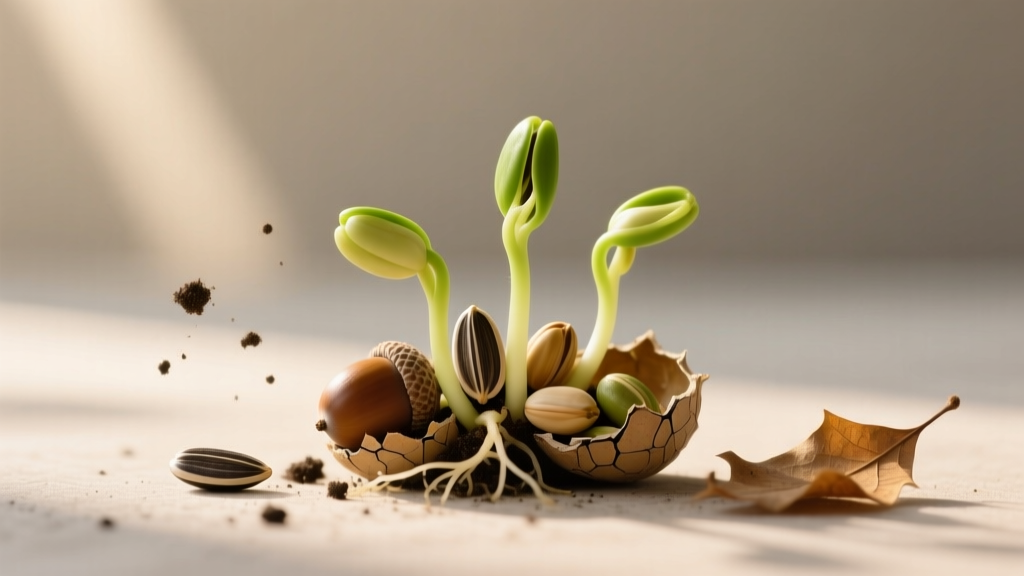
The Secret to Faster Germination for Hard Seeds
The #1 reason “easy” seeds refuse to sprout isn’t bad luck or old packets—it’s that many seeds are built like tiny safes. Hard-coated seeds (think morning glory, sweet peas, nasturtium, lupine, many trees and shrubs) are designed to not let water in until conditions are right. The common mistake is treating them like lettuce: sow, water, wait… and watch nothing happen for 2–6 weeks.
The shortcut is simple: you’re not “boosting germination” as much as you’re unlocking the seed coat. Do that well, and you can turn a 21–30 day wait into 3–10 days for many species—often with tools you already own.
Below are the tried-and-true ways gardeners (and seed labs) coax hard seeds to wake up fast, organized by what’s actually happening to that tough coat: scratching it, cracking it, heating it, or chemically softening it—plus what to do right after so you don’t lose the gains.
First: Confirm you’re actually dealing with a “hard seed” problem
Tip: Do the 60-minute “sink test” to spot water-resistant seed coats
Drop 10 seeds into room-temp water (around 68–72°F / 20–22°C) and wait 60 minutes. If most still float and look unchanged, they’re likely not taking up water; that’s classic physical dormancy. If they swell noticeably, your issue is probably temperature, oxygen, or old seed—not coat hardness.
Example: Sweet pea seeds often stay hard and buoyant after an hour unless scarified; beans usually sink and swell quickly with no special treatment needed.
Tip: Check the packet for time clues (the “14+ day warning”)
Seed packets that say “germinates in 14–30 days” for otherwise vigorous annuals are quietly telling you dormancy is involved. Morning glory listed at 14–21 days almost always pops in under a week when properly scarified. Use the packet’s long timeline as a hint to intervene.
The fastest wins: Scarification (scratch the coat so water can enter)
Tip: The 10-second sandpaper scuff (best all-around method)
Rub each seed lightly on 120–220 grit sandpaper until you see a tiny dull spot (you’re thinning the coat, not grinding the seed). Aim for one scuffed “window” per seed; stop before you expose the embryo. Then soak in water for 4–12 hours and sow immediately.
Example: For lupine, a single scuff often cuts germination time from ~2–3 weeks to 5–10 days. A $3 sheet of sandpaper does hundreds of seeds—cheaper than buying pre-treated seed.
Tip: The nail clipper nick (for big seeds like sweet pea, canna, hyacinth bean)
Use clean nail clippers to snip a pinhead-sized notch in the seed coat—avoid the “eye” (hilum) where the embryo is most vulnerable. You’re creating a doorway for water; too deep can rot the seed. After nicking, soak 6–10 hours, then sow.
Scenario: You’re planting sweet peas for an early trellis: nick + overnight soak often yields sprouts in 4–7 days instead of the two-week stretch that makes people think they “failed.”
Tip: The jar-and-grit shake (batch method for 50–200 seeds)
Put seeds in a jar with 1–2 tablespoons of coarse sand or fine aquarium gravel; shake for 30–60 seconds. Check a few seeds—look for small scuffs, not cracks. This is a fast way to prep cover-crop legumes or big pollinator patches without doing each seed by hand.
Example: If you’re sowing 100+ redbud or honey locust seeds, this batch scuffing saves you 20 minutes of individual nicking.
Heat tricks: Soaking and hot-water treatments (soften coats without tools)
Tip: The “hot tap start” soak (simple and surprisingly effective)
Pour hot tap water over seeds (target about 120–130°F / 49–54°C—hot but not boiling), then let them cool and soak for 12–24 hours. Discard floaters that remain rock-hard after a day; they often need scarification. This works well for many ornamentals and some perennials where you don’t want to nick dozens of seeds.
Cost note: Essentially free—just a mug and water—compared with $6–$12 for small packets of pre-scarified specialty seed.
Tip: The “near-boil pour” for truly stubborn coats (use carefully)
Bring water to a boil, remove from heat for 1 minute, then pour over seeds and soak as it cools for 12–24 hours. This is a classic method for some trees/shrubs with physical dormancy, but it can cook sensitive seeds if you skip the cool-down minute. If you try this, do a small test batch of 10 seeds first.
Example: Many gardeners use this for black locust or Kentucky coffeetree; it’s often the difference between patchy sprouting and a tray of uniform seedlings.
Tip: Use timing as your “thermostat” (shorter is safer)
If you can’t measure temperature, control time: start with a 4-hour soak in warm water and extend to 12 hours only if seeds are still hard. Over-soaking can deprive seeds of oxygen, especially in warm rooms. When in doubt, scarify lightly and use a shorter soak.
Chemical softening (a lab trick you can do at home—carefully)
Tip: Hydrogen peroxide pre-soak (cheap, multipurpose, and beginner-friendly)
Soak hard seeds in a 3% hydrogen peroxide solution (the standard pharmacy bottle) for 10–30 minutes, then rinse and plant. It won’t replace scarification for the toughest coats, but it can speed hydration and reduce surface pathogens. A $1–$3 bottle covers many batches and doubles as a tool-cleaning disinfectant.
Scenario: If your seed-starting setup tends to get damping-off, a short peroxide dip before sowing nasturtium can reduce losses while you’re already speeding germination.
Tip: Skip the sulfuric acid hacks (effective in research, risky in kitchens)
Some academic protocols use concentrated sulfuric acid to scarify extremely hard legumes, but it’s not a casual home method. The risk to eyes, skin, and surfaces is real, and disposal is a headache. For home gardeners, sandpaper + hot-water soak gets you most of the benefit without the hazard.
“Scarification breaks or weakens the seed coat and allows water to enter, which is essential for germination in many species with physical dormancy.”
—University extension guidance on seed dormancy and scarification (e.g., NC State Extension, 2020)
Match the method to the seed: a quick comparison table
Not all hard seeds respond the same way. Use this as a practical starting point, then adjust based on what you see (swelling, cracking, or stubborn floaters).
| Method | Best for | Time needed | Tools/cost | Risk level |
|---|---|---|---|---|
| Sandpaper scuff | Most hard-coated flowers/legumes (morning glory, lupine) | ~10 sec/seed + 4–12 hr soak | $3 sandpaper sheet | Low (if you stop at a dull spot) |
| Nail clipper nick | Large seeds (sweet pea, hyacinth bean, canna) | ~15 sec/seed + 6–10 hr soak | Free (clippers) | Medium (too deep can kill embryo) |
| Jar-and-grit shake | Big batches (50–200 seeds) | 1–2 min per batch + soak | Free–$5 gravel | Medium (can crack brittle seeds) |
| Hot tap soak (120–130°F) | Moderately hard coats; when you lack tools | 12–24 hr | Free | Low |
| Near-boil pour | Very hard tree/shrub seeds | 1 min cool-down + 12–24 hr soak | Free | High (can overheat sensitive seeds) |
After scarifying: lock in speed with the right sowing conditions
Tip: Plant immediately after soaking (the “24-hour rule”)
Once a hard seed finally takes up water, it transitions from “sleep mode” to “active mode”—and it’s more vulnerable to drying out. Sow within 24 hours of soaking/scarifying, ideally the same day. If you must wait, keep seeds wrapped in a barely damp paper towel in a sealed bag for up to 24 hours (not longer) so they don’t suffocate or mold.
Example: Morning glory seeds that were scuffed and soaked but left on a counter overnight often re-harden and stall; those planted right away usually sprout fast and evenly.
Tip: Use a measured moisture target: “damp sponge,” not “mud”
Your seed-starting mix should feel like a wrung-out sponge—moist but not dripping. A practical measure: if you squeeze a handful hard, you should get 0–2 drops of water. Waterlogged cells reduce oxygen and can rot newly hydrated seeds faster than you’d expect.
Tip: Hit the germination temperature window with a heat mat timer
Most hard-coated ornamentals still prefer warm soil: 70–80°F (21–27°C) is a sweet spot for many annual vines and legumes. If you use a heat mat, put it on a simple outlet timer: 16 hours on / 8 hours off often prevents overheating and saves electricity. Even a $15 timer can reduce your power use compared to running a 20W mat 24/7.
Money math: A 20W mat running nonstop uses ~0.48 kWh/day; at $0.20/kWh that’s about $0.10/day. Cutting 8 hours saves ~33%.
Tip: Don’t bury hard seeds too deep after scarifying
A newly hydrated seed needs oxygen; deep planting in heavy mix can slow or stop emergence. A good rule: plant at 2–3× seed thickness, not length. For sweet pea, that’s often about 1/2 inch (1.3 cm); for morning glory, closer to 1/4 inch (0.6 cm) in a fine mix.
Three real-world scenarios (and what actually works)
Scenario 1: Morning glory that “never germinates” in cool spring soil
Fix: Scuff each seed with 220-grit sandpaper, soak 6 hours, then start indoors at 75°F (24°C). Use small pots so you can transplant without disturbing roots, and move them out once nights stay above 50°F (10°C). This avoids the common trap of sowing into 55–60°F (13–16°C) soil where they sit, hard and dormant.
Result you can expect: Sprouts in roughly 4–8 days instead of 14–21, with a much tighter window so you don’t get a few early bullies and many late stragglers.
Scenario 2: Sweet peas that rot after soaking
Fix: Don’t do a long soak without scarification. Nick with clippers, then soak only 6–8 hours (not overnight if your room is warm), and sow into a gritty mix with extra perlite (aim ~3 parts mix to 1 part perlite by volume). If your indoor temps are high, germinate at 60–65°F (16–18°C); sweet peas like it cooler once hydrated.
Why it works: Long soaks + warmth can deprive oxygen and encourage rot; a nick speeds uptake so you can shorten the soak and keep seeds healthier.
Scenario 3: Tree/shrub seeds that sprout “whenever they feel like it”
Fix: Combine methods: quick mechanical scarification (jar-and-grit shake 30–45 seconds) followed by a hot-water soak. For some woody legumes, this mimics natural abrasion and temperature swings. Then sow in deep cells and be patient—some species have both a hard coat and internal dormancy that needs weeks of cold stratification.
Reality check: Scarification solves physical dormancy, but it won’t override embryos that require a cold period (common in many perennials and woody plants).
DIY shortcuts that save money (and work just as well)
Tip: Use a thrift-store nail file instead of sandpaper
A $1 emery board gives you control and reduces the chance of over-scuffing compared with loose sandpaper. It’s especially handy for round, slippery seeds like nasturtium. Keep one labeled “seed only” so you’re not introducing oils or residues.
Tip: Make a “soak station” with a muffin tin
Use a labeled muffin tin to soak multiple varieties without mix-ups—each cup holds 10–20 seeds. Add enough water to cover seeds by about 1/2 inch (1.3 cm) so they stay submerged even as they swell. This prevents the classic disaster of mystery seedlings because someone moved your cups.
Tip: Swap seed-starting mix for a paper towel sprout test (before you sow a whole tray)
After scarifying, place 10 seeds in a damp paper towel inside a zip bag and keep it warm. Check at 48 hours, then daily; as soon as roots appear (often 1–3 mm), transfer carefully to mix. This costs pennies and tells you fast whether your treatment worked before you commit a full flat.
Common mistakes that quietly slow “fast” methods
Tip: Don’t scarify and then let seeds dry back out
A scuffed seed coat is like an open door; if it dries hard again, it can re-seal or stress the embryo. Prep seeds right before planting day, not three days ahead. If life happens, keep them barely damp and cool for a short window (again: think hours, not days).
Tip: Avoid sealing soaked seeds in an airtight jar with no airflow
Seeds respire—they need oxygen. If you soak in a lidded jar, crack the lid or use a breathable cover (coffee filter + rubber band) during long soaks. That simple change can reduce the sour smell and slimy coating that signals oxygen trouble.
Tip: Stop blaming “old seed” until you’ve tested viability
Hard seeds can stay viable for years, but they look dead because they won’t imbibe water. Do a quick test: scarify 10 seeds and germinate them on a paper towel at the right temperature. If 7 out of 10 sprout, your seed is fine—you just needed the key.
What the research and extension folks agree on (in plain English)
University extension resources consistently describe physical dormancy as a water-entry problem that scarification solves. For example, NC State Extension materials on seed dormancy and scarification explain that weakening the seed coat allows water uptake, a prerequisite for germination (NC State Extension, 2020). The University of Minnesota Extension also outlines mechanical scarification and hot-water treatments as standard approaches for hard seeds, emphasizing careful technique to avoid embryo damage (University of Minnesota Extension, 2019).
On the research side, classic work on physical dormancy in legumes and other families has documented that hardseededness is widespread and that scarification is a reliable trigger for germination by permitting imbibition (Baskin & Baskin, 2014). That’s why the “secret” feels so dramatic: you’re not adding fertilizer or magic juice—you’re flipping the physical switch that lets the seed start.
A simple “pick your method” cheat sheet (use this next planting day)
Tip: If the seed is big enough to hold, nick it; if it’s small, sand it
Large seeds (sweet pea, hyacinth bean, canna) are easiest to clip-nick with good control. Smaller hard seeds (morning glory, lupine) are safer with sandpaper because you’re less likely to cut too deep. This one rule prevents most beginner scarification mishaps.
Tip: If you’re sowing outdoors, pre-sprout indoors to beat slugs and cold soil
Hard seeds that germinate slowly outdoors are easy slug bait and often stall in cool ground. Scarify + soak + 2–4 days in a warm baggie sprout test, then transplant tiny seedlings into the garden. You’ll spend maybe $0.10 on a bag and paper towel, and you’ll stop donating seeds to spring weather.
If you take nothing else: hard seeds don’t need pep talks—they need a tiny breach in the armor and a short, controlled soak. Do that, plant promptly, and keep the medium “wrung-sponge damp,” and you’ll start seeing the kind of fast, even germination that makes seed-starting feel like a cheat code instead of a waiting game.