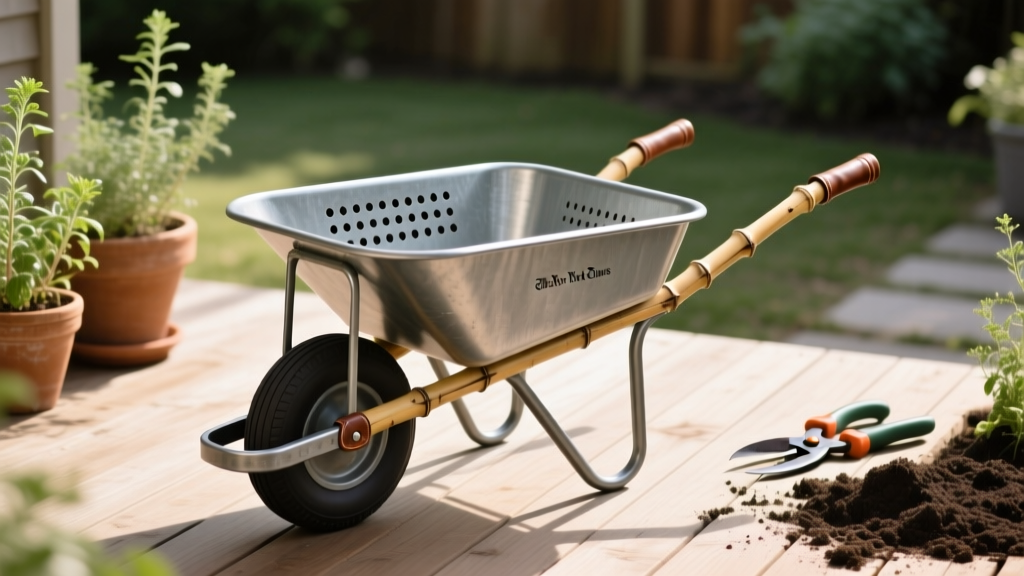
DIY Garden Wheelbarrow Upgrade
A surprising number of “wheelbarrow problems” aren’t caused by the load—they’re caused by tire pressure. A half-flat tire turns a 120 lb pile of mulch into a wrist-twisting, shoulder-burning chore, and most gardeners don’t notice until the barrow is already veering into the tomatoes. The good news: a few targeted upgrades (many under $15) can make your wheelbarrow roll straighter, dump cleaner, and last years longer.
This isn’t about buying a new wheelbarrow. It’s about turning the one you already own into a smoother, safer, more efficient garden hauler with a handful of DIY tweaks you can do in an afternoon.
Start with the “rolling system”: tire, axle, and balance
Tip: Set tire pressure with a real number, not a thumb guess
Most single-wheel wheelbarrow tires perform best in the 28–35 PSI range (check the tire sidewall for the exact max). Under-inflation increases rolling resistance and makes the barrow pull to one side, especially on slopes or rutted paths. Keep a $12 pencil gauge in the garage and top up monthly during peak season—air loss is normal.
Real-world example: After inflating from ~15 PSI to 30 PSI, a gardener hauling four 2 cu ft bags of mulch (~80–100 lb total) often notices the wheelbarrow tracks straighter and feels “lighter” because the tire isn’t squishing flat each rotation.
Tip: Switch to a no-flat option where punctures are guaranteed
If you’re constantly rolling over thorns, goatheads, or construction debris, a foam-filled or solid “no-flat” tire can save your sanity. A typical 4.80/4.00-8 no-flat wheel assembly runs about $35–$60, versus $15–$25 for a pneumatic replacement—more upfront, but fewer mid-job failures.
DIY alternative: If your current tire is fine but puncture-prone, add tire sealant (usually 8–12 oz per wheel) and remove the valve core to inject it. Sealant is a good compromise for gardeners who want the cushy ride of air without weekly patch jobs.
Tip: Grease the axle once a season (yes, even “cheap” barrows)
Squeaks and wobble often come from a dry axle, not a “bad wheelbarrow.” Pull the cotter pin, slide the wheel off, wipe grit away, and apply a thin coat of waterproof grease before reassembling. Ten minutes of maintenance can prevent the bearing area from grinding into an oval over time.
Scenario: If your wheel squeals only when loaded, it’s a classic sign the axle is dry and binding under compression—grease fixes it more often than replacing parts.
Tip: Add counterbalance for heavy, dense loads
When hauling rocks, wet soil, or sand, your forearms do too much lifting because the load sits forward of the wheel. A simple counterweight mounted behind the wheel (under the tray, near the handles) reduces the “lever arm” effect. Start with 2–5 lb (a small gym plate or a steel bar bolted through existing holes) and adjust—too much counterweight makes dumping harder.
Real-world example: For a wheelbarrow that constantly “nose-dives” when you pause, adding a 3 lb weight behind the wheel can make set-downs steadier and reduce wrist strain during stops.
Make it comfortable: handles, grips, and control
Tip: Upgrade grips with hose + tape for less hand fatigue
Hard plastic grips get slick with sweat and chew up gloves. Slide 8–10 inches of old garden hose over each handle and wrap the ends with athletic tape or self-fusing silicone tape. The thicker diameter spreads pressure across your palm and gives better control when you’re steering one-handed.
Cost: Often $0 if you’re using scrap hose; even buying tape, you can do this for $5–$10.
Tip: Fix handle height without replacing the wheelbarrow
If you’re tall and constantly stooping, add bolt-on handle risers using two short 2x4 blocks per handle (about 10–12 inches long) and carriage bolts. Pre-drill to prevent splitting, and use washers to distribute force. Aim for a modest rise—1.5–2 inches is usually enough to reduce back bend without throwing off dump angle.
Scenario: A 6'2" gardener moving compost every weekend added 2-inch risers and reported less lower-back tightness because the handles no longer forced a forward hunch on long pushes.
Tip: Add a “parking brake” strap for slopes
Wheelbarrows love to roll away at exactly the worst moment—like when you’re unloading next to seedlings. Keep a 24-inch Velcro strap or a short bungee cord on the handle; when you stop on a slope, loop it through the wheel spokes and around the frame to prevent movement. It’s a 10-second habit that can save a flat of transplants.
Cost: $3–$8 for a strap, and it doubles as a quick tie-down for awkward loads.
Turn it into a multi-tool: add-ons that expand what it can carry
Tip: Add removable sideboards for bulky, lightweight loads
Wheelbarrows are notorious for “topping out” with leaves, straw, and prunings long before weight becomes an issue. Screw together a simple sideboard frame from 1x6 boards (two sides and a back) that sits inside the tray and is held with two wing bolts. A 6-inch extension can nearly double volume for fluffy materials without affecting dumping too much.
Example: For fall cleanup, sideboards let you haul twice the leaves per trip, which can cut a 45-minute leaf run down to 25–30 minutes if your compost pile is across the yard.
Tip: Create a “bag cradle” for soil and mulch bags
Those 40 lb soil bags love to slide and split when they hit the front lip of the tray. Add a U-shaped cradle using a piece of 1/2-inch plywood cut to fit the tray bottom plus two small cleats at the front to prevent forward slide. Your bags ride flatter, and you’ll rip fewer corners open on the way home from the garden center.
Money-saver: Fewer torn bags means less wasted product and less sweeping spilled soil off the driveway.
Tip: Mount a tool holster so you stop losing your trowel
Attach a short length of 3-inch PVC pipe (6–8 inches long) to the inside of the tray with two hose clamps or U-bolts. It holds a hori-hori, hand pruners, or a soil scoop so you’re not setting tools on the ground and walking away. Add a small drain hole in the bottom so rainwater doesn’t collect.
Scenario: While planting a 30-foot row of perennials, keeping a dibber and pruners in a holster can save dozens of “where did I put that?” moments—small time savings that add up fast.
Dump cleaner, spill less: control the load
Tip: Line the tray for sticky stuff (and protect steel trays from rust)
Wet compost, clay soil, and mortar mix love to cling to bare steel, turning each dump into a shovel-out. Cut a piece of heavy rubber mat (an old truck bed mat works great) to fit the tray floor; it reduces sticking and dampens noise. For poly trays, the liner also prevents gouges that later catch debris.
Cost comparison: A used rubber mat might be $10–$20, while a replacement tray can run $60–$150 depending on the barrow.
Tip: Add a dump-stop to prevent over-rotation
If your wheelbarrow dumps too abruptly (especially with rocks), install a simple chain limiter. Bolt a short chain (8–12 inches) from the underside of the tray to the frame so the tray can tip but not slam all the way over. This gives you more control and prevents the “everything spills at once” avalanche.
Example: When spreading gravel along a 20-foot path, a chain limiter helps you pour in smaller, controlled amounts instead of dumping one big pile you have to rake back out.
Tip: Use the right load position—forward isn’t always better
Most people instinctively load heavy material at the front, but that increases the lift on your arms. Place the densest material slightly behind the wheel axis so the wheel carries more and your hands carry less. For mixed loads (tools + soil), keep tools toward the back and low to prevent the “top-heavy wobble.”
Expert-backed perspective: The CDC’s NIOSH lifting guidance emphasizes keeping loads close and reducing awkward force and leverage to lower injury risk (NIOSH, 1994). A wheelbarrow is basically a lever—load placement matters.
Protect your wheelbarrow from the two silent killers: rust and UV
Tip: Stop rust at the seam before it spreads
Rust loves tray seams and bolt holes where moisture sits. Once a year (spring is perfect), wire-brush flaky spots, wipe clean, then paint with a rust-inhibiting primer and topcoat. Even a $8 can of rust paint can add years to a steel tray if you catch it early.
Scenario: A coastal gardener with salty air noticed rust “blooms” around bolts; sealing those spots annually prevented the tray from thinning and cracking at stress points.
Tip: Store it like you mean it—off the ground and out of sun
Leaving a barrow in wet grass keeps the tray damp and speeds corrosion; leaving a poly tray in full sun makes it brittle. Hang the wheelbarrow by the handles on two wall hooks, or park it on pavers with the tray tipped up so water drains. Five minutes of better storage can save you from a $40–$60 tire-and-hardware refresh later.
Research note: UV exposure is a known driver of polymer degradation and embrittlement—keeping plastics shaded slows that process (e.g., ASTM and materials engineering references routinely document UV-driven aging; for a practical homeowner angle, many extension services recommend shading plastics for longevity).
Smart upgrades that save time every week
Tip: Add a built-in measuring guide for mixing soil and compost
If you routinely blend amendments, mark volume guides inside the tray using paint pen or a small notch system on a wooden yardstick bolted to the tray. For example, mark 1 cu ft increments so you can do consistent ratios like 3:1 (topsoil:compost) without guessing. Consistency matters when you’re filling multiple beds and want them to behave similarly.
Data point: A standard contractor wheelbarrow is often around 6 cu ft (actual capacity varies), so marking at 2, 4, and 6 cu ft gives quick reference for common mixes.
Tip: Keep a “wheelbarrow kit” attached so the small stuff stays with the barrow
Zip-tie a small weatherproof box under the handles with essentials: spare cotter pin, valve caps, a compact wrench, and a pair of nitrile gloves. When the tire starts leaking or a bolt loosens mid-job, you fix it immediately instead of abandoning the load. This is one of those upgrades you only appreciate after it saves a Saturday.
Cost: $6–$12 for a small plastic box and zip ties.
Tip: Convert it into a mobile potting station for transplant days
On big planting days, park the wheelbarrow in the shade and load it with potting mix, empty pots, labels, and a bucket of water. The tray keeps everything corralled, and you can roll it along as you work down a bed. It’s especially handy if you’re planting 20–40 starts and don’t want to walk back to the shed every five minutes.
Scenario: A community garden volunteer used a wheelbarrow potting station to move from plot to plot; the group finished transplanting in one session because supplies stayed together and mobile.
When to spend vs. when to DIY: a quick comparison
| Upgrade | DIY approach (typical cost) | Buy-it approach (typical cost) | Best for |
|---|---|---|---|
| Better grips | Old hose + tape ($5–$10) | Ergonomic grip set ($12–$25) | Hand comfort on long hauls |
| Puncture resistance | Tire sealant 8–12 oz ($8–$15) | No-flat wheel assembly ($35–$60) | Thorns, nails, gravel driveways |
| Extra capacity for leaves | 1x6 sideboards + wing bolts ($15–$30) | High-capacity garden cart ($120–$250) | Leaf cleanup, straw, prunings |
| Rust protection | Wire brush + rust paint ($8–$20) | Replacement tray ($60–$150) | Steel barrows in wet climates |
Three upgrade “recipes” for common gardener headaches
Scenario: The thorny-lot gardener who’s always patching tubes
Go straight to either sealant or a no-flat wheel. If you’re popping the tube more than twice per season, the no-flat option usually pays back in time saved—especially when punctures happen mid-haul with a full load. Pair it with axle grease and you’ll notice smoother rolling even over rough ground.
Scenario: The heavy-haul gardener moving rock, soil, and wet compost
Focus on control and body strain: correct tire pressure (28–35 PSI if that’s what your tire calls for), add a chain dump-stop, and consider a small counterweight behind the wheel (start at 2–3 lb). Add a rubber tray liner to stop sticky compost from clinging, which reduces the temptation to jerk the handles to “shake it out.”
Scenario: The suburban gardener with tight gates and tidy paths
Make it maneuverable and clean: upgrade grips, add a tool holster, and add a parking strap so it doesn’t roll onto pavers or into beds. If your paths are narrow, skip bulky sideboards and instead use a removable bag cradle for clean transport. Store it on wall hooks so it’s not cluttering the garage floor.
Insider notes on safety (because wheelbarrows injure people quietly)
Wheelbarrows cause sneaky strains because the load is awkward and the terrain is uneven. NIOSH’s lifting equation and guidance (NIOSH, 1994) repeatedly comes back to the same themes: keep loads close, reduce twisting, and minimize sudden force. A wheelbarrow lets the wheel carry weight—but only if you load it so the wheel is the primary support and your arms are steering, not deadlifting.
“The best ‘upgrade’ is reducing the force your body has to generate—keep the load close to the wheel, keep the tire properly inflated, and avoid sudden jerks when starting or dumping.” — Paraphrased from ergonomic handling principles used in NIOSH lifting guidance (1994)
Also worth remembering: compost, manure, and soil dust can irritate lungs. Many extension services recommend dampening dusty materials and wearing a mask when handling dry amendments. For composting best practices and handling considerations, Cornell Waste Management Institute resources emphasize managing moisture and materials to reduce odors and dust (Cornell WMI, 2021).
Quick upgrade checklist (pick 3 and you’ll feel the difference)
If you only do a few changes, do these first: set tire pressure with a gauge, grease the axle, and improve grips. Next tier: add a tool holster and a parking strap, because they cost almost nothing and remove daily annoyances. Then decide if your biggest pain is punctures (no-flat) or messy dumping (liner + chain dump-stop).
The fun part about wheelbarrow upgrades is you’ll feel the payoff immediately—usually on the very next load. Once your barrow rolls straight, dumps predictably, and stops eating your hands, you’ll find yourself using it for more than hauling: mobile potting bench, cleanup cart, transplant station, even a “bring everything to the bed” organizer on big garden days.
Sources: National Institute for Occupational Safety and Health (NIOSH). Applications Manual for the Revised NIOSH Lifting Equation (1994). Cornell Waste Management Institute (Cornell WMI). Composting and organics management resources (2021).