Zen Garden Design: Create a Japanese-Inspired Meditation Space at Home
The Philosophy of Zen Gardens
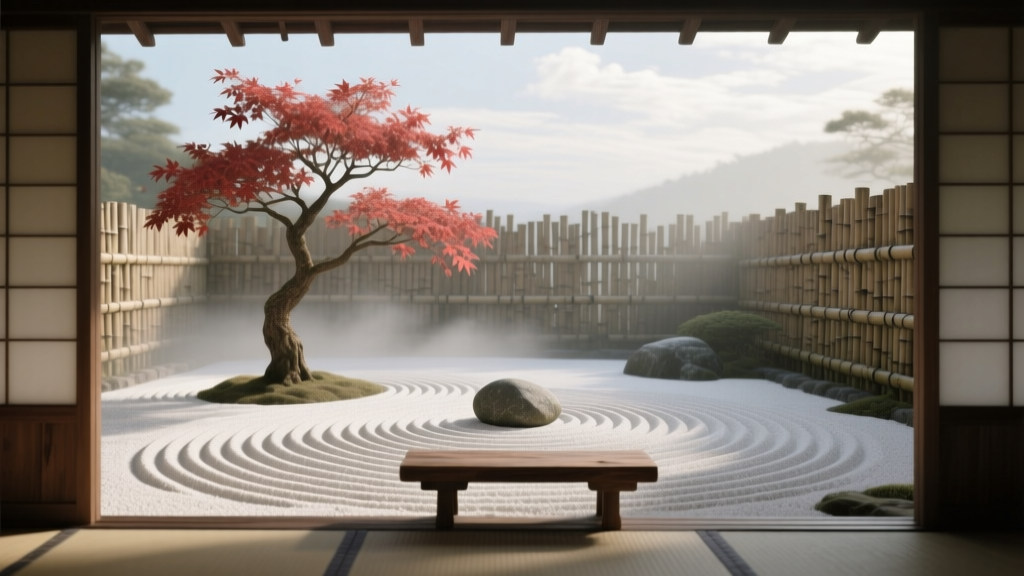
A zen garden (karesansui, or dry landscape garden) is not about plants or decoration — it is about creating a space for contemplation. Every element represents something larger: raked gravel symbolizes water, stones represent mountains, and empty space (ma) invites the mind to settle. The garden is not meant to be walked through but viewed from a single vantage point — a bench, a porch, a window.
Core Elements
1. Gravel or Sand (Water)
Use crushed granite gravel (3/8 inch) or fine white sand. The raked patterns represent water currents:
- Straight lines: calm, flowing water
- Concentric circles around stones: ripples from a stone dropped in water
- Wavy lines: ocean waves
- Cross-hatching: turbulent water
2. Stones (Mountains and Islands)
Choose odd numbers (1, 3, 5, 7). The most important stone is the tallest — it anchors the composition. Place stones before adding gravel. Partially bury them (1/3 underground) for a natural, rooted appearance.
3. Moss (Land and Age)
Moss represents ancient land. Use sheet moss or haircap moss in shaded areas between stones. In dry climates, substitute with low ground covers like Irish moss (Sagina subulata).
4. Plants (Restrained Selection)
| Plant | Role | Placement |
|---|---|---|
| Japanese maple (Acer palmatum) | Focal tree, fall color | Corner or offset from center |
| Azalea (pruned as cloud) | Spring color, structured form | Beside stone groupings |
| Hakonechloa (Japanese forest grass) | Movement, softness | Edges, near water features |
| Black pine (Pinus thunbergii) | Evergreen structure | Background or focal point |
| Ferns (Autumn fern, Painted fern) | Texture, shade filler | Under trees, north side of stones |
5. Water Feature (Optional)
A bamboo shishi-odoshi (deer scarer) or stone basin (tsukubai) adds sound and movement. The sound of water is as important as the visual — it masks neighborhood noise and creates acoustic privacy.
Design Principles
- Asymmetry: Never center elements. Offset everything slightly.
- Odd numbers: 3 stones, 5 plants, 1 tree. Even numbers feel artificial.
- Empty space (ma): 60-70% of the garden should be empty gravel. Resist filling every corner.
- Borrowed scenery (shakkei): Frame distant trees or hills as part of your garden composition.
- Wabi-sabi: Embrace imperfection. Weathered stones, cracked pots, moss on concrete.
Step-by-Step Construction (8x10 foot garden)
- Clear the area and level the ground
- Install landscape fabric (weed barrier)
- Place 3-5 stones, partially buried, in an asymmetric grouping
- Add edging (bamboo fence, stone border, or timber)
- Spread 2-3 inches of gravel over fabric
- Rake patterns around stones (practice on a section first)
- Plant 1 focal tree and 2-3 accent plants at edges
- Add a seating area: a simple wooden bench or flat stone
Maintenance
- Rake gravel weekly (this IS the meditation practice)
- Remove fallen leaves from gravel — they disrupt the patterns
- Prune plants monthly to maintain clean, architectural forms
- Top up gravel annually (1 inch per year)
Final Thoughts
A zen garden is the lowest-maintenance garden you can build. No mowing, minimal watering, no fertilizing. The act of raking gravel becomes a daily meditation — 10 minutes of focused attention that calms the mind. Start small: even a 4x4 foot corner with gravel, one stone, and a small maple creates a contemplative retreat.