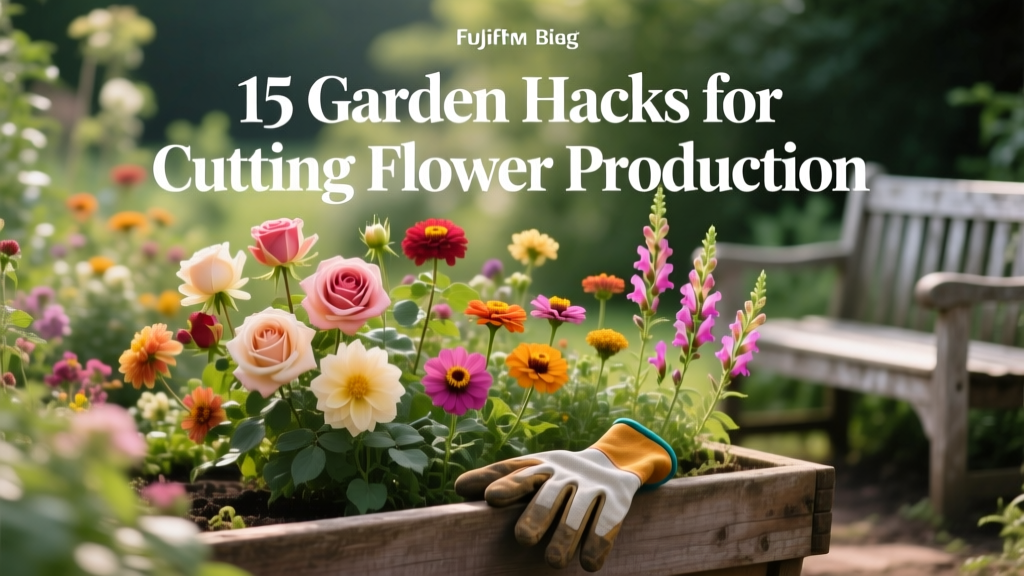
15 Garden Hacks for Cutting Flower Production
Most people blame “bad luck” when their cutting garden slows down—but a more common culprit is that they’re harvesting too politely. Many popular cut-and-come-again flowers (zinnias, cosmos, snapdragons, basil, dahlias) actually need aggressive cutting to keep cranking out stems. If you only snip the top bloom, you often leave the plant in “job done” mode, and production tapers off fast.
Below are my favorite real-world shortcuts and small-system tweaks that reliably turn a so-so cutting patch into a steady stem factory—without turning your yard into a full-time job.
Set Up for More Stems (Before You Even Plant)
1) Plant in “production blocks,” not scattered singles
Hack: Group each variety in a block at least 18–24 inches wide instead of dotting plants around the garden. Dense blocks make harvesting faster, reduce wasted steps, and help you cut deeper stems without trampling neighboring plants.
Example: A 4' x 8' bed can hold two 4' x 4' blocks—say zinnias on one side and cosmos on the other—so you can harvest a full bouquet in 5 minutes instead of hunting blooms across the yard.
2) Use landscape fabric or a “cardboard + mulch” lane system
Hack: Put weed control where it counts: your pathways. A 3-foot-wide path of landscape fabric, or overlapped cardboard topped with 2–3 inches of wood chips, prevents the midsummer weed explosion that steals water and time.
Cost note: Cardboard is often free; a half-yard of wood chips is typically $15–$35 locally. Compare that to losing a weekly hour of weeding (and the stems you don’t cut because you avoid the messy bed).
3) Pre-charge beds with compost + a measured slow feed
Hack: Cutting flowers are heavy feeders when harvested hard. Mix in 1–2 inches of finished compost plus a balanced organic fertilizer at label rate (many are around 3–5 lb per 100 sq ft) so plants don’t stall right when you start cutting.
Source: North Carolina State Extension notes compost improves soil structure and water-holding capacity, supporting more consistent growth (NCSU Extension, 2020).
4) Install drip irrigation with a cheap battery timer
Hack: Drip lines under mulch keep foliage drier (fewer leaf diseases) and water use efficient. Pair a basic timer (often $25–$45) with 30-minute cycles early morning so stems stay firm and mildew pressure drops.
Real scenario: In a hot July bed, switching from overhead sprinklers to drip often means snapdragons and zinnias stop getting that “powdery, tired” look after watering days—so you’re not tossing half your harvest.
Planting & Training Tricks That Multiply Stems
5) Pinch early—yes, it feels wrong
Hack: Pinch most annual cutting flowers when they’re 8–12 inches tall (zinnias, cosmos, celosia, basil, snapdragons after establishment). Remove the top 1–2 inches above a leaf node to force branching, which translates to more stems.
Example: Pinched zinnias commonly give you a “bouquet plant” with multiple long stems instead of one tall stalk with a bloom at the top.
6) Netting beats staking—set it once and forget it
Hack: Use horizontal trellis netting (also called flower netting) at 12 inches high, then add a second layer at 24 inches for tall growers. Netting supports entire blocks so you don’t spend the season tying and re-tying stems.
Cost comparison: A roll of netting is often $15–$30 and can support dozens of plants; individual stakes and ties can easily exceed that (and cost you time every windy week).
7) Grow “stem length” varieties and skip the heartbreak
Hack: Choose cultivars bred for cutting: look for words like “tall,” “cut flower mix,” “bouquet,” or “long stem.” Genetics matter—some landscape varieties are designed to stay short and bloom all at once (great in borders, frustrating for vases).
Example: A tall cutting snapdragon line can hit 24–36 inches of usable stem; many bedding types barely give 10–14 inches.
8) Succession sowing: schedule it like a subscription
Hack: Sow fast annuals every 2–3 weeks for steady production instead of one huge flush and then nothing. This works especially well for zinnias, sunflowers (pollenless for bouquets), and cosmos.
Real scenario: If a heat wave fries your first zinnia planting, your second sowing is already coming up—so you don’t lose the entire month of bouquets.
Harvesting Moves That Trigger More Blooms
9) Cut deep, not dainty
Hack: Take stems down to a strong set of leaves—often 6–12 inches below the bloom—rather than snipping right under the flower head. Deep cuts force the plant to push fewer, stronger replacement shoots instead of many weak ones.
Example: With cosmos, a deep cut turns a leggy plant into a branching machine in about 7–10 days.
10) Harvest at the right stage (and stop losing vase life)
Hack: Pick when stems are physiologically ready: zinnias pass the “wiggle test” (stem is stiff; bloom doesn’t flop), sunflowers at first petal lift, snapdragons when 1/3 of florets are open. Cutting too early shortens vase life; too late reduces rebloom and invites pests.
Source: Postharvest handling guidance from university programs emphasizes stage-of-harvest as a key driver of vase life (e.g., University of Florida IFAS Extension, 2019).
11) Bring a two-bucket system: one for keepers, one for compost
Hack: Carry two buckets while harvesting: clean water for good stems, and a dry bucket for spent blooms, diseased leaves, and broken stems. This prevents “I’ll deal with it later” piles that attract pests and encourages you to deadhead thoroughly.
Example: In a dahlia patch, tossing flawed blooms immediately keeps you moving and reduces the temptation to leave botrytis-prone petals on the plant.
12) Strip leaves below the waterline in the garden, not at the sink
Hack: As you harvest, remove foliage from the lower 6–10 inches of stem (anything that would sit in vase water). This is a tiny habit that prevents bacterial bloom in the bucket and buys you real vase-life gains.
DIY alternative: No fancy stripper needed—gloved hands work fine; for thorny stems, use an old kitchen towel to grip and pull leaves downward safely.
Quick Postharvest Tricks That Make Stems Last (So You Cut Less Often)
13) Condition flowers like a pro: cool water + time + shade
Hack: Put stems into clean, cool water immediately and keep them out of sun for at least 2 hours (overnight is even better) before arranging. Conditioning lets stems fully hydrate, so you get longer vase life and fewer “day-two droopers.”
Real scenario: If you harvest at 2 p.m. in heat and go straight to arranging, basil and cosmos often wilt fast. Harvesting early morning, conditioning in the shade, then arranging later can turn a flop into a 5–7 day bouquet.
14) Use a simple DIY holding solution (and know when it’s worth it)
Hack: For mixed bouquets, you can use commercial floral food—or a DIY version when you’re in a pinch: per quart (1 L) of water, mix 1 tsp sugar + 1 tsp lemon juice (or vinegar) + 1–2 drops unscented bleach. Sugar feeds, acid improves uptake, and bleach slows bacteria.
Comparison table:
| Method | What you need | Best for | Typical cost per gallon |
|---|---|---|---|
| Commercial floral food | Packet or bulk powder | Consistent results, events, gifts | ~$0.20–$0.60 (bulk is cheaper) |
| DIY sugar + acid + bleach | Pantry items | Last-minute bouquets, small batches | Often <$0.10 |
| Plain clean water | Water + clean bucket | Tough stems (sunflowers), quick use | Minimal |
“Clean buckets, clean water, and frequent solution changes are some of the most effective steps for extending vase life—often more impactful than additives alone.” — Extension postharvest guidance summarized from university floriculture programs (UF/IFAS Extension, 2019)
Maintenance Shortcuts That Keep Production Rolling
15) Treat pests with a “threshold rule,” not panic spraying
Hack: Decide your action threshold ahead of time. Example: if you see 5+ aphids on the growing tip of 3 plants in a block, spray just those tops with a strong water jet or insecticidal soap in the evening; otherwise, leave beneficials alone. This keeps you from nuking ladybugs and lacewings that do free pest control.
Source: Integrated Pest Management (IPM) guidance from extension services emphasizes monitoring and action thresholds to reduce unnecessary pesticide use (UC IPM, 2021).
Three Real-World “Fix-It” Scenarios
Scenario A: “My zinnias are tall but the stems are short and weak”
That usually means shallow harvesting and no pinch. Next round, pinch at 8–12 inches, add netting at 12 inches, and cut stems deep (down to a strong node). Within 10–14 days, you’ll see thicker side shoots that are actually bouquet-worthy.
Scenario B: “Everything blooms at once, then my garden looks tired”
This is the classic one-and-done sowing problem. Run a simple succession schedule: sow zinnias and cosmos every 2–3 weeks through early summer, and replace declining blocks with a fast filler like basil or celosia. You’ll trade one big peak for steady weekly cuts.
Scenario C: “My bouquets flop fast, so I have to cut constantly”
Usually it’s harvest timing plus conditioning. Harvest early morning, do the zinnia wiggle test, strip leaves below the waterline, and condition stems in shade for at least 2 hours. If you’re gifting flowers, use commercial floral food for consistency and change vase water every 2 days.
If you try only two hacks this week, make them these: pinch early and cut deeper than feels polite. Those two moves alone push many cutting flowers into that magical loop where harvesting creates more stems—so your garden looks better and your vases stay full without extra hours of work.