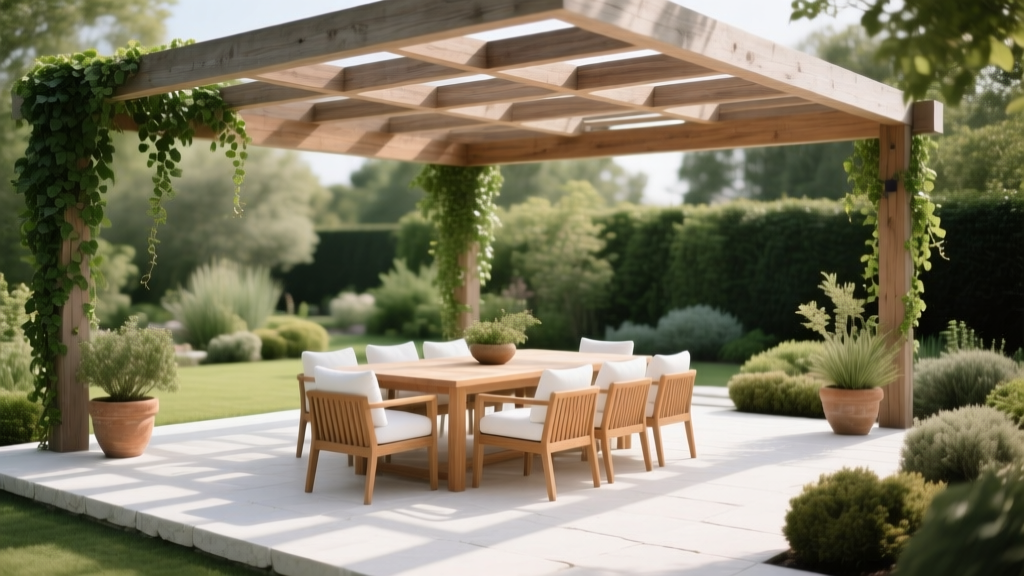
Deck Outdoor Dining Pergola Garden
It’s 6:30 p.m., you’ve got food on the table, and everyone is hovering—half in the kitchen, half outside—because the deck is either blazing hot, too windy, or lit like an interrogation scene. The grill lid is clanging, someone’s drink is sweating onto the boards, and the one chair in the “shade” is already taken. This is the moment most outdoor spaces reveal their real problem: not a lack of square footage, but a lack of layout.
A dining pergola garden on (or beside) a deck can fix that fast. It creates a defined outdoor “room,” gives you controllable shade, and frames planting in a way that feels intentional rather than accidental. I’ll walk you through a practical designer-style plan—dimensions, circulation, plant choices, and three real-world scenarios—so you can build a space that’s comfortable on a random Tuesday and ready for guests on Saturday.
Start With the Outdoor Room: Function First, Then Beauty
Before choosing lumber species or climbing roses, set the “room.” Your pergola garden works when it solves three needs: comfortable dining, safe movement, and an edge of planting that softens the structure without swallowing it.
Right-size the dining zone (so chairs don’t crash into posts)
Use these designer rules of thumb:
- Allow 24 inches of table edge per seated adult (comfortably).
- Pull-back clearance behind chairs: 36 inches minimum from table edge to any hard obstruction (railing, wall, pergola post). If you want people to walk behind seated diners, push that to 48 inches.
- Typical pergola height: 8–9 feet to keep it airy and functional for lighting and fans (where allowed).
For a standard 6-person rectangular table (about 72 inches x 36 inches), a comfortable footprint for table + chairs is roughly 10 feet x 12 feet once you add chair pull-back space. This number alone prevents the most common pergola regret: posts placed exactly where a chair wants to go.
Think in circulation loops, not “a path”
Outdoor dining works best when you can circulate without bottlenecks: kitchen door → grill → table → garden gate. Aim for a 36-inch-wide main walkway (42 inches is luxurious) and avoid dead ends where people must backtrack with hot plates.
Layout Strategies That Make a Pergola Feel Built-In
Strategy 1: Align the pergola to the house, not the fence
When you align the pergola roof beams parallel to the house wall (or deck boards), the space reads as a natural extension of the architecture. This matters even in rental spaces with freestanding pergolas: your eye follows the dominant lines, and the whole yard feels calmer.
Strategy 2: Place posts outside the chair zone
Set pergola posts so they land beyond the chair pull-back area. A common, workable pattern for a dining pergola is:
- Inside clear area: 10' x 12' (for table + chairs)
- Post-to-post dimension: 12' x 14' (gives breathing room and keeps posts out of shoulders)
If your deck is smaller, consider a wall-mounted ledger (where permitted) with two outer posts, or use a cantilever umbrella for shade and let plants do the enclosure.
Strategy 3: Use “green walls” to define edges (without losing airflow)
Pergolas love planting, but dining needs airflow—especially around smoke and heat. Instead of solid hedges, use layered planting: low herbs at the front, medium shrubs at the corners, and climbers only on one or two sides. This keeps the space open while giving it that garden-wrapped feel.
“People are more comfortable when they feel sheltered but still have a view out—what we often describe as ‘prospect and refuge.’” — Grant Hildebrand, Origins of Architectural Pleasure (1999)
That principle applies perfectly here: a pergola roof provides refuge; an open view to the garden provides prospect. Your job is to balance both.
Sun, Shade, and Heat: The Microclimate Plan
A pergola isn’t just decoration—it’s climate control. Pay attention to sun angles and reflected heat from decking boards and walls.
Know your sunlight hours and choose your shade method
- Full sun: 6+ hours of direct sun
- Part sun/part shade: 3–6 hours
- Shade: under 3 hours
If your dining time is mostly evenings, the west sun is the real enemy. For west-facing decks, add at least one of the following:
- Shade cloth panel: 70–90% shade rating (quick comfort)
- Retractable canopy: higher cost, best control
- Deciduous vine: summer shade, winter sun (takes time)
Research backs up the comfort impact of shade. The U.S. Environmental Protection Agency notes that tree shade and vegetation can reduce surface and air temperatures around buildings, helping mitigate heat (EPA, 2023).
Materials, Options, and Costs (So You Don’t Overbuild)
You can spend a little or a lot on a pergola garden. What matters is picking the right structure for your deck type (attached vs freestanding) and your commitment to maintenance.
| Pergola Option | Best For | Typical Cost Range (USD) | Maintenance | Notes |
|---|---|---|---|---|
| Pressure-treated wood DIY | Budget builds, custom sizing | $600–$1,800 | Re-seal every 2–3 years | Great value; allow wood to dry before staining |
| Cedar kit | Fast installs, warmer look | $1,500–$4,000 | Oil/stain every 2–3 years | Resists rot naturally; lighter than hardwood |
| Aluminum pergola (louvered or fixed) | Low maintenance, modern style | $3,000–$10,000 | Wash annually | Best control if louvered; higher upfront cost |
| “Pergola-lite” (sail shade + planters) | Renters, tiny decks | $150–$700 | Seasonal removal, tighten hardware | No posts needed if you use railing/wall anchors (where allowed) |
Concrete numbers to keep you grounded:
- Post size: 6x6 posts feel sturdier than 4x4 for anything near 12 feet wide.
- Footings: common depth is 12–48 inches depending on frost line; always check local code.
- Lighting budget: plan $80–$250 for outdoor-rated string lights or a hardwired fixture plus electrician time.
- Planting budget: a solid starter border can be done for $200–$600 using 1–3 gallon plants and seeds.
- Gravel or paver landing: a 6' x 8' grill pad can cost $150–$500 DIY depending on material.
For structural safety, follow reputable standards and local building requirements. The American Wood Council’s guidance for residential decks emphasizes proper connections and load considerations (American Wood Council, 2018). If your pergola ties into the deck framing or house, that’s a permitting conversation, not a guess.
Step-by-Step Setup: A Designer’s Build Order That Avoids Rework
Even if you hire parts of the job out, the sequence matters. Here’s the order that keeps your layout clean and your budget under control.
- Mark the dining footprint. Tape or chalk a 10' x 12' rectangle where you want table + chair clearance. Place chairs and physically test pull-back space.
- Locate the pergola posts. Move post positions outside the chair zone; common is 12' x 14' post-to-post for a 6–8 person table.
- Decide shade strategy. If you need immediate shade, plan for a canopy or cloth from day one; vines take 1–3 seasons to perform.
- Create the service lane. Reserve a 36-inch clear path from kitchen door to grill and table. No planters in that lane.
- Build/assemble structure. Install posts/anchors, then beams, then rafters. Add blocking now for lights and hooks.
- Run lighting. Use outdoor-rated fixtures and keep cords tidy along beams (or hire an electrician for hardwiring).
- Place containers and beds. Put the biggest planters first (corners), then layer mid-size, then small herb pots near seating.
- Plant last, mulch last. Set plants in place, water deeply, then mulch 2–3 inches to reduce watering needs.
Plant Selection: Varieties That Behave Near Dining
Outdoor dining gardens should smell good, not messy. Choose plants that handle heat, occasional drought, and container life—without dropping sticky fruit onto the table.
Climbers for the pergola (choose one main performer per side)
- Clematis ‘Jackmanii’ (purple flowers): Strong summer bloom; looks elegant trained on one panel. Works best with roots shaded and top in sun.
- Star jasmine (Trachelospermum jasminoides): Evergreen in many climates, intensely fragrant; great near seating. Give it a trellis panel and prune after bloom.
- Grape vine ‘Reliance’ (seedless): Deciduous shade and edible fruit; best if you can commit to pruning. Keep fruiting wood away from the main dining drop zone.
- Climbing rose ‘New Dawn’: Repeat bloom, classic look; place on the “view side,” not the service lane, to avoid snags.
Spacing: Plant most climbers 18–24 inches from the post/trellis base to allow airflow and watering access. Train early with soft ties.
Containers that make the space smell like dinner (in a good way)
- Rosemary ‘Arp’: Heat-tolerant, upright, and useful. One 18–24 inch pot at a corner acts like a scented “pillar.”
- Lavender ‘Hidcote’: Compact, tidy, pollinator-friendly. Plant in gritty soil; keep it out of splash zones from sprinklers.
- Thai basil (annual): Big flavor, quick growth; place near the kitchen door for easy harvesting.
- Allium ‘Millenium’: Tough perennial with tidy globe blooms; won’t flop into walkways.
Border plants that soften posts and railings without swallowing them
- Boxwood ‘Green Velvet’ (or a dwarf inkberry holly where boxwood blight is a concern): Small evergreen structure; use in pairs to frame an entry.
- Hydrangea paniculata ‘Bobo’: Compact, upright blooms; handles sun better than bigleaf hydrangeas.
- Heuchera ‘Caramel’: Warm foliage color that plays well with wood tones; great in part shade.
- Festuca glauca ‘Elijah Blue’: Blue fescue adds texture and stays neat; good for edging.
Spacing: For a clean designer border, set small shrubs 24–36 inches apart, and perennials 12–18 inches apart. Your goal is a full look by year two without immediate crowding.
Three Real-World Scenarios (With Layout Fixes)
Scenario 1: The narrow townhouse deck (8' x 16') with a grill requirement
Problem: There’s technically room to eat, but chairs hit the railing and the grill blocks traffic.
Layout move: Place a 30" x 60" narrow table parallel to the long edge. Put a pergola “bay” over the table only—about 8' x 10'—and keep the remaining 6 feet as a service lane with the grill on a non-combustible mat or paver pad.
Planting: Use two tall, slim containers (about 14–16 inches wide) with rosemary or dwarf conifers at the pergola entrance, and one trellis panel with star jasmine on the privacy side. This creates enclosure without stealing floor space.
Budget note: A sail shade plus two large planters can create a “pergola feeling” for $250–$600, renter-friendly if your lease allows railing clamps or freestanding posts in planters.
Scenario 2: The sunny suburban deck (12' x 20') that bakes after 4 p.m.
Problem: West sun turns dinner into a glare fest; the deck boards hold heat.
Layout move: Build or place a 12' x 14' pergola on the west half of the deck so the table sits in shade while the remaining space stays open for lounging. Add a retractable canopy or a 90% shade cloth panel on the west side during peak months.
Planting: Choose a deciduous climber (grape ‘Reliance’ or clematis) for seasonal shade plus two large planters with lavender and alliums for pollinators. Keep anything messy (fruiting vines) trained away from the table centerline.
Cost reality: Expect $1,500–$4,000 for a cedar kit plus hardware, or $600–$1,800 for a DIY pressure-treated build if you already own tools.
Scenario 3: The small rental patio that needs privacy from neighbors
Problem: You want a dining spot, but you also want to stop making eye contact over the fence.
Layout move: Skip a permanent pergola. Create a freestanding “frame” with two tall planters (at least 18–20 inches wide for stability), a lightweight trellis panel between them, and a shade sail overhead. Angle the seating so diners face into the garden, not toward neighboring windows.
Planting: Use fast annual climbers like black-eyed Susan vine (Thunbergia alata) or sweet peas for seasonal coverage, plus evergreen structure in pots (dwarf arborvitae where winters allow, or compact pittosporum in mild climates). These move with you when you leave.
Maintenance bonus: Containers mean you can control soil quality and watering; most renters can manage 20–30 minutes twice a week in peak summer.
Details That Make It Feel Finished: Lighting, Heat, and Sound
Outdoor dining wants soft light and low glare. Hang string lights or a single outdoor pendant centered over the table—aim for 2700K “warm” color temperature if you’re selecting LEDs.
If your deck is echoey, add textiles: an outdoor rug under the table (large enough that chair legs stay on it when pulled out—often 8' x 10') and seat cushions. These dampen sound and make the space feel more like a room.
For wind: one trellis panel on the prevailing wind side can cut gusts without trapping smoke. Use planting as a porous windbreak rather than a solid wall.
Maintenance Expectations: What This Space Asks of You
A pergola dining garden should be enjoyable, not a second job. Here’s the realistic rhythm for most homeowners:
- Weekly time: 30–60 minutes in the growing season (watering containers, quick deadheading, sweeping debris).
- Monthly: Check hardware tension on shade sails, clean light covers, prune climbers lightly to keep walkways clear.
- Spring (1–2 hours): Feed containers with slow-release fertilizer, refresh 2 inches of mulch, inspect wood for re-sealing needs.
- Mid-summer (1 hour): Hard prune or tie in vigorous vines so they don’t swallow beams or drop flowers into plates.
- Fall (1–2 hours): Remove shade cloth, clean gutters if attached, cut back perennials, and store cushions.
One practical note: if you train vines onto a pergola, you’re signing up for pruning. It’s not hard, but it is recurring. If you want near-zero plant maintenance, use a retractable canopy for shade and keep plants mostly in containers you can swap seasonally.
DIY Alternatives That Still Look Designed
If a full pergola build isn’t in the cards this year, you can still create the same “outdoor room” effect:
- Two-post corner frame: Set two posts in heavy planters, add a top beam between them, and hang a shade panel. Great for tiny decks.
- Railing-mounted trellis screens: Clamp trellis panels to deck railings (with landlord approval). Plant climbers in long trough planters.
- Umbrella + lighting + containers: A 10-foot cantilever umbrella, a defined rug, and three large planters can read as a pergola zone—especially with overhead string lighting.
Design trick: Repeat materials. If your planters are black metal, choose black hardware for lights and a black shade sail edge. Repetition makes budget elements feel intentional.
When the layout is right—posts out of the way, shade where you need it, herbs within arm’s reach—the pergola becomes the place you default to. Dinner doesn’t hover between indoors and out anymore; it lands. The garden stops being “around” the deck and starts working with it, framing your table like a reserved spot at your favorite restaurant—except you can walk out barefoot, snip basil, and stay until the lights come on.
Sources: U.S. Environmental Protection Agency (EPA), “Using Trees and Vegetation to Reduce Heat Islands” (2023). American Wood Council, DCA 6: Prescriptive Residential Wood Deck Construction Guide (2018).