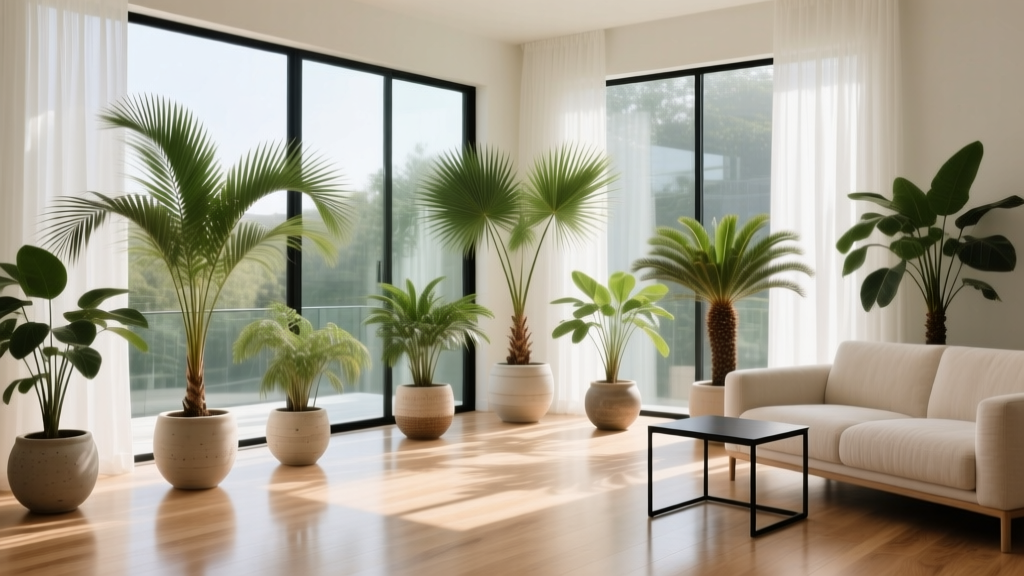
Sunroom Indoor Palm Collection Display
You bought one palm “for the vibe,” and now you’re standing in your sunroom holding a second, then a third—trying to decide where anything goes without turning the space into a jungle that blocks the view, trips your guests, and bakes half the plants in the glass corner. The light is gorgeous, but it’s inconsistent: bright on the south-facing panes, moody near the interior wall, and drafty where the window meets the floor. This is the exact moment a palm collection either becomes a curated indoor landscape—or an awkward traffic obstacle course.
Let’s design it like a small conservatory display: palms staged by height and light tolerance, with clean walking lanes, a watering strategy that won’t ruin your flooring, and enough negative space to make each frond look intentional. I’ll walk you through layout principles, specific palm picks, and three real-world scenarios you can copy—even if you’re renting.
Start with the “sun map,” not the plant list
Before we place a single pot, we map the light you actually have. Sunrooms can swing from 2 hours of direct sun in winter to 8+ hours in summer, depending on orientation and overhangs. Track it for one clear day: note where direct sun hits at 9 a.m., noon, and 3 p.m. Then label zones as bright indirect (strong light but no sunbeam on leaves) versus direct sun (sunbeam on leaves for 1+ hour).
This matters because many palms are “bright light” plants but will scorch behind glass in hard afternoon sun. The goal: match palm species to zones so your display looks stable year-round, not like a rotating rescue mission.
Target light ranges for a palm-centric sunroom
- Direct-sun zone: 3–6 hours of sun (often best as morning sun). Use tougher species and distance from glass.
- Bright-indirect zone: all-day brightness with filtered sun. This is the sweet spot for most indoor palms.
- Medium-light zone: 6–10 feet from the main windows. Reserve for the most shade-tolerant palms and underplantings.
As a practical reference point for “bright,” many interior plant guidelines treat bright indirect light as the sort of exposure near an east or south window with sheer filtering. The University of Vermont Extension notes that houseplant light categories range from low to high, with high light typically being within a few feet of a bright window (University of Vermont Extension, 2020). Use that as your baseline when zoning the room.
Layout strategy: build a staged “gallery wall,” but with plants
Think like a designer setting art: you want a hero piece, supporting pieces, and breathing room. In a sunroom, that means anchoring the display with 1–2 tall palms, then stepping down with medium and small plants. The fronds become your “canopy,” and the pots your “furniture.”
Recommended room measurements to design around
If you have a typical sunroom footprint—say 10 ft x 12 ft—your biggest enemy is crowding the walkway. Plan for:
- Main walking lane: at least 30–36 inches clear (comfortable for guests and watering cans).
- Plant staging depth along glass: 18–24 inches (enough for large pots without blocking doors).
- Distance from glass for sun-sensitive palms: 12–24 inches to reduce leaf scorch and cold drafts.
Three-zone layout you can apply to most sunrooms
Use this repeatable structure no matter the room size:
- Zone A: Window line (highest light) — tough palms and sun-lovers, staged on plant caddies for easy rotation.
- Zone B: Mid-room (bright indirect) — the bulk of your collection; medium palms on stands for layered height.
- Zone C: Interior wall (lowest light) — shade-tolerant palms and companion plants; also where you can hide a watering station.
Step-by-step setup (designer’s sequence)
Set up the room like you’d stage a small showroom: protect surfaces first, then anchor pieces, then fill in with rhythm and repetition.
- Protect the floor: Place a waterproof mat or tray under the main palm cluster. A 36 in x 60 in boot tray area works well for a grouped display. For a nicer look, set trays inside a low-profile outdoor rug.
- Mark your walkway: Use painter’s tape to outline a 32-inch path from entry to seating/door. Don’t cheat—future-you carrying water will thank you.
- Place your tallest palms first: Put 1–2 large specimens near corners (but not pressed to glass). Start them 18 inches off the window line to reduce heat/cold stress.
- Create a second tier: Add medium palms on stands so fronds overlap slightly but pots don’t. Aim for 10–14 inches between pot rims to allow airflow.
- Fill with small palms and companions: Tuck smaller pots at the “feet” of taller plants to hide soil and soften transitions. Keep at least 2 inches between leaves to limit pest spread.
- Add mobility: Put any pot larger than 12 inches in diameter on a rolling plant caddy. This turns seasonal light shifts into a 30-second adjustment instead of a wrestling match.
- Set up the watering point: Keep a slim watering can, microfiber towel, and a moisture meter (optional) in a basket in Zone C. If you’re hauling water from the kitchen, you’ll water less consistently.
Plant selection: palms that behave indoors (and look collected, not random)
Palms aren’t all equally cooperative in containers. The best sunroom palms share three traits: tolerance for indoor humidity swings, manageable growth rate, and attractive form even when viewed up close. Below are specific varieties that design well together, plus what they contribute visually.
Hero palms (tall structure)
1) Kentia Palm (Howea forsteriana)
Elegant, arching fronds; tolerant of indoor conditions; reads “classic conservatory.” Kentias perform well in bright indirect light and don’t demand full sun. They’re also slower growing, which is helpful in a finite room.
2) Majesty Palm (Ravenea rivularis)
A dramatic, feathery look that fills vertical space fast. Best for bright areas and consistent moisture. In a sunroom, it can thrive if you commit to watering and humidity. Use it as the “lush corner” statement, but give it room—its spread can reach 4–6 feet over time in a container.
3) Areca Palm (Dypsis lutescens)
Multi-stemmed, lively, and great for screening. Arecas are excellent mid-to-tall anchors when you want a full look without a single trunk. They also respond well to rotation for even growth.
Mid-layer palms (shape and repetition)
4) Bamboo Palm (Chamaedorea seifrizii)
A reliable mid-height palm with a clustered, upright habit—perfect for repeating along a window line. It handles medium light better than many palms, making it a bridge plant between Zones A and B.
5) Cat Palm (Chamaedorea cataractarum)
Dense and fountain-like, ideal for the base of taller specimens. It reads softer and more “garden bed” than “houseplant,” especially when clustered in matching pots.
Small palms and accents (detail at eye level)
6) Parlor Palm (Chamaedorea elegans)
Classic, compact, and forgiving. Use 2–3 of these in similar pots to create intentional repetition on the lower tier. It’s also one of the better options for Zone C.
7) Ponytail Palm (Beaucarnea recurvata) (not a true palm, but a great design foil)
Architectural trunk, low water needs, and high tolerance for bright sun. It adds sculptural contrast among feathery fronds—like placing a boulder in a planting bed for structure.
Design note: Many indoor palms benefit from stable temperatures and adequate humidity. The Royal Horticultural Society emphasizes avoiding cold drafts and maintaining steady conditions for indoor plants (RHS, 2022). In a sunroom, that guidance translates into pulling plants a bit away from winter-cold glass and avoiding heater vents blasting fronds.
A comparison table to match palms to your sunroom reality
| Palm | Best Light Zone | Watering Style | Container Size to Start | Design Role |
|---|---|---|---|---|
| Kentia (Howea forsteriana) | Bright indirect (Zone B) | Let top 1–2 in dry slightly | 10–14 in pot | Elegant hero / anchor |
| Areca (Dypsis lutescens) | Bright indirect to gentle sun (Zones A/B) | Even moisture; don’t leave soggy | 10–12 in pot | Screening, fullness |
| Majesty (Ravenea rivularis) | High light (Zone A/B) | Consistently moist; higher humidity | 12–16 in pot | Lush statement corner |
| Bamboo (Chamaedorea seifrizii) | Medium to bright (Zones B/C) | Moderate; avoid extremes | 8–12 in pot | Repeatable mid-layer |
| Parlor (Chamaedorea elegans) | Medium light (Zone C) | Moderate; tolerates slight dryness | 6–8 in pot | Small accents, rhythm |
| Ponytail (Beaucarnea recurvata) | Direct sun to bright (Zones A/B) | Dry between waterings | 8–10 in pot | Sculptural contrast |
Design details that make a collection look intentional
Use pot consistency like “hardscape”
If every plant sits in a different pot color and shape, the eye reads clutter. Pick one pot family (matte terracotta, charcoal fiberstone, or warm white ceramic) and repeat it. You can still vary sizes: for example, choose 8-inch, 10-inch, and 14-inch versions of the same style to keep cohesion.
Layer heights with stands—without creating wobble
Plant stands are your best friend in a sunroom because they bring smaller palms up to eye level and keep fronds from tangling. Use stands that raise pots by 8–14 inches. In corners where bumping is likely, prioritize wide-base stands or low plinths over skinny tripod styles.
Build negative space on purpose
Leave one “clean window” section—at least 24 inches wide—so the room still feels like a room. It’s the same trick used in garden borders: a rest area makes the lush areas feel lusher.
Real-world scenarios you can copy
Scenario 1: The renter’s sunroom (no drilling, no heavy remodeling)
You have a 8 ft x 10 ft sunroom in an apartment or rental house. You can’t mount shelves and you don’t want water stains.
Layout: One tall palm (Kentia or Areca) in the brightest corner, offset 18 inches from the glass. Two medium palms (Bamboo Palm) along the window line, each on rolling caddies so you can rotate them weekly. Three small Parlor Palms clustered on a single waterproof tray near the interior wall.
DIY alternative: Skip expensive matching pots. Use nursery pots inside identical woven baskets with plastic liners. Budget about $25 per basket versus $60–$120 per ceramic planter.
Budget snapshot: With 1 tall palm (~$90), 2 medium palms (~$35 each), 3 small palms (~$15 each), 4 caddies (~$12 each), you’re around $280–$350 before soil and pots.
Scenario 2: The family sunroom (traffic, toys, and a dog tail)
You have a 12 ft x 14 ft sunroom that doubles as a hangout space. Plants can’t block the path to the backyard door, and anything fragile will get bumped.
Layout: Create a “plant peninsula” along one long window wall: line up 2 larger, sturdy palms (Areca + Majesty) with a consistent setback of 20 inches from the glass. Keep the center of the room open with a 36-inch clear lane. Place Cat Palms at the base for fullness, but keep them in heavier containers that won’t tip.
Practical trick: Use 10–12 lb of decorative river stone as a top-dress in dog-accessible pots to discourage digging and add visual polish.
Maintenance reality: Plan on 30–45 minutes per week for watering checks and leaf grooming, plus a monthly deep clean of trays and the floor under the cluster.
Scenario 3: The plant collector’s “micro-conservatory” (max plants, still looks designed)
You’re building a curated collection in a bright, south-facing sunroom that hits 6–8 hours of sun in summer. You want density, but not chaos.
Layout: Treat it like a botanical display with repeating modules: three “pods,” each pod being one medium palm on a stand flanked by two smaller companions. Put the most sun-tolerant plants closest to glass (Ponytail Palm, tougher Arecas), and keep Kentias slightly deeper into the room where light is bright but filtered.
Collector’s hack: Instead of buying many large palms, buy younger plants and stage them on stands at different heights. A $18 small palm elevated on a $20 stand often looks more designer than a single $90 floor plant.
Budget and DIY options (so the design survives real life)
A sunroom palm display can be as affordable or as gallery-level as you want. Here are three tiers that still look intentional.
- Starter budget: $150–$300 — 1 medium palm, 2 small palms, two matching baskets, one waterproof tray, DIY pebble top-dress.
- Mid-range: $350–$700 — 1 tall hero palm, 2–4 medium palms, consistent pots, 3–5 rolling caddies, two stands, upgraded soil.
- High-finish: $800–$1,500 — specimen Kentia, fiberstone planters, a bench or plinths, dedicated drip trays, grow lights for winter balancing.
Soil tip (worth the money): Don’t cheap out on drainage. A quality palm/houseplant mix plus extra perlite or pumice prevents root issues. If you’re mixing your own, aim for a blend that drains fast but holds moisture—think “crumbly brownie” texture, not dense mud.
Maintenance expectations: what it takes to keep it looking like a display
Palms look best when they’re clean, evenly lit, and not pushed into feast-or-famine watering cycles. Plan for a steady rhythm rather than dramatic interventions.
Weekly routine (30–60 minutes total)
- Water check: Test top 1–2 inches of soil; water thoroughly when dry to that depth (species dependent).
- Rotate pots: Turn each palm a quarter turn every 7–10 days for balanced growth.
- Quick groom: Remove fully brown fronds at the base; trim brown tips lightly if needed (don’t cut into green tissue).
- Tray audit: Empty standing water from saucers within 30 minutes after watering to reduce root rot risk.
Seasonal tasks (the “designer reset”)
- Spring: Repot only if roots are circling heavily; move up just 2 inches in pot diameter to avoid soggy soil.
- Summer: Add sheers or a shade panel if leaf scorch appears in afternoon sun; watch for spider mites in hot, dry spells.
- Fall: Pull palms 12–24 inches away from cold glass as nights cool; reduce watering frequency.
- Winter: Supplement with a grow light if daylight drops—aim for 10–12 hours of light for palms that stall hard. Keep fronds away from heater blasts.
“The right plant in the right place reduces maintenance more than any product you can buy.” — A widely echoed principle in landscape practice, reinforced by decades of extension education focused on site-appropriate plant selection (see University of Vermont Extension, 2020).
Small design upgrades that have outsized impact
Add one bench. A simple 48-inch bench along the window creates an instant conservatory feel and gives you a tier for smaller palms. It also keeps pots from clustering only on the floor, which is what makes many plant collections look accidental.
Hide your supplies elegantly. Use a lidded basket or slim cabinet in Zone C for fertilizer, pruners, and cloths. Visual clutter makes even healthy plants feel messy.
Use a consistent top-dress. A thin layer (about 1/2 inch) of fine bark or pebbles across your pots visually unifies the collection and reduces soil splashing during watering.
Common mistakes (and how to avoid them without losing the lush look)
Mistake: Pressing palms against glass for “maximum light.”
Better: Give most palms a 12–24 inch buffer. You’ll reduce scorch, drafts, and the leaf-crush that makes fronds look tired.
Mistake: Mixing too many silhouettes at once.
Better: Pick two main frond styles (feather palms like Areca/Kentia + one bold sculptural accent like Ponytail). Repeat them for cohesion.
Mistake: Oversized pots “to avoid repotting.”
Better: Step up gradually. Too much soil stays wet, and palms hate sitting cold and soggy—especially in winter.
Sources (for light and indoor plant care references)
University of Vermont Extension. 2020. Houseplant care and indoor light guidance (general indoor plant light categories and placement principles).
Royal Horticultural Society (RHS). 2022. Indoor plant care guidance emphasizing stable conditions and avoiding drafts for best performance.
When your sunroom palm collection is designed like a display—clear path, staged heights, matched pots, and plants placed by light tolerance—you stop “finding spots” for plants and start composing a room. The best part is how forgiving the system becomes: you can add one new palm at a time, swapping it into Zone A, B, or C like a well-planned border. That’s when the collection starts to feel less like a set of purchases and more like your own indoor garden—edited, functional, and lush on purpose.