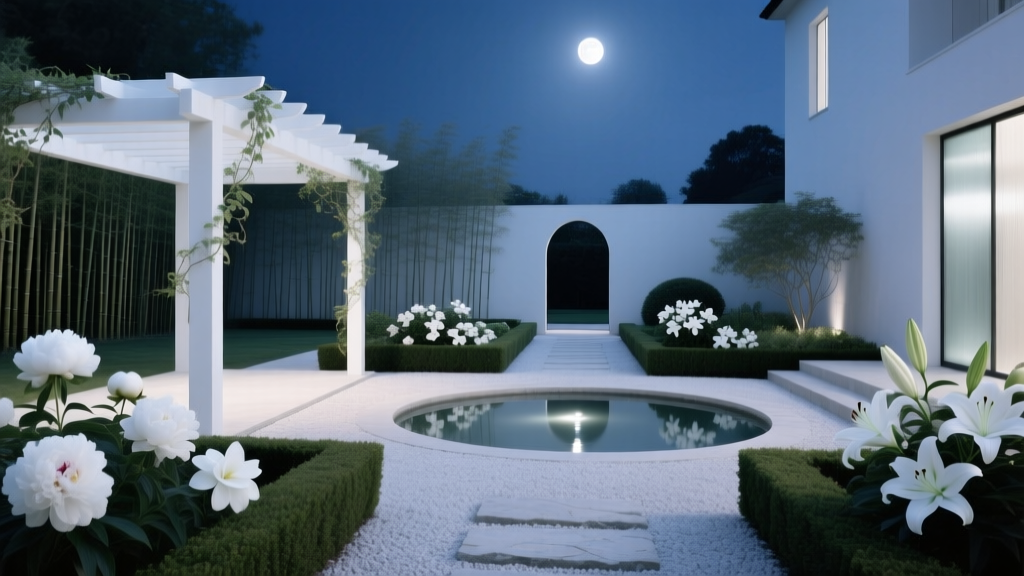
Courtyard Moonlit White Garden Theme
The first time you notice a courtyard at night is usually when you’re carrying something—laundry, a mug of tea, the dog’s leash—and the overhead light catches every dusty corner. In daylight, the space feels “fine.” After dark, it becomes a black box. The trick of a moonlit white garden is that it doesn’t fight the night; it uses it. White flowers, silver leaves, pale paving, and a few well-placed lights turn a dim courtyard into a soft, reflective room where you can actually see faces, steps, and petals.
I’m going to walk you through a design that works for homeowners and renters, and adapts to common courtyard sizes—anything from a 6 ft x 10 ft apartment patio to a 12 ft x 16 ft enclosed brick courtyard. The goal is practical: a layout you can build with basic tools, plants that look crisp in daylight and glow at dusk, and maintenance that doesn’t steal your weekends.
Design principles for a moonlit courtyard
Think in “reflective layers,” not just white flowers
A successful moonlit garden reads in layers. Flowers come and go, but pale hardscape and silver foliage carry the theme all season. Aim for:
- Light ground plane: pale gravel, light pavers, or even a cream outdoor rug to bounce light upward.
- Mid-level glow: white blooms at knee-to-waist height where you notice them from seating.
- Vertical shimmer: climbers or tall perennials that catch side lighting and moonlight.
Use contrast to make white feel brighter
White looks brightest when it’s framed. In courtyards, you already have “frames” (brick walls, fences, dark doors). Strengthen that contrast intentionally: charcoal planters, dark-stained trellis, or black metal furniture. A black backdrop makes white flowers read almost fluorescent at dusk.
Design for dusk: the 30-minute window you actually use
Most courtyard gardens are enjoyed in the evening—after work, after dinner. Prioritize plants that open or hold their color into evening: white roses, nicotiana, moonflower, white petunias. Then use low-voltage lighting so the garden is still legible when the sky goes deep blue.
“Light should reveal the space, not flatten it—aim it at surfaces and textures, not directly at the eye.” — International Dark-Sky Association guidance on responsible outdoor lighting (International Dark-Sky Association, 2023)
Layout strategies that make a courtyard feel larger at night
Start with a simple, repeatable plan (works in 8 ft x 12 ft and up)
Here’s a layout I use constantly because it scales well:
- Perimeter planting band: 18–24 inches deep along walls/fences.
- Central floor area: keep a clear zone of at least 4 ft wide for circulation and furniture.
- One vertical focal point: a trellis panel or narrow obelisk placed to be seen from indoors.
In a 10 ft x 12 ft courtyard (120 sq ft), that perimeter band gives you roughly 40–55 sq ft of planting without sacrificing comfortable movement.
Path width and furniture spacing (the numbers that prevent bumping into things)
Courtyards feel cramped when chairs scrape walls and toes catch pot edges. Use these practical dimensions:
- Main walking route: minimum 36 inches wide; 42 inches if two people pass easily.
- Behind a dining chair: allow 24 inches from chair back to wall/planter (36 inches if it’s a high-traffic spot).
- Container spacing: keep at least 6–10 inches between pots so you can water and rotate them.
Light placement: low, layered, and warm
A moonlit white garden doesn’t need stadium lighting. It needs gentle highlights. Use warm LEDs (around 2700K) so whites look creamy rather than icy. Aim for a minimum of 3 hours of evening use per week, so choose lighting you’ll actually turn on (timers help).
For a typical courtyard, a simple lighting kit might include:
- 2 uplights aimed at a trellis/feature plant
- 4 path lights marking edges/steps
- 1 string light overhead or along a wall for ambient glow
Cost range: a basic low-voltage kit often lands around $120–$250, while a more robust system with metal fixtures can run $350–$700, depending on brand and transformer size.
Step-by-step setup (designer’s order of operations)
- Measure and sketch. Note total dimensions, door swing, hose spigot, and any drains. Mark a 36–42 inch clear route from the door to seating.
- Choose your “night backdrop.” If the courtyard walls are light, add contrast with dark planters or a black trellis panel (even a removable one for renters).
- Set hardscape first. Lay a small patio of 6 ft x 8 ft (or similar) in pavers, or define a seating rectangle with gravel and edging. Budget $2–$6 per sq ft for gravel and $8–$20 per sq ft for pavers installed DIY, depending on material and base prep.
- Place the vertical feature. Install a 6 ft trellis against the wall or a freestanding obelisk in a large pot (at least 18–22 inches wide) to anchor climbers.
- Build the planting layers. Put evergreen structure in first (one or two key plants), then silver foliage, then white bloomers for succession.
- Add lighting last. At dusk, temporarily place lights and test angles before final staking. Avoid glare from fixtures visible from seating.
- Mulch and tidy. A 2-inch mulch layer reduces watering needs and makes white flowers pop against dark soil.
Plant palette: specific varieties that glow after sunset
White gardens fail when everything blooms at once and then goes flat. I like to mix long-blooming workhorses, evening-scented flowers, and silver foliage that reads as “white” from a distance.
Structural “anchors” (form and winter presence)
- Buxus microphylla ‘Winter Gem’ (boxwood): compact evergreen mounds; use sparingly in containers or beds for year-round structure. Space 18–24 inches apart for a low hedge effect.
- Ilex crenata ‘Sky Pencil’ (Japanese holly): narrow vertical accent that substitutes for columnar boxwood in tighter courtyards. One plant can act as a corner “pillar.”
- Hydrangea paniculata ‘Little Lime’ (if you have sun and room): blooms start creamy white and age to pink. Needs a larger footprint; place 3–5 ft from walls for airflow.
Silver and pale foliage (the real moonlight engine)
- Stachys byzantina ‘Silver Carpet’ (lamb’s ear): velvety silver mats that reflect light; great at the edge of beds. Space 12 inches apart.
- Artemisia ‘Powis Castle’: feathery silver shrub; excellent contrast with white blooms. Give it 24–36 inches width.
- Brunnera macrophylla ‘Jack Frost’: silver-veined leaves for part shade; looks luminous even without flowers. Space 18 inches apart.
White bloomers that perform in courtyards
- Rosa ‘Iceberg’ (floribunda rose): a classic for continuous white bloom. Needs about 6 hours of sun for best flowering; workable at 4–5 hours with fewer blooms.
- Hydrangea macrophylla ‘Endless Summer’ (in alkaline soils can lean pink; in acidic tends bluer): if you want true white, choose a white cultivar like Hydrangea arborescens ‘Annabelle’ instead—huge white heads that read from across the courtyard.
- Nicotiana alata ‘Fragrant Cloud’ (often pale/white forms available): evening fragrance is a game-changer near seating.
- Petunia ‘Supertunia White’ (container staple): long bloom season, cascades over pot edges and reflects path lighting.
- Phlox paniculata ‘David’: white midsummer blooms; strong performer where airflow is decent. Space 18 inches apart.
Night-scented and evening-opening stars
- Ipomoea alba (moonflower vine): large white blooms that open in evening; best in warm weather and full sun. Train on a 6 ft trellis; plant one vine per large container.
- Cestrum nocturnum (night-blooming jasmine): intensely fragrant, but climate-dependent and can be too strong in tiny spaces; best for larger courtyards or where it can be set back from seating.
- Lilium ‘Casa Blanca’ (Oriental lily): bold white, evening perfume; stake in windy courtyards. Plant bulbs 6–8 inches deep, 10–12 inches apart.
For plant performance and siting, remember: many “white” flowers scorch in harsh afternoon sun and look better with morning sun and light afternoon shade—especially in bright, heat-reflective courtyards.
Comparison table: best moonlit plants by courtyard condition
| Plant | Best light | Space needs | Night value | Notes |
|---|---|---|---|---|
| Rosa ‘Iceberg’ | 6+ hours sun | 3 ft wide | White repeat bloom | Needs airflow; prune annually |
| Brunnera ‘Jack Frost’ | Part shade | 18 in wide | Silver foliage glow | Great for dim corners |
| Lamb’s ear ‘Silver Carpet’ | Sun/part sun | 12 in spacing | Reflective ground layer | Drought-tolerant once established |
| Moonflower (Ipomoea alba) | Full sun | Large pot + 6 ft trellis | Evening-opening blooms | Annual in most climates |
| Petunia ‘Supertunia White’ | Sun/part sun | 12–18 in pot | Long-season white mass | Weekly feeding improves bloom |
Three real-world courtyard scenarios (and how I’d solve them)
Scenario 1: A renter’s 6 ft x 10 ft balcony-courtyard with part shade
This is the classic “I want a garden but can’t dig” situation. Your best tools are containers, a light-colored floor surface, and one vertical screen for privacy.
Layout: Keep a 3 ft clear lane from door to the far corner. Place a narrow bench (about 48 inches wide) against the wall, then flank it with two tall planters.
Planting:
- Two tall pots with Ilex crenata ‘Sky Pencil’ or compact conifers for vertical structure.
- Mid pots of Brunnera ‘Jack Frost’ and white impatiens (for shade-friendly color).
- Trailing white bacopa or petunia on the sunniest edge.
DIY tip: Use a removable trellis panel zip-tied to a railing or mounted with non-damaging clamps. Add a warm white string light line at eye level to bounce light onto foliage.
Budget: Expect $180–$400 for 6–10 containers, potting mix, and starter plants, depending on pot material and plant size.
Scenario 2: A 12 ft x 16 ft brick courtyard with 6–7 hours of sun and heat reflection
Brick courtyards are beautiful—and brutal in summer. White flowers can glare at noon and wilt. The solution is to shift emphasis to silver foliage and tough bloomers, with irrigation that’s consistent.
Layout: Create an 8 ft x 10 ft central seating pad (pavers or gravel) and keep planting beds to a 24-inch perimeter. Add one focal trellis on the wall you see from the kitchen window.
Planting:
- Artemisia ‘Powis Castle’ for durable silver mass in the hottest zones.
- Rosa ‘Iceberg’ trained as a shrub or light climber on a trellis (with drip irrigation).
- Allium (white varieties where available) and lamb’s ear along the bed edge for shimmer.
Watering reality: In reflective courtyards, container plants may need water 3–5 times per week in peak summer heat. A simple drip kit can reduce the labor dramatically.
Scenario 3: A narrow townhouse courtyard, 8 ft x 20 ft, with high walls and only 3–4 hours of sun
This one is all about making a long corridor feel like a sequence of small rooms. You’ll lean hard on foliage and strategic lighting.
Layout: Break the run into three zones: a small entry landing, a mid “pause point” with a tall pot, and a seating niche at the end. Keep a continuous path of 36 inches and vary the pot sizes to avoid a bowling-alley look.
Planting:
- Brunnera ‘Jack Frost’ and white begonias for dependable brightness.
- Hydrangea arborescens ‘Annabelle’ if you can give it consistent moisture and a larger container/bed area.
- Climbing star jasmine (flowers white and fragrant) if climate allows, trained flat against the warmest wall.
Lighting: Use wall-wash lighting aimed along the surface of the wall (not outward). This makes the courtyard feel wider and improves safety on a narrow path.
Sunlight, microclimates, and the “white balance” problem
Courtyards often have complicated light: a few hours of direct sun, then bright ambient reflection. Track actual sun with a quick observation over a weekend. If you have 6+ hours, you can grow roses, moonflower, and many sun perennials. If you have 3–4 hours, pivot toward shade-tolerant whites and silver foliage, and use containers you can rotate.
Also consider wind tunneling and heat reflection. High walls can trap warmth, which is great for fragrance but increases watering needs. A 2-inch mulch layer and self-watering containers can buy you days.
Budget planning and DIY alternatives
A moonlit courtyard can be done in stages, and it should be. Here’s a realistic breakdown you can mix and match:
- Starter phase ($150–$300): 3–5 containers, potting mix, lamb’s ear or artemisia, and a couple of white annuals. Add one warm string light.
- Build-out phase ($400–$900): add a trellis, 1–2 anchor shrubs, improved edging, and a low-voltage lighting kit.
- Polished phase ($1,000–$2,500+): upgrade pots, add pavers/gravel base, install drip irrigation, invest in specimen plants.
DIY swaps that still look designer:
- Use pea gravel and steel edging instead of a full paver install.
- Choose smaller starter plants and let them fill in over 12–18 months.
- Paint mismatched pots a unified matte charcoal or deep bronze for instant cohesion.
Maintenance expectations (so it stays beautiful at night)
Plan on 30–60 minutes per week in the growing season for a small-to-medium courtyard if you choose mostly perennials and shrubs. If you rely heavily on annual containers, expect closer to 60–90 minutes per week for deadheading, watering, and feeding.
Weekly rhythm
- Water check (10–20 minutes): especially containers; adjust for heat waves.
- Deadhead and tidy (10–20 minutes): white flowers show browning quickly—snip spent blooms before they discolor the whole scene.
- Quick pest scan (5 minutes): roses and petunias can attract aphids; catch it early with a strong water spray.
Seasonal tasks
- Spring: refresh mulch, feed roses, divide overgrown perennials, clean lighting lenses.
- Summer: consistent watering, trim artemisia lightly to prevent flopping, replace tired annuals.
- Fall: plant bulbs (like white alliums and lilies) and tidy debris that can stain pale gravel.
- Winter: protect containers from freeze-thaw (cluster pots, elevate slightly), check that lighting cables aren’t exposed.
Safety, sustainability, and responsible night lighting
Good night lighting makes a courtyard usable without blasting your neighbors. Use shields and aim lights downward or toward surfaces. The International Dark-Sky Association emphasizes minimizing glare and directing light only where needed (International Dark-Sky Association, 2023). If you’re selecting fixtures, look for options that reduce upward spill.
For plant health and smart water use, focus on root-zone watering (drip or soaker hoses) rather than overhead spraying. The EPA’s WaterSense program notes that efficient irrigation and watering practices can significantly reduce outdoor water waste (U.S. Environmental Protection Agency WaterSense, 2024). Even a simple timer can prevent accidental overwatering in container-heavy courtyards.
Putting it all together: a sample moonlit plan for a 10 ft x 12 ft courtyard
If you want a concrete template, here’s a layout that reliably works:
- Seating pad: 6 ft x 8 ft centered, leaving a 24-inch planting strip on two sides and a 36-inch path on the main route.
- Vertical feature: one 6 ft trellis on the back wall with moonflower (annual) or a restrained climber like star jasmine (perennial where hardy).
- Anchor plants: two evergreen forms (boxwood mounds or sky pencil hollies) in large pots at opposite corners to “square up” the space.
- Silver layer: lamb’s ear at bed edges and one artemisia for a soft, luminous mound.
- Bloom layer: ‘Iceberg’ rose (if sunny) or ‘Annabelle’ hydrangea (if part shade), plus white petunias in containers for continuous color.
- Lighting: two uplights grazing the trellis and one path light near the step/threshold for safety.
The effect is immediate: in daylight it reads clean and intentional; at dusk the pale leaves and blooms pick up every bit of ambient light. And because the layout leans on structure—evergreen form, repeated containers, a single vertical anchor—it still looks “designed” when flowers take a break.
Once you’ve lived with it for a few weeks, you can fine-tune like a designer does: shift a pot six inches to open a sightline, add one more silver plant where the night feels flat, or swap a white annual for a more fragrant variety near the seat. That’s how a courtyard becomes a room you step into after dark—calm, legible, and quietly luminous.
Sources: International Dark-Sky Association (2023); U.S. Environmental Protection Agency, WaterSense program (2024).