Backyard Cutting Garden for Bouquets
You step outside with coffee and clippers, hoping to steal ten minutes before the day starts. The vase on your table is empty again. You wander the yard: a couple of leggy roses that bloom all at once, a hydrangea that’s still weeks away, and lots of greenery you don’t want to cut. The problem isn’t that you can’t grow flowers—it’s that your garden isn’t designed to give flowers on a schedule.
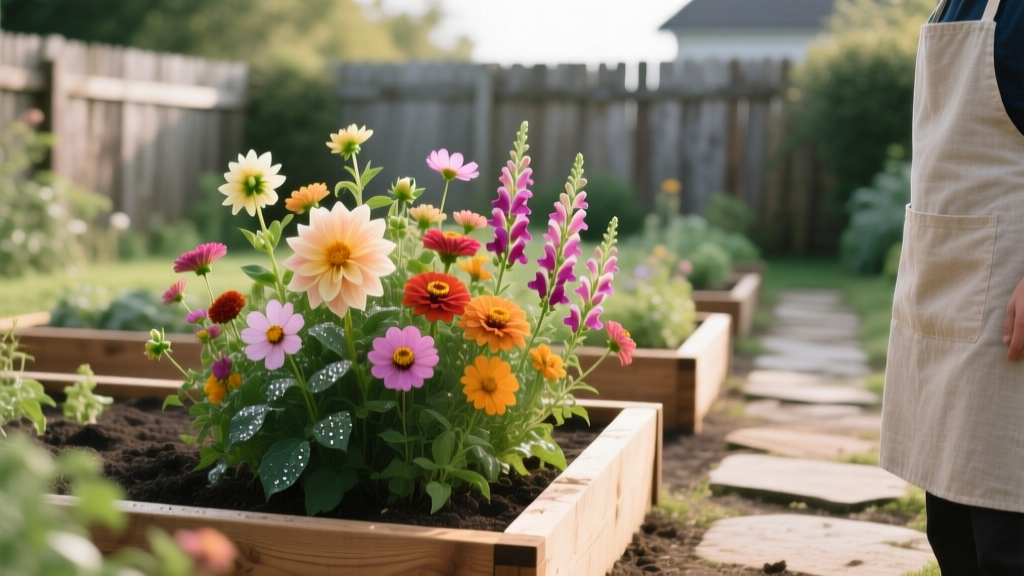
A cutting garden is different from a border that’s meant to be admired from a patio chair. It’s a working space: easy to harvest, planted in repeatable blocks, and packed with stems that keep coming back. Done well, it can fit into a 4' x 8' bed, a narrow side yard, or a few containers on a rented patio—and still produce weekly bouquets.
Design principles that make bouquets easy (not a chore)
Start with your “harvest path”: access beats perfection
If you can’t reach stems without stepping on soil, you’ll stop cutting. Build your layout around where your feet go first, then place beds within arm’s reach. A simple rule: keep any planting area reachable from an edge—about 2 feet of reach for most adults. That means a bed should be no wider than 4 feet if you can access both sides, or 2 feet if it’s against a fence.
For a typical backyard, a practical starter cutting garden is two beds at 4' x 8' with a 3-foot path between them for a wheelbarrow and a bucket. In very tight spaces, one 2' x 10' strip along a sunny fence can outproduce a large mixed border because it’s planted densely and harvested often.
Put sunlight on the map before you buy plants
Most top-tier cut flowers want 6–8 hours of direct sun. If you’re at 4–5 hours, you can still cut plenty (think foliage, some perennials, and shade-tolerant annuals), but you’ll want to shift your “main stem makers” into the brightest pocket you have.
Take one day to check sun at three times—9 a.m., 1 p.m., and 5 p.m. That quick snapshot often reveals that the best light isn’t where you assumed. If you’re renting, this is your best tool for deciding where containers will actually perform.
Design in blocks: bouquets need repeats
In a mixed ornamental bed, you might plant one of everything. For bouquets, repeats are your friend. Plant in blocks of 3, 5, or 7 of the same variety. That gives you enough stems to make a cohesive bunch—three zinnias read as “intentional,” one reads as “I grabbed what I could find.”
A simple block plan for each 4' x 8' bed:
- One front strip (12–18") for low edging and filler (sweet alyssum, statice, basil, dusty miller).
- One middle strip (18–24") for medium producers (zinnias, snapdragons, celosia).
- One back strip (18–24") for tall cuts and anchors (cosmos, sunflowers, amaranth) or trellised growers (sweet peas).
Think like a florist: anchor + focal + filler
Every bouquet is a small design. If your garden supplies all three roles, arranging becomes almost automatic:
- Anchors: foliage and structure (eucalyptus if climate allows, basil, mint in pots, ninebark twigs, dusty miller, ornamental grasses).
- Focals: the “stars” (dahlias, zinnias, tulips, roses).
- Fillers: airy or textural bloomers (cosmos, feverfew, yarrow, statice, ammi).
“Plants used for cutting should be harvested often; frequent cutting encourages many annuals and perennials to produce more flowers.” — University of Minnesota Extension, “Cut Flowers for the Home Garden” (2020)
Layout strategies you can actually build this weekend
Option A: Two 4' x 8' raised beds (the efficient backyard classic)
This is my go-to recommendation when you want maximum stems with minimum fuss. Two beds let you rotate what you grow and keep harvesting even when one bed is being refreshed.
Dimensions & spacing: Two beds at 4' x 8', separated by a 36-inch path. Bed height 10–12 inches is comfortable and warms earlier in spring.
Approximate cost: If you DIY with untreated cedar or hemlock boards, expect roughly $120–$250 per bed depending on lumber prices and hardware. Bagged raised-bed mix adds cost fast: filling a 4' x 8' x 12" bed is about 32 cubic feet of soil. If soil runs $6–$9 per 2 cu ft bag, that’s roughly $96–$144 per bed just for mix. A budget alternative is a 50/50 blend: half bulk topsoil/compost delivery plus half bagged mix for the top layer where roots start.
Option B: A 2' x 12' side-yard strip (for narrow spaces and fence lines)
Side yards often have the best uninterrupted sun—yet they’re treated like dead zones. A 24-inch-wide bed can still carry a serious bouquet program if you choose vertical plants and harvestable foliage.
Run a simple trellis (cattle panel or string lines) along the fence and dedicate the back edge to climbers: sweet peas in spring, then a warm-season vine like black-eyed Susan vine (Thunbergia) or a pole bean for edible bouquets.
Spacing tip: In a 2' bed, keep plants to a single row or a staggered double row. For example, snapdragons at 6–9 inches apart in a double stagger will fill the strip without turning into a mildew thicket.
Option C: Container cutting garden (renter-friendly and surprisingly productive)
If you can’t dig, you can still cut weekly. Think in clusters: a “bouquet station” of five 10–15 gallon containers grouped in the sunniest spot. Use at least one tall container (for focal flowers), two medium for filler, and two for foliage and herbs.
Budget reality: New large containers can run $25–$60 each. DIY alternatives: food-grade buckets (drill drainage), fabric grow bags, or galvanized tubs (add holes). Soil is your main cost; plan 1.5–2 cubic feet of potting mix per 10–15 gallon container.
Plant selection: reliable bouquet makers (with specific varieties)
Below are plants that earn their keep: long vase life, repeat flowering, and stems that handle cutting. I’m mixing annuals for volume, perennials for stability, and foliage for “professional” arrangements.
Focal flowers (the stars of the vase)
- Zinnia ‘Benary’s Giant Mix’ — Heat-tough, long stems, and keeps producing if you cut. Great for midsummer when other flowers stall. Space 9–12 inches for airflow.
- Dahlia ‘Cafe au Lait’ (or ‘Wizard of Oz’ for smaller gardens) — Unmatched focal blooms. Plant tubers after frost; stake early. Space 18 inches. Best in beds, but can work in 15–20 gallon pots with consistent watering.
- Sunflower ‘ProCut Orange’ — Pollenless (cleaner indoors) and uniform stems for bouquets. Plant in batches every 2–3 weeks for continuous cutting. Space 6–9 inches in a dedicated block.
- Snapdragon ‘Rocket Mix’ — Cool-season workhorse that bridges spring into early summer. Space 6–9 inches; pinch once at 6–8" tall for branching.
Filler flowers (the bouquet “glue”)
- Cosmos ‘Apricotta’ — Airy, romantic color; thrives on benign neglect. Space 12 inches and support with twine if tall.
- Ammi majus ‘Green Mist’ — Lacy umbels that make arrangements look expensive. Prefers cool starts; direct sow early or transplant carefully. Space 12 inches.
- Statice ‘QIS Series’ — Excellent dried flower, strong stems, holds color. Space 8–12 inches.
- Yarrow ‘Moonshine’ (perennial) — Pollinator-friendly, tough, great as fresh or dried. Space 18 inches.
Foliage and scent (what makes bouquets feel finished)
- Basil ‘Aroma 2’ or ‘Mrs. Burns’ Lemon’ — Cuts like a flower crop; pinch often. Adds fragrance and fills negative space. Space 8–12 inches.
- Dusty miller ‘Silverdust’ — Soft silver foliage; tolerates heat and drought once established. Space 10–12 inches.
- Mint (in pots only) — Unbeatable filler and scent, but invasive in beds. One 10-inch pot can supply weeks of greenery.
- Sweet peas ‘Spencer’ types (spring) — High-fragrance stems. Needs trellis and regular cutting. Space 4–6 inches.
Vase life matters when you’re cutting for your kitchen and not a same-day event. The Royal Horticultural Society notes that cleanliness and conditioning strongly affect how long flowers last indoors (RHS, 2023). That’s good news: your harvest technique can add days even if your weather isn’t perfect.
Comparison table: three layouts side by side
| Layout | Footprint | Best for | Typical weekly yield (in season) | Approx. startup cost |
|---|---|---|---|---|
| Two raised beds + path | ~11' x 12' (two 4' x 8' beds + 3' path) | Homeowners, high output, easy rotation | 1–3 mixed bouquets/week | $450–$900 (beds + soil + seed/starts) |
| Side-yard strip + trellis | 2' x 12' to 3' x 16' | Narrow spaces, fence lines, vertical growers | 0.5–2 bouquets/week | $120–$350 (soil improvement + trellis + plants) |
| Container bouquet station | 6' x 8' patio corner (5 large pots) | Renters, patios, mobility and flexibility | 0.5–1.5 bouquets/week | $180–$500 (containers + potting mix + plants) |
Step-by-step: set up a cutting garden that produces fast
1) Sketch your bouquet needs first
- Decide how often you want flowers inside: weekly is a realistic target.
- Pick a bouquet “recipe” you’ll repeat: for example, 5 focal stems, 7 filler stems, 10 foliage stems.
- Assign bed space accordingly: roughly 40% focal, 40% filler, 20% foliage.
2) Build beds or define edges (fast and neat)
- Mark your footprint with a hose or string; confirm you have at least 6 hours of sun.
- For in-ground beds, remove grass in the shape of the bed and loosen soil 8–10 inches deep.
- Add 2–3 inches of compost and rake level. (For heavy clay, incorporate pine fines or leaf mold for structure.)
- Lay a simple mulch path: cardboard + 2–3 inches of wood chips in the walkway.
3) Plant in succession so the vase never goes empty
- Direct sow cool-season flowers (snapdragons as transplants, sweet peas, ammi) as early as your region allows.
- After frost, transplant warm-season workhorses (zinnias, basil, cosmos) and plant dahlia tubers.
- Every 2–3 weeks, sow another small block of sunflowers or zinnias for staggered bloom.
4) Install simple support before plants flop
- For tall annuals, use the “grow-through” method: set stakes at corners and run twine around the perimeter at 12 inches and again at 24 inches.
- For sweet peas, use a trellis at least 6 feet tall.
- For dahlias, stake each plant at planting time to avoid root damage later.
Three real-world scenarios (and how the design changes)
Scenario 1: The small suburban backyard (two beds, kid traffic, and a grill nearby)
You have a 20' x 25' lawn, and everything competes with the patio. Here, I’d place two 4' x 8' beds along the sunniest fence line, leaving a 3-foot path between them. Keep the bed closest to the patio “clean” in color—say whites, blush, and soft apricot—so it reads tidy from the house. Put the wilder colors (hot pink zinnias, orange sunflowers) in the farther bed where it feels intentional rather than chaotic.
Planting move that pays off: dedicate one 4' x 4' quadrant to foliage (basil + dusty miller + a pot of mint sunk into the path edge). Bouquets look better immediately, and you won’t feel tempted to strip your landscape shrubs.
Scenario 2: The rental patio with morning sun only (containers and shade-adjacent cuts)
Your patio gets 4–5 hours of direct sun, then bright shade. Instead of fighting for sunflowers, lean into plants that tolerate less light and still give stems: snapdragons (spring), some cosmos (often okay in bright shade), lots of basil and mint, and shade-tolerant fillers like sweet alyssum. Add one statement plant that can take the most sun you have—often a zinnia in the brightest pot.
Design trick: use matching containers (even if they’re inexpensive grow bags inside simple outer pots). When your “garden” is portable, visual cohesion does a lot of work.
Scenario 3: The side-yard corridor (hot, reflected heat, and not much width)
This is the perfect place for a cutting garden because it’s already a pass-through. The challenge is heat and airflow. Choose mildew-resistant workhorses and space for breathing room. I’d run a 2' x 16' bed with a trellis on one side, then plant in alternating drifts: snapdragons early, then zinnias once nights warm. Tuck statice along the edge where it won’t shade others.
Practical detail: set up drip irrigation or a soaker hose. Side yards bake; even drought-tolerant flowers produce better stems with consistent moisture.
Budget planning (with DIY swaps that still look good)
You can spend a lot on a cutting garden, but you don’t have to. Here are the costs that matter and where to save without sacrificing stem quality:
- Seeds vs. starts: A $4 seed packet of zinnias can produce dozens of stems; dahlias and snapdragons are worth buying as tubers/transplants for predictability.
- Soil: Prioritize soil structure over fancy amendments. Compost at 2–3 inches annually is a better investment than a shelf of boosters.
- Support: Use bamboo stakes and jute twine instead of pricey cages. For trellises, a cattle panel is often cheaper per square foot than decorative lattice.
- Tools: One sharp set of floral snips ($12–$25) is the upgrade you’ll feel every week. Clean cuts improve regrowth and vase life.
Maintenance expectations (what it really takes to keep bouquets coming)
A cutting garden rewards consistency. Plan for 45–90 minutes per week during peak season for watering checks, deadheading, and harvesting. If you let flowers go to seed, many will slow down—so the act of making bouquets is part of the maintenance.
Weekly rhythm
- Cut and condition: Harvest in the cool of morning; strip lower leaves; place stems immediately in clean water. The RHS emphasizes clean vases and fresh water to extend vase life (RHS, 2023).
- Pinch and deadhead: Zinnias, cosmos, basil, and snapdragons respond with more stems when cut regularly.
- Scout: Check undersides of leaves for aphids and mites—especially in hot side yards.
Seasonal tasks
- Spring: Add compost (2 inches), install supports early, and start succession sowing.
- Mid-summer: Re-seed open spaces (a quick block of zinnias or sunflowers), keep watering steady, and shear tired fillers like alyssum to rebloom.
- Fall: Pull spent annuals, chop and drop clean material, and plant bulbs (tulips or daffodils) if you want spring cuts next year.
If you want a low-drama perennial backbone, add a few shrubs or perennials at the edge of your cutting area—things you can cut from without guilt: hydrangea (where hardy), yarrow, or even a compact ninebark for foliage and occasional stems. The key is to keep the core “production rows” mostly annuals so you can rework the plan each year based on what you actually loved arranging.
The most satisfying moment in a cutting garden isn’t the first bloom—it’s the first time you cut a generous armful, bring it inside, and realize you didn’t “borrow” from your landscape. You built a space meant for giving. Once you have that, bouquets stop being a special occasion and start being part of the week.
Citations: University of Minnesota Extension (2020), “Cut Flowers for the Home Garden.” Royal Horticultural Society (RHS) (2023), guidance on cut flower care and vase life practices.