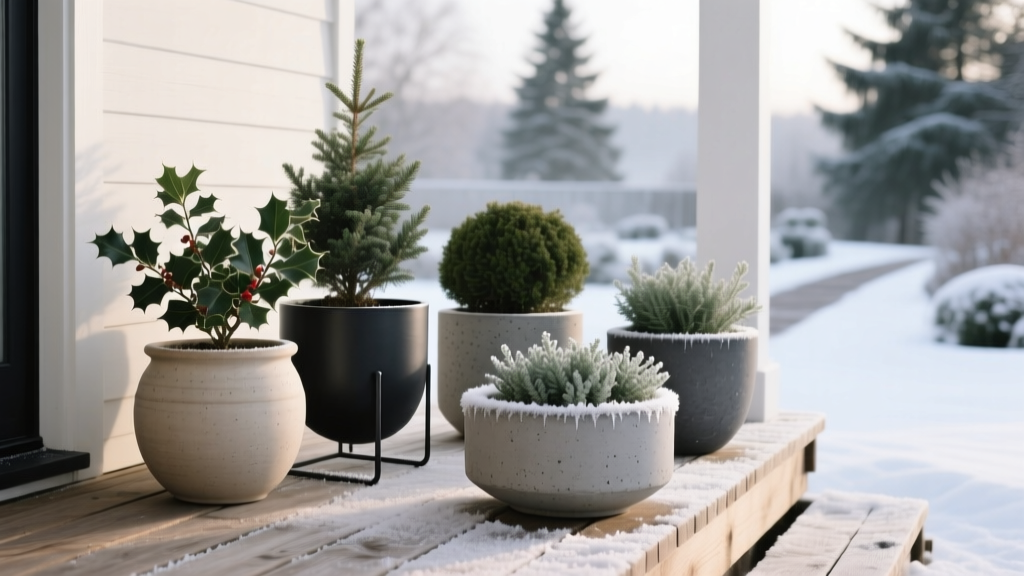
Porch Winter Hardy Planter Selection
The first hard frost always arrives on a busy week. You come home after dark, step onto the porch, and the containers that looked generous in October now feel empty—soil exposed, leaves melted, a few brittle stems rattling in the wind. The porch light catches every bare spot. If your front door is the face of your home, winter planters are the expression you wear for the longest season. The goal isn’t to “keep flowers going.” It’s to build a winter composition that holds shape, color, and calm—through freeze, thaw, wind, and weeks when you don’t want to fuss.
Let’s design porch planters the way a landscape designer would: start with the constraints (space, sun, wind), choose containers that survive, and then assemble plants and accents that look intentional from the curb and still work when temperatures drop below 20°F. Along the way, you’ll see three real-world scenarios—renter-friendly, narrow stoop, and a big exposed porch—and how the same principles flex to fit each.
Start with the porch “microclimate,” not the plant list
Winter containers succeed or fail based on microclimate more than plant labels. A porch is a strange place: warmer near the wall, colder at the edge, and often windier than the garden. Before buying anything, take five minutes and answer three questions.
1) Sunlight hours: count the winter sun, not summer sun
In winter, the sun angle is low and shadows stretch. A spot that gets “full sun” in July may only get 3–4 hours in December. For winter planters:
- Full sun planters: target 5–6 hours of winter sun for best color on hardy evergreens and winter-blooming pansies (where they overwinter).
- Bright shade planters: 2–4 hours is enough for conifers, hollies, heuchera, and winter interest stems.
2) Wind exposure: your #1 winter container problem
Wind desiccation (drying) is why “hardy” plants fail in pots. A planter at the porch edge can be effectively one zone colder than the rest of your yard. If your porch faces north or sits on a corner lot, plan for wind by using heavier containers, clustering, and choosing plants that don’t mind drying out (small conifers, heathers, boxwood, hollies).
3) The freeze-thaw cycle: choose containers that won’t crack
Unglazed terracotta and thin ceramic often crack in freeze-thaw conditions. If you love the look, use terracotta as an outer sleeve and keep the plant in a plastic nursery pot inside it (more on this in DIY options).
Layout strategies: design with proportion, repetition, and a focal point
Winter planters work best when you think like a set designer. Your porch is the stage; your door is the main actor. We want planters that read clearly from the sidewalk and still feel satisfying up close.
Anchor the entry with “pairing” and scale
Two planters framing a door is the simplest winter upgrade, and it’s renter-friendly because it’s not permanent. Use containers that are proportionate to the door:
- For a standard 36-inch-wide front door, aim for planters that are 18–22 inches wide at the rim and at least 16–20 inches tall.
- If the porch is narrow, go taller rather than wider: a 14–16 inch wide column pot can look substantial without blocking the walkway.
Use the “thriller / filler / spiller” framework—winter edition
In winter, the thriller is usually evergreen structure (a dwarf conifer or tight boxwood). Fillers are texture (heuchera, ivy, heather), and spillers are trailing evergreens or branches (creeping juniper, ivy, or cut greens). If you’re in a colder climate where perennials don’t overwinter well in containers, substitute with cut greens and hardy twigs.
Design for sightlines: curb view vs. close-up
From the street, winter planters need bold shape and contrast. Up close, they need detail. That’s why a tight evergreen form plus a few dramatic accents (red twig dogwood, berries, pinecones) works so well: it reads from 30 feet and still rewards you at the doorstep.
Pick containers that survive winter (and look good doing it)
Container choice is half the battle. If your pot cracks, your design collapses. If your pot is too light, the wind tips it. Here are practical specs that work well for most porches:
- Material: fiberglass, resin, thick plastic, or frost-rated glazed ceramic.
- Minimum soil volume: aim for 10–15 gallons per planter if you want live shrubs to overwinter. More soil buffers temperature swings.
- Drainage: at least 1–3 drainage holes. In winter, soggy soil freezes and heaves roots.
- Weight: add 5–10 lb of gravel in the base for stability (keep drainage open by separating gravel from soil with landscape fabric).
Budget reality: good winter-worthy planters often cost more than the plants. Expect $45–$120 per quality resin/fiberglass pot, and $12–$35 for a sturdy thick plastic option. DIY is possible (see below), but avoid anything that traps water.
Plant selection: dependable varieties that hold structure in the cold
Below are plants that perform well in winter planters, with specific varieties and the design job each one does. Always cross-check with your USDA hardiness zone and remember: container plants experience colder roots than in-ground plants.
“Woody plants in containers are effectively exposed to colder conditions than the same plants in the ground because their roots are aboveground and uninsulated.” — University of Illinois Extension (2020)
Evergreen “thrillers” (structure that reads from the curb)
- Dwarf Alberta spruce (Picea glauca ‘Conica’): classic porch mini-tree shape, dense, holds form. Best in bright sun to part shade. Slow-growing; great for repeated winter use.
- Boxwood (Buxus sempervirens ‘Green Gem’ or ‘Green Velvet’): tight, rounded structure; looks tailored. Protect from harsh wind to prevent bronzing.
- Hinoki cypress (Chamaecyparis obtusa ‘Nana Gracilis’): sculptural fans, rich green; excellent for close-up texture and a refined look.
- Juniper (Juniperus conferta ‘Blue Pacific’): blue-green tone, tough, handles wind well; can also spill if allowed to drape.
Cold-season “fillers” (color and texture at human height)
- Heuchera ‘Caramel’ or ‘Obsidian’ (coral bells): evergreen to semi-evergreen foliage in many climates; adds warm amber or deep purple-black. Great contrast against conifers.
- Heath/heather (Erica carnea ‘Springwood Pink’, Calluna vulgaris cultivars): fine texture and winter bloom potential in milder areas; looks great with stone and brick porches.
- Helleborus x hybridus (Lenten rose): winter-to-early spring flowers in many regions; glossy foliage. Best for sheltered porches with morning sun.
Spillers and edge-softeners
- English ivy (Hedera helix ‘Needlepoint’): reliable trailing green; use sparingly so it doesn’t swallow the design.
- Creeping juniper (Juniperus horizontalis ‘Blue Chip’): hardy, drapes nicely, adds silver-blue tone.
- Carex oshimensis ‘Evergold’ (Japanese sedge): arching cream-and-green blades; provides movement without looking messy.
Seasonal accents (the secret to “designed,” not “leftover”)
Even if you overwinter live plants, finish the composition with cut materials. They’re inexpensive and instantly elevate the look.
- Red twig dogwood (Cornus sericea stems): bright red lines that glow at dusk.
- Winterberry holly (Ilex verticillata) cut stems: red berries; use only if you can keep them out of reach of pets that chew.
- Pine boughs, cedar, and fir: bulk and fragrance; tuck around the soil surface to hide mulch.
Comparison table: best winter porch planter “recipes” by condition
| Porch condition | Recommended thriller | Filler/spiller | Why it works | Typical cost (per pot) |
|---|---|---|---|---|
| Windy, exposed (corner lot) | Juniper ‘Blue Pacific’ | Carex ‘Evergold’ + cut pine | Tolerates drying winds; flexible foliage; strong winter color | $35–$85 |
| Bright shade (covered porch) | Boxwood ‘Green Velvet’ | Heuchera ‘Obsidian’ + red twig dogwood | Boxwood holds structure; dark foliage boosts contrast in low light | $45–$110 |
| Sunny, sheltered (south-facing) | Dwarf Alberta spruce | Erica carnea + ivy | Spruce keeps a crisp silhouette; heather adds fine texture and potential bloom | $40–$120 |
| Minimal maintenance (travel often) | Hinoki cypress ‘Nana Gracilis’ | Cut cedar + pinecones | Slow-growing, tidy; cut greens do the seasonal heavy lifting | $55–$140 |
Three real-world porch scenarios (and exactly how I’d lay them out)
Let’s translate principles into porch-specific plans. Each scenario includes practical dimensions, spacing, and an approach that looks designed—not improvised.
Scenario 1: The renter’s stoop (no drilling, no heavy lifting)
Space: a 4 ft x 6 ft stoop with one step and a storm door that needs clearance. Goal: winter curb appeal without permanent changes.
Layout: Use two tall, narrow planters set back from the door swing. Choose 14-inch diameter by 20–24 inch tall resin pots. Place them 8–10 inches from the door trim so the door and storm door clear.
Planting: One dwarf conifer per pot (Dwarf Alberta spruce is ideal), underplanted with heuchera. Add three red twig dogwood stems per pot for winter color.
Why it works: Tall pots give presence without eating walkway space. The dogwood provides instant color even if foliage gets a little windburn.
Scenario 2: Narrow rowhouse porch (everything feels cramped)
Space: a 3 ft wide porch run with railing; mail carrier needs clear passage. Goal: create rhythm along the rail without blocking traffic.
Layout: Skip big floor pots. Use two railing planters (about 24 inches long each) plus one statement pot near the door. Space railing planters 36 inches apart so the repetition feels intentional.
Planting: Railing planters: cut greens (cedar + pine) with winterberry stems—no live roots to freeze. Statement pot: boxwood ‘Green Gem’ with creeping juniper to soften the rim.
Why it works: You get winter impact at eye level while keeping the floor plane open. Cut greens handle shade and cold better than struggling annuals.
Scenario 3: Large exposed porch (beautiful, but windy and dry)
Space: an 8 ft deep porch with two large columns. Goal: make it feel welcoming even in January winds.
Layout: Create a “nested entry”: place two large planters (about 20–22 inches wide) at the base of the columns, then add two smaller accent pots (about 14–16 inches) closer to the door. Keep a clear walking lane of at least 36 inches.
Planting: Large pots: juniper ‘Blue Pacific’ or a hardy upright conifer, plus Carex ‘Evergold’. Smaller pots: heuchera + cut pine + pinecones. Add gravel weight in each pot base (8–10 lb) to prevent tipping.
Why it works: The big pots take the wind visually and physically. The smaller pots create detail and a sense of shelter near the door.
Step-by-step: setting up winter hardy porch planters that last
This is the workflow I use when installing winter containers for clients—scaled for homeowners and renters.
- Measure the landing. Note the door width (often 36 inches), walkway clearance (target 36 inches minimum), and how far the door swings.
- Choose container size by proportion. For most entries, start with 18–22 inch wide pots. For narrow porches, choose 14–16 inch wide but taller forms.
- Check drainage. Confirm at least 1–3 holes. If none, use the pot as a cachepot and keep plants in nursery pots.
- Add stability. Place 5–10 lb of gravel in the bottom (don’t block holes). In very windy sites, go heavier.
- Use winter-ready potting mix. A peat/coir-based mix drains better than garden soil, which compacts and freezes hard.
- Plant the “thriller” first. Keep it centered or slightly offset toward the viewing angle (usually toward the walkway).
- Place fillers at 6–8 inch spacing. In a 20-inch pot, that’s usually 3–5 filler plants depending on size.
- Soften the edge with a spiller. Tuck it near the rim; don’t bury the crown.
- Top-dress. Cover soil with pine boughs, moss, or bark to reduce freeze-thaw heaving and make it look finished.
- Add cut accents last. Push branches deep (at least 4–6 inches) into the soil so wind doesn’t pull them out.
Budget planning and smart DIY alternatives
Winter planters can be surprisingly affordable if you separate “reusable structure” from “seasonal dressing.” Here’s a practical cost framework:
- Reusable pot: $45–$120 (resin/fiberglass). Thick plastic can be $12–$35.
- Evergreen shrub (1-gallon): often $18–$35, depending on species and region.
- Heuchera or sedge (4-inch pot): commonly $6–$12.
- Cut greens bundle: typically $8–$25 at garden centers or tree lots.
DIY alternative #1: “Pot-in-pot” for renters and terracotta lovers. Place a nursery pot inside your decorative container. Fill the gap with crumpled leaves or straw for insulation. This reduces cracking risk and makes swapping seasonal designs easy.
DIY alternative #2: Build a winter insert. Cut a circle of rigid foam to fit the pot rim and punch holes for branches. This lets you create a lush arrangement using cut greens without filling the whole pot with soil. It’s lighter, cheaper, and quick to refresh after storms.
DIY alternative #3: Forage smartly (and legally). Fallen pinecones, pruned branches, and your own evergreen trimmings can reduce costs dramatically. Keep the design cohesive by sticking to 2–3 materials plus one accent color (like red dogwood stems).
Maintenance expectations: what it really takes week to week
Winter planters shouldn’t become a chore. Expect about 10–20 minutes per week for a pair of planters, mostly quick visual checks.
Weekly (or after storms)
- Check moisture on mild days. If temperatures are above 40°F and the soil is dry 2 inches down, water lightly. Evergreens still transpire in winter.
- Re-seat branches. Wind can loosen cut stems; push them back in firmly.
- Brush off heavy snow. A gentle sweep prevents breakage, especially on dwarf spruce.
Seasonal tasks (late fall through early spring)
- Before deep freeze: water thoroughly once; hydrated plants handle cold better.
- Midwinter thaw: inspect for heaving (roots pushing up). Press soil back down and top-dress if needed.
- Early spring (when nights stay above ~25°F): remove cut greens, refresh top layer of soil, and prune any winter-burned tips.
One key expectation-setting note: many perennials and shrubs are listed as hardy to a certain zone in-ground, but containers are harsher. The USDA explains that hardiness zones reflect average annual minimum winter temperature and are a starting point—not a guarantee for every microclimate (USDA ARS, 2012). If you want consistent success, choose plants at least one zone hardier than your location when growing in pots.
Plant combinations that look designer-made (and why they hold up)
Use these as plug-and-play recipes. Each is built around repeatable structure and winter-proof contrast.
Recipe A: Classic evergreen with red accents (best for most homes)
Container: 20-inch diameter pot. Sun: 3–6 hours.
- 1 x Dwarf Alberta spruce (center)
- 3 x Heuchera ‘Caramel’ (around, 6–8 inches apart)
- 3–5 red twig dogwood stems (inserted deep)
- Top-dress with cedar boughs
Why it works: Strong shape + warm foliage + red lines = winter readability, even at dusk.
Recipe B: Modern silver-and-black (sharp on contemporary porches)
Container: tall matte black pot, 16–18 inches wide. Sun: 4–6 hours.
- 1 x Juniper ‘Blue Pacific’ (slightly off-center)
- 3 x Heuchera ‘Obsidian’
- 1 x Carex ‘Evergold’ for movement
- Finish with pale birch twigs
Why it works: The blue/silver foliage reads “clean” in snow season, and the dark heuchera keeps it grounded.
Recipe C: Low-light lush (covered porch, north or east exposure)
Container: 18–22 inch pot. Sun: 2–4 hours bright shade.
- 1 x Boxwood ‘Green Gem’
- 2–3 x Helleborus (if your winters are not brutally cold on the porch) or heuchera if colder
- English ivy to trail
- Cedar bough collar to finish
Why it works: Glossy greens look rich in shade; boxwood provides the “organized” look winter needs.
If you build your porch planters like a small landscape—solid structure, repeated forms, and a few bold seasonal accents—you won’t dread the first frost. You’ll be the house that still looks welcoming when the neighborhood is quiet, the light is low, and winter is doing its best to erase everyone else’s color.
Sources: USDA Agricultural Research Service. (2012). USDA Plant Hardiness Zone Map. University of Illinois Extension. (2020). Winter care for container plants (guidance on aboveground root exposure and winter injury in pots).