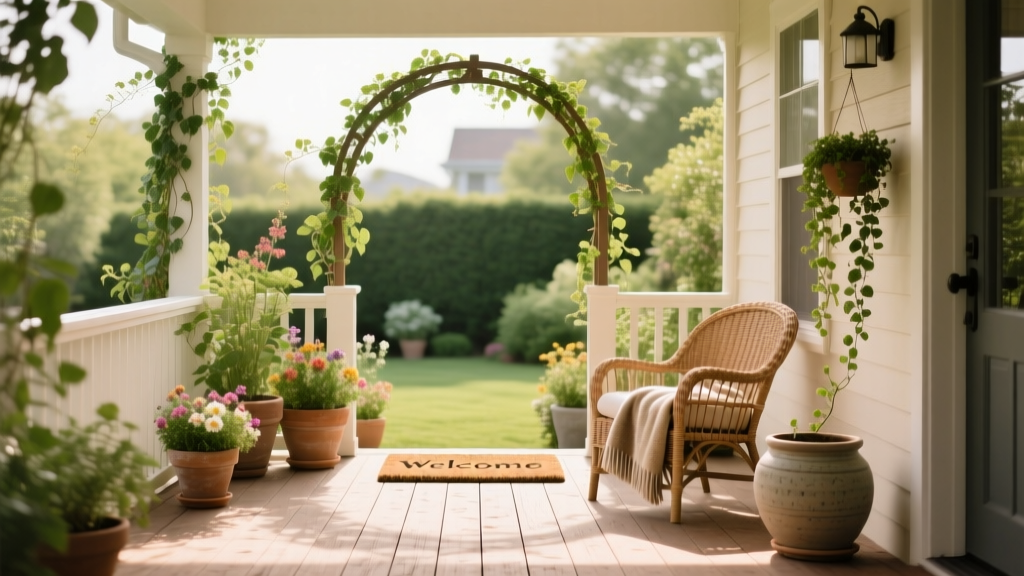
Porch Welcome Garden Ideas
You know the moment: you pull into the driveway after a long day, and your eyes land on the porch. The steps are fine, the door looks okay—but the entry still feels flat. Maybe the space is too narrow for “real landscaping,” or your HOA doesn’t want digging, or you rent and can’t change much. A porch welcome garden solves that in the most practical way: it frames the approach, softens hard edges, and makes the front door feel intentional—without needing a full yard renovation.
Think like a designer for a minute. Your porch is the “face” of the home. Even a 3 ft x 6 ft strip beside the steps or a pair of containers can create a clear welcome message: “Someone cares for this place.” The trick is layout—placing plants where they guide the eye and the feet—plus plant choices that look good from the curb and hold up to heat, wind, and missed waterings.
Start with the approach: what do visitors see first?
Before buying a single plant, stand at the sidewalk or parking spot and look toward your door. Your welcome garden should do three jobs: mark the entry, guide movement, and create a tidy frame that doesn’t block the walkway.
Measure three critical dimensions
Grab a tape measure and jot these down. These numbers drive every layout decision:
- Walkway width: Keep at least 36 inches clear for comfortable passage (more if you can).
- Planting depth: A workable in-ground welcome bed can be as shallow as 18–24 inches; containers can replace beds entirely.
- Door swing + step clearance: Leave 12–18 inches from the edge of steps/door swing to the nearest pot or shrub so it never feels cramped.
Light check: count your porch sun hours
Most porch gardens fail because the plant palette doesn’t match the light. Do a quick check over one day:
- Full sun: 6+ hours of direct sun
- Part sun/part shade: 3–6 hours
- Shade: under 3 hours (common under deep roof overhangs)
Also note reflected heat from concrete and brick. South- and west-facing porches often run hotter and drier than expected.
Layout strategies that make a porch feel designed (not “planted”)
Use the “frame + focal point” formula
This is the easiest designer trick to replicate. You create a frame on both sides of the entry (symmetry feels welcoming), then add one focal element that provides personality.
- Frame: two matching containers or two narrow beds flanking the steps.
- Focal point: a single statement planter, a seasonal wreath, a sculptural shrub, or a small trellis with a vine.
“Foundation plantings should never block access or cover windows; they should soften the transition between house and ground plane.” — University of Georgia Extension, 2019
Layer heights the way your eye reads them
On a porch, plants are viewed from above (as you walk up) and from afar (from the street). A reliable height recipe:
- Back layer (closest to house): 24–48 inches tall (evergreen or upright texture)
- Middle layer: 12–24 inches (mounding color + foliage)
- Front edge: 4–10 inches (spilling or edging plants)
If your bed is only 18 inches deep, compress the layers: one compact shrub plus one mounding perennial and one spiller. The goal is still a stepped profile, not a tall wall.
Design for the “doorway pause”
People slow down right at the door. That’s your scent and detail zone. Put fragrant plants and fine textures within 3 feet of where someone stands to knock—just not where they’ll brush against thorns or wet foliage.
Keep it simple: limit your palette
For a small welcome garden, too many plant types reads messy. A good rule is:
- 1–2 structural plants (shrubs, grasses, or topiary)
- 2–3 flowering “main characters”
- 1–2 trailing/edging plants
Scenario plans: real porch constraints and how to design around them
Scenario 1: The narrow stoop (renter-friendly, no digging)
Space: a small stoop with just 4 ft of width and maybe 2 ft depth beside the steps. Your best move is a container-only layout that still looks intentional.
Layout: Use two tall, slim planters (around 12–14 inches wide and 18–22 inches tall) flanking the door if space allows, or one tall planter plus a lower bowl on the opposite side. Keep the walkway clear at 36 inches.
Planting recipe (part shade, 3–5 hours):
- Thriller: Hydrangea paniculata ‘Little Lime’ (in a larger pot, best with more sun; swap to boxwood or holly fern if shade is deep)
- Filler: Heuchera ‘Caramel’ (great foliage color, handles containers)
- Spiller: Dichondra ‘Silver Falls’ (brightens shade, drapes beautifully)
Budget: Two composite planters can run $35–$60 each. DIY alternative: use nursery pots inside thrifted baskets (line with plastic) for under $20 per container.
Scenario 2: The sunny steps with heat reflection (low water, high impact)
Space: a 3 ft x 8 ft strip along steps, full sun 6–8 hours, with heat bouncing off concrete. Here, your welcome garden needs drought tolerance and a crisp edge.
Layout: Run a simple edging line parallel to the walk, leaving 36–42 inches of clear path. Place one upright plant at the “turn” or base of the steps to anchor the scene.
Planting recipe (full sun):
- Anchor: Juniperus conferta ‘Blue Pacific’ (low, evergreen, salt/heat tolerant)
- Color blocks: Salvia nemorosa ‘Caradonna’ (upright purple spikes; pollinator-friendly)
- Long bloom: Echinacea ‘PowWow Wild Berry’ (strong color, sturdy stems)
- Edge/spill: Sedum spurium ‘Dragon’s Blood’ (tight groundcover, clean line)
Spacing: Plant salvias about 18 inches apart; echinacea 18–24 inches apart; sedum plugs 8–12 inches apart for faster fill. Mulch 2 inches deep to reduce watering.
Cost note: A simple drip line kit for a small bed often costs around $25–$40, and it’s one of the best “welcome garden” upgrades if you travel.
Scenario 3: The shaded, covered porch (lush without sun)
Space: deep roof overhang, bright shade (1–3 hours of sun). This is where foliage becomes your flower. Texture and shine carry the design.
Layout: Use three containers: two matching medium pots plus one slightly taller “statement” pot. Stagger them so they form a shallow triangle, not a straight line—this reads more natural and gives depth.
Planting recipe (shade):
- Structure: Buxus microphylla ‘Winter Gem’ (compact boxwood; can be clipped)
- Lush filler: Hosta ‘Halcyon’ (blue leaves that glow in shade)
- Fine texture: Carex oshimensis ‘Evergold’ (bright variegation, graceful form)
- Trailing: Hedera helix ‘Needlepoint’ (or swap to creeping Jenny in brighter shade)
Why this works: In shade, strong leaf color contrast is your “bloom.” Blue hosta + gold carex + deep green boxwood reads polished from the curb.
Plant selection: dependable varieties that look good at the front door
Welcome gardens get scrutinized. You want plants that hold their shape, recover from missed watering, and don’t constantly shed petals on the steps. Below are designer-favorite options organized by job.
Evergreen “bones” (structure year-round)
- Buxus (Boxwood) ‘Winter Gem’: Classic porch framing plant; tolerates clipping into neat forms. Best with some sun, but handles bright shade.
- Ilex crenata ‘Sky Pencil’ (Japanese holly): Narrow and upright—great when space is tight. Looks formal without being fussy.
- Juniperus ‘Blue Pacific’: Low, spreading evergreen that reads clean and coastal; great for sunny steps.
Flowering workhorses (long season, tidy habit)
- Salvia nemorosa ‘Caradonna’: Upright, architectural, long bloom with deadheading; hardy and heat-tolerant.
- Lavandula ‘Hidcote’ (Lavender): Scent at the doorway; needs full sun and sharp drainage—excellent for containers with gritty mix.
- Hydrangea paniculata ‘Bobo’: Compact hydrangea for smaller entries (more sun-tolerant than bigleaf types). Needs consistent moisture.
Edgers and spillers (the finishing detail)
- Dichondra ‘Silver Falls’: Soft, reflective trailing foliage; brightens porches and pairs with almost anything.
- Sweet alyssum (Lobularia maritima): Low, fragrant edging in cool seasons; can thin in heat.
- Sedum spurium ‘Dragon’s Blood’: Crisp edge for sunny beds; great color even when not flowering.
Quick comparison: beds vs. containers for porch welcome gardens
| Option | Best for | Typical footprint | Watering needs | Ballpark cost |
|---|---|---|---|---|
| In-ground bed | Homeowners, long-term planting, more soil volume | 18–36 in deep strip along walk | Lower once established | $80–$250 (plants + mulch + edging) |
| Containers (2–3 pots) | Renters, small stoops, quick seasonal swaps | 2–6 sq ft total | Higher (especially in sun) | $70–$300 (pots + soil + plants) |
| Hybrid (small bed + 1–2 pots) | Most porches; best visual depth | Bed + pots near steps | Moderate | $120–$400 (depending on pot quality) |
Step-by-step: set up a porch welcome garden that stays neat
Option A: Building a small in-ground welcome bed
- Mark the shape: Use a hose to outline a simple curve or straight strip. Keep the deepest point around 24–30 inches for easy planting without crowding the walkway.
- Edge it: Install steel or composite edging to keep mulch tidy. Plan on roughly $2–$4 per linear foot depending on material.
- Prep the soil: Loosen soil 8–10 inches deep and mix in compost. If drainage is poor, build up a slightly raised bed by 2–3 inches.
- Place plants in pots first: Set everything (still in nursery pots) and view from the street. Adjust until it looks balanced.
- Plant and water in: Water each plant thoroughly after planting (a slow soak), then mulch 2 inches.
- Add lighting (optional): Two solar path lights at the base of steps can be enough. Place them 18–24 inches from the walkway edge so they don’t get kicked.
Option B: Designing container arrangements that don’t tip, scorch, or sulk
- Choose stable pot sizes: For windy porches, pick containers with a base width of at least 12 inches.
- Use quality potting mix: Don’t use garden soil in containers; it compacts. Refresh the top 2–3 inches each spring.
- Follow a 1–2–1 plant count: 1 structural plant, 2 fillers, 1 spiller (per pot) for a full look without overcrowding.
- Water deeply: In summer sun, expect to water containers 3–5 times per week. In shade, often 1–2 times per week.
- Elevate for drainage: Use pot feet or bricks so water can escape—especially on covered porches.
Budget-minded choices and DIY alternatives
A porch welcome garden doesn’t need luxury planters and specimen shrubs. Put your money where it shows: one or two structural plants and containers that fit the style of the house.
- Save on containers: Buy plain resin pots and paint them matte black, warm gray, or porch-trim white. A $12–$18 pot can look custom with a consistent color scheme.
- Buy smaller plants, plant tighter temporarily: Start with 1-gallon perennials (often half the price of 2–3 gallon). Use annuals to fill gaps the first season.
- Mulch smart: A single bag of mulch typically covers about 2 cu ft; for a 3 ft x 8 ft bed at 2 inches deep, you’ll need roughly 4 cu ft (about two bags).
- Use cuttings: Coleus, sweet potato vine, and some ivies root easily from cuttings—perfect for renters building a look over time.
Maintenance expectations: what it really takes to keep it welcoming
Porch gardens are small, so maintenance is lighter than a full landscape—but it’s more visible. Plan on 20–40 minutes per week during the growing season for a container-heavy setup, and 15–30 minutes per week for an in-ground bed once established.
Weekly rhythm (growing season)
- Watering: Check moisture with your finger. Water when the top 1 inch is dry (containers dry faster).
- Grooming: Remove spent blooms and yellow leaves so the entry stays crisp.
- Sweep the hardscape: A 2-minute sweep of petals and leaves keeps the whole front door area looking “managed.”
Seasonal tasks
- Spring: Refresh mulch, prune winter damage, replace the top layer of potting mix, slow-release fertilizer in containers.
- Summer: Deadhead salvias and annuals; watch for spider mites on stressed porch plants.
- Fall: Swap annuals for pansies, ornamental kale, or small mums; cut back perennials as needed.
- Winter: Use evergreen boughs in pots; protect tender containers from freeze-thaw cycles by moving them against the house.
Small design details that make the entry feel finished
A welcome garden is more than plants. It’s the relationship between plants, path, and porch details.
- Repeat a material: If your porch has black railings, repeat black in planter color or lighting.
- Match scale to architecture: A tall, narrow house likes taller planters (think 20–24 inches tall). A cottage looks best with lower, fuller masses.
- Use warm light: If you add lighting, choose a warmer color temperature (around 2700K) so the plants look inviting at night.
Citations that inform smart porch-garden choices
Two research-backed points are worth keeping in your back pocket: (1) plants can measurably improve how people perceive a space, and (2) good foundation planting principles prioritize access and appropriate scale.
- Bringslimark, T., Hartig, T., & Patil, G. G. The psychological benefits of indoor plants: A critical review of the experimental literature. Journal of Environmental Psychology, 2009.
- University of Georgia Extension. Foundation Plantings, 2019. (Guidance on keeping plantings in scale and maintaining access.)
If you’re standing on your porch right now and it feels bare, don’t overthink it. Start with the approach: keep the walkway clear, add a frame (two pots or two small beds), and pick plants that match your actual sun hours. The best porch welcome gardens aren’t complicated—they’re consistent. After a couple of weekends of small tweaks, you’ll notice something subtle but real: you’ll slow down at your own front door, because it finally feels like it belongs to you.