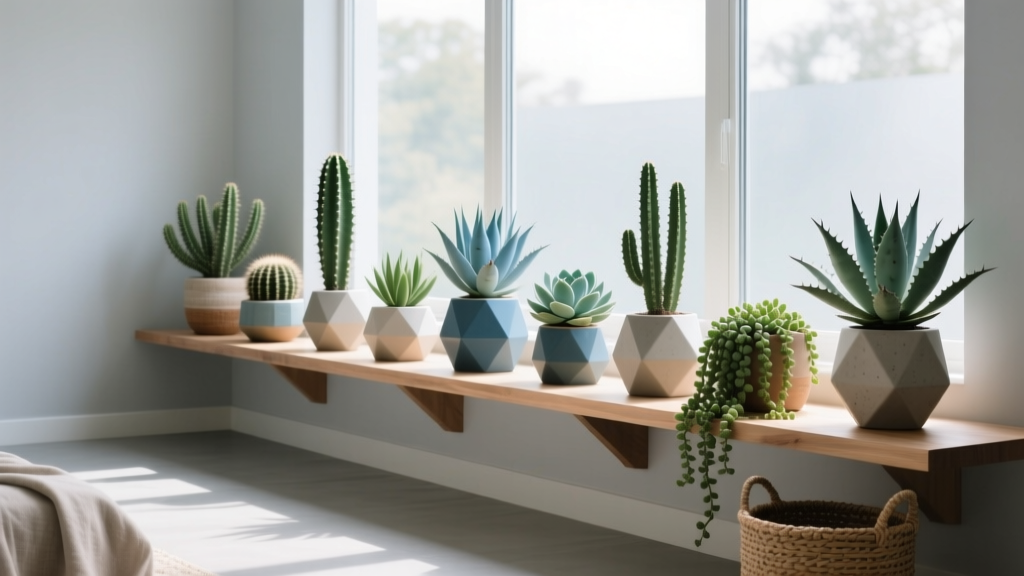
Sunroom Cactus and Succulent Display
At 2:17 p.m., the sunroom looks perfect on paper: bright light, clean windows, a warm spot to read. But on the plant shelf, it’s chaos—three stretched-out succulents leaning like they’re trying to escape, a cactus with a sunburned side, and a tray of cuttings that never quite rooted. The problem isn’t your “plant skills.” It’s that sunrooms create microclimates: intense sun angles, sudden temperature swings, and pockets of shade from window frames and furniture. The fix is a display designed like a small landscape—planned sightlines, controlled light, intentional spacing, and a watering routine that matches real life.
Below is a designer’s walk-through for building a cactus and succulent display that looks curated, stays healthy, and works for homeowners and renters alike—no built-in cabinetry required.
Start with the room, not the plants: a quick site survey
Before you buy another pot, take 10 minutes to “read” the sunroom. Two measurements and one observation will steer every decision you make.
Measure your usable footprint (and keep walkways generous)
Most sunrooms get cluttered because we treat the perimeter as infinite. It isn’t. Start by marking a clean circulation path.
- Minimum walkway: 30 inches is comfortable for most people; 36 inches feels luxurious if you have it.
- Display depth limit: Keep shelves/tables to 12–16 inches deep so light reaches plants and you can water without gymnastics.
If you’re working with a narrow sunroom—say 6 ft x 10 ft—plan for one primary display wall and one “accent cluster,” not four competing plant stations.
Track sun hours by window, not by guesswork
Succulents and cacti can handle strong light, but the difference between “bright” and “full sun” is what causes stretching or scorch. Use your phone and note direct sun hours for each window zone.
- Full-sun zone: 6–8 hours of direct sun (often south- or west-facing).
- Bright zone: 3–5 hours of direct sun or all-day bright indirect light (east-facing mornings, filtered glass, overhangs).
- Buffer zone: 0–2 hours direct sun (near doors, corners, behind furniture).
As a baseline, many succulents do best with “bright light,” while many cacti thrive with longer direct sun. Cornell University notes that most succulents prefer bright light and can scorch if abruptly moved into intense sun without acclimation (Cornell University Cooperative Extension, 2020).
Check heat and cold swings at glass level
Place a thermometer near the glass for one day. Sunroom temperatures can spike well above the rest of your home. The U.S. National Park Service cautions that unshaded glass can create very high heat in enclosed spaces—cars are the classic example, but sunrooms behave similarly (National Park Service, 2023).
If your sunroom routinely exceeds 90°F on sunny afternoons, you’ll want ventilation and a light-filtering strategy for sensitive succulents (especially Haworthia, Gasteria, and thin-leaved aloes).
Layout strategies that make a sunroom display feel intentional
Think of the display as a mini garden bed: structure first, then plant layers, then accents. These strategies keep your collection from looking like a plant sale table.
Use the “three-tier” rule: floor, mid, and eye level
A strong display includes three heights. This creates rhythm and prevents the “all pots in a row” effect.
- Floor tier (anchor): 1–3 larger statement pots (10–14 inch diameter) with architectural plants.
- Mid tier (workhorse): A bench or console (12–16 inches deep) holding the majority of your collection.
- Eye tier (gallery): One or two shelves for trailing plants, smaller rarities, and propagation trays.
For renters, a freestanding metal rack (roughly 48 inches wide) gives you tiers without wall holes. For homeowners, floating shelves can look built-in—just keep them shallow (10–12 inches) so plants aren’t shaded by the shelf above.
Design a focal point, then support it
Pick one focal plant with a strong silhouette and give it breathing room. Aim for at least 6–8 inches of clearance around its pot so it reads as a feature, not clutter.
Good focal candidates: a sculptural Euphorbia (often sold as “cactus,” though it’s not a true cactus), a tall columnar cactus, or a large Aloe.
Group by water rhythm, not by “succulent vs. cactus”
In a sunroom, your biggest risk is inconsistent watering. Group plants that dry at similar speeds. Put thirsty succulents together (many aloes), and keep true desert cacti in a separate cluster that can go longer between waterings.
“The fastest way to kill succulents indoors is to water on a schedule instead of watering by dryness. Design your display so the plants that dry together live together.” — Brittney Morgan, horticulturist and author, quoted in Better Homes & Gardens (2022)
Plan spacing like a designer (and like airflow matters)
Give plants space now, not later. Crowding reduces airflow and makes it harder to see pests early.
- Small pots (2–4 inch): 2–3 inches between pot rims.
- Medium pots (6 inch): 4–6 inches between pot rims.
- Large pots (10–14 inch): 8–12 inches between pot rims.
These gaps also create a cleaner visual grid—your eye can “rest,” which makes the display feel curated even if you own 40 plants.
Use light control as a design tool
Sheer curtains aren’t just decor; they’re a light diffuser. If you get harsh afternoon sun, a simple white sheer can reduce scorch and stabilize temperatures.
- Best for west windows: Sheers or solar shades during peak sun (roughly 2–6 p.m.).
- For sensitive succulents: Place them 12–24 inches back from the glass.
- For sun-loving cacti: Place within 6–12 inches of the glass, rotated quarterly for even growth.
Three real-world layouts (choose what matches your space)
These scenarios are based on common sunroom realities: tight footprints, mixed light, and living with furniture you actually use.
Scenario 1: Narrow rental sunroom (6 ft x 10 ft) with an east window
Goal: Morning sun display that doesn’t block the room.
Layout: One 48-inch wide shelving unit against the long wall + a 36-inch bench under the window (if the window sill height allows). Keep the center walkway at 30 inches minimum.
Plant strategy: Favor Haworthia, Gasteria, compact aloes, and Crassula that tolerate bright light without needing scorching afternoon sun.
DIY alternative: Use two stacked wire closet shelves on brackets (shallow depth) and add waterproof boot trays as drip catchers.
Scenario 2: Homeowner sunroom (10 ft x 12 ft) with south exposure and intense midday heat
Goal: Big, botanical impact without crispy plants.
Layout: Create an L-shaped display: a 60-inch console table on one wall + a corner plant stand for a tall focal cactus. Add a sheer shade for the hottest window zone.
Plant strategy: Put true cacti closest to glass; keep rosette succulents (Echeveria) slightly back. Use heavier pots (ceramic/terracotta) for tall plants to prevent tipping.
Budget note: If you’re buying mature specimens, expect a statement cactus in a 10–12 inch pot to run $60–$150 depending on species and size.
Scenario 3: Mixed-use sunroom office with a north window and one bright corner
Goal: A “gallery” of succulents that doesn’t demand perfect sun.
Layout: A slim 12-inch deep bookcase near the brightest corner + one desktop tray garden. Consider a grow light for consistency.
Plant strategy: Focus on low-light tolerant succulents: Haworthia, Sansevieria (often reclassified as Dracaena), Gasteria, and some Rhipsalis (jungle cactus) that like bright indirect light.
Lighting cost: A quality LED grow light bar setup typically runs $25–$80. Set it for 10–12 hours daily if direct sun is limited.
Plant selection: specific varieties and why they work in sunrooms
A sunroom display shines when you mix silhouettes: columns, rosettes, paddles, trails, and “oddities.” The trick is matching each plant to your light zones and your watering habits.
Reliable architectural anchors (floor or focal pots)
- Sansevieria/Dracaena trifasciata (‘Laurentii’ or ‘Moonshine’): Tolerates lower light corners, upright form, and forgiving watering. Great in office sunrooms.
- Aloe arborescens: Taller, branching form; handles bright light and some direct sun. More tolerant than many tender aloes.
- Cereus repandus (Peruvian apple cactus): Fast-growing columnar cactus for high-light zones; dramatic silhouette.
- Euphorbia trigona (African milk tree): Bold vertical lines; drought tolerant. (Wear gloves—sap can irritate.)
Mid-tier “collection builders” (bench and shelf stars)
- Haworthia cooperi: Excellent for bright indirect light; stays compact and tidy in small pots.
- Gasteria ‘Little Warty’: Thick, patterned leaves; tolerates lower light than many rosette succulents.
- Crassula ovata (jade plant): Classic, woody structure over time; thrives with strong light and drying between waterings.
- Sempervivum (hens and chicks): Best for very bright sunrooms; can struggle indoors long-term unless light is intense.
- Echeveria ‘Lola’ or ‘Perle von Nürnberg’: Gorgeous rosettes, but demand strong light. Place in the sunniest zone and rotate weekly for symmetry.
Trailing and accent plants (eye-level shelves)
- Senecio rowleyanus (string of pearls): Trailing texture; place where it gets bright light but avoid hot glass contact to prevent scorch.
- Rhipsalis baccifera (mistletoe cactus): A jungle cactus that prefers bright indirect light—perfect for the buffer zone.
- Crassula perforata (string of buttons): Architectural stacking habit; easy to propagate, great for filling gaps affordably.
Quick comparison: choose plants by light tolerance and watering rhythm
| Plant | Best light in a sunroom | Watering rhythm | Best use in display |
|---|---|---|---|
| Haworthia cooperi | Bright indirect / gentle morning sun | Let soil dry fully; moderate drought tolerance | Mid-tier collections, office sunrooms |
| Echeveria ‘Lola’ | Strong direct sun (6+ hours) or strong grow light | Dry thoroughly; water less in winter | Showpiece rosettes near glass |
| Cereus repandus | Direct sun (south/west) | Deep but infrequent watering | Floor anchor / focal point |
| Rhipsalis baccifera | Bright indirect; avoid harsh afternoon sun | More regular watering than desert cacti | Trailing shelf plant in buffer zone |
| Crassula ovata | Bright light; some direct sun | Dry down completely between watering | Mid-tier structure, long-lived specimen |
Step-by-step setup: build the display like a small landscape
This is the sequence I use when styling a sunroom so it’s beautiful on day one and still thriving months later.
- Define zones with painter’s tape. Mark the footprint of shelves/bench and keep at least 30 inches for a walkway.
- Install drip protection first. Use waterproof trays or boot mats under every cluster. Budget $8–$20 per large tray.
- Choose 1–2 anchor plants. Place them at the ends of your main surface or in a corner to “hold” the composition.
- Add mid-size plants in groups of three. Group by pot color and plant form (one upright, one rosette, one textured).
- Leave spacing gaps on purpose. Aim for 4–6 inches between medium pots for airflow and visual calm.
- Add a propagation corner. A shallow tray (like a 10 x 20 inch nursery tray) keeps cuttings organized and prevents them from scattering across every windowsill.
- Set a rotation reminder. Rotate rosette succulents and columnar cacti quarter-turn every 7–10 days to prevent leaning.
- Label discreetly. A small tag under the pot or on the tray helps you track watering needs—especially if you have look-alike rosettes.
Soil, pots, and the hidden engineering that prevents rot
Sunrooms feel dry, but containers can stay wet longer than you expect—especially in winter. Good drainage is less about a hole in the pot and more about how fast the root zone dries.
A practical soil blend (easy to DIY)
Aim for a gritty mix that drains quickly. A simple DIY blend:
- 50% cactus/succulent potting mix
- 25% pumice or perlite
- 25% fine orchid bark or gritty sand
If you’d rather buy, choose a cactus mix and amend it with pumice/perlite. Expect to spend about $12–$18 for a bag of cactus mix and $8–$15 for pumice/perlite, depending on size and brand.
Pot choice: terracotta vs. glazed vs. plastic
Terracotta breathes and dries faster—excellent for heavy-handed waterers. Glazed ceramic holds moisture longer—fine if your light is strong and your watering is restrained. Plastic is light and cheap, but can stay wet longer and tip more easily with tall plants.
A good rule: put true desert cacti and finicky rosette succulents in terracotta if you’re unsure. Save glazed pots for tougher plants like jade or larger aloes once you know your rhythm.
Budget planning (with DIY alternatives that still look designed)
A sunroom display can be built in phases. Here are three realistic budget tracks:
- Starter ($80–$150): One shelf unit, 8–12 small plants (2–4 inch pots), DIY soil amendments, two large trays.
- Mid-range ($200–$450): Add 2–3 statement plants, upgrade to heavier planters, introduce a propagation tray and a small grow light.
- Collector ($500+): Larger specimen cacti, designer planters, custom shelving, and dedicated lighting/ventilation.
DIY style upgrade: Standard nursery pots can look intentional when slipped into matching cachepots. If matching cachepots aren’t in the budget, paint terracotta (outside only) in one neutral tone and repeat it across the display for instant cohesion.
Maintenance expectations (how much time it really takes)
If the display is zoned well, upkeep is pleasantly boring—which is exactly what you want.
Weekly rhythm (15–30 minutes per week)
- 5 minutes: Walk-by inspection—look for soft leaves, wrinkling, or pests.
- 10–20 minutes: Water only the pots that are fully dry (use a wooden skewer or your finger down 2 inches).
- 5 minutes: Rotate the plants that lean toward the glass.
Seasonal tasks (four small resets per year)
- Spring: Repot fast growers; refresh top dressing; start cuttings.
- Summer: Watch heat spikes; add sheers or increase ventilation if temps exceed 90°F.
- Fall: Reduce watering frequency as light drops; clean windows to maximize winter light.
- Winter: Expect slower growth; water sparingly; keep plants away from cold drafts near doors and single-pane glass.
If you’re tracking time: most established sunroom collections run smoothly on 1–2 hours per month of hands-on care, with an extra hour during spring repotting.
Troubleshooting the three most common sunroom issues
Design is preventative maintenance. Here’s what to watch for, and how to adjust without starting over.
Stretching (etiolation)
If rosettes lift and spaces between leaves widen, light is insufficient. Move the plant 6–12 inches closer to the window or add a grow light for 10–12 hours daily. Don’t “fix” it with more water; that usually makes stems weaker.
Sunburn
Bleached, tan patches appear after sudden exposure to strong sun. Move the plant back 12–24 inches, add a sheer, and acclimate gradually over 2–3 weeks. Damaged tissue won’t turn green again, but new growth will be healthy.
Rot and lingering wet soil
Most rot starts because the center of the pot stays wet. Improve airflow and drainage: switch to terracotta, add grit to the mix, and water deeply but less often. If a plant is mushy at the base, take cuttings from healthy tissue and restart.
A final designer’s note: your best sunroom display won’t be the one with the most plants—it’ll be the one with the clearest structure. Give your collection a backbone (tiers, zones, spacing), then let the plants do what they do best: quietly repeat form and texture in the sunlight. When you can water in one pass, rotate in another, and still see the surface of your shelves, you’ve built a display that feels calm, intentional, and very much alive.
Sources: Cornell University Cooperative Extension (2020), indoor succulent care guidance; National Park Service (2023), heat buildup in enclosed glass environments; Better Homes & Gardens (2022), horticulturist guidance on watering practices.