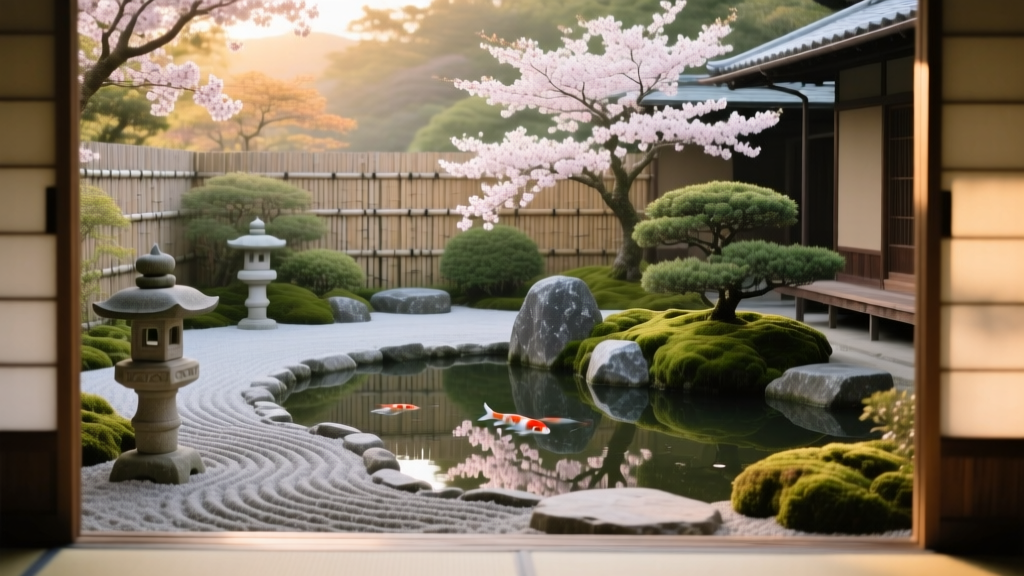
Courtyard Japanese Garden Design
The courtyard is only 12 feet by 18 feet, and it feels like a forgotten hallway: two blank walls, a downspout, and a patch of hard dirt that bakes by noon. You want calm—something you can see from the kitchen window and step into barefoot with a cup of tea—but every time you sketch an idea, it turns into “a patio with plants.” A Japanese courtyard garden solves this exact problem because it doesn’t ask for more space; it asks for clearer decisions: fewer materials, stronger lines, and plants chosen for structure as much as beauty.
Let’s walk through a layout that works for homeowners and renters, with real dimensions, realistic costs, and three on-the-ground scenarios you can borrow from. The goal is a small, legible garden that looks intentional from every angle—especially the doorway view.
Start with the courtyard’s “view seat” and one strong axis
Traditional Japanese gardens are often composed as scenes, meant to be viewed from a fixed point as much as experienced on foot. In a courtyard, your “seat” might be a kitchen sink window, a sliding door, or a bench spot. Stand there and take a photo—this becomes your primary composition frame.
Pick the main view and set a focal “anchor”
Choose one anchor you can afford and live with year-round: a boulder, a stone lantern (tōrō), a multi-stem Japanese maple, or a basin (tsukubai). Place it off-center, roughly at the 1/3 line of the view. In a 12 ft x 18 ft courtyard, that often means setting the anchor about 4–6 feet from one side wall and 6–10 feet from the viewing doorway.
“The essence of the Japanese garden is suggestion rather than display—composition that leaves room for the mind.” — Gunter Nitschke, Japanese Gardens (1993)
Use asymmetry and “borrowed view” even in tiny spaces
If you can see a neighbor’s tree canopy, a patch of sky, or even a textured wall, use it. Frame it with a pruned shrub or bamboo screen so it feels intentional. This idea—shakkei (borrowed scenery)—is widely discussed in Japanese garden history and design writing (Keane, 2016).
Layout strategies that make small courtyards feel expansive
Japanese courtyard design shines when every surface has a job. Think in three layers: ground plane (gravel/moss/pavers), mid-layer (shrubs, stones, water), and overhead (small tree canopy or trellis shadow). You’re building depth, not clutter.
Strategy 1: A “dry stream” path that slows your steps
A simple move: run a ribbon of raked gravel (or pea gravel) diagonally across the courtyard, and let stepping stones cross it. Diagonals lengthen perception. For a 12 ft x 18 ft courtyard, a dry stream 24–30 inches wide is enough to read as a feature without stealing floor space.
- Gravel depth: 2 inches over landscape fabric
- Edging: 1–2 inch steel edging or hidden brick edge
- Stepping stone spacing: 18–24 inches center-to-center for comfortable walking
Strategy 2: One “destination” corner
A courtyard can feel like a pass-through unless you give it a reason to enter. Create a small destination: a bench, a tsukubai, or a single specimen tree underplanted with moss-like groundcover. Keep the destination compact—about 4 ft x 4 ft is plenty—so it doesn’t compete with circulation.
Strategy 3: Reduce material changes to two, max three
When a small space includes five paver styles, three gravel colors, and mixed borders, it reads as busy. For a Japanese courtyard, limit yourself to:
- One hard surface (e.g., 18" square concrete pavers or natural stone)
- One loose surface (e.g., 1/4" granite gravel)
- Optional: one “soft” surface (moss, mondo grass, or creeping thyme substitute)
Three real-world courtyard scenarios (and the layout that fits)
Scenario A: Rental courtyard (no digging, no permanent changes)
Typical constraints: landlord restrictions, existing concrete slab, drainage you can’t reroute.
Layout: Place a freestanding bamboo screen (6 ft tall) against the least attractive wall, set three large pots (15–20 gallon) in an asymmetrical triangle, and create a “dry river” with gravel contained inside a shallow timber frame that sits on top of the slab.
Budget snapshot: A 6 ft x 8 ft bamboo panel screen can run $80–$160; three 20-gallon containers $45–$120 total depending on material; gravel for an 8 ft x 2.5 ft area at 2" depth is about 3.3 cubic feet (often $20–$40).
Scenario B: Narrow townhouse courtyard (bright shade, 3–5 hours sun)
Typical constraints: tall walls, reflected heat, limited planting beds (often 18–24 inches wide).
Layout: Use a stepping-stone path (18–24 inches spacing) that offsets from the wall, with a slender focal tree at the end (Japanese maple cultivar chosen for shade tolerance). Add a water bowl or a simple recirculating basin to introduce sound without a pond.
Key trick: keep shrubs pruned “cloud-like” so the wall height feels intentional rather than oppressive.
Scenario C: Owner-occupied courtyard (full sun, 6–8 hours)
Typical constraints: sun stress, glare, drying winds.
Layout: A small deck or paver pad (6 ft x 8 ft) for seating, gravel garden around it, and drought-tolerant evergreen structure. Use one small tree for canopy (or a slatted pergola for patterned shade).
Water-smart approach: swap moss expectations for mondo grass or low groundcovers that read “mossy” without constant misting.
A practical courtyard plan you can scale (with dimensions)
Here’s a layout that fits most 10–14 ft wide courtyards. Adjust proportions, not the idea.
- Mark circulation first: reserve a clear walking corridor at least 36 inches wide from door to destination.
- Place the anchor: set a boulder, lantern, or tree at roughly 5 feet off the main walkway so it’s close enough to study but not in the way.
- Build the ground plane: install pavers for a small pad (common size 6 ft x 8 ft) and use gravel elsewhere at 2 inches depth.
- Add stepping stones: set 6–9 stones, each 16–24 inches across, spaced 18–24 inches center-to-center.
- Set the “screen” layer: one trellis or bamboo panel at 6 feet tall to block bins/utility lines and create backdrop.
- Plant structure: one small tree, two evergreen shrubs, and one groundcover mass. Keep it simple so pruning stays doable.
- Finish with detail: a water basin or bowl, and a single accent plant with seasonal interest (fern, iris, or maple understory).
Plant selection: specific varieties that behave well in courtyards
Courtyards are microclimates—warmer nights, reflected heat, and abrupt shade lines. The best Japanese-garden plants here are slow-growing, tolerant of pruning, and good-looking in winter.
Small trees (choose one)
Acer palmatum ‘Sango-kaku’ (Coral Bark Japanese maple): Great winter stem color, light canopy. Best in bright shade or morning sun; in hot courtyards give it 3–5 hours of sun max and protect from afternoon scorch.
Acer palmatum ‘Shaina’: Compact, dense red foliage; ideal when you only have a 4–6 ft wide planting zone. Plan for 6–8 feet mature height with pruning.
Pinus mugo ‘Mops’ (Dwarf mugo pine): Not Japanese, but it reads Japanese when pruned and provides evergreen structure in sunny courtyards. Handles 6+ hours sun and drought once established.
Evergreen structure (choose two)
Ilex crenata ‘Soft Touch’ (Japanese holly): Boxwood look without boxwood blight issues in many regions. Tight leaves, clips cleanly into rounded forms. Space 30–36 inches apart for a low hedge effect.
Nandina domestica ‘Firepower’: Compact, red winter color, good in containers for rentals. Space 24–30 inches apart. (Note: invasive concerns in some areas—check local guidance.)
Azalea (Rhododendron) ‘Girard’s Rose’: Classic Japanese garden shrub for part shade. Needs acidic soil; good near downspouts where moisture is steadier. Space 3 feet apart.
Ground plane plants (pick one “carpet”)
Ophiopogon japonicus (Dwarf mondo grass): The courtyard workhorse—reads like moss from a distance, tolerates shade, and handles foot-adjacent planting. Space plugs 6–8 inches apart for fill-in within a year.
Sagina subulata (Irish moss): Moss-like look for cooler, evenly moist courtyards. Space 6 inches apart; avoid hot reflected sun.
Hakonechloa macra ‘Aureola’ (Japanese forest grass): Movement and softness in shade, especially near stone. Space 18 inches apart; cut back in late winter.
Seasonal accents that feel authentic (use sparingly)
Iris ensata (Japanese iris): Perfect near a basin or damp corner; wants consistent moisture. Plant 12–18 inches apart.
Polystichum polyblepharum (Tassel fern): Glossy, architectural, excellent for shaded courtyards. Space 18–24 inches apart.
Helleborus x hybridus: Not Japanese, but invaluable winter bloom in shade and pairs beautifully with stone and evergreen forms.
Hardscape and material choices (with cost ranges)
You don’t need expensive stone everywhere. Use one “real” feature and support it with simple, consistent materials.
| Element | Best for | Typical cost (USD) | DIY difficulty |
|---|---|---|---|
| 1/4" granite gravel (2" depth) | Dry stream, raked areas | $6–$12 per 0.5 cu ft bag (often 6–10 bags for small courtyard features) | Easy |
| Concrete pavers (16"–18") | Small seating pad | $3–$8 per paver | Moderate |
| Natural stepping stones | Path with authentic texture | $25–$80 each (size-dependent) | Moderate |
| Bamboo screen (freestanding/attached) | Privacy, backdrop | $80–$200 per panel | Easy–Moderate |
| Recirculating water basin kit | Sound + focal point without pond | $120–$400 | Moderate |
Realistic small-project budget: A tidy courtyard Japanese garden can be done for $450–$1,500 DIY if you’re using gravel, a few pavers, one feature stone, and plants in 1–3 gallon sizes. If you hire installation or choose premium stone/lanterns, it can run $2,500–$7,000 quickly.
DIY alternatives that still look refined
If a stone lantern is out of reach, use a single basalt boulder ($60–$180) and add a low-voltage uplight ($25–$60). If natural flagstone is too pricey, choose large-format concrete step stones and stain them with a diluted concrete tint for a softer tone.
Sunlight, drainage, and soil: the quiet success factors
Japanese courtyard gardens fail when water and heat aren’t addressed early. Courtyards often have hard runoff from roofs and compacted subsoil from construction.
Sunlight benchmarks to guide plant placement
- 2–4 hours sun (bright shade): Japanese forest grass, tassel fern, many azaleas, dwarf mondo grass.
- 4–6 hours sun: many Japanese maples (morning sun preferred), Japanese holly, hellebores.
- 6–8 hours sun: dwarf pine, gravel gardens, drought-tolerant evergreens; protect thin-leaf maples.
Drainage reality check (especially for renters)
If your courtyard puddles after rain, build the garden “above grade” in containers or raised edging beds. Even a 6-inch lift can prevent root issues. For homeowners, consider a simple French drain or regrade so water moves away from foundations.
The U.S. EPA notes that downspouts are a major contributor to stormwater runoff problems, and redirecting roof runoff is a key strategy for residential sites (U.S. EPA, 2023). In courtyards, that translates to: don’t dump a downspout directly into your maple’s root zone unless you’re designing a moisture-loving planting pocket.
Step-by-step build order (so it doesn’t turn into a half-finished mess)
- Measure and draw: sketch the courtyard to scale (1 square = 6 inches works well). Mark doors swinging and utility access.
- Choose two materials: paver + gravel, or gravel + decking tile. Commit before shopping.
- Install edging: define gravel boundaries first so everything else stays crisp.
- Set hardscape level: pavers and stepping stones should sit stable; aim for less than 1/2 inch wobble.
- Add gravel and rake: keep a dedicated rake for the courtyard. Raking becomes part of maintenance and the look.
- Place feature stone/lantern/basin: set it before planting so you’re not crushing roots later.
- Plant from big to small: tree first, then shrubs, then groundcover. Water deeply after each stage.
- Mulch or top-dress: use fine bark or gravel top-dressing depending on style; keep mulch 2–3 inches away from stems.
- Light last: a single warm uplight aimed at the anchor can double nighttime enjoyment without over-lighting.
Maintenance expectations (honest time estimates)
A Japanese courtyard garden is not zero-maintenance, but it’s predictable maintenance—small, regular, satisfying.
- Weekly (20–40 minutes): quick tidy, pull small weeds in gravel, check pots, light rake to refresh patterns.
- Monthly (45–90 minutes): prune for shape (especially holly/azalea), sweep hard surfaces, flush water basin pump if you have one.
- Seasonal:
- Late winter: cut back forest grass; clean up maple structure pruning lightly.
- Spring: feed acid-lovers (azaleas) if needed; refresh gravel where it thins.
- Summer: deep water 1–2 times per week in heat; watch reflected sun scorching on maples.
- Autumn: leaf cleanup (important—wet leaves in gravel can turn into composty mess); protect tender pots if freezes hit.
If you want a courtyard that stays crisp with minimal pruning, favor dwarf conifers, Japanese holly, and mondo grass over fast-growing shrubs. Your future self will notice.
Small design moves that make it feel “Japanese” without clichés
You don’t need a red bridge or a pagoda. The feeling comes from restraint and proportion.
Use odd numbers and unequal groupings
Group stones and plants in 3s or 5s, with one “leader” and smaller companions. This is simple, visually calming, and easier than trying to make everything symmetrical.
Let patina happen
Choose materials that age well: gravel that dulls slightly, wood that silvers, stone that grows a hint of lichen. A courtyard garden should improve, not require constant replacement to look good.
Keep ornament to one focal feature
If you choose a basin, skip the lantern. If you choose a lantern, keep the basin as a simple bowl. One focal object reads curated; two can start to feel themed.
Citations and grounding references
For the design philosophy side, Marc Peter Keane’s writing provides accessible context on composition, restraint, and the idea of gardens as crafted scenes (Keane, 2016). For stormwater and runoff considerations around buildings, the U.S. Environmental Protection Agency highlights practical steps for managing roof runoff and residential drainage (U.S. EPA, 2023).
Sources: Keane, Marc Peter. Japanese Garden Design. Tuttle Publishing, 2016. U.S. Environmental Protection Agency (EPA). “Stormwater Runoff” and residential runoff guidance, 2023.
When you’re finished, the courtyard shouldn’t feel “decorated.” It should feel edited: a place where the paving leads your feet, the focal stone holds your attention, and the plants do their job quietly—screening, softening, and catching light. Give it a month of settling, a season of growth, and one evening sitting out there after watering. That’s usually the moment it stops being a project and becomes a garden.