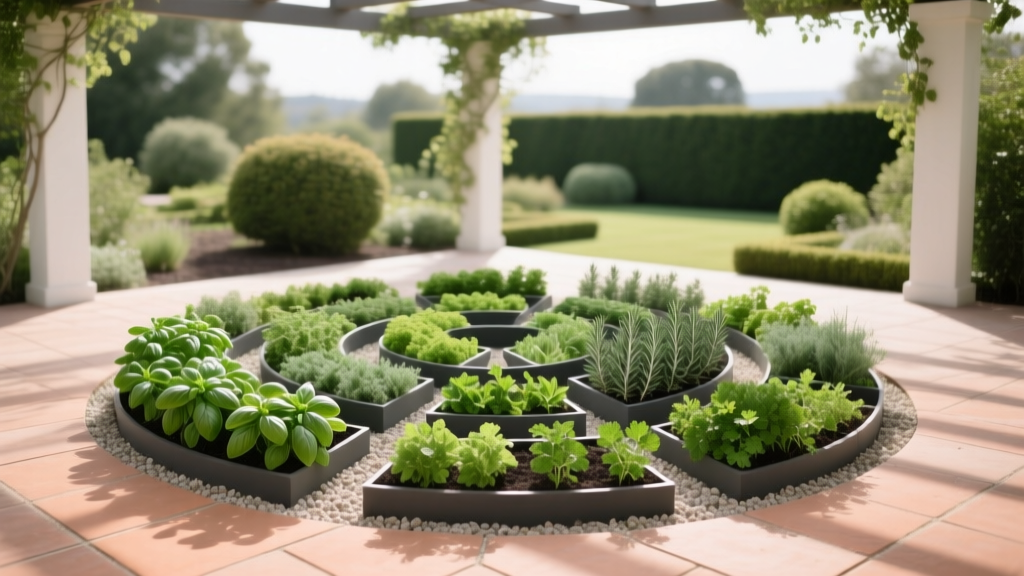
Terrace Culinary Herb Wheel Design
You step onto your terrace with a mug of coffee, already thinking about dinner. The wind is stronger up here than in the yard, the sun hits hard for a few hours and then slips behind the building, and every pot you’ve collected feels like it’s in the wrong place—basil drying out, mint taking over, thyme sulking in shade. You want herbs within arm’s reach of the kitchen, but you also want the terrace to feel intentional, not like a plant rescue mission.
This is where an herb wheel shines: a compact, circular layout that reads as design (not clutter), manages microclimates, and keeps your most-used flavors organized like a living spice rack. Think of it as a terrace-friendly “kitchen garden” that’s as pleasant to sit beside as it is to cook from.
The Herb Wheel Concept: A Small Space That Works Like a Garden
An herb wheel is a round bed (or a ring of containers) divided into wedge-shaped “slices,” usually with a central feature and paths or access points. The wedges let you group herbs by water needs, sun exposure, and harvesting style. On a terrace, the wheel also solves a practical problem: you can spin your body in place to harvest different herbs without stepping around scattered pots.
Core Design Principles (So It Looks Good and Grows Well)
1) Put access before abundance. If you can’t reach the center comfortably, the middle becomes dead space. A terrace wheel should have a maximum radius you can reach from at least one side—typically 24–30 inches for most adults.
2) Design for microclimates. Terraces create hot, dry zones near walls and reflective glass, and cooler pockets in shade or wind tunnels. Use that: Mediterranean herbs in the hottest wedge; moisture lovers in a protected wedge.
3) Keep aggressive herbs contained. Mint, lemon balm, and sometimes oregano can run. In a wheel, they get their own dedicated wedge (ideally a separate pot dropped into the wedge) so they don’t swallow the slower growers.
4) Prioritize repeat harvest. You’ll use basil, parsley, chives, and thyme constantly. Place “daily pick” herbs along the easiest access edge, and “weekly pick” herbs (rosemary, sage) slightly farther back.
Choosing the Right Wheel Size for a Terrace
You can build a wheel as a raised circular bed, a modular set of containers, or a hybrid. Here are three terrace-friendly sizes that reliably work without turning your outdoor space into an obstacle course:
- Compact Wheel: 36-inch diameter (radius 18"). Best for renters using containers only.
- Standard Terrace Wheel: 48-inch diameter (radius 24"). The sweet spot: enough wedges for variety, still reachable.
- Generous Wheel: 60-inch diameter (radius 30"). Great if your terrace is wide and you want a sitting nook beside it.
Plan for a minimum clear walkway of 24 inches around at least half the wheel. If you can give it 30–36 inches, you’ll enjoy harvesting more and bumping plants less.
Layout Strategies: How to Divide the Wheel
The 8-Wedge “Cook’s Wheel” (Most Practical)
Eight wedges balance diversity with manageability. In a 48-inch wheel, each wedge ends up with roughly 10–12 inches of outer-edge planting width—enough for one primary herb plus a small companion.
Suggested wedge themes:
- Mediterranean dry wedge (thyme, oregano)
- Woody perennial wedge (rosemary, sage)
- Sweet basil wedge (summer focal herb)
- Parsley + cilantro wedge (cool-season workhorses)
- Chives + scallions wedge (vertical accents)
- Mint wedge (contained pot-in-pot)
- Tarragon + dill wedge (airy texture)
- Salad burnet + chervil wedge (if you like French flavors) or extra basil varieties
Centerpiece Options: Function Meets Beauty
The center can be purely decorative, but on a terrace I like it to earn its keep. Pick one:
- Center pot (12–16 inches diameter) holding a bay laurel topiary or lemongrass in summer.
- Gravel “heat hub” (a circle of pea gravel) to warm the wheel and reduce splash-back on leaves.
- Vertical herb tower for strawberries or trailing thyme—only if wind isn’t extreme.
Sunlight and Exposure: Match Herbs to Hours
Most culinary herbs are happiest with 6–8 hours of direct sun, but a terrace rarely delivers textbook conditions. Track your light for a day: note when sun hits and when it leaves. Place wedges accordingly.
Herb light preferences align well with published guidance. For example, the Royal Horticultural Society notes that many herbs thrive in sun and free-draining soil (RHS, 2023). And the University of Minnesota Extension emphasizes that herbs generally perform best in full sun, though some tolerate partial shade (University of Minnesota Extension, 2020).
“Right plant, right place is the most important rule of successful gardening.” — Royal Horticultural Society (RHS, 2023)
On terraces with 4–5 hours of direct sun, lean on parsley, chives, mint (contained), cilantro (spring/fall), and lemon balm. Save basil and rosemary for the sunniest wedge, closest to reflective warmth.
Step-by-Step: Building a 48-Inch Terrace Herb Wheel (DIY Friendly)
This method assumes you’re creating a container-based wheel that won’t violate rental rules and can be disassembled.
- Measure your footprint: Mark a 48-inch circle with string and chalk. Confirm you still have at least 24 inches of walking clearance on one side.
- Choose the base: Use an outdoor rug, deck tiles, or a simple weed barrier fabric to protect the terrace surface from stains.
- Create the circle: Arrange 8 wedge-like containers (or rectangular planters forming a ring). For a clean circle, use 8 planters roughly 24 inches long x 8–10 inches wide.
- Add a center pot: Set a 14-inch round pot in the middle. This becomes the visual anchor.
- Stabilize and define edges: Fill gaps with small pavers or a band of gravel in shallow trays. On windy terraces, add weight with stone in the bottom of outer planters (keep drainage open).
- Soil mix: Use a high-quality potting mix amended for drainage. For Mediterranean wedges, add 20–30% horticultural grit or perlite.
- Install irrigation (optional but worth it): A basic drip kit with a timer prevents weekend-to-weekend stress. Set emitters at 0.5–1 gallon per hour depending on pot size.
- Plant by water needs: Keep dry lovers together; keep moisture lovers together. It simplifies watering and reduces disease pressure.
- Mulch lightly: Use fine bark or gravel (especially for thyme/oregano) to reduce evaporation and soil splash.
Plant Selection: Specific Culinary Varieties That Perform on Terraces
Terraces amplify heat, wind, and drying. Choose varieties known for container performance, compact habit, and strong flavor.
Mediterranean Wedge (Hot, Dry, Sunny)
Thyme ‘Doone Valley’ (variegated, fragrant, low mound): stays compact and cascades nicely over an edge. Space plants about 8–10 inches apart.
Greek oregano (Origanum vulgare subsp. hirtum): more intense culinary flavor than some ornamental oreganos; tolerates drying winds once established. Give it 10–12 inches.
Woody Perennial Wedge (Structure + Winter Interest)
Rosemary ‘Arp’: one of the more cold-tolerant choices for containers; upright form helps it handle tight layouts. Allow 14–18 inches if possible; pinch tips to keep it dense.
Sage ‘Berggarten’: broad leaves, strong flavor, and a tidy habit that reads “designed.” Space 12–15 inches.
High-Use Summer Wedge (Fast Growth, Frequent Harvest)
Basil ‘Genovese’: classic pesto basil; thrives in warmth and regular pinching. Plant 10–12 inches apart.
Basil ‘Prospera Compact’ (downy mildew resistant): a smart terrace insurance policy in humid cities. Use it in the same spacing as Genovese.
Cool-Season Wedge (Spring/Fall Powerhouse)
Parsley ‘Giant of Italy’: strong stems for chopping and a steady producer. Space 8–10 inches.
Cilantro ‘Santo’: slower to bolt than many; tuck it where it gets a little afternoon shade. Space 6–8 inches.
Vertical Accent Wedge (Edges and Garnishes)
Chives: compact clumps; edible flowers; excellent for small harvesting. Space 6–8 inches.
Garlic chives: slightly tougher in wind, late-season blooms. Space 8–10 inches.
Contained “Runner” Wedge (So It Behaves)
Mint ‘Kentucky Colonel’: classic for drinks and cooking; vigorous. Keep it in a 10–12 inch pot sunk into the wedge to prevent spreading.
Lemon balm (optional swap): similar vigor; great for teas. Same containment strategy.
Airy Texture Wedge (Light, Tall, Pollinator Friendly)
Dill ‘Bouquet’: compact for containers; attracts beneficial insects. Space 10–12 inches, and stake if wind is strong.
French tarragon: sophisticated flavor, prefers good drainage and consistent moisture. Give it 12 inches.
Comparison Table: Three Terrace Herb Wheel Builds
| Build Option | Footprint | Best For | Approx. Cost (USD) | Notes |
|---|---|---|---|---|
| All-Container Ring (8 planters + center pot) | 48" diameter | Renters, easy disassembly | $180–$420 | Fast setup; choose heavier planters for wind. |
| Raised Circular Bed (wood/composite) | 60" diameter, 10–12" tall | Homeowners, long-term terrace garden | $250–$650 | More soil volume = less watering; confirm load limits. |
| DIY “Upcycled Wheel” (food-safe buckets + salvaged bricks) | 36–48" diameter | Budget builds, quirky style | $60–$160 | Paint buckets for cohesion; ensure drainage holes. |
Budget Planning and Smart DIY Alternatives
If you’re pricing this out, costs cluster around containers, soil, and plants. A realistic mid-range terrace wheel (48-inch, 8 planters + center pot) often lands around $250: roughly $120 for containers, $60 for potting mix, and $70 for herb starts. Add a simple drip timer and tubing and you might add $35–$80.
To cut costs without cutting quality:
- Use smaller starts: Buy 3–4 inch pots instead of gallon-size—herbs catch up fast in warm weather.
- Propagate: Root cuttings of rosemary, sage, mint, and oregano in water, then pot up.
- Mix your own soil: Blend potting mix with perlite and a bit of compost. Keep Mediterranean wedges leaner (less compost, more grit).
- Unify mismatched pots: One paint color (matte charcoal or terracotta) makes “scrappy” look intentional.
Three Real-World Scenarios (And How the Wheel Adapts)
Scenario 1: Narrow City Balcony With Wind and Afternoon Sun
A renter has a balcony only 5 feet wide, with strong gusts between buildings and about 5 hours of sun. The solution is a 36-inch compact wheel: 6 wedges instead of 8, and heavier containers. Put rosemary and thyme closest to the warm wall. Use parsley, chives, and mint (contained) on the outer edge where harvesting is easy. Add a low center pot filled with gravel and a single basil plant protected by the surrounding planters.
Wind tip: position a simple reed screen or balcony fabric on the railing. It reduces leaf tearing and slows evaporation, which matters when containers dry in a day.
Scenario 2: Rooftop Terrace With Full Sun and Reflective Heat
A homeowner has a rooftop with 8+ hours of sun and reflective pavers. Here, the wheel becomes a heat-loving powerhouse. Use a 60-inch wheel with deeper planters (at least 12 inches deep) so roots don’t cook. Add basil ‘Prospera Compact’ for disease resistance, plus oregano, thyme, rosemary ‘Arp’, and sage ‘Berggarten’. Reserve one wedge for cilantro and parsley but place it where it gets late-day shade from a chair, umbrella, or the center pot.
On very hot roofs, you’ll likely water in the morning and again during heat waves. Drip irrigation earns its keep here.
Scenario 3: Shady Terrace With Bright Indirect Light (North-Facing)
A courtyard terrace gets only 3–4 hours of direct sun but stays bright. The wheel still works—you just shift the plant list. Focus on parsley ‘Giant of Italy’, chives, mint (contained), lemon balm, and chervil. Grow basil only in the sunniest wedge and keep expectations modest (it will be slower). If you want thyme, try lemon thyme and keep it in the brightest spot with sharp drainage.
Design trick: use a light-colored gravel mulch to bounce light up into foliage and reduce fungus from soil splash.
Spacing, Planting Density, and Harvest Rhythm
Herbs taste best when you harvest regularly, and regular harvesting also keeps plants compact—perfect for a wheel. As a rule, plan 1–2 main plants per wedge in a 48-inch wheel, not four. Overcrowding is the fastest way to invite mildew and legginess.
Harvesting guidelines that keep flavor high:
- Basil: pinch above a leaf node weekly; remove flower buds promptly.
- Parsley/cilantro: cut outer stems first; reseed cilantro every 3–4 weeks in spring for continuity.
- Rosemary/sage/thyme: snip small amounts often; avoid hard pruning into old wood on rosemary.
Maintenance Expectations (Real Time, Real Tasks)
For a well-designed terrace wheel, maintenance is steady but not burdensome. Expect about 20–40 minutes per week in mild weather, and up to 60 minutes per week during peak summer heat if you’re hand-watering.
Weekly tasks:
- Water check: lift a pot slightly—light means dry.
- Pinch basil and remove any flowering stems on leafy herbs.
- Quick pest scan: aphids love tender tips; a firm water spray often solves it.
Monthly tasks:
- Light feed: a diluted fish/seaweed fertilizer at half strength for leafy herbs (avoid overfeeding thyme/oregano).
- Rotate containers a quarter turn if one side leans toward the light.
Seasonal tasks:
- Spring: refresh top 1–2 inches of soil with compost; replant cilantro and basil when nights stay warm.
- Summer: mulch check; adjust watering schedule during heat waves.
- Fall: cut back and dry herbs; move tender rosemary closer to the building for warmth.
- Winter: in cold climates, protect pots from freeze-thaw by grouping them and wrapping with burlap, or bring the most tender plants indoors near a bright window.
Small Details That Make the Wheel Feel Designed (Not Just Planted)
Use repetition: repeat one material (all terracotta, or all matte black), one accent (gravel mulch in every wedge), and one upright “marker” plant (like rosemary or sage) to create rhythm. Tuck in edible flowers—calendula or nasturtiums—in one wedge if sun allows; they soften the geometry and invite pollinators without stealing much room.
If you entertain on your terrace, consider adding a narrow “serving ledge” nearby: a small shelf or side table where you can set scissors, a bowl for cut herbs, and your drink. That’s the moment the herb wheel becomes part of your lifestyle rather than another chore.
By the time your wheel fills in—usually 6–8 weeks after planting in warm weather—you’ll notice something unexpected: you cook differently. You don’t ration herbs because you’re “saving them.” You step outside, take what you need, and the garden responds by growing denser. On a terrace where space is precious, that kind of feedback loop is the real luxury.
Citations: Royal Horticultural Society (RHS), 2023; University of Minnesota Extension, 2020.