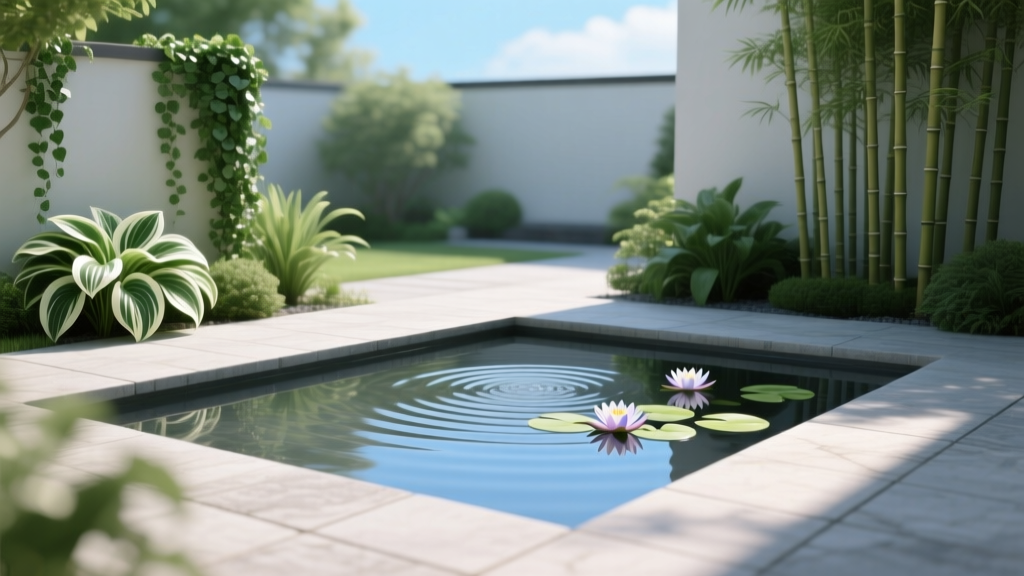
Courtyard Water Feature and Plant Pairings
The courtyard looks perfect on paper—four walls, a clean rectangle of paving, a little bit of sky. But once you live with it, the problems show up fast: it bakes in summer, echoes every footstep, and somehow still feels empty even after you buy “nice pots.” The fix isn’t more decor. It’s movement, sound, and a plant palette that makes a small space feel intentional. A well-scaled water feature does that in one move—then the right plant pairings make it feel like it belongs.
I’m going to walk you through a designer-style approach: choosing the right type of water feature for your courtyard, placing it so it looks purposeful (not stuck in a corner), and pairing plants that handle reflected heat, shade pockets, and the splash zone. Along the way you’ll get real dimensions, spacing, sun requirements, costs, and three case examples you can adapt to your own footprint—rental-friendly included.
Start With the Courtyard’s Reality: Sound, Sun, and Sightlines
Measure first: the “working rectangle”
Before you shop, sketch the courtyard and mark the usable circulation path. In small spaces, I aim for a primary walking lane of 36 inches (comfortable for carrying a tray), with an absolute minimum of 30 inches (tight but workable). If your courtyard is 10 ft × 12 ft, that lane choice determines whether your water feature becomes a centerpiece or a nuisance.
Also note: where do you sit? Where do you look from inside? A water feature should be visible from your main indoor viewpoint—kitchen sink, sofa, or desk—because you’ll enjoy it more often than you’ll stand beside it.
Sun hours decide the plant list (and algae risk)
Track sunlight for one clear day. You don’t need fancy tools: write down when direct sun hits the floor. Courtyards often have a “sun blade” that moves across the paving. If you get 6+ hours of direct sun, you can grow more flowering plants, but you’ll also fight warm water and algae faster in open bowls. If you get 2–4 hours, ferns and shade foliage shine, and water stays clearer longer.
For context, the RHS notes that algae thrives in sunlit, nutrient-rich water, and managing nutrients and shading the water are key controls (Royal Horticultural Society, 2023).
Sound matters more than size
In courtyards, the acoustics are amplified—great for masking traffic noise, but harsh if the feature “splats” too loudly. A gentle trickle is usually the sweet spot. If you’re trying to cover street noise, aim for a slightly higher drop (more on that below) and place the feature closer to your seating so it reads as intentional white noise.
“The restorative benefits of water are strongly tied to the soundscape—gentle, continuous sounds support stress recovery better than intermittent or harsh noise.” — Adapted from findings on natural soundscapes and restoration (Alvarsson, Wiens & Nilsson, 2010).
Layout Strategies That Make a Water Feature Look Built-In
Strategy 1: The anchor-and-fan layout
This is my go-to for small courtyards. The water feature becomes the anchor, and everything else “fans” around it: one seating area, one planting zone, one open zone.
- Anchor: water feature centered on a short wall or aligned with a door sightline.
- Fan 1: seating (bench or bistro set) within 4–6 ft of the water for sound enjoyment.
- Fan 2: planting band—usually 18–24 inches deep—softens hard edges.
- Fan 3: clear floor space for circulation and visual breathing room.
Strategy 2: Corner feature, but “pulled forward”
A corner water feature is space-efficient, but don’t jam it into the corner. Pull it forward 10–16 inches so you can plant behind it (even a slim vine trellis works). That little gap adds depth and prevents the corner from looking like storage.
Strategy 3: The mirror wall (for narrow courtyards)
If your courtyard is long and narrow—say 6 ft × 18 ft—use a wall-mounted spout into a trough. You keep the floor open, and the water becomes a vertical moment. For renters, this can be simulated with a freestanding frame that holds a spout panel over a container reservoir (no wall drilling required).
Choosing the Right Water Feature Type (and What It Really Costs)
Here’s the practical truth: most courtyard water features are recirculating systems. You’re buying a basin, a pump, and a way to hide the water. The best choice depends on footprint, splash tolerance, and how much maintenance you’ll actually do.
| Feature Type | Typical Footprint | Sound Level | Best For | Ballpark Cost (USD) |
|---|---|---|---|---|
| Glazed pot fountain (water bubbles from top) | 18–24 in diameter | Low–medium | DIY-friendly, small courtyards, renters | $120–$350 |
| Urn into hidden basin (spillway) | 24–36 in diameter | Medium | Masking noise, centerpiece feel | $300–$900 |
| Wall spout into trough | 12–18 in deep × 24–48 in long | Medium (controllable) | Narrow courtyards, formal look | $250–$800 |
| Mini pond (still water with plants) | 24–48 in diameter | Low | Wildlife, lush planting, shade courtyards | $80–$500 |
Concrete numbers to plan around:
- Pump size: For a pot fountain, a 120–250 GPH pump is usually enough; for a stronger trickle, consider 400 GPH.
- Drop height: A 4–8 inch water drop gives a gentle sound; 10–18 inches increases sound but also splash.
- Reservoir depth: Aim for at least 10–12 inches of water depth in the hidden basin to reduce pump burn-out during hot weeks.
- Electricity: A small pump often draws roughly 10–30 watts; at 24/7 use, that can matter on your bill.
- Top-up water: In a sunny courtyard, expect topping up 1–3 gallons every few days in summer due to evaporation.
Step-by-Step: A Courtyard Fountain You Can Build in a Weekend
This is the most adaptable approach: a pot fountain with a hidden reservoir (great for renters because it’s not permanent).
- Pick the location: Place the feature where you can see it from indoors and where splashes won’t hit a door threshold. Keep it at least 18 inches away from painted walls.
- Lay a stable base: Use a 24 in × 24 in paver or compacted gravel pad under the reservoir tub so it doesn’t settle unevenly.
- Set the reservoir: Use a sturdy plastic basin (often 20–27 gallons) and cover with a pump vault or upside-down crate to keep the pump accessible.
- Add a grate: Place a heavy-duty grate or perforated panel over the reservoir. This supports the pot and hides the water.
- Install the pump and tubing: Run vinyl tubing up through the center of your pot/urn. For most pots, 1/2-inch tubing is standard.
- Set the pot: Drill a hole (or use an existing drainage hole) for tubing. Stabilize with shims so it sits level.
- Hide the mechanics: Top-dress the grate with river stones (aim for 1–2 inch stones so they don’t fall through).
- Test splash: Fill, run the pump, then adjust flow. If splash is excessive, reduce flow or add stones at the spill point to break the fall.
- Plug-in safely: Use a GFCI outlet. If you need an extension cord, choose an outdoor-rated cord and keep connections elevated off the ground.
DIY budget reality: a basic setup can be done for $150–$250 (pump, basin, tubing, stones, and a pot). A more sculptural urn plus higher-quality pump and grate often lands around $450–$700.
Plant Pairings That Make Water Features Look Intentional
In courtyards, plants have to do multiple jobs: soften hard edges, tolerate heat and wind tunnels, and visually “connect” the water feature to the rest of the space. I design in layers: backdrop, mid-layer, edge/spill, plus one accent plant that repeats elsewhere.
Pairing rules that keep it practical
- Keep the splash zone simple: Use plants that don’t mind occasional wet feet, but avoid those that drop lots of debris into the water.
- Repeat two plants twice: Repetition creates calm in tight spaces—two matching pots look more “designed” than five different ones.
- Plan for adult size: Crowded plants shed more, dry out faster, and look messy. In containers, leave 2–4 inches between the plant crown and pot rim for watering.
Sun courtyard (6+ hours): clean lines + heat-tolerant fragrance
Water feature style: bubbling pot or low spillway to limit algae.
Plant palette:
- Lavandula angustifolia ‘Hidcote’ (English lavender): fragrant, compact habit, handles reflected heat; plant in a pot at least 14–16 inches wide. Space plants 18 inches apart if in a bed.
- Rosmarinus officinalis ‘Tuscan Blue’ (rosemary): upright structure to frame the fountain; tolerates drought once established.
- Stipa tenuissima (Mexican feather grass): adds movement that echoes water; place 12–18 inches from the fountain edge so it doesn’t shed directly into water.
- Agapanthus ‘Peter Pan’: tidy strappy leaves, flowers read well against stone; reliable in pots.
- Sedum ‘Autumn Joy’: a succulent-like mass that stays neat; excellent near warm paving.
Why it works: The gray-green foliage visually “cools” sun-baked courtyards, and the grasses provide motion even when the pump is off.
Part-shade courtyard (3–5 hours): glossy foliage + calm texture
Water feature style: wall spout into trough or a small bowl with a steady trickle.
Plant palette:
- Hydrangea macrophylla ‘Endless Summer’: a lush anchor in a large container (18–22 inches wide). Works best with morning sun and afternoon shade.
- Heuchera ‘Caramel’ or ‘Palace Purple’: colorful foliage that doesn’t demand full sun; plant 12–16 inches apart.
- Hakonechloa macra ‘Aureola’ (Japanese forest grass): soft, cascading edge near troughs; keep 10–12 inches back from water to reduce leaf drop into the basin.
- Sarcococca confusa (sweet box): evergreen structure plus winter fragrance—gold in courtyards where you notice scent.
- Fatsia japonica: bold leaves for instant impact; one plant can anchor an entire corner (give it a pot at least 20 inches wide).
Shade courtyard (2–3 hours or bright shade): mossy mood + strong shapes
Water feature style: mini pond or still bowl with a small aerator (less splash in tight shade corners).
Plant palette:
- Dryopteris erythrosora (autumn fern): coppery new fronds, reliable texture; space 18–24 inches apart.
- Hosta ‘Halcyon’: blue leaves read as “water-adjacent”; keep slugs in mind in damp microclimates.
- Carex oshimensis ‘Evergold’: bright variegation that lifts shade; neat clump habit.
- Helleborus x hybridus: winter-spring flowers, evergreen-ish presence; very courtyard-friendly.
- Ophiopogon planiscapus ‘Nigrescens’ (black mondo grass): dark contrast that makes water sparkle; use as a repeating edge plant.
For renters or anyone avoiding in-ground planting, these palettes work beautifully in clustered containers. Use a consistent pot finish (all matte black, or all aged terracotta) so the plants and water remain the stars.
Three Courtyard Scenarios You Can Copy
Scenario 1: The rental courtyard that can’t be drilled or dug (8 ft × 10 ft)
Goal: Add calm sound and greenery without permanent changes.
Layout: Place a 20-inch bubbling pot fountain centered on the far wall, pulled forward 12 inches. Add two tall containers (one on each side) for symmetry and to hide the “floating pot” look.
Plant pairing: One Sarcococca confusa (structure + fragrance) and one Hakonechloa (softness) on each side. Underplant with Heuchera for color.
Budget: Keep it around $220–$400 by using a basic basin, a 200 GPH pump, and locally sourced river stones. Use a freestanding trellis behind the fountain to create depth without wall fixings.
Scenario 2: The suntrap courtyard that feels harsh (12 ft × 16 ft, 7 hours sun)
Goal: Reduce glare and make seating comfortable.
Layout: Put a low spillway urn with a 10-inch drop on the side wall that faces your seating. Set seating 5 ft away so the sound reads as gentle, not loud. Create an 24-inch deep planting band along the hottest wall.
Plant pairing: Lavender ‘Hidcote’ repeated in two pots near seating, rosemary ‘Tuscan Blue’ to frame the urn, and Stipa tenuissima to add movement. Add Agapanthus for strappy calm and summer flowers.
Budget: Expect $450–$900 depending on urn material (cast stone costs more than ceramic). Save money by using a simple ceramic pot and upgrading only the pump and grate—those are the parts you’ll feel over time.
Scenario 3: The narrow side courtyard (6 ft × 20 ft) with neighbor windows
Goal: Privacy, a focal point, and a sense of width.
Layout: Install (or mimic) a wall spout into a 36-inch long trough at the midpoint of the long run. Keep a 30–36 inch clear path along one side. Add a slim vertical trellis panel behind the trough and plant a climber in a container at the base.
Plant pairing: Use Fatsia japonica (bold leaves) at the far end to pull the eye down the space, Carex ‘Evergold’ as repeating rhythm, and Hellebores for seasonal flowers. If you have enough sun at the top, a container-grown Trachelospermum jasminoides (star jasmine) gives scent and a privacy screen.
Budget: A trough + pump + spout setup often lands around $250–$800. DIY alternative: use a galvanized stock-style container as the trough and a freestanding spout frame you build from cedar, so the walls stay untouched.
Spacing and Placement Details Designers Use (So It Doesn’t Feel Crowded)
These are the small numbers that prevent big regrets:
- From seating to water: keep 4–6 ft for comfort and sound enjoyment.
- From water to planting: leave 10–14 inches of clear space for cleaning access and to stop leaves falling straight in.
- Container grouping: cluster pots in odd numbers (3 or 5), but repeat the same plant at least twice.
- Planting density in beds: for many perennials, 12–18 inches on center is a safe courtyard spacing—tight enough to look lush, open enough to stay healthy.
Keeping Water Clean Without Turning It Into a Chore
Maintenance is where a courtyard water feature succeeds or quietly gets turned off. Plan for a realistic rhythm, especially in summer.
Weekly time expectations
For most small recirculating features, budget about 15–25 minutes per week:
- Top up water (more often in heat).
- Quick skim of leaves.
- Check pump flow and remove debris from the intake.
The EPA notes that fixing household leaks can save water significantly—use that mindset here too: a feature that loses water quickly often has splash-out or a hidden leak you can correct (U.S. EPA, 2024).
Seasonal tasks (the ones people forget)
- Spring (30–60 minutes): full clean-out: drain, rinse basin, wipe algae film, and flush tubing.
- Summer: increase shade over the water if algae shows up—floating plants for ponds, or add a taller plant nearby to cast afternoon shade.
- Autumn: add a simple net temporarily if leaf drop is heavy, or relocate nearby deciduous pots a few feet away.
- Winter: in freezing climates, unplug and drain. Store the pump indoors. If winters are mild, keep it running and top up; moving water resists light frost better than still water.
Low-chemical approach to algae
Start with design: reduce direct sun on the water surface and keep fertilizer runoff away. If you feed container plants near the feature, use slow-release fertilizer and water carefully so nutrients don’t wash into the basin. The RHS emphasizes algae prevention through nutrient control and shading rather than relying solely on treatments (Royal Horticultural Society, 2023).
Budget-Smart Upgrades (Spend Where It Counts)
If you’re deciding where to invest, here’s my hierarchy:
- Spend on the pump and accessibility: a reliable pump and an easy-to-reach intake reduce weekly friction. A pump that clogs constantly is why features get abandoned.
- Spend on one great pot/urn shape: the silhouette is what you see. You can save on hidden basins and stones.
- Save with plants as “mass,” not specimens: repeating mid-priced plants (like heucheras or grasses) often looks better than one expensive specimen surrounded by random fillers.
DIY alternative if electricity is difficult: try a solar fountain pump in a bowl. It’s the lowest-commitment way to test if you like water sound. The tradeoff is consistency—solar pumps slow down in cloud or shade—but for renters, it can be the perfect trial run before you invest.
If you take one designer habit into your courtyard project, let it be this: treat the water feature as a piece of “garden furniture,” then dress it with plants that repeat elsewhere. Do that, and even a simple 20-inch pot fountain can feel like it’s always belonged—softening the hard lines, cooling the mood, and giving your courtyard a steady heartbeat you’ll notice every time you walk past the window.