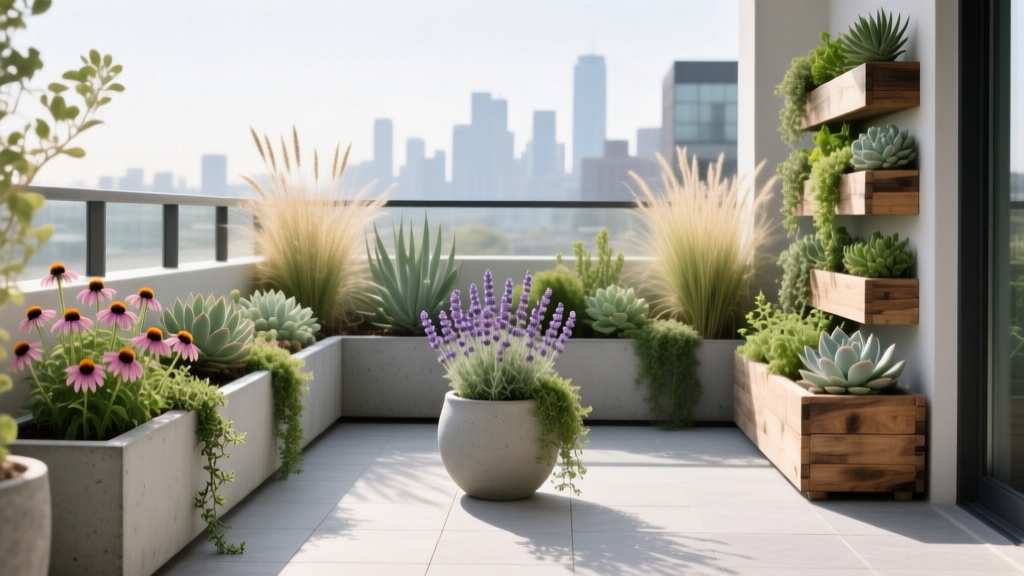
Terrace Balcony Mixed Border Recipes
The wind always finds the terrace first. One minute you’re holding a mug of coffee, the next you’re watching a flimsy pot tip and a plant you liked snap at the stem. On balconies, the challenges show up fast: thin soil, intense sun reflected off glass, shade cast by neighboring buildings, and a layout that has to share space with a chair, a grill, a bike, or the laundry rack. The good news is that a “mixed border” isn’t reserved for big gardens—you can cook up a border-like planting on a terrace by thinking in recipes: repeatable ingredient groups (structure + fillers + spillers) arranged in a tight footprint, with a plan for wind, weight, and watering.
This article walks you through several workable terrace balcony border “recipes” with real dimensions, spacing, and plant varieties that behave well in containers. I’ll write it like I’m standing next to you on the balcony: we’ll measure first, place the “bones,” then layer in color and movement—without making maintenance your second job.
Start with the balcony “inventory” (before you buy a single plant)
1) Measure the usable planting strip, not the whole balcony
Most balconies have a natural planting zone: along the railing, or pushed against a wall. A very workable mixed-border footprint is 0.45–0.60 m deep (18–24 in) by 2.4–3.6 m long (8–12 ft). Even 2.0 m (6.5 ft) is enough if you repeat a tight pattern. Mark it with painter’s tape so you can feel the circulation space you’re keeping clear.
2) Track sunlight hours where the pots will actually sit
Balcony light is rarely “full sun” in the classic garden sense. Take note for three days: how many direct-sun hours hit the floor where containers will live? Use these brackets:
- Bright shade: 0–2 hours direct sun
- Part sun: 3–5 hours direct sun
- Full sun: 6+ hours direct sun
For flowering container borders, 4–6 hours is the sweet spot; for herbs and many grasses, 6+ hours is ideal.
3) Confirm weight limits and wind exposure
If you’re a renter, check your lease and ask building management about balcony load limits. Many residential balconies are engineered to handle typical live loads, but the exact capacity varies. When in doubt, use lighter containers (resin, fiberglass) and avoid waterlogged soil. Wind matters just as much: if you can feel a steady breeze most afternoons, plan on heavier base pots, shorter top growth near the edge, and at least one wind-tough evergreen or grass to act as a buffer.
Layout strategies: make a border feel “deep” in only 60 cm
The border formula: structure + season + spill
Think like a chef:
- Structure (the bones): 20–30% of pots. Evergreen or architectural plants that look good in February.
- Season (the flavor): 50–60% of pots. Flowering perennials, bulbs, and long-bloom annuals.
- Spill (the garnish): 15–25% of pots. Trailers and soften-the-edge plants.
Use “modules” you can repeat
A terrace border becomes cohesive when you repeat a module every 60–90 cm. One reliable module is:
- 1 tall anchor pot (30–40 cm diameter / 12–16 in)
- 2 medium companion pots (25–30 cm diameter / 10–12 in)
- 1 low trough or window box (60–80 cm long / 24–32 in)
Repeat the module 3 times along a 3 m (10 ft) run and you’ve got rhythm—without buying 40 different things.
Stagger heights like a theater seating plan
On a balcony, “back of border” might be the wall, or it might be the railing depending on what you want to screen. Aim for a clean height ladder:
- Back row: 90–150 cm (3–5 ft) tall plants in stable pots
- Middle row: 40–80 cm (16–32 in) mounding and upright bloomers
- Front edge: 10–30 cm (4–12 in) spillers and low texture
Soil depth is your hidden design constraint
Most perennial roots in containers perform better with 30+ cm (12+ in) soil depth. For herbs and annuals, 20–25 cm (8–10 in) can work. Use large pots where you want shrubs, grasses, and anything meant to overwinter.
Step-by-step setup: build the border like a pro
- Sketch a 2D plan of your planting strip (example: 0.6 m x 3.0 m) and mark door swing, seating, and any drains.
- Choose your container set first. For a 3 m run, a practical starting kit is 3 large pots (35–45 cm), 6 medium pots (25–30 cm), and 3 troughs (60–80 cm).
- Place anchors (the large pots) at 90–120 cm (36–48 in) intervals; this sets your rhythm.
- Add middle-layer companions between anchors, keeping 10–15 cm (4–6 in) air space between pots so foliage doesn’t become a mildew blanket.
- Install drip irrigation or a watering routine now, before it’s crowded. A basic gravity-fed kit or tap-connected micro-drip often costs $35–$120 depending on length and fittings.
- Fill with a container mix (not straight garden soil). If you want fewer watering emergencies, blend in water-holding amendments according to label rates.
- Plant by spacing, not by impulse: small perennials generally need 25–35 cm spacing; larger perennials and grasses 40–60 cm. In containers, you can tighten slightly, but avoid packing roots like sardines.
- Mulch the surface with 2–3 cm of fine bark or gravel to reduce evaporation and keep soil from splashing onto leaves.
Plant “recipes” that behave on terraces
Below are three core recipes you can adapt. Each uses specific varieties that tolerate container life, wind, and the stop-start watering that happens on balconies.
Recipe 1: Sunny, windy, low-drama Mediterranean mix (6+ sun hours)
Design goal: A border that looks intentional even if you miss a watering day. Aromatic foliage, silver tones, and long bloom windows.
Anchor (choose 1–2 types, repeat):
- Olea europaea (dwarf olive) in a 45–50 cm pot: evergreen structure and wind tolerance. Great for a “tree” note without taking over.
- Lavandula angustifolia ‘Hidcote’: compact lavender, fragrant, and container-friendly if drainage is sharp.
Middle layer:
- Salvia nemorosa ‘Caradonna’: upright purple spires; stands up to sun and gives a designer “vertical” line.
- Nepeta x faassenii ‘Walker’s Low’: soft haze, pollinator magnet, and forgiving if you shear it once mid-season.
- Stipa tenuissima (Mexican feather grass): movement in wind; use in heavier pots so it doesn’t act like a sail.
Spillers:
- Thymus serpyllum (creeping thyme): edible, drought-tolerant, and knits edges together.
- Erigeron karvinskianus (Mexican fleabane): airy daisies that self-renew without looking stiff.
Why it works: These plants share similar needs—sun, drainage, and moderate fertility—so you’re not juggling conflicting care instructions.
Recipe 2: Part-sun “soft color” border for urban heat and reflected light (3–5 sun hours)
Design goal: You get direct sun only part of the day, but the balcony still runs hot. This mix reads lush without being thirsty divas.
Anchor:
- Hydrangea paniculata ‘Little Lime’ (compact panicle hydrangea) in a 50 cm pot: tolerates more sun than mopheads and flowers reliably with part sun.
- Ilex crenata ‘Sky Pencil’ (upright Japanese holly) for narrow evergreen punctuation where space is tight.
Middle layer:
- Heuchera ‘Caramel’: warm foliage that holds color for months; excellent container texture.
- Astilbe ‘Visions in Pink’: feathery blooms for part sun; appreciates consistent moisture.
- Geranium ‘Rozanne’: long blooming, relaxed habit, and it threads between neighbors without bullying.
Spillers:
- Carex oshimensis ‘Evergold’: bright edging grass-like texture; handles part shade and containers well.
- Bacopa (Sutera cordata) white or lavender: steady trailing bloom in moderate light.
Why it works: Foliage does as much as flowers here; you get a designed look even between bloom cycles.
Recipe 3: Bright shade border that still feels “garden” (0–2 sun hours)
Design goal: North-facing or courtyard shade—no sad, leggy plants. This is a texture border with strategic flowering.
Anchor:
- Fatsia japonica in a 45–50 cm pot: bold leaves that read lush in shade and handle urban conditions.
- Skimmia japonica ‘Rubella’: evergreen with winter buds; excellent for year-round presence.
Middle layer:
- Hakonechloa macra ‘Aureola’ (Japanese forest grass): cascading form and luminous color in shade.
- Helleborus x hybridus (Lenten rose): early-season flowers; leathery foliage holds structure.
- Hosta ‘Halcyon’ (if slugs aren’t a major issue on your balcony): blue foliage that looks expensive in a pot.
Spillers:
- Hedera helix ‘Glacier’ (variegated ivy): controlled trailing in containers; keep it trimmed and it behaves.
- Lysimachia nummularia ‘Aurea’ (golden creeping jenny): bright trailing color; watch moisture so it doesn’t crisp.
Why it works: In shade, leaf size and sheen become your “flower.” These picks keep the border from reading flat.
A quick comparison: which recipe fits your balcony conditions?
| Recipe | Best light | Typical pot depth | Watering frequency (summer) | Look + strength |
|---|---|---|---|---|
| Mediterranean mix | 6–8 hours sun | 30–40 cm | 2–4x/week | Wind-tough, fragrant, long bloom |
| Part-sun soft color | 3–5 hours sun | 35–45 cm | 3–5x/week | Lush foliage, steady flowers, forgiving |
| Bright shade texture | 0–2 hours sun | 35–45 cm | 2–4x/week | Architectural leaves, year-round structure |
Real-world scenarios: three balconies, three workable layouts
Scenario A: A narrow rental balcony (0.9 m x 3.0 m) with strict “no drilling” rules
Problem: You need planting, privacy, and still must pass through with groceries. No wall hooks, no railing planters that clamp on permanently.
Layout strategy: Build a border only on one side: 0.45 m deep along the railing, leaving 0.45 m as a walking lane. Use three repeating modules with troughs on the floor (not mounted).
Planting plan (part sun, 4 hours): Use Recipe 2. Place 2 ‘Sky Pencil’ hollies at each end in 40–45 cm pots, then fill between with Heuchera ‘Caramel’, Geranium ‘Rozanne’, and Carex ‘Evergold’ spilling over trough edges.
Cost reality: For a rental-friendly setup, assume $220–$450 for containers (resin/fiberglass mix), $80–$140 for potting mix, and $150–$350 for plants depending on size. If you buy smaller perennials (9–10 cm pots) and grow them on, you can trim the plant spend by 30–50%.
Scenario B: A roof terrace (2.4 m x 4.0 m) that bakes in sun and wind
Problem: Heat, glare, and gusts shred tender leaves. You want a border feel without constant replacement.
Layout strategy: Create an L-shaped mixed border along two edges: 0.6 m deep by 2.4 m long on one side and 0.6 m by 3.0 m on the other. Use heavier “anchor” pots at the corners (think 50 cm diameter) to stabilize the whole composition visually and physically.
Planting plan (full sun, 7 hours): Recipe 1, but lean into grasses and salvias. Place 3 anchors: dwarf olive at the corner, lavender mid-run, and another olive at the far end. Between, repeat Salvia ‘Caradonna’ and Nepeta ‘Walker’s Low’. Add thyme and erigeron to spill over troughs.
DIY alternative: Instead of pricey large pots, use galvanized steel tubs (lined with a few drainage holes) or wooden crates with pond liner and a gravel drainage layer. They’re not forever containers, but they’re budget-smart for a first season.
Scenario C: A shaded city balcony facing a courtyard (1.2 m x 2.4 m) with the neighbor’s window nearby
Problem: You want green privacy without turning the balcony into a wall of dead brown stems by winter.
Layout strategy: Use a “screen-and-skirt” approach: 2–3 evergreen anchors for height, with a soft skirt of textural plants at their feet. Keep the tallest pots 30–45 cm back from the railing so wind doesn’t push them outward.
Planting plan (bright shade): Recipe 3. Use Skimmia ‘Rubella’ as anchors (buds in winter), add Hakonechloa ‘Aureola’ for movement, and tuck in hellebores for late winter/early spring flowers. Trail ivy ‘Glacier’ sparingly to soften edges.
Budget tip: In shade, you can buy fewer flowering plants and spend a bit more on one excellent anchor. One strong evergreen in a large pot often looks better than six struggling bloomers.
Spacing, pairing, and “don’t-fight-the-pot” plant choices
Container borders fail when we choose plants that need radically different moisture levels in the same pot cluster. University extension guidance consistently recommends using potting media designed for containers rather than garden soil because it’s lighter and drains better (University of Illinois Extension, 2023). That matters on terraces where overwatering is just as common as underwatering.
Also, resist the temptation to overpack. If a tag says a plant spreads 45 cm, believe it—especially for vigorous performers like catmint and some geraniums. A dependable spacing approach in containers:
- 25–30 cm centers for compact perennials (heuchera, small salvias)
- 35–45 cm centers for medium spreaders (nepeta, geranium ‘Rozanne’)
- 50–70 cm centers for grasses and small shrubs (stipa, skimmia, dwarf olive)
“The right plant in the right place is the foundation of sustainable landscapes—matching species to site conditions reduces inputs like water and replacement planting.” — Royal Horticultural Society guidance on sustainable gardening (RHS, 2021)
Budget planning and smart swaps (so the design doesn’t stall at checkout)
For a balcony mixed border along 3 m (10 ft), a realistic mid-range budget often lands around $450–$900 total (containers + soil + plants). Here’s how to control it without sacrificing the “designed” look:
- Spend on anchors, save on fillers: Buy 2–3 good structural plants in larger sizes (a dwarf olive, skimmia, or hydrangea), then fill the rest with smaller perennials that grow in.
- Use fewer container types: Repeating one pot style looks intentional and often costs less than mixing. You can vary height using risers or hidden bricks.
- Swap pricey annual spillers for cuttings: Ivy, creeping jenny, and thyme are easy to propagate. Start with 1–2 plants and make more.
- DIY self-watering reservoir: If you can’t install drip irrigation, use large saucers and add a layer of gravel to keep roots from sitting in water. Not a true self-watering system, but it buffers a hot afternoon.
If you want one upgrade that pays you back in plant health, it’s irrigation. Even a simple micro-drip on a timer can reduce summer stress dramatically, especially on full-sun terraces where containers can dry out in a day. The U.S. Environmental Protection Agency notes that drip irrigation can be an efficient method because it delivers water directly to the root zone (EPA WaterSense, 2022).
Maintenance expectations: what it takes to keep it looking like the plan
A terrace mixed border should be enjoyable, not needy. With the recipes above, expect:
- Weekly time: about 20–40 minutes/week in peak season for watering checks, deadheading, and quick grooming. Add 10 minutes if you hand-water daily in hot spells.
- Feeding: Container plants benefit from consistent nutrition. Use a slow-release fertilizer once in spring, or a liquid feed every 2–4 weeks depending on the product and planting density.
- Midseason haircut: Shear nepeta and salvia after the first flush to promote rebloom; plan a 15-minute tidy in midsummer.
- Autumn: Cut back perennials that collapse; leave some seedheads (grasses, salvias) if you like winter texture. Check that drains aren’t blocked by leaves.
- Winter (cold climates): Group pots together, move the most tender plants closer to the building, and avoid keeping saucers full. If you overwinter shrubs, choose larger pots (40–50 cm) because small pots freeze solid faster.
One designer trick: every two weeks, step back inside and look at the border through the glass door. If one pot is failing, you’ll see it immediately—and you can swap it before the whole planting looks tired.
The best terrace balcony mixed borders don’t come from buying “one of everything.” They come from repeating a few reliable ingredients, giving them enough root room, and laying them out so the view has a calm rhythm. When your anchors are placed and your modules repeat, you can change the seasonal “flavor” any time—add spring bulbs to troughs, tuck in summer annuals, or shift to autumn tones—without rebuilding the whole design. That’s the real luxury of balcony gardening: you get to redesign in small, satisfying edits, one pot at a time.