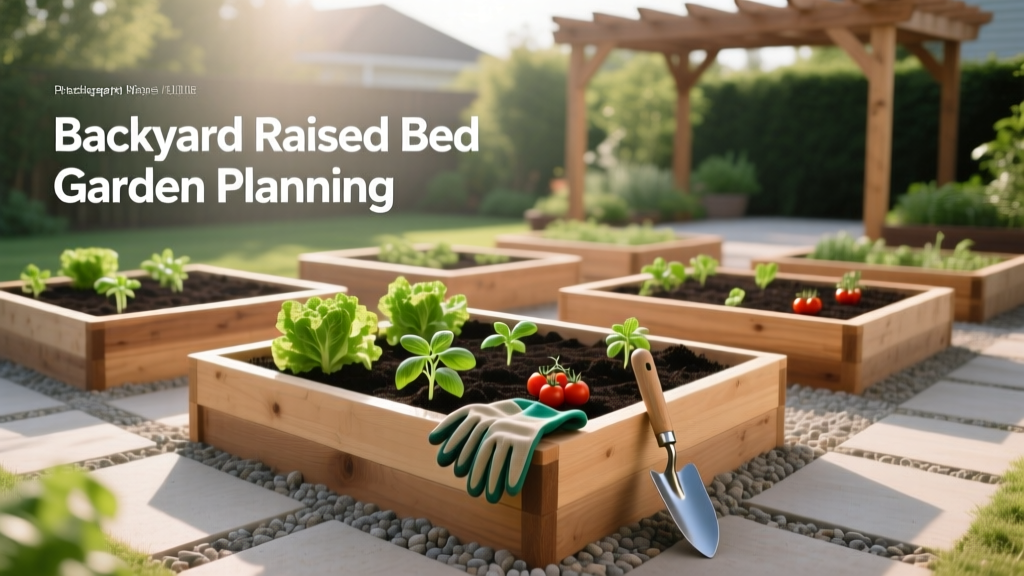
Backyard Raised Bed Garden Planning
The hose kinks for the third time, the dog has discovered your freshly seeded row, and the “quick veggie patch” you imagined has turned into a patchwork of half-grown plants and bare soil. You can grow plenty of food in a backyard—without it feeling like a part-time job—but only if the layout does some of the heavy lifting. Raised beds give you that advantage: defined growing zones, cleaner pathways, better soil control, and a garden that looks intentional from the kitchen window.
I’m going to walk you through planning a raised bed backyard garden the way a landscape designer would: start with how you move through the space, then place beds where plants will actually thrive, then choose varieties that match your sun, your schedule, and your appetite.
Start with a quick site “audit” (15 minutes that saves a season)
Before you buy lumber or soil, stand in the backyard with a tape measure and a notebook. You’re not just looking for empty space; you’re looking for usable space.
Sunlight: count hours, don’t guess
Most fruiting crops (tomatoes, peppers, cucumbers) perform best with 6–8+ hours of direct sun. Leafy greens can manage with 4–6 hours, especially with afternoon shade in hot climates. A simple check: note sun at 9 a.m., noon, and 3 p.m. for two days. If the bed area is sunny at all three times, you’re usually in the “full sun” range.
Light matters more than almost any product you can buy. As the Royal Horticultural Society notes, vegetables generally need as much sun as you can give them, while some salads and herbs tolerate lighter shade (RHS, 2020).
Water access: design around the spigot
Place beds so the farthest corner is within a 25–50 ft hose reach, or plan a drip line. If you’re hauling watering cans more than a few steps, the garden will quietly fail in July.
Level and drainage: avoid the “bathtub bed”
A raised bed shouldn’t sit where water pools. If your yard has a low spot, either move the beds upslope or plan a shallow swale pathway and add gravel where needed. Even though beds drain better than in-ground rows, soggy footing and splashback disease can still be an issue.
Design principles that make raised beds feel effortless
A raised bed garden is part production, part outdoor room. The best layouts let you work comfortably, harvest quickly, and keep the space tidy enough that you’ll actually use it.
Bed width: reach is your ruler
Keep bed width to what you can reach without stepping into the soil:
- 4 ft wide is the classic choice because most people can reach the center from either side.
- 3 ft wide is easier for kids, shorter arms, or tighter spaces.
- If a bed is accessible from only one side (against a fence), cap width at 2 ft.
Bed length: think in modules
Common, efficient lengths are 6 ft, 8 ft, and 12 ft. An 4 ft x 8 ft bed is a sweet spot: enough root volume and planting area, but still easy to cover with hoops or frost cloth.
Bed height: match your soil and your back
Height is where comfort and cost meet:
- 10–12 in: economical, great over decent native soil
- 18 in: easier on the back, better over compacted clay
- 24 in+: near “standing garden,” higher material cost but ideal for accessibility
Pathways: you need more room than you think
Plan paths like you plan hallways inside a home:
- 24 in minimum for comfortable walking and kneeling
- 30–36 in if you’ll use a wheelbarrow, garden cart, or have two people harvesting
- 42–48 in for wheelchair access or if the garden doubles as a social space
“In raised bed systems, keeping soil uncompacted is central—designing beds you never step in preserves pore space for roots and water movement.” — University of Minnesota Extension, raised bed guidance (University of Minnesota Extension, 2022)
Layout strategies that work in real backyards
Below are layout approaches I use again and again. Choose the one that fits your space and the way you live.
The “Two-Bed Starter” (fastest to build, easiest to learn)
Layout: two 4 ft x 8 ft beds with a 30 in center path and 24 in perimeter paths. This fits nicely into an area about 12 ft x 18 ft once you include walking space.
Why it works: you can rotate crops between beds, learn your site, and expand later without redesigning everything.
The “U-Shape Work Zone” (maximum access in a compact footprint)
Layout: three beds forming a U, with the opening facing your door or patio. Use 3 ft wide beds and a 3 ft inner aisle so you can stand in the center and reach all sides. This creates a very “kitchen garden” feel—close, contained, and pleasant to maintain.
Pro tip: put your compost bin just outside the U so it’s one step away but not visually dominant.
The “Fence-Line + One Island Bed” (best for narrow yards and renters)
Layout: one long bed along the sunniest fence (a 2 ft x 12 ft works well) plus one freestanding 4 ft x 6 ft bed nearby. The fence bed becomes your trellis zone for cucumbers, pole beans, and cherry tomatoes.
Why it works: you get vertical production without filling the whole yard with boxes.
Comparison: common raised bed materials (cost, durability, feel)
| Material | Typical Cost (per 4’x8’ bed frame) | Expected Lifespan | Notes for Design & Use |
|---|---|---|---|
| Cedar boards | $120–$220 | 10–15 years | Warm, clean look; naturally rot resistant; easy DIY with screws. |
| Pine (untreated) | $60–$120 | 3–6 years | Budget-friendly; plan for replacement; seal exterior for longer life. |
| Galvanized metal kit | $90–$250 | 10–20 years | Modern look; fast assembly; can heat up in hot climates—mulch helps. |
| Concrete blocks | $80–$180 | 20+ years | Very durable; heavier; can create planting pockets in block holes. |
Cost varies wildly by region and lumber prices, but you can plan realistically with a few numbers. Filling a new 4 ft x 8 ft x 12 in bed takes about 32 cubic feet of soil mix (roughly 1.2 cubic yards). Bagged soil at $6–$8 per 2 cu ft bag adds up quickly, so consider a bulk soil delivery if you’re building more than two beds.
Step-by-step: set up a raised bed layout that stays flexible
This is the process I use on client sites because it avoids expensive do-overs.
- Measure and mark: Use stakes and string (or a garden hose) to outline bed edges and paths. Walk it like you’ll harvest it.
- Confirm sun: Stand at the marked area at midday; check for tree or fence shadows. Adjust beds before you build.
- Plan your “service zone”: choose a spot for compost, potting bench, and tool storage within 10–20 ft of the beds.
- Build frames: Keep beds square and level. If the yard slopes, level the beds rather than the paths, or terrace slightly.
- Prepare the base: Remove turf, loosen the top few inches of soil, and water the ground. If gophers/voles are common, staple 1/2-inch hardware cloth to the bottom before filling.
- Fill with a layered mix: Aim for a blend like 50% screened topsoil, 30% compost, 20% aeration material (pumice or coarse perlite). Water as you fill to reduce settling.
- Add irrigation: Drip lines or soaker hoses under mulch reduce disease and save time. Even one simple timer can stabilize your harvest.
- Mulch paths: Use wood chips 2–3 in deep for comfort and weed control; refresh as needed.
Plant selection that matches raised beds (varieties, spacing, and why)
Raised beds shine when you plant with intention: vertical where it makes sense, compact varieties where space is tight, and reliable performers where you want steady harvests.
Bed A: “Salad and herbs that you’ll actually pick”
Best for: near the kitchen door, partial sun acceptable (4–6 hours).
- Lettuce ‘Buttercrunch’: tender, heat-tolerant for a butterhead; plant 8–10 in apart for heads or 4 in for cut-and-come-again.
- Spinach ‘Bloomsdale Long Standing’: slower to bolt; sow in bands, thin to 4–6 in.
- Arugula ‘Astro’: quick harvest (often 21–30 days for baby leaves); tuck into edges.
- Basil ‘Genovese’: classic for pesto; space 10–12 in; pinch early for bushiness.
- Parsley ‘Italian Flat Leaf’: productive and more versatile than curly; space 8–10 in.
Bed B: “Summer fruiting crops with clean structure”
Best for: full sun (6–8+ hours), ideally your warmest microclimate.
- Tomato ‘Sungold’ (cherry): heavy producer and high flavor; one plant can dominate—give it 24–30 in and a sturdy trellis.
- Tomato ‘Celebrity’: reliable slicer with good disease resistance; space 24–30 in.
- Pepper ‘California Wonder’: classic bell pepper; space 18 in; benefits from consistent moisture in raised beds.
- Cucumber ‘Diva’: parthenocarpic (sets fruit well without perfect pollination); trellis at the north side; space 12 in.
- Marigold ‘Gem’ series: small, tidy companion at corners; adds color and helps mark bed edges visually.
Bed edges and vertical spaces: get “free” square footage
- Nasturtium ‘Alaska’: edible flowers/leaves; trails over edges and shades soil.
- Green onion ‘Evergreen Hardy White’: tuck along borders; space 2 in for a steady pull.
- Pole bean ‘Kentucky Wonder’: climbs a simple trellis; space 6 in; excellent yield per square foot.
If you want a reliable planning reference, Cornell University’s Home Gardening resources emphasize matching crops to sun exposure and using vertical support for vining plants to improve airflow and reduce disease pressure (Cornell Cooperative Extension, 2021).
Three real-world layout scenarios (and what I’d do)
These are the situations I see most often—each one needs a slightly different plan.
Scenario 1: The small urban backyard (12 ft x 20 ft usable area)
Goal: maximum harvest without losing the “hangout” space.
Plan: two 3 ft x 8 ft beds along the sunniest side plus one 2 ft x 6 ft herb bed near the door. Keep paths at 30 in. Add a vertical trellis on the fence bed for cucumbers and beans.
Planting approach: one bed becomes summer fruiting (tomatoes/peppers), one becomes spring/fall greens and roots, and the herb bed stays constant.
Scenario 2: The rental yard (you can’t build permanent structures)
Goal: a neat garden you can take with you.
Plan: use two metal kit beds (often lighter and faster to assemble) or fabric raised beds like a 3 ft x 6 ft and a 2 ft x 4 ft. Put down cardboard and wood chips for paths—no digging required. Keep everything modular so you can disassemble in under a day.
DIY alternative: if budget is tight, use food-safe 27-gallon totes with drainage holes as mini beds for peppers and herbs. It’s not as elegant, but it’s surprisingly productive when arranged in a tidy grid.
Scenario 3: The family yard (kids, pets, and a muddy spring)
Goal: protected beds, easy access, fewer tears.
Plan: build 18 in tall beds and widen main paths to 36 in so you can move a cart and avoid stepping into planting zones. Add a simple low fence or visual barrier (even a 24 in decorative fence) around the bed area. Mulch paths deeply (3 in) to reduce mud tracking.
Planting approach: choose sturdy crops kids can snack on—cherry tomatoes ‘Sungold’, sugar snap peas ‘Sugar Ann’ (spring), and strawberries ‘Seascape’ in a dedicated corner bed.
Budget planning: what you’ll spend (and where to save)
A realistic starter budget for two 4 ft x 8 ft x 12 in beds typically lands between $250 and $700, depending on materials and whether you buy bagged soil. Here’s how to control costs without cutting corners that matter.
Where to spend
- Soil and compost: healthy soil is the whole point. If you cut cost here, you’ll repay it in frustration.
- Fasteners and bracing: cheap screws rust and snap. Use exterior-rated screws and corner braces for longevity.
- Irrigation timer: even a basic timer (often $25–$60) can prevent the “missed watering” slump.
Where to save (smart DIY alternatives)
- Path material: ask local arborists for free wood chips; many drop them at no cost.
- Trellises: build with cattle panel or concrete remesh tied to T-posts—durable and usually cheaper than decorative kits.
- Mulch: leaf mulch in fall is free and excellent for soil life.
If you’re pricing soil: one bulk delivery of 3 cubic yards can be enough for multiple beds and often costs less than the equivalent in bags. Call local landscape yards and ask for a “raised bed mix” with compost included; request it screened if possible.
Maintenance expectations: what it takes week to week
A well-planned raised bed garden is surprisingly manageable. For a two-bed setup, plan on 45–90 minutes per week during peak season (late spring through summer), plus short daily harvest moments.
Weekly rhythm (growing season)
- 10 minutes: quick harvest and pest check (undersides of leaves, new growth)
- 20–30 minutes: replanting/succession sowing (greens, radishes, beans)
- 15–30 minutes: tying tomatoes, pruning, and adjusting irrigation
Seasonal tasks to plan for
- Spring: top-dress each bed with 1–2 in compost; check drip lines; plant cool-season crops first.
- Summer: mulch bare soil; deep-water consistently; shade cloth may be needed in extreme heat.
- Fall: remove spent plants; sow cover crops (like crimson clover) or add leaves and compost.
- Winter: review notes, order seeds, and repair frames/trellises.
Small design details that make the garden feel finished
This is where a functional garden turns into a space you’ll be proud of.
Align beds with a visual anchor—a fence line, patio edge, or the centerline of a back door. Straight lines read calmer, even if the planting is lush and informal.
Add one seat (a simple bench or even a weatherproof chair). If you can sit in the garden, you’ll notice problems earlier—like aphids starting on new growth—and you’ll also enjoy the space more.
Give every bed a purpose: “salad bed,” “summer bed,” “trellis bed.” Labels aren’t just cute; they reduce decision fatigue when you’re standing there with seedlings and ten minutes before dinner.
Once the beds are in, the rest is tuning—adjusting plant choices based on what you actually eat, nudging a bed a foot for better sun, swapping a fussy crop for a reliable one. That’s the beauty of raised bed planning: you’re building a layout that supports you, season after season, with room to grow—literally and creatively.