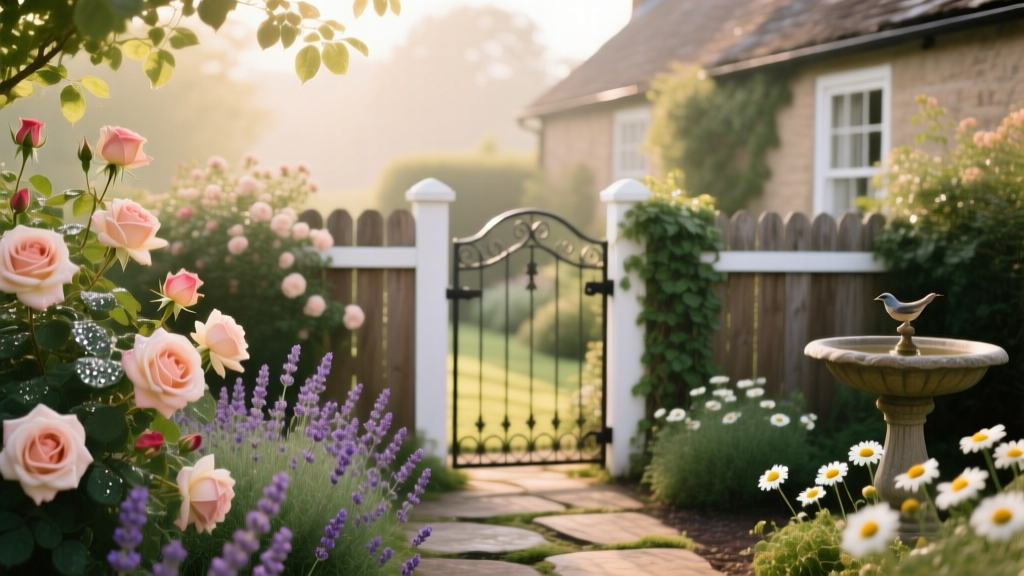
Front Yard Cottage Garden Style
You step out to grab the mail and the front yard does that familiar thing: it feels exposed, a little flat, and somehow both empty and messy at the same time. There’s lawn you don’t love mowing, a straight foundation bed with tired shrubs, and a walkway that gets you to the door but doesn’t welcome anyone. Cottage style solves this exact problem—softening hard lines, adding fragrance and movement, and creating a “walk up” that feels like a lived-in garden rather than a landscaping job.
The trick is making it look relaxed while it behaves responsibly: clear sightlines for safety, tidy edges where you need them, and plant choices that won’t flop onto the sidewalk or swallow your windows by July. Let’s lay out a front yard cottage garden the way a designer would—starting with the bones, then layering plants like you’re composing a bouquet that blooms from spring through frost.
Start with the bones: paths, edges, and sightlines
Keep the approach readable (and deliverable)
Cottage gardens are generous, but the “front door path” has to function. If you’re reworking the walkway, aim for 42–48 inches wide so two people can pass comfortably (or you can carry a box without brushing plants). A narrower existing path can still work; just keep plantings set back so the clear walking width stays at least 36 inches.
At street corners and driveways, maintain a low planting zone for visibility. Many municipalities use a “sight triangle” standard; a practical homeowner version is: within 10 feet of a driveway or sidewalk intersection, keep plants under 30 inches tall. That still leaves room for mounding perennials and plenty of flowers—just put the taller spires deeper in the bed.
Use a simple layout that reads as cottage, not chaos
The easiest way to get cottage style in a front yard is to combine two shapes: a foundation border (along the house) and a path border (along the walk), then stitch them together with one focal point.
- Foundation border: 4–6 feet deep (deep enough for layered planting without crowding the house).
- Path border: 2.5–4 feet deep (deep enough for spillers, but still keeps the walkway clean).
- Focal point: a small ornamental tree, a birdbath, or a bench set 6–10 feet from the sidewalk for a sense of invitation without blocking circulation.
If you have a tiny yard, you can compress this: a 3-foot foundation bed and a 2.5-foot path bed still reads cottage if the planting is layered and densely textured.
Edge intentionally so it looks charming on purpose
A crisp edge is what makes abundant planting feel designed. For DIY, a simple spade-cut trench edge works and costs almost nothing. If you want a more finished look, consider steel edging: it disappears visually and holds curves. Expect roughly $2–$4 per linear foot for basic steel edging materials, depending on thickness and brand.
Sun, soil, and water: design with the real conditions
Cottage gardens are often pictured in full sun, but front yards vary—big street trees, overhangs, and north-facing walls change everything. Before you buy plants, track sunlight for one day (morning, noon, late afternoon). Most classic cottage bloomers want 6+ hours of sun, while many shade-tolerant cottage picks bloom well at 3–5 hours of dappled light.
Soil prep doesn’t need to be fancy, but it does need to be consistent. A 2-inch compost top-dress across new beds is usually enough to jump-start planting. The U.S. Composting Council notes that compost improves soil structure and water-holding capacity (U.S. Composting Council, 2021). That matters in front yards, where reflected heat from pavement can dry beds quickly.
“Right plant, right place is the most important rule—and it’s also the cheapest.” —Beth Chatto, quoted widely from her drought-resilient planting philosophy (Chatto, 2007)
For water, plan on deep watering new plantings for the first season. A practical baseline: 1 inch of water per week (from rain + irrigation) during establishment is a common extension recommendation for many landscape plantings (see general lawn and garden irrigation guidance from university extensions such as University of Minnesota Extension, 2022).
Layout strategies that make cottage style work in front yards
Strategy 1: Layer heights like a theater seating chart
Think in three layers so the garden looks full but not jumbled:
- Front edge (6–18 inches): low mounds and spillers to soften hard lines.
- Middle (18–30 inches): the main flowering perennials and grasses.
- Back (30–60 inches): vertical accents (salvias, foxgloves, shrubs) placed so they don’t block windows.
Spacing matters. Cottage gardens look lush because plants touch, but you still want airflow. A workable rule: plant most perennials on 12–18 inch centers, larger clumps on 24–36 inch centers, and then knit gaps with annuals the first year.
Strategy 2: Repeat a few “anchor” plants, then improvise
Pick 3–5 anchor plants and repeat them in drifts. This keeps cottage planting from turning into a plant collection. Good anchors are durable, long-blooming, and look fine even when not flowering.
Example anchor set for a sunny front yard:
- Salvia nemorosa ‘Caradonna’ (vertical purple spires, long bloom)
- Nepeta ‘Walker’s Low’ (soft mound, pollinator favorite, tidy edge)
- Echinacea ‘Magnus’ (strong stems, summer into fall)
- Allium ‘Millenium’ (late summer, clean foliage)
- Hydrangea paniculata ‘Bobo’ (compact shrub, big bloom impact)
Strategy 3: Build in “tidy moments” near the sidewalk and door
Front yards need to look intentional from the street. Place your neatest plants closest to the hardscape—think clipped herbs, low evergreens, or plants with a naturally mounded habit. Save the looser, wilder textures (like taller daisies or airy grasses) for deeper in the bed.
Strategy 4: Plan a long season with three bloom waves
A cottage garden earns its keep by changing. Aim for:
- Spring: bulbs + early perennials
- Summer: main perennials + roses
- Fall: late perennials + seedheads + grasses
If you’re in a cold-winter region, a few evergreen shapes (boxwood substitutes if boxwood blight is an issue) keep the front from looking empty from November to March.
Plant selection: specific varieties that behave well in front yards
The best cottage plants for front yards have three traits: strong stems (they don’t collapse into the walkway), long bloom or great foliage, and pollinator value without being wasp-magnets right at the doorstep. Below are reliable choices, with notes on where they shine.
Sunny to part-sun (6+ hours preferred)
Roses (disease-resistant shrub types): Choose roses bred for fewer sprays and better repeat bloom. Look for Rosa ‘Olivia Rose Austin’ (soft pink, strong repeat), ‘Lady of Shalott’ (apricot, healthy foliage), or Knock Out-type shrubs where you want minimal fuss. Space shrub roses about 3 feet apart for airflow and easy pruning.
Salvia nemorosa ‘Caradonna’: Stays upright, looks modern but blends with cottage palettes. Plant on 18-inch centers; cut back after the first flush for rebloom.
Nepeta ‘Walker’s Low’: A classic path-edge softener with a long season. Plant on 24-inch centers; shear lightly midseason to refresh.
Lavandula angustifolia ‘Hidcote’: For fragrance near the path. Needs drainage; keep it on the drier edge of the bed. Plant 18–24 inches apart.
Echinacea ‘Magnus’: Strong cone flower with sturdy stems; excellent for summer structure and birds later. Space 18 inches apart.
Allium ‘Millenium’: Late-summer purple globes; neat clump and excellent with grasses. Space 18 inches apart.
Part shade (3–5 hours, or bright filtered light)
Hydrangea arborescens ‘Incrediball’ or ‘Annabelle’: Big blooms, but place them where rain runoff won’t flatten them and consider discreet staking. Give 4 feet of width.
Heuchera (Coral Bells) ‘Caramel’ or ‘Palace Purple’: A cottage-friendly foliage plant that acts as a color “bridge.” Space 12–18 inches.
Brunnera ‘Jack Frost’: Silver leaves brighten shady fronts and look good all season. Space 18 inches.
Geranium macrorrhizum ‘Ingwersen’s Variety’: Tough, fragrant foliage, and excellent as a groundcover that still feels cottage. Space 18 inches.
Front-edge “neat knitters” (great near sidewalks)
Thymus serpyllum (Creeping thyme): For sunny edges and between stepping stones. Space plugs 8–12 inches apart; it will fill in.
Alchemilla mollis (Lady’s mantle): Soft scalloped leaves and chartreuse flowers. Lovely, but it can self-seed; deadhead if you want it controlled. Space 18 inches.
Comparison table: choose the right backbone plants
| Plant | Best light | Typical mature size | Spacing | Why it works in a front-yard cottage layout |
|---|---|---|---|---|
| Salvia nemorosa ‘Caradonna’ | Full sun | 18–24 in. tall x 18 in. wide | 18 in. | Upright habit, repeat bloom, strong vertical accent without flopping |
| Nepeta ‘Walker’s Low’ | Sun/part sun | 18–24 in. tall x 24–36 in. wide | 24 in. | Softens edges, long bloom, pollinator-friendly, easy to shear tidy |
| Hydrangea paniculata ‘Bobo’ | Sun/part sun | 2.5–3 ft tall x 3–4 ft wide | 3–4 ft | Compact shrub for structure; big flowers without blocking windows |
| Heuchera ‘Caramel’ | Part shade | 12–18 in. tall x 18 in. wide | 12–18 in. | Foliage color all season; tidy mounds near paths |
| Allium ‘Millenium’ | Full sun | 15–20 in. tall x 15–18 in. wide | 18 in. | Late-season color; clean foliage; doesn’t sprawl into walkways |
Three real-world layout scenarios (with numbers you can copy)
Scenario 1: The small rental front (12 ft x 15 ft) with a straight walk
You can’t rip out hardscape, and you may not want to invest in shrubs you can’t take with you. Here’s a renter-friendly cottage plan using mostly perennials in containers and a narrow in-ground strip.
Layout: Add two large pots (at least 18 inches wide) flanking the stoop, and create a 2.5-foot deep bed along one side of the walkway. Keep the other side as simple mulch + one repeating groundcover for a tidy look.
Planting approach: Use repeatable, tough plants: Nepeta ‘Walker’s Low’ (2–3 plants), Salvia ‘Caradonna’ (2 plants), and seasonal annuals (alyssum, calibrachoa) to fill gaps. In pots, try a compact rose or lavender plus trailing thyme.
Cost range: You can often pull this off for $150–$350 depending on pot quality and how many perennials you buy as 1-gallon vs. 2-gallon sizes. DIY alternative: use thrifted containers (drill drainage holes) and buy smaller plants; they’ll fill in by year two.
Scenario 2: The typical suburban rectangle (25 ft x 40 ft) with foundation shrubs
This is the most common “blank canvas with baggage”: oversized shrubs at the foundation and too much lawn in front.
Layout: Keep a 5-foot deep foundation bed with a gentle curve, and add a path border on both sides at 3 feet deep. Place one small ornamental tree (like Amelanchier serviceberry) about 8 feet off the sidewalk, offset from center to look natural.
Planting approach: Remove (or heavily reduce) the largest shrubs blocking windows. Rebuild with one compact structural shrub per 8–10 feet (e.g., Hydrangea paniculata ‘Bobo’ or dwarf inkberry holly), then mass perennials in repeating groups of 3s and 5s.
Spacing & quantities example: Along a 20-foot run, you might install 7 nepeta (24-inch spacing), 7 salvia (18-inch spacing in pockets), and 5 echinacea (18-inch spacing), then weave in spring bulbs at about 8 bulbs per square foot in clusters (denser in focal spots, lighter elsewhere).
Cost range: If you buy mostly 1-gallon perennials and 2–3 shrubs, budget around $600–$1,200 for plants, mulch, and edging. DIY savings: skip new edging the first year and do a crisp spade edge; buy smaller perennials and be patient.
Scenario 3: The shady urban front with a big street tree (limited sun, dry soil)
This yard frustrates people because traditional cottage flowers sulk in dry shade. The solution is a cottage feel—texture, repetition, and seasonal moments—using plants that actually enjoy those conditions.
Layout: Keep beds shallow near tree roots: 3–4 feet deep is plenty. Add a stepping-stone path through one bed if you need access for pruning, with stones about 18–24 inches apart for comfortable walking.
Planting approach: Use brunnera, heuchera, geranium macrorrhizum, and spring bulbs like snowdrops and species tulips where sun hits early. Add a few vertical accents that tolerate shade such as foxglove (biennial), Japanese anemone (if you can contain it), or astilbe in moister pockets.
Water strategy: Dry shade needs consistent deep watering the first year—plan for 30–45 minutes on a soaker hose once a week during dry spells, then taper as plants establish.
Cost range: Expect $400–$900 depending on how many shade perennials you need. DIY alternative: start with plugs (smaller plants) for groundcovers like geranium and let them knit over two seasons.
Step-by-step setup (designer workflow you can follow)
- Map what stays: Mark utilities, mature trees, and any plants you like. Identify sightline zones near driveways where plants must stay under 30 inches.
- Measure and sketch: Draw your yard to scale on graph paper. Even a simple 1 square = 1 foot sketch prevents expensive overbuying.
- Define bedlines: Use a garden hose to test curves. Stand at the street and the door—adjust until it looks smooth from both angles.
- Prep the soil: Remove sod in beds, loosen compacted soil, and top-dress with 2 inches of compost. Keep soil below siding and maintain a gap so mulch doesn’t touch the house.
- Place the structure first: Install the tree/shrubs, then perennials, then groundcovers/edgers.
- Plant in repeating groups: Group the same plant in 3s or 5s, repeating every 6–10 feet for cohesion.
- Mulch and water: Mulch to 2–3 inches (not volcanoes around stems). Water deeply right after planting.
- Fill gaps for year one: Use annuals (calendula, cosmos, alyssum) where perennials haven’t filled in yet. This is how you get instant cottage charm without overcrowding long-term.
Budget-smart choices and DIY alternatives
If you want cottage density without cottage spending, prioritize plants that multiply or are easy to divide. Nepeta, salvia, daylilies (choose modern tidy varieties), hardy geraniums, and many ornamental grasses can be divided every 2–3 years. That means your “year one” bed can be intentionally underfilled, then thickened with divisions.
Bulbs are another budget lever. A bag of 50 daffodils often costs less than a single shrub, and daffodils are long-lived and critter-resistant. Plant them in clusters along the path border so spring has a clear script.
Hardscape can be kept modest. Instead of replacing a walkway, soften it: widen visually with plants, add a pair of pots, and install lighting only where it matters. Solar path lights can work as placeholders, but a simple low-voltage kit aimed at the steps is a safer long-term investment.
Maintenance expectations (what it really takes)
A front yard cottage garden isn’t “no maintenance,” but it doesn’t have to become your weekend identity. After establishment, plan on about 45–90 minutes per week during the main growing season for deadheading, quick weeding, and edging. Spring and fall have their own rhythms:
- Early spring (1–2 sessions): Cut back last year’s perennials, tidy grasses, top-dress compost, refresh mulch where needed.
- Late spring to midsummer (weekly light touch): Deadhead roses and repeat bloomers; shear nepeta after the first flush; stake anything that leans early (staking late always looks obvious).
- Late summer (biweekly): Spot-weed, cut back tired stems, and let some seedheads stand for birds if they’re not messy near the path.
- Fall (1–2 sessions): Plant bulbs, cut back only what flops into walkways, and leave sturdier stems for winter structure.
If you want a neater look with less deadheading, choose plants with long-lasting flowers and clean habits—like Allium ‘Millenium’ and many salvias—then limit high-maintenance picks (some dahlias, for example) to containers where you can fuss over them more easily.
Small design moves that make it feel “cottage” without feeling messy
Add scent near the route: Lavender by the steps, thyme near the edge, and a rose where you’ll brush past it. Keep strongly scented plants 2–3 feet from the door if fragrance sensitivity is a concern.
Mix flower shapes: Spikes (salvia), daisies (echinacea), umbels (yarrow), and globes (allium) create the classic cottage richness without relying on dozens of colors.
Use a restrained color palette: If you’re nervous, pick one main palette (soft pink/purple/white or yellow/blue/white) and add one contrast color in small doses. Repetition is what reads as “designed.”
Keep the front edge disciplined: One continuous line of a low plant (creeping thyme, lady’s mantle, dwarf mondo grass in shade) acts like a hem on a dress—everything behind it can be more playful.
Sources
U.S. Composting Council. 2021. Compost use and benefits guidance (soil health, water-holding capacity).
University of Minnesota Extension. 2022. General irrigation guidance commonly citing ~1 inch of water per week for actively growing landscapes/lawns during dry periods.
Beth Chatto. 2007 (widely cited editions). Planting philosophy emphasizing “right plant, right place.”
When you’re done, the front yard won’t just look prettier—it will function better. The walk stays clear, the door feels framed, and the planting has a loose, generous mood that still behaves. Give it one season to settle, then one more to knit together, and you’ll start noticing the best part: you’ll slow down on your way inside, because the garden finally gives you a reason to.