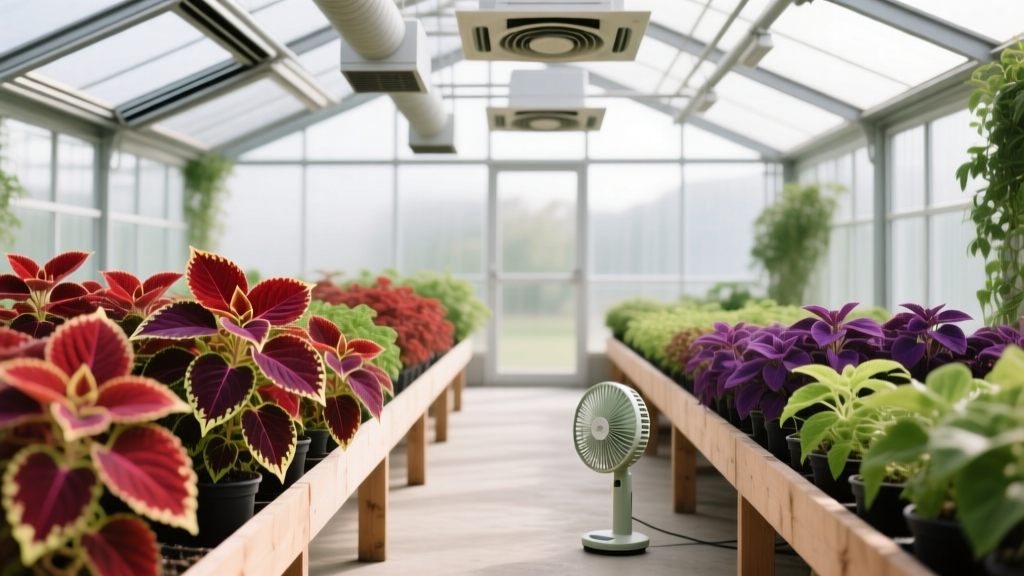
How to Ventilate a Greenhouse for Coleus
You walk into the greenhouse at 10 a.m., and your coleus looks like it got the wind knocked out of it—leaves limp, colors dull, a few stems flopped sideways. The soil is still damp, so you water “just a little,” and by evening you’ve got more collapse and a faint musty smell. That’s the trap: coleus often doesn’t fail from thirst in a greenhouse—it fails from stale, humid air that turns heat and moisture into a disease incubator.
Coleus (Plectranthus scutellarioides) is a fast grower with juicy stems and broad leaves. In a greenhouse, that lush growth means higher transpiration and a canopy that can hold humidity. If you don’t move air and exchange it, you get the classic greenhouse combo: hot + humid + still. The fix isn’t complicated, but it has to be intentional—ventilation strategy comes first, then you tune watering, light, and feeding to match the airflow you can actually provide.
This is the practical, home-gardener version of greenhouse ventilation: how to set it up, what numbers to aim for, what to do on heat waves and rainy stretches, and how to troubleshoot coleus problems that are really “air problems” in disguise.
Ventilation targets for coleus (the numbers that keep you out of trouble)
Before you start opening vents at random, set targets. Coleus is forgiving, but in a greenhouse it rewards consistency.
- Day temperature: 70–85°F (21–29°C). Short spikes to 90°F (32°C) happen, but don’t let it sit there for hours.
- Night temperature: 60–70°F (16–21°C). Above 72°F (22°C) at night with high humidity is when mildew and rot start lining up.
- Relative humidity (RH): aim for 50–70%. Try not to camp above 80% RH for long stretches.
- Air movement at canopy: a gentle, constant stir. If you can feel a light breeze on your hand at plant level, you’re close.
- Watering window: morning, so leaves and soil surface don’t stay wet overnight.
These targets line up with standard greenhouse disease prevention guidance: keep humidity controlled and avoid prolonged leaf wetness. University of Minnesota Extension (2023) emphasizes that many greenhouse diseases intensify with extended moisture on foliage and poor air movement. Similarly, Penn State Extension (2022) notes that ventilation and horizontal airflow are foundational tools for reducing humidity-driven disease pressure in protected culture.
“Most greenhouse leaf diseases don’t need a ‘bad plant’—they need a wet surface and time. Air movement and venting steal that time.” — paraphrased from greenhouse disease management principles discussed by Penn State Extension (2022)
Ventilation methods: natural vs mechanical (and when each wins)
For coleus, you can get excellent results with either natural ventilation (vents/doors) or mechanical ventilation (fans), but the payoff is different depending on your greenhouse size, climate, and how often you’re home to babysit it.
| Method | What it does best | Typical setup | Best for | Watch-outs |
|---|---|---|---|---|
| Natural ventilation | Dump heat fast when outdoor air is cooler/drier | Roof vent + side vent/door; insect screen | Small-to-mid greenhouses; mild summers; gardeners home daily | Stalls on still, humid days; can spike drying and stress if you overdo it |
| Mechanical exhaust + intake | Predictable air exchange regardless of wind | Exhaust fan + louvered intake opposite end | Hot climates; larger houses; consistent coleus production | Can over-dry pots if airflow is too aggressive; needs power and cleaning |
| HAF (horizontal airflow) fans | Prevents stagnant pockets; evens temperature and humidity | 2+ circulating fans running continuously | Any greenhouse growing dense coleus benches | Doesn’t remove heat alone; must pair with venting/exhaust |
| Shade + ventilation combo | Reduces heat load so ventilation can keep up | 30–50% shade cloth + vents/fans | Bright regions; summer coleus color production | Too much shade can stretch plants and dull color |
Comparison analysis with actual data: passive venting vs exhaust fan
Here’s a practical comparison from real greenhouse behavior. Imagine a 8 ft x 12 ft hobby greenhouse (~96 sq ft). On a sunny day, inside temperature can rise 15–30°F above outdoor air if it’s closed up. With:
- Passive venting: Opening a roof vent plus the door often drops interior temperature by 5–15°F within 15–30 minutes, depending on wind and outdoor humidity.
- Mechanical exhaust: A properly sized exhaust fan can pull that same drop in 5–15 minutes because it forces air exchange even when the air outside is still.
The practical takeaway for coleus: if you’re regularly seeing 85–90°F by mid-morning, a fan-based system stops the daily heat spike that leads to midday wilt and night-time disease pressure.
Step-by-step: a ventilation routine that works (daily and seasonal)
Ventilation succeeds when it’s routine. Here’s a system you can follow without guessing.
Daily routine (spring through early fall)
- Morning (8–10 a.m.): Crack the roof vent and open a low intake (door or side vent) on the opposite side. Your goal is gentle exchange before heat builds.
- Midday check (12–2 p.m.): If interior temps reach 85°F (29°C), increase vent opening or switch on exhaust. If RH is above 75–80%, prioritize air exchange even if it cools slightly.
- Late afternoon (4–6 p.m.): Start dialing vents back so plants don’t sit in a cold draft overnight, but avoid sealing the house tight if humidity is high.
- Night: If you struggle with mildew, run HAF fans continuously (low speed). Moving air at night is a quiet disease prevention tool.
Seasonal adjustments (what changes and when)
- Cool spring nights: Vent early in the day, but don’t over-vent late afternoon. Coleus hates cold stress; keep nights above 60°F (16°C).
- Summer heat: Add 30–50% shade cloth and prioritize exhaust ventilation by late morning. If your coleus wilts daily at noon, you’re not “watering wrong”—you’re overheating.
- Rainy, humid stretches: Counterintuitive but true: you often need more air movement when it’s wet outside, because the greenhouse traps moisture. Use HAF fans plus brief exhaust cycles to keep RH below 80%.
Watering coleus in a greenhouse (so ventilation can do its job)
Watering and ventilation are a matched pair. If you water heavily in the evening and then close up the greenhouse, you’ve created a humid chamber that holds wet soil surfaces and damp foliage for hours.
How much and how often
Rather than giving a fixed schedule, use a repeatable method:
- Water when the top 1 inch (2.5 cm) of mix feels dry or when pots feel noticeably lighter.
- Water thoroughly until you get 10–20% runoff from the bottom. That flush prevents salt buildup from fertilizer.
- In typical summer greenhouse conditions, expect watering every 1–3 days for 4–6 inch pots, and every 2–5 days for larger containers—adjust for heat, airflow, and plant size.
Timing matters more than people think
Water in the morning. If any splashes hit foliage, the day’s warmth and airflow help it dry quickly. Minnesota Extension greenhouse guidance (2023) repeatedly points to reducing leaf wetness duration as a key disease prevention step—timing irrigation is one of the easiest ways to do that without buying new equipment.
Real-world case: “I watered less and it got worse”
This happens when humidity is high and airflow is low. The gardener cuts watering to stop wilting, but the plant still wilts because roots are stressed by heat and the greenhouse air is stagnant. Leaves lose water faster than roots can replace it. Fix the air exchange first, then resume proper deep watering in the morning.
Soil and potting mix: build for airflow at the roots
Ventilation isn’t just above the bench. Coleus roots need oxygen. In a greenhouse, wet media plus warm temps can suffocate roots quickly.
A mix that behaves well in humidity
- Use a peat/coir-based potting mix with added perlite for air space.
- If you blend your own, aim for roughly 20–30% perlite by volume for containers.
- Choose pots with generous drainage holes; avoid decorative cachepots that trap runoff.
If you’re seeing fungus gnats, algae on the soil surface, or a sour smell, your mix is staying too wet for too long—usually a ventilation + watering + container drainage problem working together.
Light management: ventilation is easier when the sun load is controlled
Coleus can take bright light, but greenhouse sun is intense. Too much sun load drives temperatures up, forcing you to over-vent, which can whip plants with hot, dry drafts or swing temperatures too hard.
Practical light targets
- Give coleus bright, filtered light. In many hobby greenhouses, that means 30–50% shade cloth from late spring through summer.
- If leaves bleach or look “washed out,” you may be running too hot and too bright—add shade and increase midday ventilation.
- If plants stretch (long internodes, floppy stems), you may be too shady or too warm at night—reduce shade slightly and ventilate evenings to keep nights nearer 60–70°F.
Feeding coleus: strong growth without turning the greenhouse into a pest buffet
In warm, humid conditions, heavy feeding pushes soft growth that pests love. The goal is steady, compact growth with strong color.
A workable fertilizer plan
- Use a balanced liquid fertilizer (for example, 10-10-10 or 20-20-20) at 1/4 to 1/2 strength every 7–14 days.
- Alternatively, use slow-release fertilizer at label rate and water normally, flushing with 10–20% runoff at least occasionally to prevent salt buildup.
- If leaf edges brown and pots dry fast, check for fertilizer salt accumulation—flush with plain water until runoff is clear, and improve ventilation to reduce stress swings.
Common coleus problems tied directly to poor ventilation (and how to fix them)
When coleus looks rough in a greenhouse, many gardeners chase the wrong thing—more water, less water, more food, less sun. Start by reading the air.
Powdery mildew
Symptoms: White powdery patches on leaves, often starting in shaded, crowded spots; leaves may curl or yellow.
Why ventilation matters: Mildew thrives when humidity is high and air is still, especially with warm days and cooler nights.
Fix:
- Increase air exchange: open roof vent + low intake earlier in the day.
- Run HAF fans continuously at low speed to break up still pockets.
- Space plants so leaves aren’t touching; prune dense tops.
- Water early morning only; keep foliage dry.
Botrytis (gray mold)
Symptoms: Brown, water-soaked spots; gray fuzzy mold on dying leaves or flowers; worse after cloudy, damp weather.
Fix:
- Remove dead leaves immediately—don’t compost them inside the greenhouse.
- Ventilate during the day even if it’s cool; short air exchanges beat stagnant humidity.
- Avoid overhead watering; switch to soil-level watering.
Root rot / stem rot
Symptoms: Sudden collapse despite moist soil; blackened stem at soil line; roots brown and mushy.
Fix:
- Improve drainage and reduce water frequency, but don’t “sip water” daily—water deeply, then let the top inch dry.
- Boost airflow and temperature stability; avoid cold, wet nights under 60°F.
- Take clean cuttings from healthy tops and restart if the base is compromised.
Edema (blistering)
Symptoms: Corky bumps or blisters on leaf undersides; leaves may distort.
Why it happens: Roots take up water faster than leaves can transpire—common when humidity is high and airflow is low.
Fix:
- Increase air movement (HAF fans) to improve transpiration.
- Water in the morning; avoid heavy watering before cool, cloudy days.
- Reduce humidity by venting briefly even during damp weather.
Troubleshooting by symptom: quick diagnosis for greenhouse coleus
If you only remember one thing: match your response to the symptom, not your assumptions.
Symptom: Midday wilting, recovery at night
- Most likely: Heat stress + insufficient air exchange.
- Do this today: Vent earlier; add shade cloth; check temps at canopy height—if you’re hitting 85–90°F, you’re in the danger zone.
- Also check: Pots may be root-bound; a tight root ball dries too fast and exaggerates wilt.
Symptom: Leaves stay wet for hours after watering
- Most likely: Poor airflow or watering too late.
- Do this today: Switch to morning watering; add a small circulating fan; increase venting for 30–60 minutes after watering to dry surfaces.
Symptom: Pale color, stretched stems
- Most likely: Too warm at night, too much shade, or too much nitrogen.
- Do this this week: Vent late afternoon to keep nights closer to 60–70°F; reduce shade slightly (for example from 50% down to 30%); cut fertilizer strength to 1/4 for two feedings.
Symptom: Fungus gnats hovering, algae on soil
- Most likely: Media staying too wet due to humidity and low evaporation.
- Do this today: Increase air movement at bench level; allow the top 1 inch to dry between waterings; bottom-water if you tend to splash.
Three real-world greenhouse scenarios (and what I’d do first)
These are the situations that show up in home greenhouses every season.
Scenario 1: Small greenhouse, you work away from home
You can’t open and close vents hourly. Coleus overheats by noon, then sits humid at night.
- Install an automatic vent opener on a roof vent, set to begin opening around 75–80°F.
- Run a small HAF fan continuously.
- Use 30–40% shade cloth to prevent the worst heat spikes.
Scenario 2: Coastal or rainy climate (humidity is the enemy)
Outdoor air is humid, so opening vents doesn’t “dry” the greenhouse much.
- Prioritize air movement (HAF fans) to prevent still pockets around leaves.
- Vent in short, purposeful bursts to dump saturated air and replace it, even if the incoming air isn’t perfectly dry.
- Water early and avoid wetting foliage.
Scenario 3: Heat wave week (90–100°F outside)
Ventilation alone may not keep up because you’re bringing in hot air.
- Use 50% shade cloth temporarily.
- Vent fully early to prevent heat buildup, then maintain maximum airflow.
- Water in the morning and consider a second light watering early afternoon if pots are drying dangerously fast—don’t soak late day.
- Space plants and pinch back overly dense tops to reduce humidity in the canopy.
Practical greenhouse setup tips that make coleus easier
You don’t need a commercial setup. A few small choices make ventilation far more effective.
- Put a thermometer/hygrometer at plant height, not hanging at eye level near the door. Canopy climate is what matters.
- Vent high + intake low: Hot air exits at the roof; cooler air enters low. This creates a natural flow even with modest wind.
- Use insect screening thoughtfully: Screens reduce airflow. If your venting is weak, you may need a fan to compensate.
- Don’t crowd benches: Leave at least a few inches between pots so air can move. Coleus grows fast; what’s “spaced” today is a jungle in two weeks.
- Clean fan blades and louvers monthly during peak season. Dust reduces efficiency more than people expect.
For best disease suppression, combine ventilation (air exchange) with circulation (air movement). University extension greenhouse recommendations consistently pair these two approaches for humidity management and disease prevention (University of Minnesota Extension, 2023; Penn State Extension, 2022).
If you get the air right, coleus becomes the easy plant it’s supposed to be: vivid color, fast fill, quick recovery after pruning, and far fewer “mystery” leaf problems. Your greenhouse should smell fresh when you open the door—warm soil and green plants, not musty, not sour. When it does, you’ll find you can water more confidently, feed more consistently, and enjoy coleus the way it looks in the catalogs—without the daily drama.
Sources: University of Minnesota Extension (2023), greenhouse plant disease prevention and moisture management guidance; Penn State Extension (2022), greenhouse humidity/airflow principles for disease suppression and crop health.