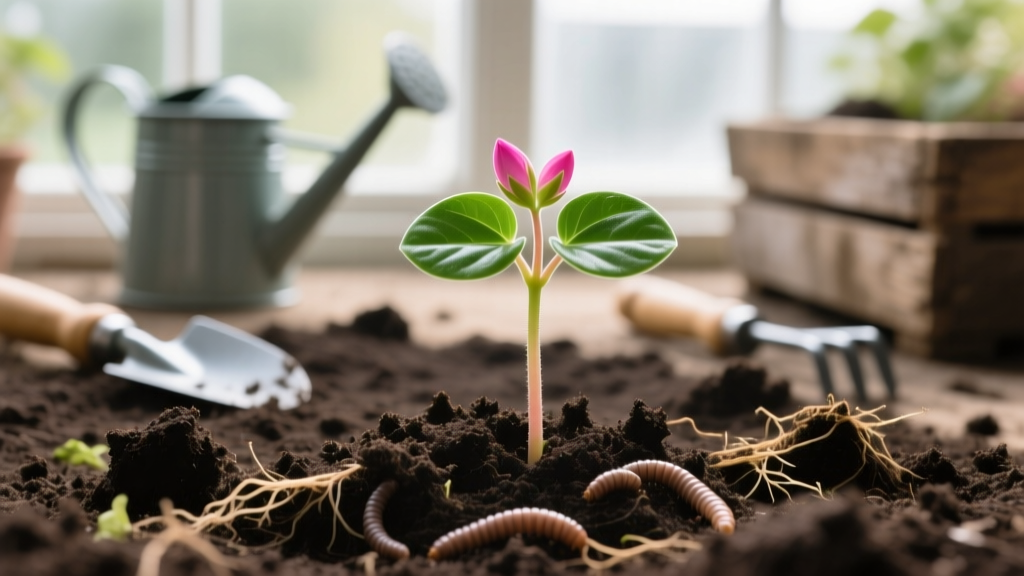
Building Healthy Soil for Impatiens
You plant a flat of impatiens, they look fantastic for about two weeks, and then the slow slump begins: flowers thin out, leaves pale, stems get leggy, and the whole planting seems to “stall.” Most gardeners blame shade or fertilizer. More often, it’s the soil behaving like a bad sponge—either staying soggy and airless or drying hard as a brick. Impatiens aren’t fussy plants, but they are honest ones: if the root zone isn’t balanced, they show you fast.
The good news is that “healthy soil” for impatiens isn’t mysterious or expensive. It’s a short list of practical targets—drainage, moisture-holding capacity, organic matter, and steady nutrition—plus a few habits that keep that soil functioning from May through frost.
Start with the goal: what impatiens roots actually need
Impatiens (especially common bedding impatiens, Impatiens walleriana, and New Guinea impatiens, I. hawkeri) have fine, shallow roots. They like consistent moisture but also need oxygen around those roots. That’s why the “perfect” impatiens soil feels like a wrung-out sponge: moist, springy, and crumbly, not muddy and not dusty.
Aim for these root-zone targets:
- Moisture: evenly moist; top 1 inch dries slightly between waterings.
- Drainage: water should soak in within 30–60 seconds, not puddle for minutes.
- Organic matter: roughly 5–10% in beds (higher in containers).
- Soil pH: slightly acidic, roughly 6.0–6.5 for best nutrient availability.
- Root temperature: steady growth when soil is around 60–75°F (cold, wet soil invites rot).
Those numbers aren’t pulled from thin air. University-based recommendations consistently point home gardeners toward improving structure with organic matter and keeping pH in the slightly acidic range for most ornamentals. For example, Penn State Extension’s guidance on soil testing and pH management emphasizes matching amendments to soil test results rather than guessing (Penn State Extension Soil Testing Guide, 2023). Similarly, the University of Minnesota Extension notes that organic matter improves both water-holding and drainage—exactly the paradox impatiens need solved (University of Minnesota Extension, Soil Organic Matter, 2022).
Soil: building the “wrung-out sponge” texture
Step 1: Do a quick texture and drainage check (10 minutes)
Before you add anything, learn what you’re working with. Here are two fast tests:
- Squeeze test: Grab a handful of moist soil (not dripping). Squeeze.
- If it forms a hard ball and stays that way: likely clay-heavy, needs aeration and organic matter.
- If it falls apart like dry sand: likely too sandy, needs compost for water-holding.
- If it holds lightly, then crumbles when poked: you’re close.
- Infiltration test: Dig a hole about 6 inches wide and 6 inches deep. Fill with water and time the drain.
- < 5 minutes: drains fast; plan to increase compost and mulch.
- 5–30 minutes: good garden drainage.
- > 30 minutes: slow; address compaction, add organic matter, consider raised beds.
Step 2: Add the right organic matter (and the right amount)
For impatiens beds, compost is the workhorse amendment. It improves structure in both sandy and clay soils and supports a steady nutrient supply. The common mistake is adding “a little” compost and expecting miracles. For real improvement, you need volume.
Use these practical rates:
- In-ground beds: Spread 2–3 inches of finished compost and mix into the top 6–8 inches of soil.
- New bed on poor soil: Go up to 4 inches compost the first season, mixed thoroughly.
- Annual tune-up: Topdress 1 inch compost each spring; let worms and watering carry it down.
If you’re dealing with heavy clay, compost is still the best first move, but you’ll also need to avoid compaction. Don’t work the soil when it’s wet—if you can roll it into a worm, it’s too wet to dig without damage.
“Adding organic matter is the single most important thing you can do to improve garden soil—because it improves drainage in clay and water-holding in sand.” — University of Minnesota Extension, Soil Organic Matter (2022)
Step 3: Know what not to add
A few popular “fixes” can backfire for impatiens:
- Sand into clay (in small amounts): This can create a concrete-like texture. Compost is safer and more reliable.
- Fresh manure: Too hot, too salty, and can push lush, weak growth. If you use manure, it should be well-composted and applied lightly (think 1 inch or less).
- Excess lime: Impatiens don’t need alkaline soil. Lime without a soil test often creates micronutrient problems (chlorosis).
Comparison: common bed-building methods (with real numbers)
If you’re trying to decide between “dig it all in,” “topdress,” or “raised bed,” here’s a practical comparison. These are typical home-garden numbers that reflect how much material and labor each approach usually takes.
| Method | Compost Needed (per 100 sq ft) | Labor Level | Time to Notice Improvement | Best For |
|---|---|---|---|---|
| Mix in compost (2–3 inches into top 6–8 inches) | ~0.6–0.9 cu yd (about 16–24 cu ft) | High (digging/tilling) | Immediate (this season) | New beds, compacted soil, poor texture |
| Topdress (1 inch yearly, no digging) | ~0.3 cu yd (about 8 cu ft) | Low | Gradual (1–2 seasons) | Maintaining decent soil, protecting soil structure |
| Raised bed (6–10 inches of blended mix) | ~1.9–3.1 cu yd total fill | Medium (build + fill) | Immediate | Very heavy clay, poor drainage, roots struggling |
My rule: if water puddles after rain for more than 30 minutes where you want impatiens, you’re a raised-bed candidate or you need serious soil rehab (compost + aeration + avoiding foot traffic).
Watering: the soil–water relationship that makes or breaks impatiens
Impatiens failures are often watering failures—but the soil sets you up for those mistakes. The same “twice a week” schedule can drown plants in clay and starve them in sand.
How often to water (based on location)
- In-ground, amended beds: Water deeply 1–2 times per week during dry spells, delivering roughly 1 inch of water total per week (rain included).
- Containers (10–12 inch pots): Expect to water 3–7 times per week depending on heat and wind. In a hot spell above 85°F, daily watering is common.
- Hanging baskets: Often need water daily once roots fill the basket, sometimes twice daily in heat.
The most reliable “sensor” is your finger. Push it into the soil up to your second knuckle (about 2 inches): if it feels dry at that depth, water. If it’s cool and moist, wait.
Case #1: The shady bed that still wilts
This surprises people: “It’s in shade, why is it wilting?” In shade, soil can stay damp on top but dry out underneath if roots are shallow and the soil is compacted. Compaction sheds water sideways instead of soaking in.
Fix:
- Water slowly so it penetrates: a gentle hose flow for 3–5 minutes per plant cluster, or a soaker hose for 30–45 minutes.
- Mulch with 1–2 inches of shredded bark or leaf mold to reduce evaporation and moderate soil temperature.
- Next season, mix in 2–3 inches compost to improve infiltration.
Light: enough brightness without baking the roots
For common impatiens, bright shade or morning sun with afternoon shade is the sweet spot. New Guinea impatiens tolerate more sun but still prefer protection from harsh afternoon heat in many climates.
- Common impatiens: about 2–4 hours of gentle sun (morning) or dappled light all day.
- New Guinea impatiens: up to 4–6 hours of sun if soil moisture is steady.
Light and soil interact. More sun means faster drying, which means your soil mix must hold moisture without turning swampy. That’s compost + mulch, not heavy peat alone in the ground.
Feeding: steady, light nutrition beats big doses
Impatiens respond to consistent feeding, especially in containers where nutrients leach out. But overfeeding pushes soft growth that flops and attracts problems.
Feeding plan for beds
- At planting: Mix compost into the planting area (your base fertility).
- After 3–4 weeks: If growth is pale or slow, apply a balanced granular fertilizer (something like 10-10-10) at the label rate, watered in well.
- Midseason boost: A light side-dress of compost (1/2 inch) around plants, then water.
Feeding plan for containers (more precise)
Choose one approach:
- Slow-release fertilizer: Mix into potting mix at planting; it typically feeds for 8–12 weeks. Refresh once midseason if labeled for it.
- Liquid feed: Apply at 1/4–1/2 strength every 7–14 days. This is my preferred method for baskets because you can adjust quickly if plants look too dark (overfed) or too pale (underfed).
If you’re unsure, feed less and improve soil first. Great soil buffers mistakes; poor soil punishes them.
Common problems tied to soil health (and how to troubleshoot fast)
When impatiens struggle, you’ll often see the symptom in leaves—but the cause is usually in the root zone. Here are the problems I see most often in home gardens, with specific fixes.
Symptom: Leaves yellowing from the bottom up, soil stays wet
- Likely causes: waterlogged soil, poor drainage, root rot starting.
- Immediate fixes:
- Stop watering until the top 1–2 inches dry.
- Pull mulch back 2 inches from stems to improve airflow.
- If in a pot, check drainage holes and empty saucers within 30 minutes of watering.
- Long-term fixes:
- Amend beds with 2–3 inches compost mixed into top 6–8 inches.
- Consider a raised bed if infiltration is > 30 minutes.
Symptom: Wilting every afternoon even though you watered yesterday
- Likely causes: root-bound containers; hydrophobic potting mix; too much sun; soil too sandy.
- Fixes:
- Check pot: if roots circle tightly, move up 2 inches in pot diameter or root-prune and refresh mix.
- Re-wet a dry pot thoroughly by soaking the container in a tub for 20–30 minutes, then letting it drain.
- Add 1–2 inches mulch in beds; switch to morning sun if possible.
Symptom: Pale leaves with green veins (chlorosis), slow flowering
- Likely causes: pH too high; nutrient lockout (often iron/manganese).
- Fixes:
- Get a soil test before adding lime or sulfur. Soil testing guidance from Penn State Extension emphasizes correcting based on results, not guesses (Penn State Extension, 2023).
- In containers, switch to a fresh potting mix and use a complete fertilizer that includes micronutrients.
Symptom: Mushy stems at soil line, seedlings topple
- Likely causes: damping-off (fungal disease) favored by wet, stagnant conditions.
- Fixes:
- Improve airflow; don’t crowd plants.
- Water early in the day; keep foliage dry.
- Use sterile seed-starting mix; don’t reuse old flats without cleaning.
Real-world scenarios: what I’d do in your yard
Case #2: Heavy clay bed along a north wall (slow drainage, patchy growth)
North walls stay cooler and wetter. In clay, that often means roots sit in cold muck, especially early in the season when soil temps are below 60°F.
Plan:
- Run the infiltration test. If it’s > 30 minutes, don’t fight physics.
- Build up: create a raised planting strip 6–8 inches tall.
- Fill with a blend: roughly 60% quality topsoil + 40% compost (or a reputable raised-bed mix).
- Mulch with 1–2 inches and water only when the top 1 inch is dry.
This approach gives impatiens the oxygen they want without you constantly guessing at watering.
Case #3: Containers that look great in June, tired by mid-July
This is usually a nutrition + root-space issue. By July, a 10-inch pot can be a solid mat of roots, and any fertilizer you mixed in at planting may be running out around week 8–10.
Plan:
- Scratch in a top-dressing of compost (1/2 inch) or refresh with slow-release fertilizer if it’s been 8–12 weeks.
- Switch to liquid feeding at 1/4 strength weekly for 3 weeks, then reassess.
- Water until it runs out the bottom; then wait until the top 1 inch is dry. “Sips” encourage shallow roots and quick wilting.