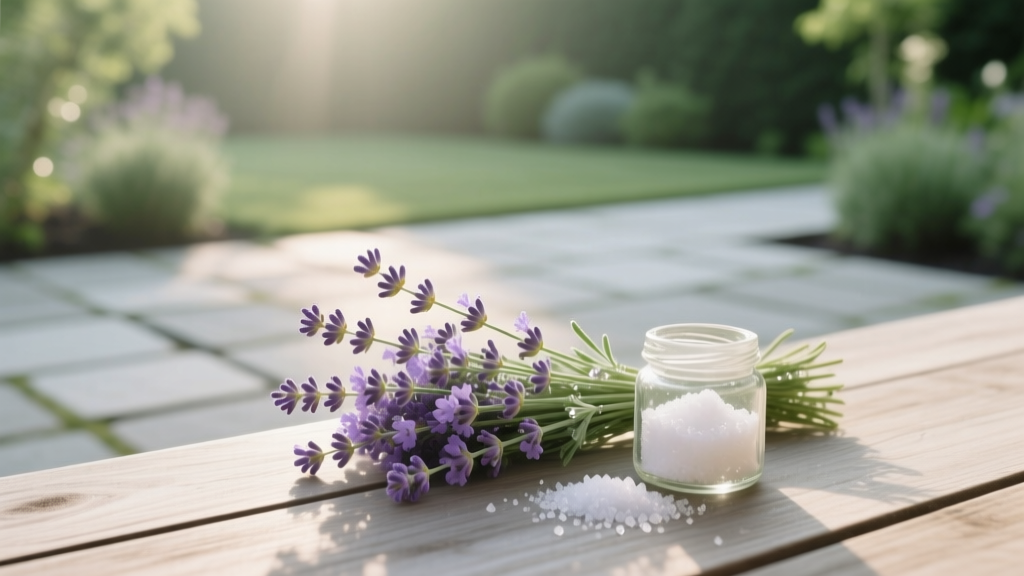
How to Use Epsom Salt on Lavender
You’ve got lavender planted in the sunniest spot you own. You’ve been careful not to overwater. And yet it still looks… off. The leaves are going pale, growth is stingy, and flowering feels more like a rumor than a guarantee. A lot of gardeners reach for fertilizer at this point—usually the wrong kind—and end up with a bigger, softer plant that flops, splits, or winters poorly.
Epsom salt gets suggested as a “quick fix,” and sometimes it truly helps. Other times it quietly makes things worse. The difference comes down to one question: Is your lavender actually short on magnesium, or are you fighting a different issue (like wet roots, acidic soil, or too much nitrogen)?
Below is how I use Epsom salt on lavender in a practical, measured way—only when it fits the problem—plus the watering, soil, light, and feeding habits that make lavender thrive without constant rescue treatments.
What Epsom Salt Really Does for Lavender (and When It Doesn’t)
Epsom salt is magnesium sulfate (MgSO4). Magnesium is central to chlorophyll production, so a true magnesium deficiency can show up as leaf yellowing (chlorosis), especially on older leaves, while the veins stay greener.
But here’s the catch: lavender is a Mediterranean plant that prefers lean, well-drained, slightly alkaline soil. Many “lavender problems” are caused by soil that holds too much water, fertilizer that pushes soft growth, or pH that’s too low. Epsom salt won’t fix those.
“Magnesium deficiency is best confirmed by soil testing; unnecessary applications can upset nutrient balance and do not correct problems caused by overwatering or poor drainage.” — University of Minnesota Extension soil nutrients guidance (2023)
Two credible points to keep in mind:
- Magnesium is a secondary nutrient. Plants need it, but it’s not a cure-all.
- More is not better. Over-application can compete with calcium and potassium uptake and can increase salt levels in containers.
For soil testing and nutrient balance principles, I lean on Extension resources like University of Minnesota Extension (2023) and Clemson Cooperative Extension guidance on soil testing and nutrient management (2020). These aren’t hobby opinions; they’re field-tested recommendations.
Three Real-World Scenarios: When Epsom Salt Helps (and When It’s a Trap)
Let’s ground this in situations I’ve seen repeatedly in home gardens.
Scenario 1: Container lavender with pale older leaves in mid-summer
What’s happening: Potting mixes get leached fast. By July or August, magnesium can be low—especially if you water often and never refresh the mix.
What helps: A single, measured Epsom salt drench may green things up within 7–14 days if magnesium is the limiting factor.
Scenario 2: Lavender in heavy clay that looks yellow and sulky
What’s happening: Wet feet. Roots are stressed, oxygen is limited, and nutrient uptake is impaired.
What helps: Not Epsom salt. Fix drainage first: raise the planting area, amend structure, reduce watering, or replant to a mound.
Scenario 3: Lavender growing fast, floppy, with few blooms
What’s happening: Too much nitrogen (often from lawn fertilizer drift, rich compost, or frequent feeding). Lavender responds with leafy growth and fewer flowers.
What helps: Stop feeding, improve light/airflow, and prune properly. Epsom salt won’t correct nitrogen excess.
Before You Apply Epsom Salt: Do These Two Checks
If you want results instead of guesswork, do a quick diagnostic first.
1) Check watering and root conditions
- Push a finger down 2 inches into the soil. If it feels cool and wet, don’t feed—dry it out.
- In pots, lift the container. If it feels heavy day after day, you’re likely overwatering or drainage is poor.
- Look for blackened stems near the base or a musty smell—classic early rot signs.
2) Check soil pH (especially in-ground)
Lavender generally performs best around pH 6.5–7.5. If your soil is below pH 6.0, many nutrients become less available, and plants struggle even when nutrients are technically present.
If you can, do a basic soil test. Clemson Cooperative Extension emphasizes soil testing as the first step before adding amendments (Clemson Cooperative Extension, 2020).
How to Apply Epsom Salt to Lavender (Measured, Not Messy)
Use Epsom salt only as a targeted supplement. Think of it like seasoning, not the main meal.
Option A: Soil drench (best for containers and quick correction)
Mixing rate: Dissolve 1 tablespoon of Epsom salt in 1 gallon of water.
How to apply:
- Water the lavender lightly first if the soil is bone dry (this prevents a salty “shock”).
- Apply the solution to the soil surface, soaking the root zone evenly.
- For a 10–12 inch pot, use about 1/2 gallon of solution. For larger pots, use up to 1 gallon.
- Do not reapply for at least 4–6 weeks.
Timing: Apply during active growth—typically spring through midsummer. Avoid late-season applications within 6–8 weeks of first frost; you don’t want to push tender growth going into cold weather.
Option B: Foliar spray (fast, but easy to overdo)
Foliar feeding can green leaves quickly, but it’s not my first choice for lavender because wet foliage can encourage disease in humid climates.
Mixing rate: Use 1 teaspoon Epsom salt per 1 quart of water (equivalent strength to the gallon mix).
How to apply safely:
- Spray early morning so leaves dry quickly.
- Lightly mist tops and undersides—don’t drench.
- Stop if you see leaf spotting or if humidity stays high for days.
Option C: Dry sprinkle (works in-ground, riskiest in pots)
If you prefer dry application, keep it conservative.
- In-ground: Sprinkle 1 tablespoon around the drip line of a mature plant, then water it in.
- In pots: I generally avoid dry sprinkling because salts can build up fast. If you do it, use 1 teaspoon maximum and water thoroughly.
Comparison: Epsom Salt Methods Side-by-Side (with Practical Data)
| Method | Mix/Rate | Speed of Response | Best Use Case | Main Risk |
|---|---|---|---|---|
| Soil drench | 1 tbsp per 1 gallon | 7–14 days | Container plants, mild deficiency | Salt buildup if repeated too often |
| Foliar spray | 1 tsp per 1 quart | 3–10 days | Quick cosmetic correction when weather is dry | Leaf spotting; disease risk in humidity |
| Dry sprinkle | 1 tbsp in-ground; 1 tsp in pots | 10–21 days | In-ground plants with good drainage | Uneven distribution; root burn if overapplied |
My practical take: If you’re going to use Epsom salt on lavender, the soil drench gives the best balance of control and safety. Foliar sprays are for dry climates or one-off corrections. Dry applications are fine in-ground if you’re careful, but they’re the easiest to overdo.
Watering: The Habit That Determines Whether Any Feeding Works
If lavender is watered like basil, it will act like basil for a while—lush, soft, and short-lived. Then it collapses. Lavender needs a wet/dry rhythm and oxygen at the roots.
In-ground watering schedule (typical home garden)
- New transplants (first 2–4 weeks): Water deeply every 3–5 days if there’s no rain.
- Established plants: Water only when the top 2–3 inches are dry. In many climates, that’s every 10–14 days during summer dry spells.
Container watering schedule
Pots dry faster, but lavender still hates constant moisture.
- Water thoroughly until water drains out the bottom.
- Wait until the pot feels noticeably lighter and the top 2 inches are dry before watering again.
- In heat waves above 90°F, you may water more often, but still avoid daily “sips.”
If you apply Epsom salt and keep the soil wet afterward, you’ve wasted the effort—roots under stress can’t take up nutrients efficiently.
Soil: Drainage First, Fertility Second
Lavender doesn’t need rich soil. It needs fast-draining soil. If you’re choosing between compost and grit, lavender usually prefers grit.
Quick soil targets that work in most yards
- Texture: Sandy loam or sharply drained raised bed mix
- pH: Aim for 6.5–7.5
- Drainage test: If a planting hole stays waterlogged longer than 4–6 hours after a deep soak, improve drainage before planting.
Simple drainage upgrades (realistic for home gardeners)
- Plant on a mound: Raise the planting area 6–12 inches above surrounding soil.
- Add mineral drainage: Mix in coarse sand or fine gravel (not a handful—think a meaningful portion in the planting zone).
- Avoid heavy mulches: Keep bark or compost mulches away from the crown; use light gravel mulch if you mulch at all.
If your soil is heavy and wet, Epsom salt isn’t the missing ingredient—air is.
Light and Temperature: The Non-Negotiables
Lavender’s performance tracks directly with sunlight.
- Minimum: 6 hours of direct sun
- Better: 8+ hours for dense growth and strong flowering
Heat is rarely the problem; lack of sun is. In muggy climates, morning sun plus airflow is especially valuable to dry foliage quickly.
If you’re overwintering lavender in a pot, keep it cool and bright. Many varieties do best when winter-protected but not kept warm like a houseplant—think an unheated garage window or cold sunroom where temps stay roughly 35–50°F rather than 70°F living-room warmth.
Feeding Lavender: Keep It Lean (and Where Epsom Salt Fits)
Lavender generally needs very little fertilizer. Overfeeding is one of the fastest ways to shorten its life.
A sensible feeding plan
- In-ground: Skip routine feeding. If growth is weak, top-dress lightly with a thin layer of compost in spring (not piled at the crown).
- Containers: Use a mild, balanced fertilizer at 1/4 strength once in spring, then leave it alone unless you see a true deficiency.
When Epsom salt makes sense in the feeding plan
- After confirming low magnesium via soil test, or
- When symptoms match magnesium deficiency and the plant is otherwise well-sited (sun, drainage) and not overfed
University of Minnesota Extension notes that nutrient applications should be driven by testing and symptoms rather than routine use (University of Minnesota Extension, 2023). That approach saves plants—and money.
Common Problems Mistaken for Magnesium Deficiency
This is where gardeners get tripped up. Yellowing leaves don’t always mean “add magnesium.” Here are frequent look-alikes.
Overwatering/root stress
- Symptoms: Overall paling, droop despite wet soil, darkening at the base, slow growth
- Fix: Let soil dry, improve drainage, reduce irrigation frequency
Nitrogen overload
- Symptoms: Soft, lush growth; fewer flowers; sprawling plant; more pest issues
- Fix: Stop fertilizing; avoid lawn fertilizer near lavender; prune lightly after bloom to tighten shape
Low pH (too acidic)
- Symptoms: Poor vigor, pale leaves, weak flowering even with sun
- Fix: Test pH; adjust per soil test recommendations (often lime is used, but rates should be based on your test)
Troubleshooting: Symptoms and Exactly What to Do
If you only read one section, make it this one. Match the symptom to the fix and you’ll avoid random treatments.
Symptom: Older leaves yellowing first, veins stay greener
Likely cause: Magnesium deficiency (more common in containers or sandy soils)
What to do:
- Confirm soil is not constantly wet.
- Apply an Epsom salt soil drench: 1 tbsp per 1 gallon.
- Wait 10–14 days before deciding if it worked.
Symptom: New growth is yellow or distorted, older leaves look okay
Likely cause: Iron deficiency (often tied to pH) or root stress, not magnesium
What to do:
- Check pH; if too high or too low, correct based on a soil test.
- Inspect roots if in a pot—circling roots or sour soil means it’s time to repot into a gritty mix.
Symptom: Plant turns gray-green, then brown at the base; stems die back
Likely cause: Root/crown rot from poor drainage
What to do:
- Stop watering immediately.
- Remove mulch from the crown area.
- If in a pot, unpot and assess roots; trim black/mushy roots and repot into a fast-draining mix.
- If in-ground clay, move the plant to a mound or raised bed. Feeding won’t fix rot.
Symptom: Lots of leaves, few blooms
Likely cause: Too little sun or too much nitrogen
What to do:
- Make sure it gets 6–8 hours of direct sun.
- Stop fertilizing for the season.
- Prune after flowering: remove about 1/3 of green growth (don’t cut deep into old woody stems).
Case Notes from the Garden: What I’d Do in These Situations
Case 1: A 12-inch patio pot that needs watering every day in July. I’d first check the potting mix. If it’s peat-heavy, it may swing between soggy and bone dry. I’d repot into a grittier blend and only then consider a single Epsom drench if older leaves remain pale after the watering pattern is corrected.
Case 2: Lavender along a walkway that gets sprinkler overspray 4 mornings a week. I’d adjust irrigation coverage before touching Epsom salt. Many “deficiencies” disappear when the crown stays dry and roots get air.
Case 3: A mature in-ground lavender that’s always been fine, but suddenly looks washed-out after a rainy month. I wouldn’t feed at all. I’d let it dry, open up airflow by lightly thinning, and consider a gravel top-dress to keep the crown drier. Nutrients don’t solve weather.
Safety and Best Practices (So You Don’t Create New Problems)
- Don’t combine Epsom salt with heavy fertilizing. If your lavender is already getting fertilizer, fix that first.
- Don’t apply to drought-stressed plants without pre-watering. Salts plus dry roots can burn.
- Don’t apply repeatedly “just because.” If one application doesn’t help and your site conditions are good, magnesium probably isn’t the issue.
- In containers, flush occasionally. Every 6–8 weeks during the growing season, water deeply so excess salts wash out the drainage holes.
If you remember nothing else: lavender thrives on restraint. Plenty of sun, sharp drainage, and just enough water to keep it moving. Epsom salt is a useful tool when magnesium is truly limiting—but lavender punishes the “more is better” approach faster than most herbs.
Use the measured rates above, watch how the plant responds over the next couple of weeks, and spend most of your effort getting the basics right: gritty soil, dry crowns, and full sun. That’s where the real lavender magic comes from.
Sources: University of Minnesota Extension nutrient management guidance (2023); Clemson Cooperative Extension soil testing and fertilizer recommendations (2020).