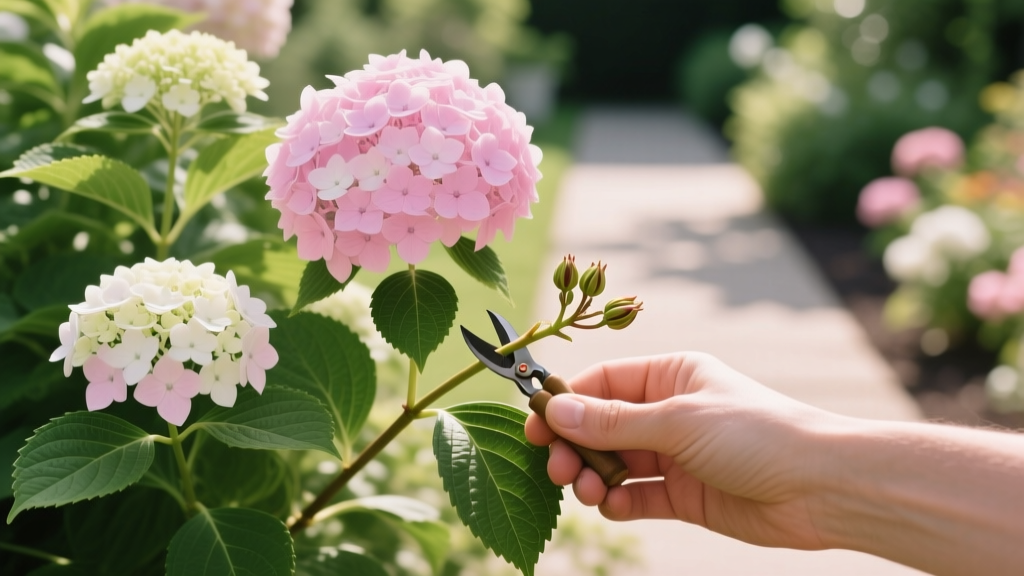
How to Deadhead Hydrangeas for More Blooms
You walk out one July morning and your hydrangeas look… tired. The mophead blooms that were candy-bright two weeks ago are now papery, brown-edged, and flopping after a thunderstorm. Your first instinct is to grab pruners and “clean it up”—but then the worry hits: If I cut the wrong thing, will I cut off next year’s flowers? That fear is justified. I’ve seen plenty of healthy hydrangeas turned into leafy, bloom-less shrubs for a whole season because of one well-meaning snip at the wrong time.
Deadheading (removing spent flowers) can absolutely make hydrangeas look better fast, and in certain types it can encourage additional blooming. But the real payoff is more reliable flowering over time—because you’re guiding the plant’s energy, preventing breakage, and avoiding the pruning mistakes that sabotage buds.
This is the practical, boots-on-the-ground way to deadhead hydrangeas for more blooms—without guessing.
Deadheading vs Pruning: The One Distinction That Saves Blooms
Deadheading is removing the spent flowerhead only. Pruning changes the structure of the plant (shortening stems, removing canes). With hydrangeas, the difference is often just a few inches—but those inches can include next year’s flower buds, especially on “old wood” types.
A good rule: In summer, deadhead high—remove the flowerhead and a short piece of stem. Save major shaping for the correct season for your hydrangea type.
“For bigleaf hydrangea, avoid removing stems that may carry next year’s flower buds; deadheading can be done by cutting just below the spent bloom.” — North Carolina State Extension (2020)
Step 1: Know What You’re Growing (Because Timing Depends on It)
Hydrangeas fall into a few main groups in home gardens. Two of them are where gardeners get into trouble: bigleaf and oakleaf. Here’s a quick comparison that directly affects deadheading depth and timing.
| Hydrangea type (common name) | Botanical name | Blooms on | Deadheading effect | Safe deadheading window |
|---|---|---|---|---|
| Bigleaf (mophead/lacecap) | Hydrangea macrophylla | Mostly old wood; some rebloomers do both | Improves looks; can help rebloomers set more blooms | After bloom fades through mid–late summer; keep cuts short |
| Mountain | Hydrangea serrata | Mostly old wood | Mostly cosmetic; be conservative | Same as bigleaf; shallow cuts |
| Smooth (Annabelle types) | Hydrangea arborescens | New wood | Can encourage a second flush in good conditions | Early–mid summer; avoid late-season forcing |
| Panicle | Hydrangea paniculata | New wood | Optional; usually cosmetic, sometimes tidies for more bloom display | Mid–late summer; or leave for winter interest |
| Oakleaf | Hydrangea quercifolia | Old wood | Mostly cosmetic; can reduce next year’s bloom if cut too low | Right after flowering; minimal stem removal |
If you don’t know what you have, look at the bloom shape and leaves:
- Bigleaf: big round “mopheads” or flatter lacecaps; glossy oval leaves.
- Panicle: cone-shaped blooms; often blooms later (mid/late summer).
- Smooth: large round blooms, often on long stems that flop after rain.
- Oakleaf: oak-shaped leaves; cones that age to pink/tan.
When to Deadhead Hydrangeas (Timing That Actually Works)
Deadhead when the bloom is clearly past its prime but before you’re tempted to cut deep. In most climates, that’s a window from late June through August, depending on variety and weather.
Here’s the practical timing I use:
- Bigleaf/mountain/oakleaf (old wood): deadhead as soon as blooms go papery and color dulls. Avoid deep cuts after August 1 in colder regions (Zones 3–6), because you’re getting close to bud-setting time and the plant needs to harden off for winter.
- Smooth/panicle (new wood): you can deadhead a little longer, but I still stop heavy deadheading by mid-August so you don’t push tender growth that won’t harden before frost.
A temperature cue helps too: when nights start dropping regularly below 55°F (13°C), I shift from “encouraging more flowers” to “help the plant finish the season strong.”
Tools and Prep (Small Details That Prevent Big Problems)
Use sharp, clean hand pruners. Hydrangea stems crush easily when blades are dull, and crushed tissue is an open invitation for disease.
- Sanitize pruners with 70% isopropyl alcohol or disinfectant wipes between plants if you’ve had leaf spots or mildew.
- For large, woody stems on old shrubs, use bypass loppers—but deadheading usually shouldn’t need them.
How to Deadhead Hydrangeas: Step-by-Step (Safe for Most Gardens)
Method A: The “Short Cut” (Best for Bigleaf, Oakleaf, Mountain)
This is the method that protects next year’s buds.
- Find the spent flowerhead.
- Follow the stem down to the first pair of healthy leaves.
- Cut 1/4 inch (6 mm) above that leaf pair, on a slight angle.
- Stop there—don’t chase the stem deeper into the plant in summer.
Why it works: on old-wood hydrangeas, next year’s flower buds can be set on the upper parts of stems. Cutting just under the bloom removes the dead weight without gambling on buds.
Method B: The “Stimulate” Cut (Best for Smooth Hydrangea in Strong Growth)
On smooth hydrangea (like ‘Annabelle’) in good conditions, you can cut a little deeper to prompt new flowering stems.
- Deadhead down to a strong set of leaves or a side shoot.
- Remove up to 6–12 inches (15–30 cm) of stem if the plant is vigorous and well-watered.
- Water well afterward and don’t let the plant dry out for the next 10–14 days.
Reality check: if your plant is stressed (drought, too much sun, root competition), the deeper cut can backfire by producing weak, floppy regrowth.
Method C: Leave Some Blooms On Purpose (Panicles and Winter Interest)
Panicle hydrangeas often look great as blooms age from white to pink to tan. If you’re growing them partly for fall/winter texture, deadhead only the worst-looking heads and leave the rest.
- Deadhead selectively after heavy rain if flowerheads are bending stems.
- Otherwise, consider leaving many heads until late winter, then prune for shape before spring growth starts.
Comparison Analysis: Deadheading Methods and What You Can Expect
Gardeners often ask if deadheading truly makes “more blooms.” The honest answer: it depends on the hydrangea type and the growing conditions. Here’s a practical comparison based on what happens in real yards.
| Approach | Where it shines | Expected result (typical home garden) | Risk level |
|---|---|---|---|
| Method A: cut just below bloom | Bigleaf, oakleaf, mountain | Cleaner plant; less breakage; protects next year’s buds; occasional rebloom on remontant bigleaf | Low |
| Method B: remove 6–12 inches of stem | Smooth hydrangea in rich soil + consistent moisture | Often triggers new shoots and can yield a lighter second flush 4–8 weeks later | Medium (flop + stress if dry) |
| Leave spent blooms | Panicles; gardens with winter interest goals | No extra blooms, but better fall/winter structure; less summer fussing | Low |
Extension guidance aligns with this cautious approach: deadheading is mainly cosmetic for many hydrangeas, but it can support reblooming types and overall plant health when paired with good care. (University of Illinois Extension, 2022; Missouri Botanical Garden, 2023)
Watering: The Hidden Driver of “More Blooms” After Deadheading
If you deadhead and the plant doesn’t push fresh growth or rebloom, water is usually the reason. Hydrangeas have broad leaves that lose moisture fast, especially in sun and wind.
Use this baseline:
- Provide about 1–1.5 inches of water per week (rain + irrigation) during active growth.
- In hot spells above 90°F (32°C), expect to water deeply 2 times per week on sandy soils.
- Water at soil level early in the day; avoid soaking the foliage at night if leaf spots are common.
A deep watering means the moisture reaches 6–8 inches into the soil. If only the surface is wet, roots stay shallow and the plant droops faster.
Soil: What Hydrangeas Need (and What They Tolerate)
Hydrangeas are forgiving, but “more blooms” comes from steady growth. They do best in moisture-retentive, well-drained soil rich in organic matter.
- Aim for a soil pH of roughly 5.5–6.5 for general vigor (color shifts in bigleaf hydrangeas depend on pH and aluminum availability, but that’s a separate project).
- Top-dress with 1–2 inches of compost in spring, keeping it a couple inches away from the crown.
- Mulch with 2–3 inches of shredded bark or leaf mold to stabilize moisture and reduce heat stress.
That mulch layer is one of the simplest “bloom boosters” there is because it makes watering more effective and prevents the feast-or-famine cycle that leads to bud drop.
Light: The Sweet Spot for Flowers Without Fried Leaves
Hydrangeas can bloom in part shade, and many struggle in hard afternoon sun. The common “more sun = more flowers” idea doesn’t always hold if the plant wilts daily.
- Bigleaf & oakleaf: morning sun with afternoon shade is ideal—think 3–5 hours of direct sun.
- Panicle: handles more sun; 6+ hours often gives sturdier stems and fuller blooms if watered well.
- Smooth: part sun/part shade is a good balance to reduce flopping and scorching.
If your hydrangea is in full afternoon sun and wilts by 2 p.m. even when soil is moist, it’s spending energy on survival—not flowers.
Feeding: Fertilizer That Helps Blooms (Without Causing Flop)
Overfeeding is one of the fastest ways to get big leaves and fewer blooms. Hydrangeas don’t need heavy fertilizer to flower well if the soil has organic matter.
- If you fertilize, use a balanced slow-release fertilizer (something like 10-10-10) in early spring as new growth starts.
- Apply at label rates; as a cautious benchmark for many granular products, that’s often around 1/2 cup per 25 sq ft—but always follow your specific product directions.
- Avoid high-nitrogen lawn fertilizer near hydrangeas; runoff can push leafy growth and reduce flowering.
University guidance commonly emphasizes moderation and timing. For example, University of Illinois Extension (2022) notes that excessive nitrogen can reduce flowering and increase soft growth.
Common Problems That Make Deadheading “Not Work”
When gardeners say, “I deadheaded and nothing happened,” the plant is usually dealing with one of these.
Problem 1: You Deadheaded Too Deep on Old Wood
Symptom: Great foliage next year, few or no blooms.
Fix:
- For bigleaf/oakleaf/mountain, deadhead only just below the bloom for the rest of this season.
- Do structural pruning (if needed) right after flowering, not in fall or late winter.
Problem 2: Drought Stress After Cutting
Symptom: New shoots stall; leaves crisp at edges; blooms are smaller.
Fix:
- Water deeply so soil is moist 6–8 inches down.
- Add 2–3 inches mulch to stabilize moisture.
- Provide afternoon shade during heat waves if possible (temporary shade cloth works).
Problem 3: Leaf Spot / Mildew Slowing the Plant
Symptom: Spotted, yellowing leaves; plant looks thin by August.
Fix:
- Water at the base; avoid wetting leaves late in day.
- Thin a few interior stems for airflow (light hand pruning, not shearing).
- Remove heavily infected leaves from the ground in fall to reduce reinfection.
Problem 4: Heavy Blooms Bending or Snapping Stems
Symptom: After rain, flowerheads sit on the ground; stems crease.
Fix:
- Deadhead promptly to reduce weight during storm season.
- Use discreet supports (peony rings) early in the season.
- For smooth hydrangea, avoid high nitrogen and give morning sun to strengthen stems.
Three Real-World Scenarios (and Exactly What I’d Do)
Scenario 1: Bigleaf Hydrangea With Brown Blooms in Mid-July
You’ve got mopheads that browned after a heat spike. The shrub is otherwise healthy.
- Deadhead using Method A (cut just above the first strong leaf pair).
- Water to hit the 1–1.5 inches/week target; add mulch if bare soil shows.
- If it’s a reblooming cultivar and you keep it evenly moist, you may get new buds later—don’t force it with heavy fertilizer.
Scenario 2: Smooth Hydrangea (‘Annabelle’) Flopping After Every Storm
The flowers are huge, the stems are long, and after rain it looks like a collapsed umbrella.
- Deadhead some of the heaviest heads right after storms to reduce leverage.
- Do a modest deeper deadhead (6–12 inches) only if the plant is vigorous and you can water consistently for the next 2 weeks.
- Next spring, consider a support ring early, and go easy on nitrogen.
Scenario 3: Panicle Hydrangea With Spent Blooms Turning Tan in September
You’re torn between tidying and enjoying the fall look.
- If you like winter texture: leave most blooms on; remove only broken or badly bent stems.
- If you need a cleaner look near a walkway: deadhead selectively, but save major pruning for late winter/early spring since panicles bloom on new wood.
Troubleshooting: Symptoms You Can Diagnose in 60 Seconds
- Leaves droop midday, perk up at night: mild heat stress. Mulch, water deeply, add afternoon shade if possible.
- Leaves droop all day and soil is dry 2 inches down: underwatering. Increase soak time until moisture reaches 6–8 inches.
- Lots of leaves, no blooms: likely pruning time error (old wood cut off) or too much nitrogen. Adjust next season; don’t “fix” with more fertilizer.
- Blooms small and sparse: low light or drought. Aim for 3–5 hours morning sun for bigleaf, more sun for panicle if watered.
- Blackened tips after a cold snap: bud damage. Protect in future with burlap windbreaks in exposed sites; avoid late-summer fertilizing that encourages tender growth.
Common Questions Gardeners Ask While Holding the Pruners
Should I deadhead hydrangeas in fall?
Most of the time, no. In fall, you risk removing buds on old-wood types, and you can encourage late, tender growth on new-wood types. If you can’t stand the look, deadhead very lightly—just the flowerhead—then stop.
How far down should I cut a spent hydrangea bloom?
For bigleaf/oakleaf/mountain, I stick to just below the bloom and above the first leaf pair. For smooth hydrangea, you can go 6–12 inches down only if the plant is thriving and you’ll keep it watered.
Will deadheading guarantee reblooming?
No. Reblooming is mostly genetic (certain cultivars), and the plant needs steady moisture, decent light, and enough time left in the season. Deadheading helps by removing spent blooms and redirecting energy, but it can’t override drought or wrong light.
If you want a simple habit that pays off every year: deadhead your old-wood hydrangeas lightly as blooms fade, then put your effort into consistent watering and mulch through the hottest stretch. That’s the combination that keeps the shrub growing steadily—so when it’s time to set buds, it has the reserves to do it well.
Sources: North Carolina State Extension (2020); University of Illinois Extension (2022); Missouri Botanical Garden Plant Finder (2023).