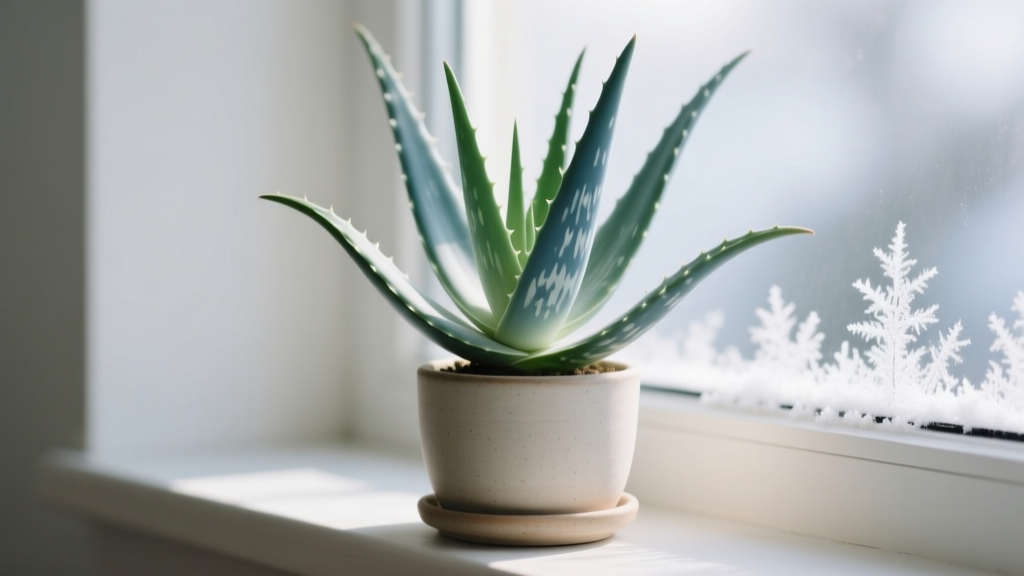
How to Winterize Aloe Vera Before Cold Weather
The first real cold snap of fall is sneaky. One day your aloe is fat, upright, and smug on the patio; the next morning it’s gone dull and watery-looking, like someone let the air out. I’ve seen perfectly healthy aloe vera turn to mush after a single night at 28°F (-2°C)—and once that leaf tissue freezes, you don’t get it back. The good news: winterizing aloe isn’t complicated, but it is specific. A few changes in timing, watering, and light make the difference between a thriving plant in spring and a compost-bin regret.
Aloe vera is a desert succulent that stores water in its leaves. That storage is exactly why cold hurts it: water expands when it freezes, rupturing cells. According to the University of Florida IFAS Extension (2021), aloe is not frost tolerant and should be protected from freezing temperatures. And the Royal Horticultural Society (RHS, 2023) lists aloe as needing winter protection and a bright, frost-free spot. Translation: plan ahead before your forecast shows frost.
Know Your Thresholds: When Aloe Needs Winter Help
Use temperature—not the calendar—to decide when to act. Aloe starts to suffer from chill stress well before a hard freeze.
- Below 50°F (10°C): growth slows; overwatering becomes risky.
- Below 40°F (4°C): cold stress shows up (soft spots, droop, discoloration), especially if soil is wet.
- At/Below 32°F (0°C): frost damage is likely; below freezing can be fatal.
If you only remember one rule: keep aloe dry-ish and above 40°F, and you’ll avoid most winter disasters.
“Most winter losses in succulents aren’t from cold alone—they’re from cold combined with wet soil.” — common guidance echoed across extension recommendations for succulent care, including UF/IFAS Extension (2021)
Scenario Check: Three Real-World Winter Setups (and What to Do)
Before you change anything, figure out which situation matches your home. Winterizing looks different depending on where your aloe lives.
Scenario 1: Aloe in a pot outdoors (patio, balcony, porch)
This is the most common situation—and the most urgent. Plan to move it inside when nights consistently dip below 45°F (7°C), or immediately if frost is forecast.
Scenario 2: Aloe planted in the ground (mild climates)
If you’re in a warm zone where aloe can live outside most winters, you still need a frost plan for unusual cold snaps. Frost cloth and a dry root zone matter more than fertilizer or “winter tonics.”
Scenario 3: Aloe already indoors (houseplant year-round)
Your job is simpler: adjust watering and light because indoor winter conditions (low sun, heater air, cold windows) change how aloe uses water.
Watering in Winter: The #1 Place Gardeners Get Aloe Wrong
Aloe doesn’t “need” much water in winter, and it absolutely doesn’t want to sit cold and wet. Think of winter watering as maintenance, not growth support.
How often to water aloe in winter (practical ranges)
- Indoors, bright window: about every 3–5 weeks
- Indoors, moderate light: about every 4–6 weeks
- Cool garage/sunroom (40–55°F / 4–13°C): about every 5–8 weeks
These ranges assume a fast-draining mix and a pot with a drain hole. If your aloe is in a heavy, peat-based mix, stretch the interval longer.
A simple, reliable winter watering test
- Stick a finger or wooden chopstick 2 inches into the mix.
- If it comes out dry and clean, it’s safe to water.
- If it comes out cool, damp, or with soil stuck to it, wait 7–10 days and test again.
How much water is “enough”?
Water deeply, but infrequently. For a typical 6-inch pot, that might be roughly 1/2 to 3/4 cup (120–180 mL)—enough that a little drains out the bottom. Then discard any water in the saucer within 10 minutes. Don’t do “sip” watering; it keeps the upper roots damp and encourages rot.
Soil and Pot Setup: Drainage Is Your Winter Insurance
Winterizing aloe often means making the root zone less risky. Cold + moisture is the rot recipe. You can’t control the weather, but you can control drainage.
Best winter soil mix for aloe (actionable ratios)
If you’re repotting before winter (early fall is ideal), aim for this:
- 2 parts cactus/succulent potting mix
- 1 part pumice or perlite
- Optional: a handful of coarse sand for extra grit (avoid fine play sand that compacts)
Choose a pot with at least 1 drainage hole. Terracotta helps the mix dry faster—useful in winter when evaporation slows.
Timing: When to repot (and when not to)
Repot aloe at least 4–6 weeks before your first likely frost so it can re-root without cold stress. If cold weather is already here and your aloe is stressed, skip repotting and focus on keeping it warm, bright, and on the dry side.
Light in Winter: Keep It Bright Without Freezing It
Aloe wants bright light year-round, but winter light is weaker and days are shorter. The trap is putting aloe in a sunny window where the leaves touch icy glass at night—those contact points can cold-burn even if your room is warm.
Indoor window placement that actually works
- Best: south or west-facing window (Northern Hemisphere)
- Keep leaves 2–6 inches away from the glass on cold nights
- Rotate the pot 1/4 turn every 2 weeks to prevent leaning
If you use a grow light (simple targets)
A basic LED grow light can carry aloe through winter. Aim for:
- 10–12 hours of light per day
- Light positioned about 10–16 inches above the plant (adjust to your fixture’s intensity)
If the plant stays compact and doesn’t stretch, you’re in the right zone.
Feeding: Stop Fertilizing on Schedule, Not on Hope
Aloe doesn’t need fertilizer in winter. Feeding a plant that’s barely growing is like pushing food at someone who’s already full—it doesn’t help, and it can cause problems.
A practical fertilizer calendar
- Stop fertilizing about 6–8 weeks before your expected first frost.
- Do not fertilize during the darkest winter months.
- Resume in spring when you see active new growth (often when nights are reliably above 55°F / 13°C or indoor light increases).
If you insist on feeding: use a diluted cactus fertilizer at 1/4 strength at most, and only if the plant is in strong light and actively growing. Most home setups don’t meet that standard in winter.
Comparison Table: Winterizing Methods That Actually Differ
Here’s a straight comparison of common winter strategies with real-world outcomes. Choose based on your space and your local lows.
| Method | Best for | Temperature safety | Watering frequency | Risk profile |
|---|---|---|---|---|
| Bring indoors to bright window | Most home gardeners | Safe if kept above 50°F (10°C); avoid cold glass contact | Every 3–6 weeks | Low risk; watch for stretching and overwatering |
| Move to cool garage/sunroom (with window) | Gardeners with limited indoor space | Works if space stays above 40°F (4°C) | Every 5–8 weeks | Moderate risk; low light can cause legginess |
| Leave outside + frost cloth on cold nights | Mild climates, short cold snaps | Only protects a few degrees; not safe below 32°F (0°C) | Only if dry for many weeks; rain is the bigger problem | High risk in wet winters; frost + wet soil is a rot trigger |
| Outdoor microclimate (under eave) + heat source | Dedicated setups | Can buffer to mid-30s°F depending on heat and enclosure | Minimal | Variable risk; fire/electrical safety considerations |
Step-by-Step: Winterizing Aloe Vera in a Pot (My Go-To Routine)
This is the routine I use for patio aloes when the forecast starts flirting with frost.
- Watch the 10-day forecast. When nights trend toward 45°F (7°C), start preparing.
- Stop fertilizing. If you fed recently, don’t panic—just don’t add more.
- Let the pot dry down. If the mix is moist, wait until it’s dry 2 inches down before moving indoors.
- Inspect for pests. Check leaf axils and undersides for mealybugs or scale (more on this below).
- Move it to bright light. South or west window; keep leaves off cold glass at night.
- Water sparingly. First indoor watering usually happens after 2–4 weeks, not immediately.
- Stabilize temperatures. Keep away from drafty doors and heating vents. Aim for 55–70°F (13–21°C).
Winterizing Aloe in the Ground: Emergency Frost Plans That Work
If your aloe is planted in the ground, you’re managing two enemies: frost and winter rain. The goal is to keep the crown and roots as dry and protected as possible.
For a one-night frost (quick response)
- Watering: do not water before a freeze.
- Cover: Use frost cloth (not plastic) draped to the ground to trap heat.
- Support: Use stakes so the cloth doesn’t press and bruise leaves.
- Remove the cover in the morning once temps rise above 40°F (4°C).
For a week of cold rain + chilly nights (the rot setup)
- Build a simple rain shield: a clear plastic panel or tarp above the plant (like a tiny roof), leaving sides open for airflow.
- Mulch with gravel, not bark: a 1–2 inch top dressing of gravel helps keep the crown drier.
- Do not fertilize and do not “warm it up” with heavy blankets that trap moisture.
Common Winter Problems (and How to Fix Them Fast)
Winter damage tends to show up in predictable ways. Here’s how to read your aloe like a mechanic reads an engine noise.
Symptom: Leaves turn soft, translucent, and watery
- Likely cause: Freeze damage or cold + wet stress.
- What to do:
- Move the plant to a spot above 60°F (16°C) with bright light.
- Do not water for at least 2–3 weeks.
- Trim off fully mushy leaves with a clean knife; leave firm tissue alone.
- If the crown is mushy or foul-smelling, unpot and inspect roots; remove rot and repot into dry, gritty mix.
Symptom: Brown/black patches that look “burned”
- Likely cause: Cold injury (especially from touching cold window glass) or sun scorch after a move.
- What to do: Move it 4–8 inches back from the window at night; keep light bright but not baking-hot. Damaged patches won’t turn green again, but new growth can be healthy.
Symptom: Aloe is leaning, stretching, or leaves are long and thin
- Likely cause: Not enough light indoors.
- What to do: Shift to a brighter window or add a grow light for 10–12 hours daily. Rotate the pot every 2 weeks.
Symptom: Lower leaves shrivel and curl inward (but aren’t mushy)
- Likely cause: Normal winter slowdown, mild underwatering, or root-bound plant.
- What to do: Check dryness at 2 inches. If bone dry, water thoroughly once. If it’s been in the same pot 3+ years, plan a spring repot.
Symptom: White cottony fluff in leaf joints
- Likely cause: Mealybugs (they love indoor winter conditions).
- What to do:
- Isolate the plant immediately.
- Dab pests with 70% isopropyl alcohol on a cotton swab.
- Repeat inspection every 7 days for 3 weeks.
- Reduce nitrogen (stop feeding) and avoid overwatering.
Case Notes From Real Gardens: What Actually Happens
Case 1: The “I’ll bring it in tomorrow” patio aloe. This is the classic. Forecast calls for 33°F, but the actual low hits 28°F. By noon the next day, leaves look waterlogged. The fix is damage control: warmth, dry soil, and removing mush. Sometimes the center survives and regrows; sometimes the crown collapses. The lesson: move it inside when the forecast gets close, not after it dips below freezing.
Case 2: The indoor aloe that rots in December. It’s sitting in a decorative cachepot with no drainage, watered “a little” weekly. The plant slowly yellows, then suddenly slumps. When you unpot it, roots are brown and smell sour. The fix: cut away rot, let the plant air-dry (callus) for 24–48 hours, then repot into a gritty mix in a pot with drainage. Water only after 7–10 days to let cuts seal.
Case 3: In-ground aloe in a mild climate hit by cold rain. No frost, but weeks of wet soil at 45–55°F leads to crown rot. The plant looks fine until the outer leaves suddenly loosen and pull away. The fix is prevention: keep winter rain off the crown with a simple cover and use gravel mulch. Once the crown is rotting, recovery is difficult unless offsets (“pups”) are healthy and can be separated.
How to Separate and Save Aloe Pups Before Winter (If You Need a Backup)
If your main plant is large and you see healthy pups, consider separating one as an insurance policy—especially if you’re experimenting with outdoor protection.
- Choose a pup at least 4 inches tall with its own roots (or obvious root nubs).
- Unpot and gently clear soil so you can see the connection.
- Cut with a clean knife; avoid tearing.
- Let the cut end dry and callus for 24–72 hours in a shaded, airy spot.
- Pot into dry succulent mix; wait 7 days before the first watering.
This single step has saved more “favorite aloes” than any fancy winter gadget.
Cold Weather Checklist: What to Do the Week Before Frost
- Confirm your nighttime lows and the first frost window.
- Move outdoor pots inside when nights approach 45°F (7°C).
- Ensure the pot has drainage; remove cachepots that trap water.
- Let soil dry before and after the move—no wet feet in cold rooms.
- Set the plant 2–6 inches off cold window glass at night.
- Stop fertilizer for the season.
- Inspect for mealybugs and scale before bringing plants indoors.
Winterizing aloe vera is mostly about restraint: less water, no feeding, steady temperatures, and brighter light than you think. Do those things before the first real cold night, and your aloe will come through winter looking a little quieter—but alive, firm, and ready to grow when the days stretch out again.
Sources: University of Florida IFAS Extension (2021), guidance on aloe cold sensitivity and protection; Royal Horticultural Society (RHS, 2023), aloe care recommendations including winter conditions and frost-free placement.