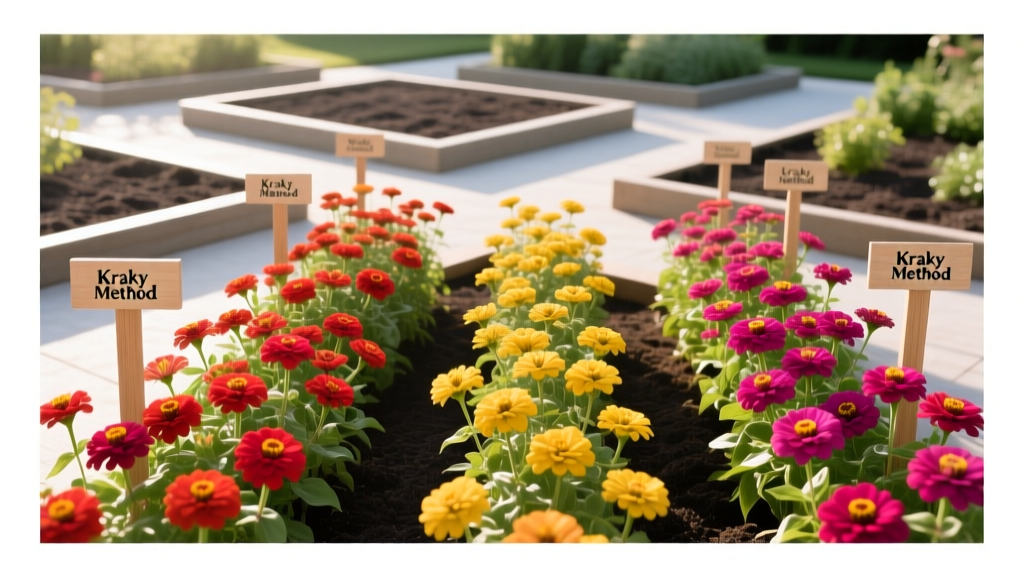
Kraky Method for Growing Zinnias
The first time most gardeners try zinnias in water, the failure is oddly consistent: you get gorgeous seedlings for a week or two, then the leaves yellow, the stems stall, and the whole thing sulks like it’s offended. The surprising part is that zinnias aren’t “hard” hydroponic flowers at all—what trips people up is treating the Kratky method like a jar of cut flowers instead of a plant that needs a stable air-and-water balance. Once you dial that in, zinnias can grow fast, bloom heavily, and stay surprisingly clean.
This is the Kratky (often misspelled “Kraky”) method applied specifically to zinnias: a passive, non-circulating hydroponic setup where the plant drinks from a nutrient reservoir while an air gap forms to oxygenate roots. No pumps. No bubbling. Just smart container choices, steady light, and correct nutrient timing.
What makes zinnias a good Kratky candidate (and what makes them tricky)
Zinnias (Zinnia elegans) are warm-season annuals that love sun, steady feeding, and consistent moisture. That’s perfect for passive hydroponics. The tricky part is their sensitivity to cold roots, low oxygen, and sudden swings in nutrient strength. In soil, those problems get buffered. In Kratky, you’re the buffer.
Plan on warm temperatures and bright light. If you can keep your reservoir stable and your plant supported, you’ll get sturdy stems and repeat blooms that rival bed-grown plants—often with less mildew pressure because the foliage stays drier.
Quick comparison: Kratky vs soil-grown zinnias (real-world numbers)
| Factor | Kratky Method (Passive Hydroponic) | Soil Bed / Container |
|---|---|---|
| Watering frequency | Refill reservoir every 7–14 days (typical indoor setup) | Every 1–3 days in summer heat (containers), 2–4 days (beds) |
| Typical nutrient/feeding | Hydro nutrients at ~EC 1.2–2.0 (ppm 600–1000 on 500 scale) | Granular fertilizer every 4–6 weeks or liquid every 1–2 weeks |
| Root oxygenation | Air gap required: 1–3 inches (2.5–7.5 cm) | Provided by soil structure; worsens if waterlogged |
| Heat stress | Reservoir can overheat; keep solution 65–75°F (18–24°C) | Soil temps fluctuate but buffer roots better |
| Common disease pressure | Lower leaf wetness; powdery mildew often reduced | Higher leaf wetness and splash; mildew and leaf spot more common |
Setup: containers, net cups, and the air gap that makes it work
You can grow zinnias in Kratky with a mason jar, but you’ll usually outgrow it fast. Zinnias are thirsty and top-heavy once they start blooming.
Container size (don’t undersize this)
- Minimum per plant: 1 gallon (3.8 L) reservoir for dwarf varieties.
- Better for full-size zinnias: 2–5 gallons (7.5–19 L) per plant, especially outdoors or under strong lights.
- Container color: Opaque is best to block algae. If you’re using clear containers, wrap them completely.
Net cup and media
- Net cup size: 2–3 inches (5–7.5 cm) works well.
- Media: Expanded clay pebbles (LECA) or rockwool cubes. LECA is forgiving and reusable; rockwool starts seeds easily but needs careful moisture management early on.
The critical air gap
Fill the reservoir so nutrient solution touches the bottom 1/4–1/2 inch (0.6–1.2 cm) of the net cup at transplant. After the plant establishes roots, let the solution level fall naturally and maintain an air gap of 1–3 inches (2.5–7.5 cm). That air gap is where the “Kratky magic” happens—roots adapt, and the upper roots become oxygen-hungry “air roots.”
“In non-circulating hydroponics, maintaining an appropriate air space above the solution is essential for root aeration as the solution level drops.” — Kratky method research summarized by University of Hawaiʻi CTAHR (2017)
Light: the fastest way to get blooms (or lanky plants)
Zinnias are sun lovers. In Kratky, light drives everything—water uptake, nutrient demand, stem thickness, and bloom count.
Outdoors
- Sun: Aim for 6–8+ hours of direct sun.
- Temperature sweet spot: Daytime 70–90°F (21–32°C). They can handle warmer, but reservoirs can’t (more on that below).
Indoors under grow lights
- Photoperiod: 14–16 hours/day.
- Target intensity: Moderate to high. If your zinnias stretch (long internodes, leaning), increase light or lower the fixture.
- Practical tip: Keep the top of the plant within the effective range of your light; many home LED fixtures lose intensity quickly past 12–18 inches.
Real-world scenario #1: If you’re growing indoors and your zinnia seedlings look healthy but “reach” hard, you’ll get weak stems that flop once they flower. Fix the light first, then feeding. A stake can’t replace sunlight.
Watering in Kratky: it’s not “no maintenance,” it’s “predictable maintenance”
Kratky’s big advantage is that you don’t water daily. The plant drinks, the reservoir drops, and you top up on a schedule. But zinnias don’t forgive a neglected reservoir once they’re big.
How often to top up
- Small plants: Check level every 5–7 days.
- Blooming plants: In warm conditions, check every 2–4 days. A mature zinnia can drink fast.
How to top up without drowning the roots
This is where many Kratky growers accidentally sabotage themselves: they refill to the top every time, eliminating the air gap and suffocating roots.
- Mark your container with two lines: “Start/Transplant Level” and “Minimum Safe Level.”
- After the plant is established, refill only to a point that preserves at least a 1–2 inch (2.5–5 cm) air gap.
- If you must refill higher (heat wave, long trip), consider adding an air stone temporarily or splitting into two partial refills a few days apart.
Solution temperature matters more than people expect
Warm nutrient solution holds less oxygen and encourages root disease. Aim to keep solution between 65–75°F (18–24°C). If your reservoir consistently hits 80°F (27°C) or higher, you’re in the danger zone.
Real-world scenario #2: Outdoor patio zinnias in black buckets can look great in the morning and crash by late afternoon during a heat wave. The plant isn’t always “thirsty”—sometimes the roots are oxygen-starved in hot solution. Move the container into afternoon shade, wrap it in reflective insulation, or bury the reservoir partway to moderate temperature.
Feeding: nutrients, EC/ppm targets, and a schedule that actually works
Zinnias are not heavy feeders like tomatoes, but they bloom better with steady nutrition. In Kratky, you’ll get best results by using a complete hydroponic fertilizer that includes micronutrients.
Target strength (use what you can measure)
- Seedlings/early growth: EC 0.8–1.2 (about 400–600 ppm on a 500 scale).
- Vegetative to budding: EC 1.2–1.6 (about 600–800 ppm).
- Heavy bloom: EC 1.6–2.0 (about 800–1000 ppm), if the plant is drinking well and leaves look deep green.
If you don’t have an EC meter, use the fertilizer label and start at 1/2 strength, then adjust over 10–14 days based on leaf color and growth.
pH target
Aim for pH 5.8–6.3. Zinnias will tolerate slight drift, but nutrient lockout becomes more likely when pH rises above about 6.8 in hydro systems. Colorado State University Extension notes that pH strongly influences nutrient availability in growing media and soil alike (CSU Extension, 2023). The same principle applies here—except hydro gives you less buffering.
A simple feeding rhythm
- Mix fresh solution every 2–3 weeks for best stability (more often in hot weather).
- Top off with plain water once between changes if EC creeps up (common when water evaporates faster than the plant drinks).
- Top off with nutrient solution if EC falls and leaves pale (common in fast growth phases).
Real-world scenario #3: Your zinnia is flowering, but newer leaves look pale while older leaves stay green. In Kratky, that often means the reservoir is depleted—refill with a fresh, complete nutrient mix at EC 1.6 and verify pH around 6.0. You’ll usually see improved color within 5–10 days.
Soil talk (because you’ll still start seeds somewhere)
Kratky growing doesn’t require soil, but most home gardeners start zinnia seeds in a seed-starting mix or cubes before moving to net cups.
Seed starting options
- Rockwool cubes: Start seeds 1/4 inch (6 mm) deep. Keep cubes moist, not soaked.
- Seed-starting mix: Start in plug trays; transplant to a net cup once roots show at the bottom.
- Direct in net cup: Possible with a small starter plug, but you must manage early moisture carefully.
For germination, zinnias are happiest warm. Many seed guides place warm-season annual germination around 70–75°F (21–24°C). If your indoor space runs cool, a heat mat makes a noticeable difference in speed and uniformity. University of Minnesota Extension emphasizes matching plants to proper temperatures and light for successful growth (University of Minnesota Extension, 2024).
Training and support: keeping tall zinnias upright in water
Zinnias can get top-heavy, especially varieties that reach 24–36 inches tall. Hydroponic media doesn’t anchor like soil, so plan support early.
- Stake early: Insert a bamboo stake or flower support ring when the plant is 8–12 inches tall.
- Pinch once: When the plant has 4–6 true leaves, pinch the growing tip to encourage branching and more blooms (but don’t pinch dwarf bedding types unless you want a wider plant).
- Rotate containers: Indoors, rotate 1–2 times a week to prevent leaning.
Common problems (and the fixes that actually work)
Yellowing leaves (chlorosis)
Symptoms: Leaves fade from green to yellow; may start with newer growth (iron issue) or older leaves (nitrogen issue).
- Check pH: If pH is above 6.5, adjust back to 5.8–6.3.
- Check EC/ppm: If EC is below 1.0 in active growth, raise to 1.2–1.6.
- Refresh solution: If the reservoir is older than 3 weeks, dump and remix. Stale solution causes odd deficiencies.
Wilting even though there’s plenty of solution
Symptoms: Plant droops midday; roots may look tan/brown; solution smells “swampy.”
- Root oxygen problem: Preserve a 1–3 inch air gap; don’t refill to the top.
- Heat problem: Keep solution under 75°F if possible; shade the reservoir.
- Root rot risk: Remove badly affected roots, refresh solution, and consider adding beneficial microbes labeled for hydroponics. If rot is advanced, restart with a clean container.
Algae (green slime, green water)
Symptoms: Green film on net cup/media; green-tinged solution; fungus gnats may appear.
- Block light: Use an opaque lid and reservoir. Cover net cup openings with foil or a light-blocking collar.
- Clean between runs: Wash containers with soap and water, then sanitize (a mild bleach solution is commonly used by growers; rinse thoroughly).
- Reduce spills: Nutrient splashes on the lid feed algae.
Powdery mildew (yes, it can still happen)
Symptoms: White, dusty coating on leaves; older leaves usually show it first; growth slows.
- Airflow: Space plants so leaves don’t touch; use a fan indoors.
- Avoid overhead wetting: One of the perks of Kratky is dry foliage—keep it that way.
- Remove worst leaves: Don’t compost heavily infected foliage if you’re fighting mildew in your garden.
Powdery mildew is common on zinnias in many climates. Cultural steps like spacing, sun, and airflow are consistently recommended by extension resources as first-line control (University of California IPM, 2022).
Bud drop or weak flowering
Symptoms: Buds form then shrivel; blooms are small; stems are thin.
- Light first: If you’re under lights, increase intensity or duration to 16 hours.
- Feeding: Move from EC 1.2 up to 1.6 gradually.
- Container stability: If the plant rocks in the net cup, it struggles. Add more LECA and stake the stem.
Step-by-step: a reliable Kratky workflow for zinnias
- Start seeds: Sow 1/4 inch deep; keep at 70–75°F. Expect germination in about 3–7 days (variety and temperature dependent).
- Transplant timing: Move seedlings when they have 2–3 true leaves and roots are showing well.
- Mix starter nutrient: EC 0.8–1.2, pH 5.8–6.3.
- Set initial water level: Touch the bottom of the net cup (about 1/4–1/2 inch up).
- Provide strong light: Outdoors full sun; indoors 14–16 hours.
- Let the level drop: Don’t chase it upward; let the air gap develop.
- Top up smart: Preserve a 1–3 inch air space.
- Support and pinch: Stake at 8–12 inches; pinch after 4–6 true leaves for branching types.
- Refresh solution: Every 2–3 weeks (more often in heat).
Three case notes from real gardens (what to do differently next time)
Case 1: “Mason jar zinnias” that stalled at 6 inches
The jar ran out of solution too quickly, and refills drowned the air roots. Fix: upgrade to a 1–2 gallon reservoir and mark fill lines. The plant needs a stable air gap and room for roots to stratify (water roots below, air roots above).
Case 2: Balcony grow with stunning growth… then sudden collapse
Hot wind plus a sun-baked reservoir pushed solution temperature too high. Fix: insulate or shade the container, and keep solution closer to 65–75°F. A white bucket outperforms a black bucket in full sun more often than people want to admit.
Case 3: Indoor blooms were plentiful, but stems were floppy
Light intensity was borderline; the plant “reached” and couldn’t hold flowers. Fix: bring the light closer, run 16 hours, and pinch once to promote branching. Add a stake earlier than you think you need it.
Harvesting blooms and keeping plants flowering
Zinnias reward cutting. Harvest often and they branch more, which means more buds.
- When to cut: Cut when blooms are fully open and the stem passes the “wiggle test” (a mature zinnia stem is firm; immature stems flop after cutting).
- Where to cut: Cut above a leaf node to encourage two new shoots.
- Deadhead weekly: If you don’t cut for bouquets, remove spent blooms at least every 7 days.
If your Kratky zinnias are thriving, you’ll notice something satisfying: fewer muddy splashes, less leaf spotting from soil, and the kind of steady growth you usually only see in well-irrigated beds. Keep the reservoir cool, protect the air gap, and feed consistently, and zinnias will do what they do best—turn simple sunshine and nutrients into armloads of color.
Sources: University of Hawaiʻi CTAHR (2017) non-circulating hydroponics/Kratky method guidance; Colorado State University Extension (2023) on pH and nutrient availability principles; University of Minnesota Extension (2024) general plant growth requirements (light/temperature considerations); University of California IPM (2022) powdery mildew cultural management principles.