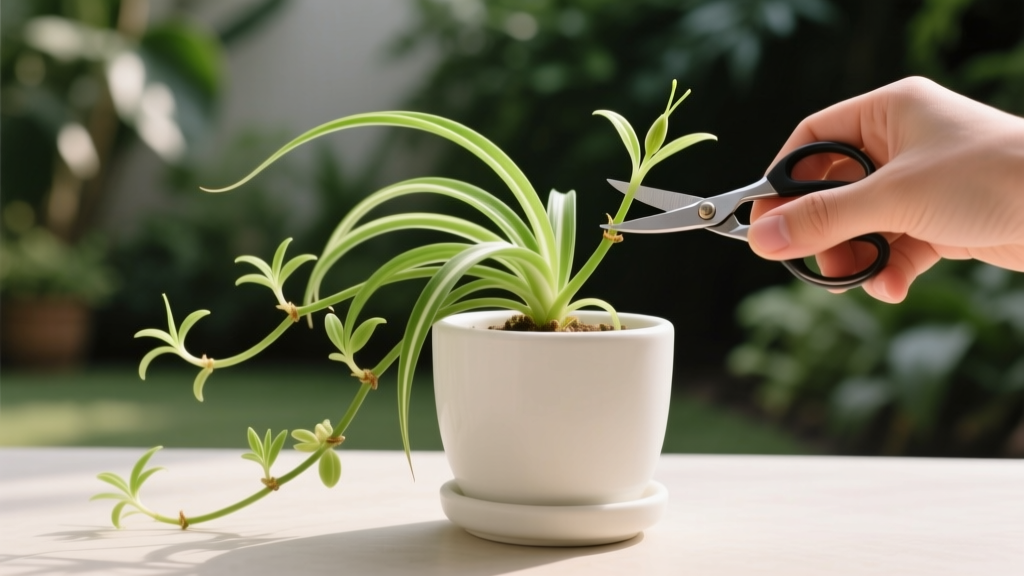
Pinching Back Spider Plants for Bushier Growth
You bring home a spider plant that looks like a fountain—thick, arching leaves spilling over the pot. Six months later it’s still alive, still green, but it’s turned into a sparse “octopus” with long legs and a bare center. Meanwhile it’s pumping out babies (plantlets) like crazy, which feels like success… until you look at the mother plant and realize it’s getting leggier by the week.
The fix usually isn’t exotic fertilizer or a bigger pot. It’s a mix of smarter light, steadier watering, and—yes—pinching or trimming in the right places at the right time. Spider plants (Chlorophytum comosum) respond beautifully to a little haircut, but only if you understand what you’re cutting and what the plant will do next.
This is the approach I use when clients want a fuller, denser spider plant instead of a floppy one: make the crown stronger, encourage new basal shoots, and manage the plant’s energy so it grows leaves—not just runners.
What “Pinching Back” Really Means for Spider Plants
With many houseplants, “pinching” means removing soft growing tips to force branching. Spider plants don’t branch the same way as basil or coleus. Their leaves arise from a central crown and new offsets (new rosettes) form from the base. So when gardeners say “pinch back a spider plant,” they’re usually talking about one (or more) of these actions:
- Trimming leaf tips or shortening long leaves to reduce flop and encourage a tighter silhouette.
- Removing flower spikes/runners (stolons) so energy goes to the mother plant’s leaf production.
- Dividing a crowded plant to reset growth and stimulate fresh crowns.
- Selective removal of older outer leaves to open the center to light and reduce stress.
Done well, the plant responds with more vigorous leaf growth from the crown and, over time, a bushier appearance. Done poorly (like cutting the entire crown), you can set it back for months.
Before You Cut: Three Real-World Scenarios I See All the Time
Scenario 1: “My spider plant is healthy but looks thin and floppy.”
This is almost always light-related. Low light produces longer, narrower leaves and fewer new rosettes. Trimming helps the look, but improving light is what changes the plant’s growth pattern.
Scenario 2: “It’s making tons of babies but the main plant is shrinking.”
Spider plants can pour energy into runners and plantlets. If the mother plant is underfed, rootbound, or light-starved, that baby production can come at the expense of fullness.
Scenario 3: “Brown tips everywhere—can I pinch those off?”
Yes, you can trim tips for looks, but brown tips are usually a water quality + inconsistent moisture issue. Cut the tips and the problem returns unless you fix the cause.
Tools and Timing (This Matters More Than People Think)
Use clean scissors or pruners. Wipe blades with isopropyl alcohol (at least 70%) before you start, especially if you’re removing any soft or rotting tissue.
Best time to do major trimming or division is when the plant is actively growing—typically spring through early summer. Indoors, you can do minor grooming any time, but try to avoid heavy cutting in the darkest months unless you can give brighter light.
Comfortable growth temperatures are generally 65–80°F (18–27°C). If your home runs cooler than 60°F (16°C) near windows in winter, keep pruning light because recovery slows down.
For baseline care expectations, I lean on university and botanical references. North Carolina State Extension lists spider plant as an easy indoor foliage plant preferring bright, indirect light and even moisture (NC State Extension Plant Toolbox, 2023). The Missouri Botanical Garden notes it tolerates lower light but performs best with brighter indirect light and moderate watering (Missouri Botanical Garden, 2022).
Step-by-Step: How to Pinch/Trim for a Bushier Spider Plant
Method A: Remove Runners to Redirect Energy
If you want a fuller mother plant, this is the single most effective “pinch back” move.
- Find the long, arching stems (runners/stolons) that carry flowers and plantlets.
- Trace each runner back to where it emerges from the crown.
- Cut the runner off cleanly 1/4 inch (0.6 cm) above the crown to avoid nicking the main growth point.
- Repeat, but don’t remove everything at once if the plant is stressed. A safe rule is to remove no more than 50% of runners in one session.
This doesn’t “force branching” the way tip-pinching does on other plants. Instead, it reduces the plant’s energy drain and encourages stronger leaf production and basal offsets over the next 4–8 weeks.
Method B: Shorten Overlong Leaves (Cosmetic, But Useful)
Trimming leaves won’t create new leaves at the cut point, but it can make a plant look tighter while it grows new foliage from the center.
- Cut individual leaves back to a length that suits your pot—often removing 2–6 inches (5–15 cm) from the longest leaves.
- Make a tapered “V” cut that mimics the natural pointed leaf tip. A blunt straight cut can look ragged as it dries.
- Avoid cutting the newest inner leaves unless they’re damaged; those are your future fullness.
Method C: Remove Old Outer Leaves to Open the Crown
If the center is shaded by old, tired leaves, you can selectively remove a few.
- Identify the oldest leaves on the outside—often paler, kinked, or with heavy tip burn.
- Pull gently downward to see where the leaf meets the crown.
- Cut as close to the base as you can without gouging the crown.
- Stop after removing 3–8 leaves on an average 6–8 inch pot. You should still have plenty of foliage.
Method D: Divide a Crowded Plant (The Real “Reset Button”)
If your spider plant is jammed into its pot and the crown is thick like a clenched fist, division can create multiple bushy plants and stimulate fresh growth.
- Water the plant the day before so roots are pliable.
- Slide it out and tease the root mass apart. If it’s stubborn, use a clean knife to cut into sections.
- Each division should have a healthy crown and a solid root portion—aim for at least 8–12 firm roots per division if possible.
- Repot into containers only 1–2 inches (2.5–5 cm) wider than the root mass.
“For many interior foliage plants, the fastest way to improve appearance is not fertilizer—it’s correcting light and using selective pruning to balance top growth with the root system.” — Extension horticulture guidance commonly emphasized in indoor plant care programs (University Extension indoor foliage recommendations, 2020)
Comparison: Two Ways to Get a Bushier Look (With Real Tradeoffs)
Here’s the practical comparison I give gardeners deciding between “trim leaves” and “remove runners.” Both help, but they work differently.
| Goal/Metric | Method 1: Shorten Leaves | Method 2: Remove Runners (Stolons) |
|---|---|---|
| Visible improvement | Immediate (same day) | Gradual (noticeable in ~4–8 weeks) |
| Best for | Leggy silhouette, uneven length, aesthetic shaping | Mother plant thinning while making babies; weak crown |
| How much to remove | Up to 1/3 of total leaf length across the plant | Up to 50% of runners per session |
| Risk if overdone | Plant looks “chopped”; slower photosynthesis temporarily | Loss of propagation material; mild stress if plant was relying on runners |
| Actual bushiness (new basal growth) | Indirect/slow | More direct, because energy shifts back to leaf production |
Light: The Non-Negotiable for Dense Growth
If you want compact, bushy spider plants, give them brighter conditions than most people think. Bright, indirect light is the sweet spot: near an east window, or a few feet back from a south/west window with a sheer curtain.
- Target 10–12 hours of good indoor brightness in growing season if possible.
- If using a grow light, aim for 12–14 hours/day and keep the light roughly 12–18 inches (30–45 cm) above the foliage (adjust based on fixture strength and heat).
Low light is what creates long, arching, widely spaced leaves and a hollow-looking center. You can trim all day long, but if the light stays dim, it will keep stretching.
Watering: The Trick Is Consistency, Not Quantity
Spider plants like evenly moist soil, but not constant wetness. The easiest rhythm for most homes:
- Water when the top 1–2 inches (2.5–5 cm) of soil feels dry.
- Water thoroughly until you get runoff; then empty the saucer within 10 minutes.
Most brown tips and limp leaves come from the back-and-forth between bone dry and soggy. Pick a consistent pattern. If you’re forgetful, set a reminder and check moisture weekly rather than watering on a strict calendar.
Water quality and brown tips
Spider plants can be sensitive to mineral buildup. If you’re seeing persistent tip burn:
- Switch to filtered water or rainwater for a month and see if new growth improves.
- Flush the pot every 4–8 weeks by running water through the soil for 1–2 minutes to leach salts (make sure drainage is good).
Soil and Potting: Airy Mix, Tight Pot (Within Reason)
A bushier plant needs a healthy root system, and roots need oxygen. Use a loose, well-draining mix. A reliable blend:
- 2 parts quality indoor potting mix
- 1 part perlite or pumice
Spider plants don’t mind being a bit snug. In fact, a slightly rootbound plant often grows well, but there’s a tipping point where it dries too fast and stops filling in. Repot when:
- Roots are circling densely and the plant dries out in 2–3 days, or
- The pot is deforming, or
- You see roots pushing out the drainage holes heavily
When you repot, go up only 1–2 inches (2.5–5 cm) in diameter. Oversized pots hold extra wet soil, which leads to soft roots and a plant that refuses to thicken.
Feeding: Enough to Support Leaf Production (Not a Salt Bath)
If you’re pinching runners and encouraging leaf growth, the plant needs steady nutrition—but spider plants are not heavy feeders.
- Use a balanced houseplant fertilizer at 1/2 strength every 4 weeks from spring through early fall.
- In winter, back off to every 8–10 weeks or pause if growth slows.
If you see lots of pale, narrow new leaves even in decent light, that’s often underfeeding. If you see crusty soil, sudden tip burn, or limp growth after fertilizing, that’s often salt buildup—flush and reduce frequency.
Common Problems That Block Bushy Growth (And How to Fix Them)
Problem: Brown tips
Symptoms: crispy brown ends, especially on older leaves; new growth may look fine at first.
Likely causes: mineral salts, inconsistent watering, low humidity combined with dry-down swings.
Fix:
- Trim tips with a V-cut for appearance.
- Switch to filtered/rainwater for 3–4 weeks.
- Flush the pot monthly; ensure free drainage.
Problem: Pale leaves, slow growth, “won’t fill in”
Symptoms: thin leaves, long petiole-like bases, large gaps, few new leaves from center.
Likely causes: light too low, pot too large and staying wet, or roots exhausted in old mix.
Fix:
- Move to brighter indirect light (or add a grow light 12–14 hours/day).
- Check roots; repot into airy mix if soil is compacted.
- Remove runners so energy returns to the crown.
Problem: Limp leaves, soft crown, sour-smelling soil
Symptoms: leaves fold or collapse; crown feels loose; soil stays wet; sometimes fungus gnats.
Likely causes: overwatering, poor drainage, root rot starting.
Fix:
- Stop watering and let the top 2 inches (5 cm) dry.
- Unpot and inspect roots—trim mushy roots with clean scissors.
- Repot into fresh, airy mix and a pot with drainage.
- After repotting, water lightly once, then wait until the top 1–2 inches dries again.
Problem: Leaves with silvery streaks or tiny speckles
Symptoms: stippling, dullness, occasional webbing (spider mites), or black specks (thrips frass).
Likely causes: spider mites or thrips, often in dry indoor air.
Fix:
- Rinse the plant thoroughly in the shower, focusing under leaves.
- Repeat weekly for 3 weeks.
- If needed, apply insecticidal soap, following label directions carefully.
Pinching Back for Bushiness: A Practical 30-Day Plan
If you want a clear path (and not just random snipping), here’s a plan that works in real homes.
Week 1: Reset the plant’s priorities
- Move it to brighter indirect light.
- Remove up to 50% of runners (or all, if the plant is vigorous and well-rooted).
- Trim only the most unruly leaves—no more than 1/3 of total leaf length across the plant.
Week 2: Dial in watering
- Check moisture twice this week; water only when the top 1–2 inches are dry.
- Empty saucers after 10 minutes.
Week 3: Feed lightly (if it’s growing)
- Apply fertilizer at 1/2 strength.
- Flush first if you see crusty buildup.
Week 4: Evaluate and adjust
- Look for new leaves emerging from the center.
- If growth is still thin, increase light again before you fertilize more.
- If the plant is pushing runners again and you want bushiness, remove them promptly.
Extra Notes From the Potting Bench: What Actually Works in Homes
Case: The office spider plant under fluorescent lights. These often survive but don’t thicken. Put it under a small grow light for 12 hours/day and remove runners for a month. You’ll usually see stronger center growth by week 6, even if the plant stays in the same pot.
Case: The hanging basket that dries out constantly. A basket near a window can dry in a day or two. If it’s swinging between drought and flood, it will never look lush. Repot into a slightly larger container (only 1–2 inches wider), use an airy mix, and water thoroughly when the top 1 inch dries.
Case: The “baby factory” mother plant. If you love propagating, keep one plant dedicated to making runners. But if you want the mother plant to look like a dense fountain, you have to be willing to remove runners early—before plantlets get big. It’s the easiest energy shift you can make.
When Not to Pinch Back
Hold off on heavy trimming if:
- The plant is recovering from repotting (give it 2–3 weeks).
- It’s in very low light and you can’t improve it (pruning won’t fix stretch).
- You see active rot in the crown (address roots and soil first).
Spider plants are forgiving, but bushy growth is a reward for steady conditions. Trim strategically, then give the plant what it needs to respond—bright indirect light, even moisture, airy soil, and modest feeding.
If you do just one thing this week, do this: cut off the runners you don’t want, move the plant a little closer to good light, and stop letting it bounce between too dry and too wet. In a month or two, you’ll see the center push fresh leaves, and the plant will start looking like that fountain again—without begging for a bigger pot or a complicated routine.
Sources: NC State Extension Plant Toolbox (Spider Plant / Chlorophytum comosum), 2023. Missouri Botanical Garden Plant Finder (Chlorophytum comosum), 2022. University Extension indoor foliage plant care recommendations, 2020.