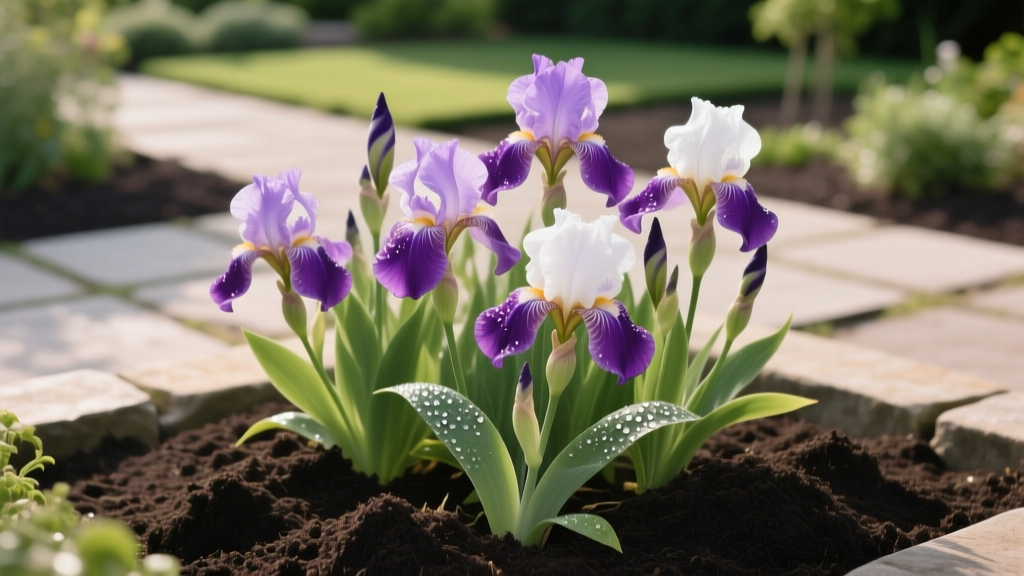
Top-Dressing Soil for Healthier Irises
You weed, you water, you even divide your irises on schedule—yet the blooms keep shrinking, the clumps look tired, and the rhizomes start riding up on the soil like little sunbathers. I see this all the time in home gardens: irises that technically “survive,” but don’t thrive. The surprising fix is often not a new fertilizer or a different variety—it’s a smarter top-dressing routine that respects how irises actually grow.
Top-dressing is one of those unglamorous jobs that quietly changes everything. Done right, it stabilizes moisture without smothering rhizomes, improves soil structure, feeds gently, and reduces the stress that invites disease. Done wrong, it can rot rhizomes, bury the fans, and create a slug-and-fungus paradise. Let’s do it the master-gardener way—practical, measured, and timed to the plant’s real needs.
What top-dressing does (and what it can ruin) for irises
Irises—especially bearded irises (Iris germanica and relatives)—like their rhizomes close to the surface. They want sun on their shoulders. Siberian and Japanese irises are different: they grow from crowns/rhizomes that tolerate (and often prefer) more consistent moisture and a bit more cover.
Top-dressing is a thin, surface-applied layer of organic and/or mineral material. It’s not tilling. It’s not burying. It’s a controlled upgrade to the top 1–2 inches of the soil environment where feeder roots do their work.
“Bearded iris rhizomes should be planted at or just below the soil surface and not covered with mulch.” — Clemson Cooperative Extension, HGIC 1178 (rev. 2023)
That one sentence explains why top-dressing irises is a balancing act: we want the benefits of added organic matter and nutrients, without creating a damp blanket over the rhizomes.
Soil first: know your iris type and your existing conditions
Before you spread anything, take five minutes to identify what you’re growing and what you’re working with. Top-dressing strategy changes with iris type and drainage.
Bearded irises (rhizomes visible or near surface)
- Best in well-drained soil; avoid heavy, wet mulches on rhizomes.
- Top-dress around rhizomes, not over them.
- Ideal soil pH often falls near neutral; many extensions recommend roughly pH 6.8–7.0 for bearded irises.
Siberian and Japanese irises (more moisture-tolerant)
- Can handle a slightly thicker organic top-dress.
- Japanese irises generally tolerate more moisture and richer soil than bearded types.
- Still avoid burying the crown deeply; aim for even moisture, not sogginess.
Quick drainage check (takes 15 minutes of effort + time)
- Dig a hole 12 inches deep and wide.
- Fill with water and let it drain completely once (pre-wets the soil).
- Refill and time the drain rate: if water is still sitting after 4 hours, you have a drainage limitation.
Poor drainage is the number-one reason top-dressing goes wrong for bearded irises. If your soil holds water, your top-dressing must be mineral-leaning (grit/compost in small amounts) and kept off the rhizomes.
Top-dressing materials that work (and what to avoid)
Here’s the straight talk: most iris problems from “mulching” are really top-dressing mistakes—too thick, too wet, too close to the rhizome, or too rich with fast nitrogen.
Best materials for most home iris beds
- Finished compost (screened if chunky): improves structure and microbial life; use sparingly for bearded irises.
- Leaf mold (fully broken down): gentle, moisture-moderating, less “hot” than manure-based composts.
- Fine pine bark (aged): good structure builder, but keep it away from bearded rhizomes.
- Washed coarse sand or horticultural grit: excellent for improving surface drainage in heavy soils (especially around bearded rhizomes).
Materials I generally avoid right on iris beds
- Fresh manure (too hot; can push lush, disease-prone growth and burn roots).
- Thick wood chips as a blanket over rhizomes (holds moisture, shelters slugs).
- High-nitrogen lawn fertilizers (encourages soft growth; increases rot risk).
How to top-dress irises: step-by-step (with exact thickness and spacing)
The goal is to refresh the soil surface while keeping the rhizome “shoulders” exposed (for bearded) and the fans upright and dry at the base.
Timing: when to top-dress for best results
- Early spring (as new growth is 2–4 inches tall): supports the season’s root activity without smothering.
- After bloom (late spring/early summer): good window for light feeding and moisture stabilization.
- Late summer (often 6–8 weeks after bloom, and near dividing time): ideal for resetting soil around newly reset rhizomes.
Many gardeners combine top-dressing with cleanup and a light feeding. That’s fine—just don’t create a wet collar around the plant.
Method A: Bearded irises (the “donut ring” top-dress)
- Clean first: Remove dead leaves and pull weeds. Trim ragged foliage to about 6 inches tall if needed for airflow.
- Expose rhizomes: If soil has crept up, gently brush it back so the top of the rhizome is visible.
- Apply a thin layer: Spread 1/4 to 1/2 inch of finished compost or leaf mold around the rhizome, not on it.
- Add grit in heavy soil: In clay, add 1/2 inch of coarse sand/grit in a ring on the outer root zone to improve surface drainage.
- Keep a clear collar: Maintain a bare space of 1–2 inches around the rhizome itself.
- Water once to settle: Give a single deep watering (see watering section), then let the surface dry between irrigations.
Method B: Siberian/Japanese irises (the “blanket, not a mound”)
- Weed and remove last year’s debris.
- Spread 1/2 to 1 inch of compost or leaf mold evenly across the bed.
- Keep the plant crown visible—don’t bury it more than about 1/2 inch deeper than it already sits.
- Water to settle, then maintain even moisture through the growing season.
If you’re new to top-dressing irises, start thin. You can always add a little more later. You can’t easily un-rot a rhizome.
Comparison: top-dressing methods and results you can expect
Home gardeners usually choose between “organic-only,” “grit-focused,” or “mulch like I do everywhere else.” Here’s how they stack up in real beds, with practical numbers you can use.
| Method | Material + Thickness | Best For | Expected Soil/Moisture Effect | Risk Level (Bearded) |
|---|---|---|---|---|
| A. Compost ring (“donut”) | Finished compost, 1/4–1/2 inch, kept 1–2 inches off rhizome | Average soils, routine maintenance | Moderate nutrition + improved crumb structure; slight moisture buffering | Low if kept off rhizomes |
| B. Compost + grit | Compost 1/4 inch + grit 1/2 inch in outer root zone | Clay soils, rot-prone beds | Faster surface drying; better drainage at crown zone | Lowest (best in wet climates) |
| C. Thick mulch blanket | Wood chips/straw, 2–3 inches over everything | Rarely appropriate for bearded; sometimes paths between rows | High moisture retention; cooler soil | High (rot + slugs) |
If you’re gardening in a rainy spring climate or irrigating heavily, Method B is the workhorse. In balanced conditions, Method A is usually plenty.
Watering: top-dressing changes how you should irrigate
Once you top-dress, the soil surface behaves differently. Compost and leaf mold hold moisture; grit sheds it. Adjust watering so you’re not accidentally creating a damp rot zone.
Practical watering targets
- Bearded irises: Aim for deep, infrequent watering—about 1 inch of water per week during active growth if rainfall is lacking. Let the top inch dry between waterings.
- Siberian/Japanese: More consistent moisture; don’t let them dry hard during bud set and bloom. In heat, they may need the equivalent of 1.5 inches per week depending on soil.
How to water after top-dressing
- Water once to settle the dressing.
- For the next 7–10 days, check moisture by finger: if the top inch is damp, wait.
- Water early in the day so foliage dries before nightfall.
One common mistake: adding compost, then continuing with daily sprinklers. That’s how you turn a healthy rhizome into a soft, smelly problem.
Light and airflow: the hidden partners of top-dressing
Top-dressing improves the soil, but light and air are what keep irises clean and blooming. Bearded irises want full sun—ideally 6–8 hours daily. Less sun means slower drying, fewer blooms, and higher leaf disease pressure.
If your irises get morning shade and afternoon sun, that can still work. But if they get afternoon shade and stay damp, keep top-dressing very lean and prioritize grit and airflow.
Spacing that actually prevents problems
- Set bearded iris rhizomes roughly 12–18 inches apart for airflow and room to increase.
- Don’t let companion plants crowd the rhizomes; keep a low, open zone around the fans.
Feeding: how to pair fertilizer with top-dressing (without overdoing nitrogen)
Top-dressing with compost is gentle feeding, not a full fertilizer program. Irises typically bloom best with moderate fertility and good drainage.
For bearded irises, many extension recommendations emphasize avoiding excessive nitrogen to reduce soft growth and rot risk. Clemson notes the “no mulch over rhizomes” guidance (HGIC 1178, rev. 2023), and similar cultural advice is echoed by university extension iris notes across regions.
Simple feeding plan that works in real gardens
- Early spring: Apply a low-to-moderate nitrogen fertilizer (for example, something close to 5-10-10) at label rates, keeping it off the rhizome itself.
- After bloom: Optional light feeding if plants are weak, or skip if soil is already fertile and top-dressed with compost.
As a reference point, many gardeners apply roughly 1/2 cup of granular fertilizer per 10 square feet (always verify your product’s label). Water it in, and don’t let granules lodge against the rhizome.
For Japanese irises, richer soils and consistent moisture can support a bit more feeding, but the same caution applies: strong growth without enough sun and airflow equals more disease.
Common problems top-dressing can solve (and cause)
When irises “mysteriously” decline, it’s usually a short list: drainage, crowding, light, and sanitation. Top-dressing intersects with all four.
Troubleshooting: symptoms and fixes you can do this week
Problem: Rhizomes turning soft, mushy, or smelly (rot)
- Likely causes: Top-dressing/mulch piled over rhizomes; poor drainage; overwatering; high nitrogen.
- Immediate fix:
- Pull back all organic material from rhizomes, leaving a dry collar.
- Cut away soft tissue with a clean knife until you reach firm, white tissue.
- Let the cut surface dry for 24–48 hours in dry weather.
- Improve drainage by adding grit around (not on) the rhizome zone.
- Prevention: Keep top-dressing to 1/4–1/2 inch around bearded irises; avoid thick mulches.
Problem: Lots of leaves, few or no blooms
- Likely causes: Too much shade; overfeeding nitrogen; clumps overcrowded; rhizomes buried by repeated top-dressing.
- Fix:
- Check sun: aim for 6–8 hours.
- Brush soil back off rhizomes so tops are exposed.
- Divide and replant if clumps haven’t been divided in 3–5 years.
- Switch to a bloom-supporting fertilizer (lower N) and skip lawn feeds nearby.
Problem: Yellowing leaves and weak growth despite watering
- Likely causes: Compacted soil; roots stressed by alternating drought and saturation; nutrient tie-up in very woody mulches.
- Fix: Use a thin compost top-dress (1/4 inch) plus grit in heavy soils; water deeply but less often; avoid fresh wood chips near crowns.
Problem: Iris borer or chewing damage
- Likely causes: Old foliage left in place; dense mulch harboring pests; stressed plants.
- Fix: Remove and discard old leaves (don’t compost if infested). Keep the bed clean and open. A thin, clean top-dress is fine; thick, damp mulch is not.
Sanitation matters. University of Minnesota Extension notes that removing old iris leaves can help reduce iris borer problems (University of Minnesota Extension, updated 2020).
Real-world scenarios: how I’d top-dress in three common gardens
Most advice sounds good until it hits your yard. Here are three situations I see constantly, with the exact approach I use.
Scenario 1: Heavy clay bed, spring stays wet, bearded irises rotting
What’s happening: Clay holds water at the surface. If you add compost too thickly, you keep the rhizome zone damp even longer.
- Pull mulch/compost back to expose rhizomes.
- Top-dress with 1/4 inch compost only in the outer root zone, not right against the rhizome.
- Add 1/2 inch horticultural grit around the plants to speed surface drying.
- Water only when the top inch is dry; avoid evening watering.
Extra tip: If the bed is chronically wet, consider lifting and replanting on a slight ridge (even 2–3 inches higher) so gravity helps you.
Scenario 2: Sandy soil, irises bloom but look thin and drought-stressed by June
What’s happening: Water and nutrients move through fast. A careful organic top-dress helps hold moisture without waterlogging.
- Apply a compost ring of 1/2 inch around bearded irises, keeping that 1–2 inch bare collar at the rhizome.
- Water deeply to wet soil down 6–8 inches.
- Use a light post-bloom feeding if foliage pales early.
Extra tip: In very sandy beds, I’d rather top-dress twice at 1/4 inch than once at 1 inch. It’s easier to control and less likely to creep over rhizomes.
Scenario 3: Raised bed with beautiful compost… and no blooms
What’s happening: Raised beds are often filled with rich mixes that push leaves, not flowers—especially if the bed gets frequent irrigation and the rhizomes have slowly been buried by repeated composting.
- Check rhizome exposure; brush back soil so tops are at/near the surface.
- Skip compost top-dressing for a season; use a grit-focused surface layer instead.
- Switch to a lower-nitrogen fertilizer and apply only once in early spring.
- Thin/divide if crowded; reset spacing to 12–18 inches.
Seasonal top-dressing calendar (simple and repeatable)
If you want a routine you can stick to, this is the one I recommend to most home gardeners.
Early spring (as growth starts)
- Clean up debris.
- Top-dress bearded irises with 1/4–1/2 inch compost around rhizomes (not over).
- Optional: light fertilizer application (low N) and water in.
After bloom
- Remove spent stalks.
- Check for creeping soil over rhizomes; brush back as needed.
- Top-dress only if soil is depleted or crusting—keep it thin.
Late summer (division window for many bearded irises)
- Divide crowded clumps (often every 3–5 years).
- Reset rhizomes at the surface.
- Use grit and a light compost top-dress to settle soil structure without burying.
Top-dressing is not about adding a thick layer every year. It’s about making small corrections that keep the rhizome zone dry, airy, and fed just enough.
Common top-dressing mistakes I see (so you can skip the heartbreak)
I’ve watched gardeners love their irises to death with kindness. These are the pitfalls that cause the most trouble.
- Piling compost like mulch: If you can’t see the rhizome anymore, it’s too much for bearded irises.
- Using soggy materials: Half-finished compost heats, settles, and stays wet.
- Top-dressing right before a long rainy stretch: If you know you’re heading into wet weather, wait. A dry surface is your friend.
- Feeding heavy nitrogen “because more blooms”: It often does the opposite—more leaves, more rot.
- Ignoring crowding: No top-dress fixes a clump that needed dividing two years ago.
If you take just one idea from all of this, let it be this: top-dress to improve the soil, but keep the iris crown and rhizome zone breathing. When the rhizomes stay firm and sun-warmed, the plant has the energy to do what we’re all growing it for—strong fans and a real flower show.
Sources: Clemson Cooperative Extension, HGIC 1178 “Bearded Iris” (rev. 2023). University of Minnesota Extension, “Iris borer” management guidance (updated 2020).