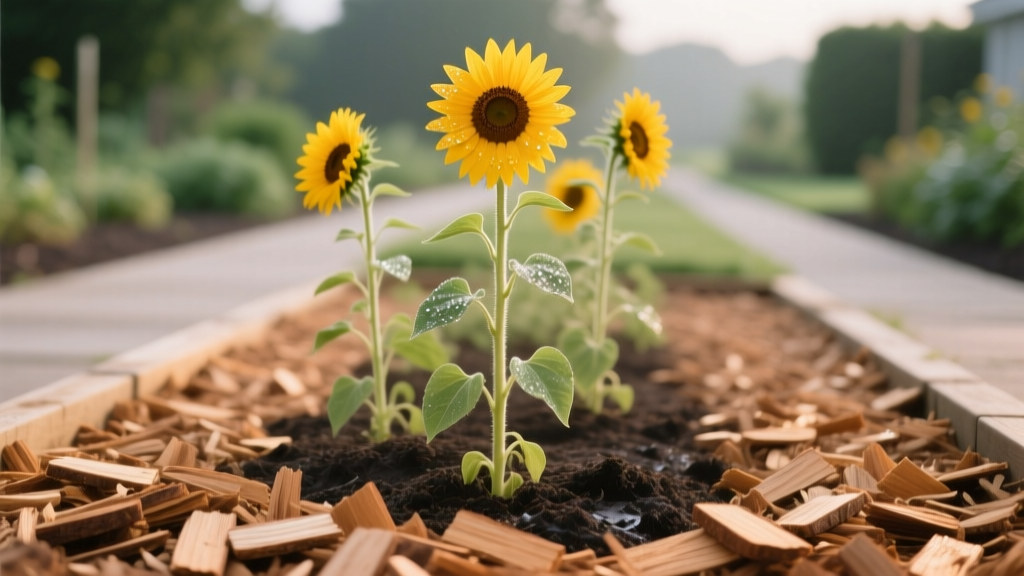
How to Apply Wood Chip Mulch to Sunflowers
It usually happens right when sunflowers are finally hitting their stride: a hot week rolls in, you water in the evening, and by the next afternoon the leaves are drooping like you forgot them entirely. Then you notice the soil surface has turned to crust, weeds are popping through, and every time you water, it feels like the moisture disappears in an hour. The fix isn’t more water—it’s keeping the water you already applied from evaporating. That’s where wood chip mulch earns its keep around sunflowers.
Wood chips can steady soil moisture, cool the root zone, and reduce weed pressure without babying your sunflowers. But you have to apply them the right way. Too close to the stem, too thick, or applied at the wrong time, and you can invite slugs, crown rot, or a nitrogen hiccup in young plants. Below is how I mulch sunflowers in real gardens—raised beds, clay yards, and droughty sandy spots—along with numbers you can actually use.
What wood chip mulch does for sunflowers (and what it doesn’t)
Sunflowers (Helianthus annuus) are tough, but they perform better with steady moisture—especially when they’re putting on height and forming buds. Wood chip mulch helps by reducing evaporation at the soil surface and limiting temperature swings. It also slows weed germination, which matters because sunflowers dislike root competition when they’re young.
“Keep organic mulches a few inches away from plant stems to prevent moisture-related disease and rodent damage.” — Washington State University Extension, Home Garden Series (2023)
What wood chips won’t do: they won’t “feed” sunflowers quickly. Chips break down slowly, mostly helping long-term soil structure. If your sunflowers are hungry, mulch alone won’t correct that this season.
When to mulch sunflowers: timing that prevents headaches
The best time to mulch depends on whether you direct-sowed or transplanted.
Direct-sown sunflowers
Wait until seedlings are established and sturdy. I like this benchmark:
- Height: 6–12 inches tall
- True leaves: at least 2–3 sets of true leaves
- Soil warmth: consistently above 55°F at 2 inches deep
If you mulch too early, you can slow soil warming and give slugs a cool, damp hiding place right next to tender stems.
Transplanted sunflowers
Mulch after the transplant has recovered and started new growth—usually 5–10 days after planting, depending on temperatures and wind.
Choosing wood chips: what works best in home gardens
Not all “wood chips” behave the same. Your goal is a chunky, mixed texture that interlocks, stays put, and allows rainfall to penetrate.
- Best all-around: arborist chips (a mix of wood, bark, and leaves). They knit together well and resist blowing.
- Okay with extra attention: bagged “wood mulch” that’s mostly shredded bark—often floats or mats if you water hard.
- Avoid right around sunflowers: fresh sawdust (too fine; mats and can tie up nitrogen at the surface).
If your chips are very fresh (bright, greenish wood with lots of leaves), they’re still usable—but apply them as a surface layer and keep them off the stem zone. You’re not digging them in.
Step-by-step: how to apply wood chip mulch around sunflowers
This is the process I use whether I’m mulching a single giant sunflower or a whole row.
Tools and supplies
- Wood chips
- Rake or gloved hands
- Watering can or hose with a gentle nozzle
- Optional: cardboard for row areas (not tight around stems)
1) Water first, mulch second
Mulch is a lid. Put it on after the soil is hydrated.
- Water deeply so moisture reaches 6–8 inches down.
- Wait 15–30 minutes for water to soak in (especially in clay).
2) Weed and loosen the crust
Pull weeds and lightly scuff the top 1 inch of soil with a hand tool. Don’t chop roots. You just want to break the crust so water moves evenly under the mulch.
3) Apply the right depth: 2–4 inches
For sunflowers, 2–3 inches is the sweet spot in most beds. Go up to 4 inches in very hot, windy sites—if you keep mulch away from stems.
- Too thin (under 2 inches): weeds still germinate; soil still bakes.
- Too thick (over 4 inches): can stay soggy near the crown and attract slugs; rain may not penetrate quickly.
4) Leave a bare collar around stems
This is the detail that prevents most mulch-related problems:
- Keep chips 3–4 inches away from each sunflower stem (a “donut,” not a volcano).
- Never pile mulch against the stalk.
5) Set the mulch radius based on plant size
Mulch out to where the roots actually are.
- Young plants (under 18 inches tall): mulch a 12–18 inch radius.
- Mid-season plants: mulch a 18–24 inch radius.
- Giant varieties (8–12 feet tall): mulch at least a 24–30 inch radius if you have space.
6) Top up midseason (lightly)
Wood chips settle. If your 3-inch layer compresses to 1–2 inches, add another 1 inch midseason—especially going into hot weather.
Watering with wood chip mulch: how your schedule changes
Mulch changes the feel of watering. The surface may look dry while soil underneath stays nicely damp. Don’t guess—check.
How to check moisture under mulch
- Pull back chips and feel the soil 2–3 inches down.
- If it’s cool and slightly damp, you can wait.
- If it’s dry and crumbly, water deeply.
Practical watering targets
These are reasonable starting points for established sunflowers in summer. Adjust for heat, wind, and soil type.
- Deep watering: about 1 inch of water per week (including rain), delivered in 1–2 soakings.
- Heat waves (90–100°F): check every 2 days; you may need an extra deep soak.
- Containers: mulching helps, but pots can still need water every 1–2 days in hot weather.
Mulch won’t replace watering, but it reduces the “yo-yo” pattern—bone-dry to soaking-wet—that leads to stress, leaf scorch, and weaker stems.
Soil and mulch together: keeping roots happy
Sunflowers don’t need perfect soil, but they do need drainage and oxygen around roots. Wood chips help protect soil structure by softening rainfall impact and reducing crusting.
Soil texture scenarios
Clay soil: Use a 2–3 inch chip layer, water slowly, and avoid piling thick mulch near stems. Clay holds water; mulch helps prevent cracking, but too much can keep the crown damp.
Sandy soil: Use 3–4 inches of chips to slow evaporation. Sandy beds benefit hugely from mulching because water drains fast and the surface heats up quickly.
Raised beds: Beds dry out faster than in-ground soil. Mulch is almost always beneficial, especially if your bed mix is compost-heavy and prone to drying on top.
Light and heat: mulching as temperature control
Sunflowers want full sun—ideally 6–8+ hours daily. Mulch doesn’t change that, but it changes what’s happening at ground level. On a bright, windy site, bare soil can become a heat radiator. A 3-inch mulch layer buffers temperature swings, which helps sunflowers keep growing instead of pausing during extreme afternoons.
If you’re in a cool-summer area, don’t mulch too early. Let the soil warm up first so seedlings don’t stall.
Feeding sunflowers when using wood chips
The big worry gardeners hear is “wood chips steal nitrogen.” Here’s the grounded version: nitrogen tie-up happens mostly where chips mix into soil, because microbes need nitrogen to decompose carbon-rich wood. A surface layer of chips generally does not starve established plants.
Still, young sunflowers can show pale growth if your soil is already low in nitrogen—mulch or not. If you notice slow growth and light green leaves, a small feeding can help.
Simple feeding plan (keeps stems strong)
- At 12–18 inches tall: side-dress with a balanced fertilizer (for example, 5-5-5) at label rate, kept 6 inches away from the stem, then water in.
- At bud formation: a light second application if plants look pale or growth stalls.
Avoid overfeeding nitrogen late in the season—it can push soft growth and increase flopping.
Mulch and compost work nicely together, but layer them correctly: compost as a thin 1/2–1 inch top-dressing on soil, then wood chips on top to protect it.
Wood chips vs other mulches: real differences you’ll notice
Here’s a practical comparison for sunflower beds. Depths assume typical home garden conditions.
| Mulch type | Recommended depth | Weed suppression | Moisture retention | Best use case | Common drawback |
|---|---|---|---|---|---|
| Wood chips (arborist) | 2–4 inches | High | High | In-ground beds, around tall varieties, windy sites | Can harbor slugs if piled against stems |
| Straw (seed-free) | 3–6 inches | Medium | Medium | Quick seasonal mulch for vegetable-style rows | Blows around; can introduce weed seeds if low quality |
| Shredded leaves | 2–3 inches | Medium | Medium | Fall mulching; soil-building over time | Can mat if applied thick and wet |
| Compost (as mulch) | 1–2 inches | Low–Medium | Medium | Feeding and improving soil; combine with chips on top | Weeds can germinate in it; dries and crusts alone |
Comparison analysis: two mulching methods with measurable differences
I’ve seen the biggest performance difference not between mulch brands, but between how it’s applied.
Method A: “Volcano mulching” (chips piled against the stalk)
- Mulch depth at stem: often 6+ inches
- Typical outcome: damp crown, more slug damage, occasional stem rot, weaker anchoring
- Watering behavior: gardeners often water less, but moisture stays trapped right where you don’t want it
Method B: “Donut mulching” (chips kept off the stem)
- Mulch depth: 2–4 inches, with a 3–4 inch bare collar
- Typical outcome: fewer crown issues, better oxygen at the base, steadier growth during heat
- Watering behavior: deeper watering less often; soil stays evenly moist under the ring
In my beds, Method B consistently reduces midday wilt during hot spells because the root zone stays cooler and moisture loss slows. Method A is the one that leads to “my sunflower suddenly collapsed” stories.
Common problems (and fixes) when mulching sunflowers with wood chips
Most mulch issues show up as visible symptoms. Here’s what to look for and what to do next.
Problem: seedlings chewed at the base (slugs, earwigs)
Symptoms: ragged holes, missing cotyledons, or a seedling cut down overnight; damage is worse in cool, wet weather.
What to do:
- Pull chips back 6 inches from seedlings until stems toughen.
- Water in the morning so the surface dries by night.
- Use iron phosphate slug bait if needed, following label directions.
Problem: sunflower stem looks dark or soft near soil line (crown rot risk)
Symptoms: darkened tissue at the base, softening, plant wilts despite moist soil.
What to do:
- Immediately clear mulch back to create a dry zone around the stem (4–6 inches).
- Reduce watering frequency; water deeper but less often.
- Improve airflow—thin crowded plantings.
Problem: pale leaves and slow growth after mulching (nitrogen low)
Symptoms: lower leaves yellowing first, overall light green color, slow height gain.
What to do:
- Apply a light nitrogen feed (for example, a balanced fertilizer like 5-5-5 at label rate).
- Avoid mixing chips into the soil; keep them as a surface layer.
- Top-dress with 1/2 inch compost under chips for a gentle nutrient buffer.
Problem: chips repel water and runoff happens
Symptoms: water beads and runs off the mulch; soil underneath stays dry.
What to do:
- Use a gentle shower nozzle and water longer, not harder.
- Break up any matted layers; fluff chips with a rake.
- In extreme cases, remove the top 1 inch of fines and replace with chunkier chips.
Problem: weeds still coming through
Symptoms: grass or vigorous weeds punching through a thin mulch layer.
What to do:
- Increase mulch to a true 3 inches after weeding.
- For persistent weeds, lay cardboard between plants (not touching stems) and cover with chips.
Three real-world mulching scenarios (what I’d do in each)
Scenario 1: A windy front-yard strip where chips blow away
Windy strips are notorious. Use arborist chips (chunkier) at 3 inches deep, then water them in so they knit together. Keep the collar open around stems. If the strip is very exposed, create a slightly saucered mulch basin: chips slightly higher on the outside edge and thinner near the inner collar so they settle in place.
Scenario 2: Heavy clay backyard—sunflowers wilt after rain, not just heat
That’s a drainage and oxygen problem. Mulch helps with crusting, but you must avoid soggy crowns. Keep chips to 2 inches and expand the radius rather than the depth. Water only when the soil under mulch is dry 2–3 inches down. If you’re amending, do it between seasons with compost—don’t dig chips in.
Scenario 3: Droughty sandy soil—watering every day is wearing you out
Go to 4 inches of chips (still with a collar around stems). Add a 1 inch compost layer beneath if your soil is very lean. Switch to fewer, deeper soakings aiming to wet 8 inches down. You’ll still check often in 95°F stretches, but you’ll stop losing so much water to midday evaporation.
Ongoing care: what to watch as sunflowers grow taller
As sunflowers put on height, your mulching job is mostly done—now it’s maintenance.
- Re-check the stem collar every couple of weeks. Chips creep inward with watering and rain.
- Stake tall varieties early if you live with summer storms. Mulch can keep soil moist and slightly looser at the surface; staking prevents wind-rock.
- Don’t bury fallen leaves under the stem. Remove diseased leaves and keep the base airy.
Citations and research-backed notes
Mulching guidance is remarkably consistent across extension programs: keep mulch off stems, avoid excessive depth, and use organic mulches to moderate soil moisture and temperature.
- Washington State University Extension, Home Garden Series (2023), guidance on keeping mulch away from stems to reduce disease and pest issues.
- University of California Agriculture and Natural Resources (UC ANR) (2020), recommendations on organic mulch use for water conservation and weed suppression in home landscapes.
If you take only one habit from experienced gardeners, make it this: water deeply, then mulch like a donut, not a volcano. Sunflowers respond fast to that steadier root zone—less droop, fewer weeds to fight, and stronger stems when those heavy flower heads finally open.