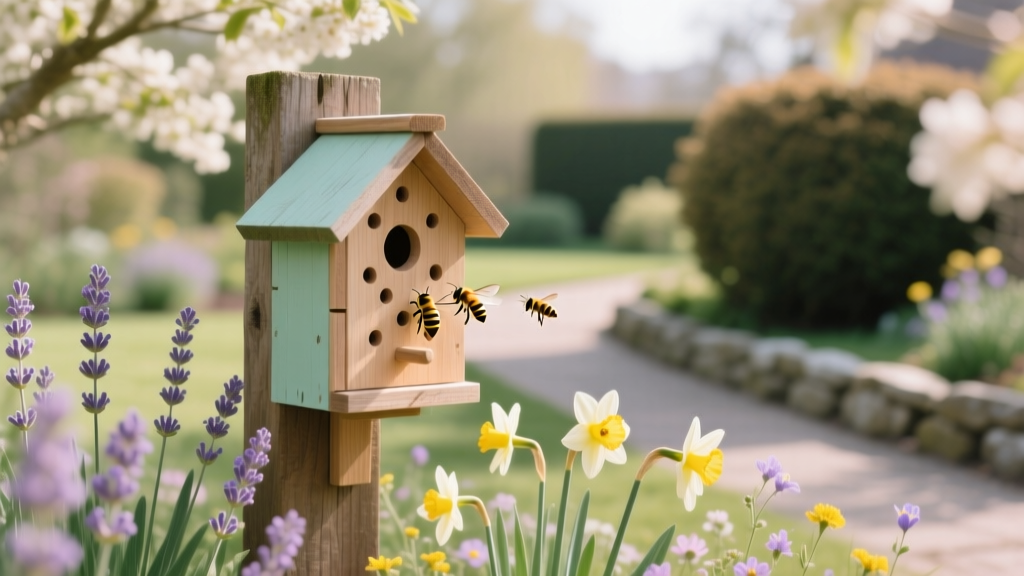
Spring Garden: Setting Up Bee Hotels for Pollinators
The window for helping spring pollinators is tight: once daytime highs stabilize above 55°F (13°C), many solitary bees begin scouting for nesting sites, and by the time your fruit trees bloom, it’s often too late to add habitat and expect full-season occupancy. Put bee hotels on your “do it this week” list—right alongside pruning and seed starting—because nesting decisions happen early, fast, and close to where bees already forage.
This guide is organized by priority, with immediate tasks first. You’ll get timing cues (dates, temps, frost markers), regional adjustments, checklists, and a practical build-and-maintain plan that reduces pests and disease—so your bee hotel helps pollinators instead of becoming a parasite nursery.
Priority 1: What to Prepare (This Week) — Build or Refresh a Bee Hotel Correctly
Bee hotels primarily serve cavity-nesting solitary bees (like mason bees and leafcutter bees), not honey bees. The goal is clean, dry, appropriately sized nesting tubes placed where they warm early but don’t bake, with a maintenance plan. Poorly built hotels can concentrate disease and predators; a good one is replaceable, cleanable, and sized to local bees.
Timing triggers (use at least one)
Use these concrete cues to time setup:
- 4–6 weeks before your average last frost date: ideal for installation in many regions because early spring bees will be active soon.
- When soil temps reach ~50°F (10°C) and daytime highs regularly exceed 55°F (13°C): mason bees and other solitary bees begin active nesting searches in many areas.
- By March 15–April 15 in many Zone 6–7 gardens (adjust earlier in warmer zones, later in colder zones).
- At least 2 weeks before fruit tree bloom (apples/pears/cherries): gives bees time to orient to the site.
- Before a warm spell (3+ days above 60°F/16°C): bees may emerge quickly and start nesting immediately.
Choose materials that support sanitation (avoid “decorative” hotels)
Skip mixed media “bee condo” blocks stuffed with pinecones, random holes, and brittle bamboo. Prioritize paper liners inside a wooden housing, or removable tubes you can replace yearly. Extension resources consistently emphasize that maintenance is the difference between helping bees and amplifying disease.
- Best options: paper tube liners in a rain-sheltered box; removable cardboard tubes; drilled blocks with removable liners.
- Avoid: permanently drilled blocks you can’t clean; holes with splinters; “anything goes” filler materials.
Correct hole diameters and depths (most common failure point)
Aim for a range so different local bees can use the hotel, but don’t overdo variety. For most gardens, this set covers a lot of cavity nesters:
- Diameter: 5/16 inch (8 mm) is a strong general-purpose size for mason bees; add some 1/4 inch (6 mm) and 3/8 inch (10 mm) tubes for diversity.
- Depth: 4–6 inches (10–15 cm) is a practical target; deeper can increase female offspring ratios for some species, but only if ventilation and dryness are excellent.
- Back wall: tubes must be closed at the back (or have a solid stop) so bees can partition cells properly.
Make sure drilled holes are smooth (no splinters) and slightly angled upward (about 5–10°) to reduce moisture intrusion.
Install: placement rules that actually work
Put the bee hotel where bees can warm up early and stay dry:
- Height: 3–6 feet off the ground (easy for you, safe from splashback and many predators).
- Sun: morning sun is key; aim for east or southeast exposure.
- Rain protection: under eaves or with a roof overhang; keep tubes dry.
- Stability: firmly mounted (no swinging on a hook).
- Distance to forage: within 300 feet of spring blooms if possible.
“Artificial nesting structures can increase nesting opportunities for some species, but they also can concentrate parasites and predators if not maintained.” — University of California Agriculture and Natural Resources (UC ANR), 2018
Citation: UC ANR publishes guidance on bee hotels and emphasizes careful placement and sanitation to reduce disease and parasitism (UC ANR, 2018).
Quick-start checklist (do this right now)
- Mount bee hotel facing east/southeast, 3–6 ft high
- Use replaceable liners/tubes (paper or cardboard preferred)
- Provide 6–10 inches of roof overhang or place under eaves
- Install a predator guard if woodpeckers are active (mesh set 1–2 inches away from tube faces)
- Label the hotel with install date; plan tube replacement after the season
Priority 2: What to Plant (Next 1–3 Weeks) — Continuous Bloom Near the Hotel
A bee hotel without nearby nectar and pollen is like a birdhouse in a treeless yard. In spring, your job is to ensure something blooms from early thaw through late spring, especially within the first 50–100 feet of the nesting site.
Timing by frost dates and soil temperatures
Use your USDA zone and last frost date as a starting point:
- Zones 8–10: many areas have last frost between Feb 1–Mar 15; plant early bloomers in late winter; install hotels by Feb–early Mar.
- Zones 6–7: last frost often falls between Apr 1–May 1; install hotels by mid-March to early April (or 4–6 weeks before last frost).
- Zones 3–5: last frost commonly May 10–June 10; install hotels by late April (or earlier during warm spells), and focus on cold-hardy blooms.
Planting targets that align with bee activity:
- Direct-sow hardy annuals when soil is workable and daytime highs are consistently above 50–55°F (10–13°C).
- Transplant cool-season flowers 2–4 weeks before last frost with protection.
- Aim for your first major bloom wave by the time fruit trees break bud—often when nights are above 40°F (4°C) more consistently.
High-impact spring bloom list (choose what fits your region)
Mix natives and proven garden performers. Prioritize early and mid-spring flowers, then bridge into summer.
- Early spring (very early forage): willow (Salix), redbud (Cercis), currant/gooseberry (Ribes), woodland phlox, lungwort (Pulmonaria), crocus, grape hyacinth (Muscari).
- Mid-spring: native penstemons, borage, calendula, clover (in edges), chives (let some bloom), catmint (Nepeta), columbine (Aquilegia).
- Late spring into summer: lavender (where hardy), echinacea, bee balm (Monarda), salvia, yarrow (Achillea).
Practical placement tip: Plant a “pollinator strip” within 10–20 feet of the hotel. Even a 3x8-foot bed can provide enough forage to keep nesting females working close to home.
Scenario: Small yard or balcony (urban Zone 7–9)
If you’re working with containers, focus on continuous bloom and “hotel adjacency.” A small bee hotel mounted on a sunny wall near pots works well if you can keep blooms coming:
- Week 1: plant chives + calendula + borage starts in containers
- Week 2–4: add salvia or catmint; keep one pot for herbs allowed to flower
- Maintain: avoid broad-spectrum insecticides; water early to reduce mildew
Priority 3: What to Protect (All Spring) — Prevent Pests, Parasites, and Weather Losses
Spring is when bee hotels fail quietly: moisture moves in, mold develops, predators learn the location, and parasites build. Protection is mostly design + monitoring.
Moisture control (the #1 preventable issue)
- Keep tubes dry with a roof and morning sun; avoid deep shade.
- Angle tubes slightly upward (5–10°) so rain doesn’t run in.
- Replace waterlogged tubes immediately—don’t “let them dry out later.”
Predator management: birds, rodents, and wasps
- Woodpeckers: add a wire mesh guard 1–2 inches in front of tube openings if pecking begins.
- Rodents: mount securely; don’t place hotels on fence tops where animals perch.
- Wasps: some wasps may occupy tubes; they’re not automatically “bad,” but if aggressive species dominate, reduce large-diameter holes and prioritize 6–8 mm sizes.
Parasites and disease: prevent the “parasite hotel” effect
Overcrowding and reusing dirty nesting materials are the main causes. Extension guidance commonly recommends replaceable liners and periodic replacement/cleaning to reduce buildup of chalkbrood and parasitic flies/wasps.
Citation: Oregon State University Extension has published guidance on mason bees and management practices emphasizing clean nesting materials and proper housing placement (OSU Extension, 2019).
Spring pesticide reality check (avoid collateral damage)
Spring is also when gardeners spray “just in case,” right as bees are emerging. If you must treat a plant problem:
- Avoid applying insecticides to blooming plants.
- Spray only at dusk when bees are inactive, and only targeted products for the specific pest.
- Use cultural controls first (sanitation, pruning, resistant varieties).
Weather swings: late frosts and sudden heat
Bee hotels are fairly weather-tolerant if dry, but your forage plants may not be. Protect blossoms during cold snaps to keep nectar and pollen available.
- If a freeze is forecast below 28°F (-2°C) after bud break, cover tender blooms overnight (row cover or sheets) and remove in the morning.
- If temps spike above 85°F (29°C) unusually early, ensure nearby water sources (a shallow dish with stones) and keep container plants watered so blooms persist.
Priority 4: What to Prune (Next 2–4 Weeks) — Support Bloom and Reduce Disease Pressure
Pruning in spring is about two goals: (1) keep flowering shrubs productive and (2) prevent fungal problems that reduce bloom quality and shorten the flowering window. Do not shear everything at once—time it to the plant’s bloom cycle.
Prune by bloom time (quick rules)
- Spring-flowering shrubs (lilac, forsythia, many viburnums): prune right after bloom, not now, or you’ll remove flower buds.
- Summer-flowering shrubs (many panicle hydrangeas, butterfly bush where non-invasive): prune in early spring before strong growth.
- Fruit trees: late winter to early spring pruning improves airflow; avoid heavy pruning during wet periods that spread disease.
Reduce disease that impacts pollinator forage
Spring moisture encourages fungal issues like powdery mildew (later), leaf spots, and fire blight risk in pears/apples. While bees don’t catch these diseases, your bloom quality suffers if plants are stressed.
- Remove mummified fruit and diseased twigs now (dispose—don’t compost if infected).
- Thin dense interiors for airflow, especially on roses and fruit trees.
- Water at soil level; avoid overhead watering that keeps blooms wet.
By-the-Month Schedule (Adjust for Your Frost Date)
Use this as a practical spring cadence. Shift earlier by 2–6 weeks in Zones 8–10 and later by 2–4+ weeks in Zones 3–5.
| Month | Bee Hotel Tasks | Planting/Forage Tasks | Protection & Monitoring |
|---|---|---|---|
| March | Install/rehang hotel; replace old tubes; confirm morning sun exposure | Plant early bloomers; direct-sow hardy annuals when highs > 50–55°F | Check for rain intrusion; tighten mounts; watch for bird activity |
| April | Add additional tubes if >50% filled; avoid overcrowding with multiple hotels in one spot | Increase bloom diversity; let herbs (chives) flower; add natives if available | Freeze protection when forecasts dip below 28°F after bud break |
| May | Monitor occupancy; note which tube sizes are used most | Plant warm-season nectar plants after last frost (often May 1–30 in Zones 5–7) | Watch for parasites; keep blooms pesticide-free; provide shallow water |
Regional Variations (Real-World Scenarios)
Scenario 1: Pacific Northwest (Zones 7–9, cool wet spring)
Your biggest issue is moisture. Prioritize roof protection and morning sun.
- Install hotels under eaves by late February to March when mild spells arrive.
- Use paper liners so you can replace any that get damp.
- Plant: red-flowering currant (Ribes sanguineum), native willows, camas where suitable, and early herbs in containers.
- Monitoring: check weekly during rainy periods; swap any moldy tubes immediately.
Scenario 2: Upper Midwest / Northern Plains (Zones 3–5, late frosts, fast spring)
Spring arrives late but accelerates quickly. Your opportunity is brief: install during the first stable warm stretch.
- Target install time: late April to mid-May, or 4–6 weeks before last frost (often May 10–June 10 depending on location).
- Protect early blooms from surprise freezes below 28°F (-2°C).
- Plant: early bulbs, native woodland plants, and cold-hardy perennials; keep a reserve of row cover for bloom protection.
- Tip: mount hotels on a south-facing wall to increase morning warmth, but ensure a roof overhang to prevent overheating during sudden heat spikes.
Scenario 3: Southeast (Zones 7–9, warm early, high humidity, strong predator pressure)
You may see early nesting activity by late winter, plus higher parasite and mold pressure.
- Install by February in many areas; don’t wait for “spring gardening weekend.”
- Use a well-ventilated hotel with replaceable liners; avoid deep shade.
- Expect more mud daubers/wasps; keep tube sizes mostly 6–8 mm to favor mason bees over large wasps.
- Plant: early flowering shrubs (native redbuds), clovers in margins, and long-season herbs allowed to bloom.
Scenario 4: Southwest / Intermountain West (Zones 5–9, dry air, intense sun)
Your main challenges are overheating and forage gaps.
- Install by early March in many valleys; place with morning sun but provide afternoon shade in hot microclimates.
- Keep nearby blooms watered so nectar flow doesn’t stop during dry winds.
- Plant: penstemons, salvia, yarrow, and region-appropriate natives; stagger bloom times deliberately.
Monitoring: What to Look For (10 minutes per week)
Once installed, don’t fuss daily. A short weekly check prevents most issues.
Signs it’s working
- Bees entering tubes with pollen on their abdomen or legs
- Tubes gradually capped with mud (mason bees) or leaf pieces (leafcutters)
- Activity concentrated on warm mornings when temps exceed 55–60°F (13–16°C)
Signs to intervene
- Moldy tube faces or musty smell (replace tubes/liners; improve rain protection)
- Chewed, torn tube ends (add predator guard; relocate slightly)
- Hotel completely dominated by one large wasp type (reduce large holes; add more 6–8 mm tubes)
Spring Timeline: Do This in Order
Use this timeline as a working plan. Adjust by your last frost date and local temperatures.
- Week 1 (now): mount or refresh bee hotel; confirm dry roof cover; install 6–8 mm and 8 mm tubes; plant/position early blooms within 10–20 feet.
- Week 2: direct-sow hardy annuals if highs stay above 50–55°F; prune summer-blooming shrubs; remove diseased plant debris.
- Week 3: add a second small hotel only if the first is filling fast; set up a shallow water source with stones.
- Week 4: monitor caps forming; protect blossoms during freezes below 28°F; keep bloom continuity by planting the next wave.
Common Mistakes That Waste the Season (and How to Avoid Them)
These are the problems that show up repeatedly in spring gardens:
- Putting up a hotel in late spring: many bees already chose nest sites. Install 4–6 weeks before last frost or at first consistent 55°F days.
- Using random hole sizes: standardize around 6–10 mm with most at 8 mm for broad usefulness.
- Hanging it on a tree: too shady and too swingy. Mount on a building, post, or sturdy fence with morning sun.
- Never replacing tubes: reuse drives parasite loads. Plan now to replace liners/tubes after the season.
- Spraying blooming plants: even “organic” insecticides can harm pollinators when applied to flowers.
Research and Extension Notes (What the Evidence Suggests)
Bee hotels can help certain cavity-nesting bees, but results depend heavily on design and upkeep. University and extension sources emphasize that artificial nests can also favor non-native species and increase parasite pressure when unmanaged.
Citation: A Smithsonian-led review found that bee hotels often increase occupancy by wasps and non-native bees, and highlighted the need for careful design and maintenance (MacIvor & Packer, 2015).
Citation: Several extension publications (including UC ANR, 2018; OSU Extension, 2019) stress proper placement (sun, dryness) and sanitation (replaceable tubes/liners) to reduce disease and parasitism.
Ready-to-Use Spring Checklist (Print This)
- Install: bee hotel mounted 3–6 ft high, east/southeast, stable, rain-sheltered
- Size: mostly 8 mm (5/16") tubes, plus some 6 mm (1/4") and 10 mm (3/8"), 4–6" deep
- Sanitation plan: replaceable liners/tubes in place; calendar reminder set for end-of-season maintenance
- Forage: at least 3 spring-blooming plants within 20 ft; plan for continuous bloom into summer
- Protection: predator guard ready if pecking starts; no insecticide sprays on blooms
- Monitoring: 10 minutes weekly for moisture, damage, and occupancy
If you get the hotel up while spring is still ramping up—before the first big bloom wave and while daytime temps are hovering in that 55–60°F range—you’ll see the payoff quickly: more consistent pollinator presence, better fruit set, and a garden that’s actively supporting local biodiversity. Start with one well-built, maintainable hotel, keep flowers coming, and treat “clean and dry” as your spring mantra.