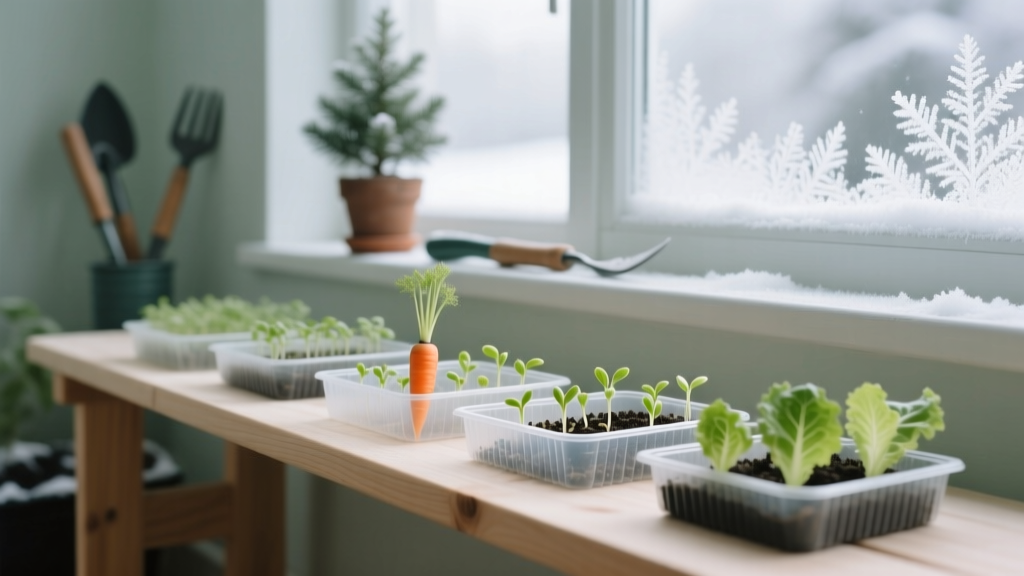
Winter Garden: Starting Slow-Growing Seeds Early
Winter is the season where a week of waiting can cost you a month of harvest. If you want artichokes to size up, onions to bulb properly, leeks to thicken, and sturdy perennial seedlings ready for spring planting, you start now—while the garden outside is quiet. The opportunity is simple: use indoor light and stable temperatures to give slow-growing crops an 8–12 week head start, then time your transplanting to your last spring frost date (or to cool-season soil temperatures) so plants hit the ground running.
This guide is organized by priority: what to plant first, what to prune right now, what to protect during hard freezes, and what to prepare so your spring isn’t a scramble. Keep your local frost dates handy and adjust timing using USDA hardiness zones and the regional scenarios below.
Priority 1: What to plant now (slow growers that need a long runway)
In winter, your best “planting bed” is a seed tray under lights. Focus on crops that either (a) need a long season to reach harvest size, (b) benefit from cool weather early, or (c) are perennials that take time to establish.
Start these seeds 10–14 weeks before your last spring frost
These are the classic slow starters. If you wait until spring, they often stay small all season.
- Globe artichoke (Cynara scolymus): Start indoors 12–14 weeks before last frost. Aim for transplanting after hard freezes ease, but while nights are still cool (often 4–6 weeks before last frost with protection in colder zones).
- Onions from seed (bulbing types): Start 10–12 weeks before last frost. Many growers begin onions indoors in January in cold-winter areas to get pencil-thick transplants by spring.
- Leeks: Start 10–12 weeks before last frost; they tolerate cool transplant conditions.
- Celery and celeriac: Start 12–14 weeks before last frost; slow germination and slow early growth.
- Parsley: Start 10–12 weeks before last frost; germination can be slow, so pre-soak seed 12–24 hours.
Temperature targets: For reliable germination, keep seed-starting media at 70–75°F for celery/celeriac and parsley, and 65–75°F for onions/leeks. Once emerged, drop air temps to around 60–65°F to prevent weak, stretched growth.
Start these seeds 6–10 weeks before your last spring frost (or earlier for flowers)
- Brassicas for early planting (broccoli, cabbage, cauliflower): Typically 6–8 weeks before last frost for spring transplanting. In very mild winter climates, you may already be succession-sowing outdoors instead.
- Perennial herbs (thyme, oregano, sage): Start 8–10 weeks before last frost; slow to size up.
- Hardy flowers that tolerate cool transplanting (snapdragon, stock): 10–12 weeks before last frost for early blooms.
Quick timing math (use your frost date)
Pick your average last spring frost date, then count backward. Examples (adjust to your location):
- If your last frost is April 15, start onions/leeks around January 20–February 5 (10–12 weeks earlier).
- If your last frost is May 10, start celery/celeriac around February 1–15 (12–14 weeks earlier).
- Plan hardening-off to begin about 10–14 days before transplanting.
For frost dates and planting windows, many gardeners use NOAA normals and local station history; also cross-check with your county extension calendar.
Seed-starting checklist (do this before you sow)
- Fresh seed-starting mix (not garden soil) to reduce damping-off risk.
- Clean trays/pots (wash and sanitize to prevent disease carryover).
- Grow lights on a timer: 14–16 hours/day.
- Light distance: keep LEDs 2–4 inches above seedlings; adjust as they grow.
- Small fan for airflow or gentle daily brushing to strengthen stems.
- Labels with sow date + variety + target transplant date.
Winter pest and disease prevention indoors
Indoor seed starting has its own winter pests: fungus gnats, damping-off fungi, and powdery mildew in stagnant air. Prevent problems before they start.
- Damping-off: Avoid overwatering; bottom-water when possible; keep air moving. Use clean containers. University of Minnesota Extension emphasizes sanitation and avoiding saturated media as key prevention steps for damping-off (University of Minnesota Extension, 2020).
- Fungus gnats: Let the surface dry slightly between waterings; use yellow sticky cards; consider a thin layer of coarse sand on top of trays.
- Leggy seedlings: Increase light intensity and lower temps at night (aim 60–65°F), and avoid crowding.
“Providing bright light, good air circulation, and careful watering are the most effective ways to prevent common seedling diseases like damping-off.” — University of Minnesota Extension (2020)
Priority 2: What to prune now (and what to leave alone)
Winter pruning is about timing and temperature. Prune on a dry day when temperatures are safely above deep-freeze conditions to reduce bark damage and stress. As a rule of thumb, avoid pruning when it’s below 20°F (wood can be brittle), and don’t prune immediately before a hard freeze.
Prune now (mid-winter through late winter, depending on region)
- Apple and pear: Dormant pruning is commonly done in late winter before bud break to shape structure and remove dead, crossing, or diseased wood.
- Grapes: Prune while dormant; timing varies, but many growers prune in late winter. Don’t delay too close to bud swell if you want to avoid heavy sap flow (“bleeding”).
- Summer-blooming shrubs (e.g., panicle hydrangea, crape myrtle in warmer zones): Prune in late winter before new growth.
Hold off (or prune lightly)
- Spring-blooming shrubs (lilac, forsythia, azalea): Prune after they flower, or you’ll remove buds set last season.
- Stone fruits (peach, cherry, plum): In colder climates, heavy winter pruning can increase risk of winter injury. Many extensions recommend pruning closer to late winter/early spring as conditions moderate.
Disease-aware pruning practices
- Remove mummified fruit from trees and the ground to reduce overwintering disease inoculum (brown rot, apple scab-related debris cycles).
- Disinfect tools between known diseased cuts (70% isopropyl alcohol wipes are practical).
- Cut out dead/diseased wood back to healthy tissue; don’t leave stubs.
For many fruit and ornamental diseases, winter sanitation is as important as any spray. UC IPM highlights the role of orchard sanitation (removing mummies and infected debris) as a cornerstone of disease management for home fruit trees (University of California Statewide IPM Program, 2018).
Priority 3: What to protect (winter weather, rodents, and sunscald)
Protection work in winter prevents setbacks that steal spring growth. The big threats now are freeze/thaw cycles, drying winds, rodents girdling trunks, and sunscald on young bark.
Temperature thresholds that matter
- Protect tender evergreens when forecasts dip below 10°F, especially with wind.
- Water before a hard freeze if soil is dry and temps will drop below 25°F; hydrated roots handle cold better than drought-stressed ones.
- Mulch after soil cools (often when soil temps are consistently below 40°F) to stabilize, not to keep soil warm.
Winter protection checklist (do a walk-through this week)
- Tree guards on young fruit trees to prevent rabbit/vole girdling; keep guards a few inches into soil.
- Wrap thin-barked trees (young maple, fruit trees) on the southwest side to reduce sunscald; remove wraps in spring.
- Secure burlap windbreaks for broadleaf evergreens (boxwood, rhododendron) in exposed sites.
- Mulch perennials 2–4 inches once soil is cold; keep mulch off crowns to prevent rot.
- Check stored dahlias/cannas: keep around 40–50°F, lightly dry, and inspect monthly for rot or shrivel.
Cold-frame and hoop-house tactics
If you garden in USDA zones 5–7, winter protection can also mean creating a “landing zone” for early transplants. A low tunnel can buy you 2–4 weeks in spring by warming soil and blocking wind. Vent on sunny days when interior temps rise above 75°F to prevent cooked seedlings and fungal outbreaks.
Priority 4: What to prepare (soil, beds, supplies, and a realistic timeline)
The calm of winter is the best time to set up systems that pay off in spring: seed-starting stations, bed plans, irrigation fixes, and soil testing. Small prep now prevents rushed mistakes later.
Do a winter soil test and nutrient plan
If your ground isn’t frozen solid, collect soil samples now and send them to a lab. Results typically take 1–3 weeks. That window lines up perfectly with ordering amendments so they’re on hand when beds are workable. Many extension services recommend routine soil testing every few years to guide lime and fertilizer decisions rather than guessing (see your state university extension soil testing program for local interpretation).
Seed-starting station setup (one afternoon that saves weeks)
- Put lights on a timer set for 16 hours on / 8 hours off.
- Use a heat mat only until germination for heat-loving slow starters (celery/celeriac), then remove to reduce legginess.
- Stage pot sizes: 128-cell trays → 50-cell → 3–4 inch pots for onions/leeks if needed.
- Mix labeled, dated fertilizer plan: begin light feeding at first true leaves (for many seedlings, 1/4–1/2 strength).
Monthly schedule table (adjust by frost date and zone)
Use this as a working calendar. Shift earlier in warmer zones (USDA 8–10) and later in colder zones (USDA 3–5).
| Month | Priority Seed Starts (Indoors) | Outdoor Tasks (When Weather Allows) | Key Thresholds / Timing |
|---|---|---|---|
| December | Artichoke (warm indoor setup), slow herbs if you want large spring transplants | Mulch after soil is cold; install trunk guards; remove mummified fruit | Mulch when soil ~<40°F; protect evergreens <10°F |
| January | Onions from seed; leeks; parsley (start early to beat slow germination) | Dormant pruning on mild days; tool cleaning and sharpening | Start onions ~10–12 weeks before last frost (often Jan/Feb in cold zones) |
| February | Celery/celeriac; more onions; early brassicas in late Feb for many zones | Bed planning; soil test; prep low tunnels | Germinate celery at 70–75°F; begin hardening off 10–14 days pre-transplant |
| March | Brassicas; early flowers; succession sow parsley | Direct sow peas/spinach when soil workable; set up hoops; finish dormant pruning | Transplant hardy seedlings 2–4 weeks before last frost with protection |
Regional scenarios: how to apply this in real gardens
Your winter “now” depends on how hard your winter is and how early spring arrives. Use these scenarios to adjust your seed-starting pace and outdoor tasks.
Scenario 1: Cold winter, short growing season (USDA zones 3–5; Upper Midwest, interior Northeast, mountain towns)
In these regions, the last frost commonly lands in mid-May to early June. That makes winter seed-starting non-negotiable for slow crops.
- Start onions late January through February to avoid undersized bulbs.
- Plan transplanting under protection: low tunnels or cold frames can let you set out onions/leeks 2–4 weeks before last frost if soil is workable.
- Watch indoor humidity: homes are dry in winter; use bottom watering and a humidity dome only until germination to prevent damping-off.
- Outdoor: prioritize rodent guards and sunscald wraps—freeze/thaw is a major bark stressor.
Timely move: If you haven’t started onions by February 15 in a zone 4–5 climate with a mid-May last frost, start immediately and plan for slightly smaller transplants rather than skipping.
Scenario 2: Maritime/mild winter (USDA zones 7–9 coastal; Pacific Northwest lowlands, Mid-Atlantic coast)
Mild winters blur the line between indoor and outdoor work. You may be able to overwinter greens outside and still start slow seeds indoors for a jump.
- Start onions and leeks indoors in January, but also consider direct sowing in protected beds if soil isn’t waterlogged.
- Slug/snail prevention matters now: cool, wet conditions favor them. Keep debris down, use traps, and protect seedlings in cold frames.
- Prune on dry stretches; fungal diseases spread easily in persistent damp weather.
Timely move: Vent cold frames on any sunny day where interior temps exceed 75°F—mild regions can overheat faster than gardeners expect.
Scenario 3: Warm-winter climates (USDA zones 9–11; parts of Southern California, Gulf Coast, desert lowlands)
Your “winter garden” may already be in production outdoors. The slow-seed advantage still applies, but timing shifts earlier and heat becomes the spring challenge.
- Start artichokes and onions early enough to establish before heat. Some zone 10 gardens start onion seed in late fall to early winter for late winter/spring bulbing.
- Choose short-day or intermediate-day onion varieties suited to your latitude; variety selection matters as much as start date.
- Focus protection on wind and drying rather than extreme cold; irrigate strategically during warm winter spells.
Timely move: If daytime highs regularly exceed 80°F by early spring, prioritize earlier transplanting and afternoon shade for cool-season transplants to prevent bolting.
Practical timelines: from sowing day to transplant day
Slow-growing seeds succeed when you treat winter like a production schedule. Use these timelines as your default, then adjust to your local last frost date and microclimate.
Onions from seed (typical indoor timeline)
- Week 0: Sow 1/4 inch deep; keep at 65–75°F.
- Week 1–2: Germination; move under strong light immediately.
- Week 3–6: Start gentle feeding; keep tops trimmed to ~4 inches if they flop (helps manage tangling).
- Week 8–10: Begin hardening off during mild spells.
- Week 10–12: Transplant when soil is workable; onions tolerate frost, but protect from hard freezes.
Celery/celeriac (slow and picky, but worth it)
- Week 0: Surface sow or barely cover; maintain 70–75°F and even moisture.
- Week 2–3: Germination can be slow; don’t let the surface crust.
- Week 4–8: Pot up gently; keep steady growth (check nitrogen—celery stalls easily).
- Week 10–12: Harden off; transplant after the worst cold passes (celery dislikes hard freezes).
Artichokes (long lead time)
- Week 0: Sow indoors; steady warmth and bright light.
- Week 4–6: Pot up; keep plants stocky (cooler nights around 60°F help).
- Week 8–10: Harden off gradually; protect from frost and wind.
- Week 10–14: Transplant with protection in cooler zones; in mild zones, transplant earlier for spring growth.
Winter “right now” checklist (printable-style)
Use this list to decide what to do this weekend versus what can wait.
Do this week
- Calculate your seed-start dates using your last frost date (count back 10–14 weeks for slow crops).
- Start onions/leeks/parsley if you’re inside that window.
- Sanitize trays and set lights to 14–16 hours/day.
- Inspect fruit trees for mummified fruit; remove and discard.
- Install or check rodent guards on young trees.
Do in the next 2–3 weeks
- Start celery/celeriac (aim for 12–14 weeks before last frost).
- Prune apples/pears on a dry day above 20°F, before bud break.
- Set up a cold frame or low tunnel if you plan early transplants.
- Order onion varieties matched to your daylength (short/intermediate/long-day).
Do before transplant season
- Begin hardening off 10–14 days before transplanting.
- Ventilate protected structures to prevent overheating above 75°F.
- Plan slug/snail controls for mild, wet regions; plan vole control for snowy regions.
Winter gardening rewards decisiveness. Start the slow seeds first, keep seedlings compact with bright light and cooler nights, and use winter’s calm to prune and sanitize with purpose. When the first workable soil arrives—and your last frost date is still weeks away—you’ll already have sturdy transplants and protected beds ready to move.
Sources: University of Minnesota Extension (2020), guidance on damping-off prevention and seedling disease management; University of California Statewide Integrated Pest Management Program (UC IPM) (2018), home orchard sanitation and disease management principles.