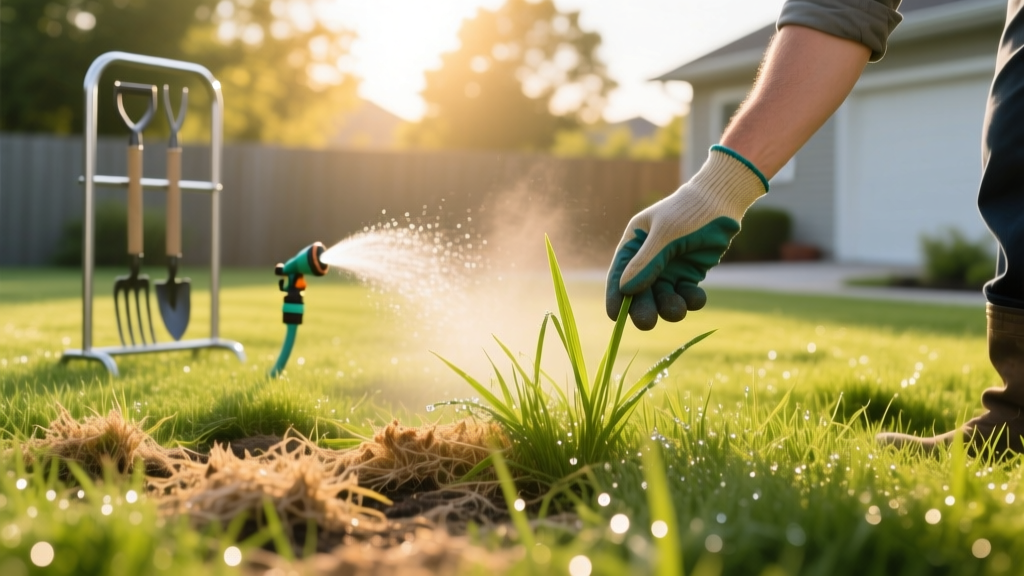
Summer Lawn Care During Heat Stress
When the forecast locks into 90–100°F days and rain shuts off, lawns don’t “grow through it”—they ration water, stop growing, and start shedding older blades to survive. The opportunity right now is to keep turf alive (not perfect), prevent permanent thinning, and set yourself up for a strong recovery when nights cool. The wrong move—scalping, heavy feeding, or frequent shallow watering—can turn a temporary brown spell into dead patches and weeds that linger into fall.
Use this as a triage plan: first protect crowns and roots, then manage water wisely, then adjust mowing and traffic, and only then consider repairs. Heat-stressed lawn care is less about doing more and more about doing the right few things on the right week.
Priority 1: Protect the lawn you already have (this week)
Know what heat stress looks like (and why it matters)
Heat stress often shows up before outright dormancy. Watch for:
- Footprints that linger for 30+ seconds after walking—turf isn’t springing back.
- Blue-gray cast on cool-season grasses (Kentucky bluegrass, perennial ryegrass, tall fescue).
- Leaf rolling or folded blades—plants are reducing surface area to conserve water.
- Hot spots over shallow soils, near sidewalks/driveways, and on slopes.
If daytime highs are consistently above 85°F for cool-season lawns, growth slows; above 90°F with warm nights, stress accelerates. Warm-season grasses (bermudagrass, zoysiagrass, centipedegrass, St. Augustinegrass) can handle higher heat, but still suffer when soils dry and mowing is too short.
Water correctly: deep, infrequent, and early
During heat stress, your goal is to keep the crown and upper root zone hydrated without promoting disease. Most established lawns typically need about 1 inch of water per week from rain + irrigation during summer, applied in 1–2 deep soakings rather than daily sprinkles. This aligns with widely used turf recommendations from extension programs (e.g., Michigan State University Extension, 2020).
- Best time: irrigate between 4 a.m. and 9 a.m. to reduce evaporation and leaf-wetness hours at night.
- Emergency heat wave rule: if highs hit 95°F+ for 3+ days, consider a short “syringing” cycle (2–5 minutes) in mid-afternoon only for high-value turf to cool the canopy; avoid soaking (which can worsen disease).
- Skip watering: if the lawn is going intentionally dormant and you’re okay with browning, you can withhold irrigation; many cool-season lawns can survive 3–4 weeks of dormancy depending on soil and cultivar, but traffic must be minimized.
Do the tuna-can test today: Place 6–10 straight-sided cans across a zone, run irrigation for 15 minutes, then measure. If you collected 0.25 inches in 15 minutes, you’ll need ~60 minutes to apply 1 inch (split into two cycles to prevent runoff).
“Avoid frequent, light watering. It encourages shallow roots and increases stress when hot weather persists.” — Purdue Extension turf management guidance (2019)
Raise your mowing height—immediately
The fastest, most reliable heat-stress improvement is to stop mowing short. Taller grass shades soil, reduces evaporation, and maintains more photosynthetic capacity.
- Cool-season lawns: raise to 3.5–4 inches during sustained heat.
- Warm-season lawns: keep within species norms but avoid “scalping”; for many bermudagrass lawns, 1–2 inches is common, but during extreme heat or drought, err toward the higher end of your mower’s recommended range.
- One-third rule: never remove more than 1/3 of the blade in one mow.
Also sharpen your blade now. Ragged cuts increase water loss and raise disease risk.
Stop fertilizing cool-season lawns in peak heat
If you have a cool-season lawn (common in USDA Zones 3–7), avoid nitrogen applications during heat stress—especially when temperatures are regularly above 85–90°F. Pushing growth in heat can increase disease pressure and water demand. Save the main nitrogen feeding for late summer/early fall recovery (often mid-August to late September depending on region).
Warm-season lawns (common in Zones 7–10) are actively growing in summer and can be fertilized, but only if irrigated properly and not under severe drought restrictions. If the lawn is drought-stressed, pause feeding until growth resumes.
Reduce traffic and heat load
During heat stress, turf crowns are vulnerable. Avoid:
- Kids/pets running the same path daily (rotate routes)
- Mowing when turf is crispy (risk of crown damage)
- Parking equipment on the lawn
If you have reflected heat from pavement, treat edges as “priority zones.” They often need separate irrigation cycles or temporary shade (even a light shade cloth for a week can reduce edge burn).
Priority 2: Protect against summer pests and diseases (next 7–14 days)
Grub timing: watch the calendar and soil temperature
In many regions, white grubs become a serious risk from mid-summer into early fall as eggs hatch and young grubs begin feeding on roots. Prevention and early intervention are timing-dependent.
- Typical window: late June through August (varies by region/species).
- Scout now: if you can roll back turf like a carpet and find >5–10 grubs per square foot in damaged areas, you may need action.
Check your local extension grub calendar for your state—timing varies significantly between northern and southern areas and between Japanese beetle vs. masked chafer populations.
Heat + humidity disease watch list
Summer stress can tip lawns into disease, especially where watering is late-day or nitrogen is high.
- Brown patch (especially tall fescue): common with warm, humid nights (often when nighttime lows stay above 65–70°F).
- Dollar spot: thrives with low nitrogen and prolonged leaf wetness; shows as small straw-colored patches.
- Pythium blight: a rapid “greasy” collapse during hot, wet conditions; can spread fast along mowing patterns.
Prevention steps that work:
- Water early morning only; avoid evening irrigation.
- Improve airflow: trim back shrubs encroaching on lawn edges.
- Bag clippings only if disease is actively spreading; otherwise mulch clippings to recycle moisture and nutrients.
- Do not over-fertilize in heat.
For identification help, use extension photo guides and, if needed, submit a sample to a local diagnostic lab. Correct diagnosis saves money and prevents unnecessary pesticide use.
Weed pressure: don’t “nuke” the lawn during a heat wave
Heat-stressed turf is more sensitive to herbicides. Many labels advise avoiding application during high temperatures (often above 85–90°F) or when turf is drought-stressed. If you must spot-treat, do it in the cooler part of the day and follow the label precisely.
Instead, prioritize cultural suppression: raise mowing height, water deeply, and prevent bare soil—those steps reduce crabgrass and spurge pressure over time.
Priority 3: What to plant now (smart, heat-proof moves)
Warm-season lawns: plug or sod repairs when soil is warm
If you’re in USDA Zones 7–10 with bermudagrass, zoysia, centipede, or St. Augustine, summer is often prime repair time because these grasses spread aggressively in heat—if they have water.
- Best window: when daytime highs are 80–95°F and you can irrigate consistently.
- Method: plug thin areas, topdress lightly, and keep plugs moist for the first 10–14 days.
Avoid seeding warm-season lawns unless you’re using a species/cultivar designed for seed establishment (common for bermuda; uncommon for St. Augustine).
Cool-season lawns: resist seeding during peak heat
In Zones 3–7, cool-season seedings in mid-summer often fail without intense irrigation and disease management. The better “planting” move is to plan for late summer/early fall establishment when nights cool.
Use this timing anchor: aim to seed cool-season grasses about 6–8 weeks before your average first fall frost. If your first frost is around October 10, target seeding between mid-August and early September. If your first frost is September 20, seed by early August.
Right now, focus on site prep rather than seeding: kill weeds, correct compaction, and line up seed and materials.
Heat-smart groundcovers and borders (to shrink lawn footprint)
If your lawn repeatedly struggles each summer—especially along hellstrips and slopes—consider converting the worst zones to plantings that thrive on less irrigation. Options vary by region, but the concept is consistent: reduce turf where it performs poorly.
- Hot, sunny strips: ornamental grasses, drought-tolerant perennials, or mulched beds with drip irrigation.
- Light shade: shade-tolerant groundcovers or a mulched understory bed instead of thin turf.
Priority 4: What to prune (and what to leave alone)
Skip heavy pruning near the lawn during extreme heat
Hard pruning stimulates new growth that needs water—exactly what plants lack in heat stress. Postpone major shrub renovation until temperatures moderate.
Do now: light clearance pruning to improve airflow over turf (reduces humidity and disease). Keep it conservative—think “open up,” not “cut back hard.”
Edge and trim with a strategy
String trimming during heat waves often scalps edges, exposing soil and crowns. Raise the trimmer angle and avoid cutting into the crown line. If you edge, do it once, then maintain lightly.
Priority 5: What to prepare for recovery (late summer into early fall)
Plan your recovery timeline by region (three real-world scenarios)
Scenario A: Northern cool-season lawns (USDA Zones 3–5; shorter summers)
If you’re in the Upper Midwest, northern New England, or higher elevations, the best lawn renovation window can be tight. Mark these targets:
- Now through late July: protect turf; avoid heavy nitrogen.
- Early August: start site prep for overseeding; core aeration if needed.
- Mid-August to early September: overseed/repair (often 6–8 weeks before frost).
Scenario B: Transition zone lawns (USDA Zones 6–7; hot summers, cold winters)
This is where summer lawn care decisions have the biggest consequences. Cool-season grasses struggle; warm-season grasses may winterkill in colder pockets.
- If you have tall fescue: prioritize survival now, then overseed in late summer. Consider more drought-tolerant tall fescue blends for fall renovation.
- If you have bermuda/zoysia: summer is your growth window; repair now, but stop major nitrogen and aggressive cultivation as you approach late summer so turf can harden before fall.
Scenario C: Hot, arid regions and water restrictions (parts of Zones 8–10; Southwest/Intermountain)
When watering days are limited, efficiency matters more than theory.
- Audit irrigation: fix tilted heads, clogged nozzles, overspray onto pavement.
- Cycle-and-soak: run shorter cycles (e.g., 3 cycles of 7–10 minutes) to prevent runoff on slopes and compacted soil.
- Accept managed dormancy: if water allocations are tight, keep the crown alive with occasional deep watering rather than chasing green color.
Research-based water conservation messaging from university turf programs consistently emphasizes deep, infrequent irrigation and mowing high to reduce evapotranspiration (see University of California turf and landscape water guidance, 2018).
Core aeration: schedule it, don’t rush it
Aeration is powerful—but timing matters.
- Cool-season lawns: plan core aeration for late August through September in many areas, when turf can recover quickly and seedlings can establish.
- Warm-season lawns: aerate during active growth (often late spring through mid-summer), not as the grass is slowing down for fall.
Don’t aerate a severely drought-stressed lawn unless you can water afterward; open holes can dry roots further.
Soil test planning (the quiet high-impact move)
If your lawn repeatedly struggles, a soil test guides fall fertilization and lime decisions. Many extensions recommend testing every 3 years or when performance changes. Order a test kit now so results are in hand before fall feeding.
Monthly heat-stress lawn care schedule (June–August)
| Month | Primary goal | Do this | Avoid this |
|---|---|---|---|
| June | Build resilience before peak heat | Raise mowing height; calibrate irrigation; spot-scout for early disease and insects | Scalping; heavy nitrogen on cool-season lawns going into heat |
| July | Survive heat waves with minimal damage | Deep water 1–2x/week as needed; mow less often; minimize traffic; morning-only watering | Frequent shallow watering; herbicide applications during 90°F+ stretches; aggressive dethatching |
| August | Prepare for recovery window | Cool-season: plan/execute overseeding 6–8 weeks before frost; Warm-season: continue repairs if actively growing | Late summer stress practices that weaken turf before fall (wrong-timed aeration, overwatering at night) |
Heat-stress checklists you can use today
48-hour lawn triage checklist
- Set mower to 3.5–4 inches (cool-season) and sharpen blade
- Run a tuna-can irrigation test and calculate minutes per 0.5 inch
- Switch watering to 4–9 a.m. only
- Mark hot spots (pavement edges, slopes, sandy patches) for extra attention
- Pause nitrogen fertilization on cool-season lawns during 85–90°F+ periods
7–14 day monitoring checklist
- Check for disease patterns after humid nights (especially if lows stay above 65–70°F)
- Scout for grub damage in thinning patches; peel back a 1 sq ft section and count
- Look for irrigation coverage gaps (dry arcs, blocked spray, overspray onto sidewalks)
- Spot-pull weeds in thin areas rather than blanket-spraying during heat
Late-summer recovery timeline (pin this to your calendar)
- Week 1–2 (now): protect, water correctly, mow high, reduce traffic
- Week 3–4: soil test order; plan seed/aeration; address sprinkler repairs
- 6–8 weeks before first frost: cool-season overseeding window opens (adjust to your local frost date)
- After daytime highs drop below ~85°F consistently: cool-season lawns begin responding better to nitrogen and renovation work
Common summer mistakes that cause permanent thinning
These are the big ones that show up every year:
- Scalping before a heat wave: removes the plant’s shade and forces heat onto crowns.
- Watering every day for 5 minutes: trains shallow roots and wastes water to evaporation.
- Fertilizing to “green it up” in July: can trigger disease and burn on stressed turf, especially cool-season lawns.
- Blanket herbicide applications at 90°F+: increases turf injury and can leave you with bigger bare patches.
Quick decision guide: green lawn vs. survival dormancy
If water is available and your lawn is high-use (kids, pets, entertaining), aim for “functional green”: deep irrigation 1–2 times weekly and mowing high. If water is limited, aim for survival: allow dormancy, keep traffic off, and apply occasional deep watering to protect crowns. Neither approach is wrong—mix them by zone (front yard green, side yard dormant) if needed.
The best heat-stress lawn care has a calm logic: protect crowns, conserve moisture, avoid forcing growth, and prepare for the recovery window. When temperatures ease—often in late August or September for many regions—you’ll be positioned to thicken turf quickly instead of starting over from bare soil.