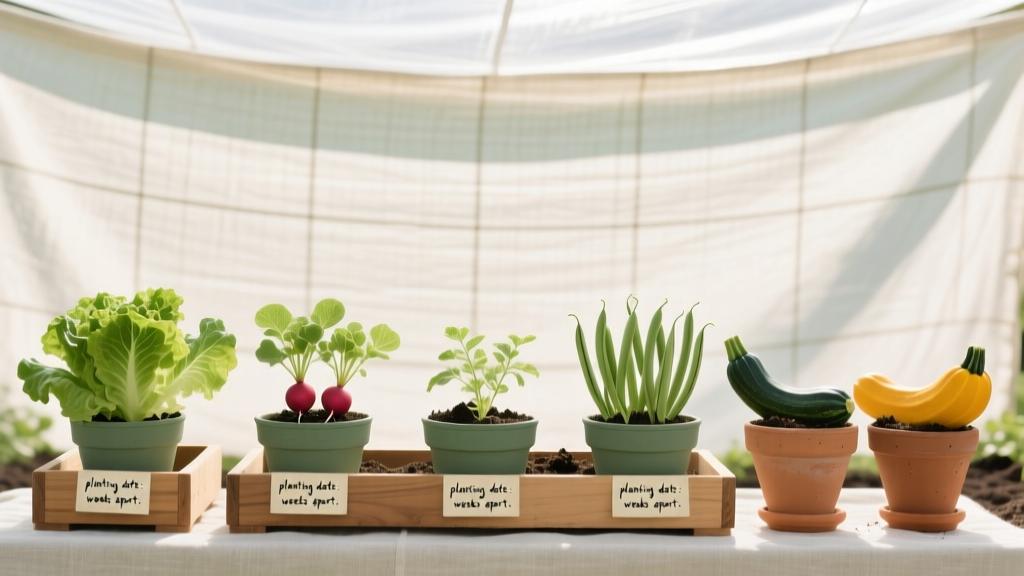
Summer Succession: What to Plant Every Two Weeks
The fastest way to waste summer garden space is to plant once, harvest once, and then stare at bare soil while weeds move in. The opportunity right now: warm soil, long days, and quick crop turnover. If you plant on a two-week rhythm, you can keep harvesting through late summer and right up to your first frost—without needing more beds.
This is a practical succession schedule for the “right now” window—built around temperature thresholds, day-length realities, and the fact that pests peak in summer. Use it as a working almanac: pick your week, check your average first fall frost date, then plant and protect accordingly.
How to use this guide: Mark your average first fall frost date on the calendar (often between Sept 15 and Nov 15 depending on region). Then count backward. Many quick crops need 30–60 days to harvest; fall brassicas often need 55–85 days. If daytime highs are consistently above 85°F, shift toward heat-lovers and use shade cloth for cool crops. If nights drop below 50°F, start prioritizing fall plantings and row cover.
Priority 1: What to plant (every two weeks)
Succession planting works because plants don’t all mature at once. You’re also hedging your bets: a heat wave, storm, or pest flare-up won’t wipe out the entire season’s crop. The schedule below assumes you’re planting repeatedly from early summer through late summer; adjust start dates to match your local climate and USDA hardiness zone.
Two-week planting rhythm (quick reference schedule)
| Time window | What to sow/plant | Temperature cues | Notes for success |
|---|---|---|---|
| June 1–15 | Bush beans, cucumbers, basil, zinnias, more sweet corn | Soil ≥ 60°F for beans; nights ≥ 55°F for cucurbits | Water deeply after sowing; use insect netting for cucumber beetles |
| June 16–30 | Second sowing: beans, dill, cilantro (in shade), carrots (with shade board) | Germination slows above 85°F | Pre-moisten carrot row; cover with burlap until sprout |
| July 1–15 | Beans again, summer squash, basil, more cucumbers; start fall broccoli indoors | Heat stress above 90°F | Succession beans every 14 days for steady harvest |
| July 16–31 | Direct sow: beets, chard; transplant: leeks; start fall cabbage/kale indoors | Cool crops prefer 65–75°F but can be managed | Use 30–40% shade cloth for germination |
| Aug 1–15 | Direct sow: carrots, turnips, rutabaga (cooler regions); transplant: fall brassicas | Nights trending toward 50–60°F | Plan for row cover when nights dip < 50°F |
| Aug 16–31 | Spinach (cool regions), lettuce (shade), radish, arugula, cilantro | Spinach germinates best 50–70°F | In hot zones, wait until soil cools; water twice daily for germination |
| Sept 1–15 | Radish, spinach (most regions), Asian greens; garlic planning | Watch first frost windows (many areas Sept 15–Oct 15) | Use low tunnels to extend harvest 2–4 weeks |
Start here: the “every two weeks” staples
If you only plant a few things on repeat, make them crops that (1) germinate reliably, (2) mature fast, and (3) taste best fresh. These are the backbone of summer succession.
- Bush beans: Sow a new 5–10 foot row every 14 days until about 8–10 weeks before first frost. Beans typically need 50–60 days to first pick.
- Sweet corn: Stagger plantings every 10–14 days for a rolling harvest (plant in blocks for pollination). Stop when the days-to-maturity exceeds your remaining frost-free days.
- Cucumbers: Direct sow or transplant every 2–3 weeks through midsummer for continuous production and as insurance against cucumber beetles.
- Basil and dill: New sowings every 2 weeks prevent the “all-bolted at once” problem.
- Radishes: Plant every 10–14 days once nights begin to cool; summer heat makes them pithy.
- Lettuce: Summer successions work best with shade cloth and heat-tolerant varieties; sow every 2 weeks in partial shade.
Biweekly planting timeline (printable checklist)
Every two weeks, same routine:
- Pull one finished crop (or cut-and-come-again greens back hard).
- Top-dress with 1–2 inches compost or a light organic fertilizer.
- Water bed deeply the day before sowing (especially if highs are > 85°F).
- Sow/transplant in the evening to reduce heat stress.
- Mulch immediately after seedlings are established.
- Label with date and variety—succession planting fails fast without dates.
Expert note on timing and heat
“High soil temperatures can inhibit germination of cool-season crops like lettuce and spinach; using shade and keeping the seed zone consistently moist improves stands during summer plantings.” (Extension guidance summarized from multiple university recommendations)
That’s the core summer problem: warm-season crops love it, cool-season crops resist it. Don’t fight physics—use shade cloth, irrigation timing, and variety choice to make summer successions reliable.
Priority 2: What to prune (so plants keep producing)
Pruning in summer isn’t about shaping; it’s about keeping airflow high, disease low, and harvest steady. Do the following on a weekly loop—more often after rainstorms or when humidity stays high overnight.
Tomatoes: prune for airflow, not perfection
If you grow indeterminate tomatoes, remove suckers below the first flower cluster and keep lower leaves off the soil. When daytime highs are consistently above 90°F, avoid heavy pruning—plants need leaf cover to prevent sunscald.
- Remove leaves touching soil to reduce splash-borne disease.
- Stake/trellis and keep vines open for faster drying after dew.
- Pinch new flowers about 4–6 weeks before first frost in short-season regions so plants finish ripening existing fruit.
Herbs: harvest hard to prevent bolting
Basil, mint, and oregano respond to frequent cutting. Harvest basil when plants have 6–8 sets of true leaves; always cut above a node to force branching. Dill and cilantro bolt quickly in heat—succession sowing plus morning shade helps.
Summer squash and cucumbers: remove damaged leaves
As powdery mildew season ramps up, remove the worst-infected leaves first (never more than about a third of foliage at once). This improves airflow and makes sprays—if you use them—more effective.
Priority 3: What to protect (heat, pests, and disease)
Summer is when gardens look vigorous—right before pests and pathogens take advantage. Protection now is less work than rescue later.
Heat management: keep plants growing through the 85–95°F stretch
- Shade cloth: Use 30–40% shade over lettuce, spinach starts, cilantro, and newly seeded carrots when highs exceed 85°F.
- Mulch: Apply 2–3 inches of straw or shredded leaves around tomatoes, peppers, beans, and cucurbits after soil warms. Mulch stabilizes moisture and reduces blossom end rot risk by preventing drought swings.
- Water timing: Water early morning. During heat waves, prioritize deep watering every 2–4 days over daily sprinkles.
Pest prevention you should do this week
These are the recurring summer culprits. The goal is early detection and interruption—before populations explode.
- Cucumber beetles: Use floating row cover until flowering, then remove for pollination. Trap crops and hand-picking at dawn helps. (These beetles can also spread bacterial wilt.)
- Squash vine borer: In many regions, adult activity peaks in early to midsummer. Wrap the lower 6 inches of stems with foil, mound soil over nodes, and consider succession planting a second round of squash in mid-July to replace damaged plants.
- Tomato hornworms: Check twice weekly; hand-pick. Look for white cocoons (parasitic wasps)—leave those worms as biological control.
- Aphids and whiteflies: Blast with water; avoid over-fertilizing with nitrogen. Encourage beneficials with dill, alyssum, and yarrow successions.
Extension guidance consistently emphasizes prevention via scouting and sanitation. For example, Colorado State University Extension notes that integrated pest management relies on monitoring and targeted action rather than routine pesticide use (Colorado State University Extension, 2023).
Disease prevention during humid weeks
Warm nights and heavy dew are the triggers. If your area has a run of nights above 65°F with high humidity, expect foliar diseases to accelerate.
- Powdery mildew (squash, cucumbers): Improve airflow, avoid overhead watering late day, and remove heavily infected leaves.
- Early blight/septoria (tomatoes): Mulch to prevent soil splash, prune lower leaves, and keep plants staked. Rotate away from nightshades for 3–4 years if you had major issues.
- Downy mildew (cucurbits in many regions): Watch local alerts; it can arrive suddenly. University extension networks often publish county-level updates—use them to decide whether to replant cucumbers or switch to resistant varieties.
For home garden disease management, sanitation and rotation are repeatedly emphasized by extension resources. The University of Minnesota Extension highlights the importance of removing infected plant debris and avoiding overhead irrigation to reduce leaf wetness periods (University of Minnesota Extension, 2022).
Priority 4: What to prepare (so fall harvests are already in motion)
Mid-to-late summer is when next month’s garden is decided. If you wait until it “feels like fall,” you’ll miss the planting window for many autumn crops—especially in USDA Zones 3–6.
Count back from frost: a simple rule that works
Find your average first fall frost date, then count backward:
- 60–80 days before frost: transplant broccoli, cabbage, cauliflower (or sow fast brassicas)
- 45–60 days before frost: sow beets, carrots (fast varieties), chard, bush beans (warm regions)
- 30–45 days before frost: sow lettuce, Asian greens, radishes
- 14–30 days before frost: last sowings of spinach in cooler regions; plan row cover
If your average first frost is Oct 15, then target brassica transplants around Aug 1–15. If your frost is Nov 15, you can push those plantings into late August or early September in many areas.
Soil reset between successions (10-minute bed turnaround)
When you pull a crop, don’t just replant into depleted soil. A quick reset keeps successions vigorous.
- Pull roots and remove diseased leaves (don’t compost diseased foliage unless your compost gets hot).
- Loosen the top 2–4 inches with a rake or hoe.
- Add compost plus a light nitrogen source before leafy successions (greens, basil).
- Water, then plant later the same day (evening is best in heat).
Supplies to stage now (before you need them)
- Row cover or insect netting for brassicas and late cucumbers
- Hoops or conduit for quick low tunnels (frost extension)
- Shade cloth for July/August germination
- Extra dripline or soaker hoses (summer successions fail without steady moisture)
- Labels and a garden notebook for sowing dates
Regional variations: three real-world summer succession scenarios
Your “every two weeks” list changes based on night temperatures, humidity, and how quickly fall arrives. Use these scenarios to adjust your choices without redoing the whole plan.
Scenario 1: Cool-summer, short-season gardens (USDA Zones 3–5; high elevation)
If your nights are regularly < 55°F even in summer, focus on fast-maturing crops and start fall brassicas early. A typical first frost might land around Sept 15–Oct 1.
- Prioritize: bush beans, peas (late summer), carrots, beets, cabbage family transplants, hardy greens.
- Start broccoli/cabbage indoors by early July; transplant by late July.
- Use low tunnels in September to buy 2–4 weeks of extra harvest.
Scenario 2: Hot, humid summers (USDA Zones 7–9; Southeast and Mid-Atlantic)
Here, the challenge is heat plus disease pressure. High humidity and warm nights (often > 70°F) favor fungal issues, and cool-season crops struggle in July.
- Prioritize: okra, sweet potatoes, southern peas, basil, peppers, eggplant; keep successions of cucumbers and beans going with disease-resistant varieties.
- Delay spinach and most lettuces until late August or September when soil temperatures drop closer to 70°F.
- Expect powdery mildew; prune for airflow and avoid overhead irrigation late day.
Scenario 3: Dry heat and big temperature swings (USDA Zones 5–9; interior West)
Low humidity reduces some foliar diseases, but direct sun and drying winds can wreck germination. In many places, daytime highs hit 95–105°F while nights cool sharply.
- Prioritize: melons, squash, beans (with consistent irrigation), basil, corn; start fall brassicas with shade and steady water.
- Germinate carrots and lettuce under boards/burlap for 3–7 days to keep the seed zone moist.
- Mulch aggressively; drip irrigation is a major advantage for succession planting.
Summer succession timelines you can follow this week
Pick the timeline that matches where you are in the season. If you’re not sure, use your first frost date and count backward.
If it’s early summer (roughly June 1–July 1)
- This week: Sow beans, cucumbers, basil; make a second corn planting; transplant another round of basil.
- In 2 weeks: Sow beans again; re-seed dill; start fall broccoli indoors (Zones 3–6).
- In 4 weeks: Sow carrots with shade assistance; start cabbage/kale indoors.
If it’s mid-summer (roughly July 1–Aug 1)
- This week: Sow beans (last big wave in short-season areas), beets, chard; start fall brassicas indoors if you haven’t.
- In 2 weeks: Transplant broccoli/cabbage (Zones 3–7); sow another bed of basil and dill.
- In 4 weeks: Begin radish/Asian greens successions as nights cool.
If it’s late summer (roughly Aug 1–Sept 1)
- This week: Transplant fall brassicas; sow carrots (fast varieties), turnips, beets; start lettuce in shade.
- In 2 weeks: Sow spinach where soil temps are trending ≤ 70°F; continue radish successions.
- In 4 weeks: Install row cover/low tunnels ahead of first frost; keep harvesting and re-sowing quick greens.
Common summer succession mistakes (and quick fixes)
Mistake: Replanting into dry, hot soil and blaming the seed packet when nothing comes up.
Fix: Pre-water the bed, sow in the evening, and cover with shade cloth or burlap until germination.
Mistake: Planting cool-season crops in peak heat without protection.
Fix: Wait until nights cool (often late August), or use shade cloth and consistent moisture to keep germination going.
Mistake: Letting pests build up between plantings.
Fix: Clean up crop residue, rotate families where possible, and cover young plants with netting during the most vulnerable stage.
Mistake: Planting “one last time” without checking days to maturity against frost.
Fix: Count back from your average first frost (e.g., Oct 15 or Nov 1) and choose varieties that fit your remaining window—then add row cover to extend.
Right-now field checklist (walk your garden with this)
- Empty spaces: Any bare soil bigger than a dinner plate gets a job today—mulch, cover crop, or a new succession.
- Moisture: Check soil 2 inches down. If dry, irrigate before sowing.
- Tomato health: Lower leaves off the ground; cages/stakes secure.
- Cucurbit leaves: Remove the worst powdery mildew leaves; confirm pollination is happening.
- Brassicas for fall: If your frost is within 70 days, start seeds or source transplants this week.
- Supplies staged: Shade cloth ready if highs exceed 85°F; row cover ready if nights dip under 50°F.
The rhythm is the whole trick: every two weeks you’re planting something, clearing something, and protecting something. If you keep that cadence through August, September becomes a harvest month instead of a scramble—and your garden stays full of crops instead of regrets.