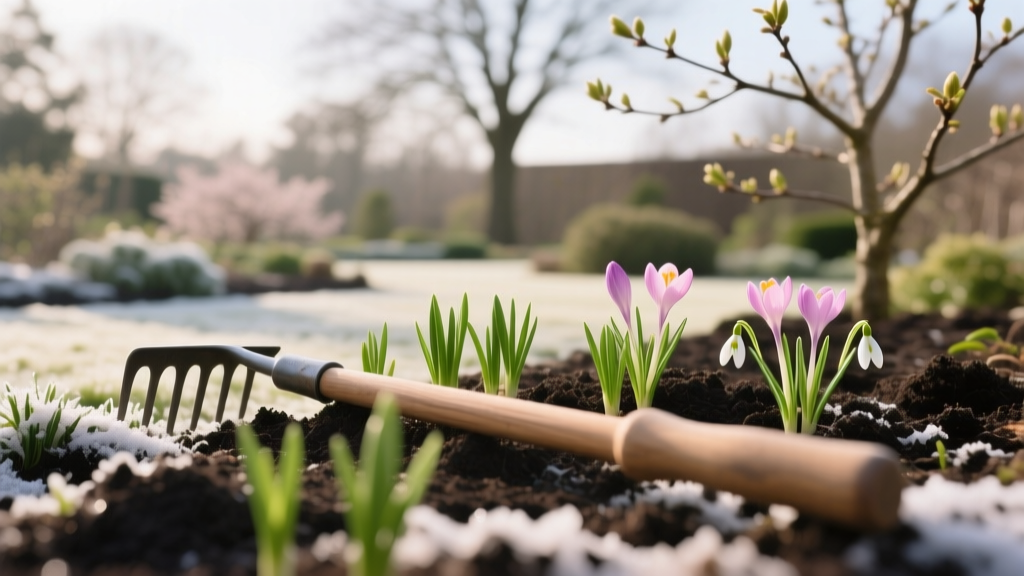
Transitioning Your Garden from Winter to Spring
The next 4–6 weeks decide what kind of spring you’re going to have: a clean, productive start or a season spent catching up. Soil is thawing, buds are swelling, and pests are waking up on the same schedule as your perennials. If you act while nights still dip near 32°F and days hover in the 45–60°F range, you can prune safely, prep beds without compacting wet soil, and get cold-hardy crops going weeks ahead of your last frost date.
Use this as a right-now playbook. Focus on priority tasks first, then move down the list as weather and soil conditions allow. Timing notes below include temperature triggers, week-by-week cues, and frost-date anchors so you can adapt to your USDA hardiness zone.
First, anchor your timing (do this today)
Before you touch a pruner or seed packet, pin down three numbers for your garden: (1) average last spring frost date, (2) soil temperature, and (3) how wet your soil is right now. These three variables control almost everything below.
- Average last frost date: Find yours by ZIP code (many state extension sites publish maps) and write it on your calendar. Most spring timelines below reference 6 weeks before, 4 weeks before, and 2 weeks after that date.
- Soil temperature targets: Use a soil thermometer at 2–4 inches deep, mid-morning.
- 40°F: peas, spinach, radish, some brassicas can germinate (slowly), lawns begin to “wake.”
- 50°F: many cool-season crops germinate reliably; you can start thinking about seeding beets and carrots.
- 60°F: warm-season crops start to make sense; soil biology ramps up fast.
- Soil moisture “squeeze test”: Grab a handful. If it forms a sticky ball and smears, it’s too wet—wait to avoid compaction. If it crumbles when you poke it, you can work it.
“Tilling or working soil when it is too wet can destroy soil structure, leading to clods and compaction that persist all season.” — University of Minnesota Extension, soil management guidance (commonly cited principle in spring field and garden prep)
Zone reality check: In USDA Zones 3–5, spring tasks often compress into a short window; prioritize drainage, cleanup, and cold crops. In Zones 6–7, you can stagger plantings and prune earlier. In Zones 8–10, your “spring” may already be underway—focus on pest pressure, heat planning, and finishing cool-season crops before temperatures jump.
Priority 1: What to protect (freeze swings, soil, and emerging growth)
Spring isn’t a straight warm-up; it’s a zig-zag. One warm week can push buds, followed by a hard freeze that damages flowers, fruit spurs, and tender new growth. Protection is often the highest-ROI task because it prevents losses you can’t “fix” later.
Frost protection: be ready for 28°F nights
If your forecast threatens 28°F or lower after buds break, act the same day. Tender blossoms on stone fruits, berries, and early ornamentals are most vulnerable.
- Row cover (floating fabric): Keep it folded and labeled. Use it when night temps are forecast 32°F or below. Secure edges to prevent wind leaks.
- Cloche or bucket method: For individual plants (new transplants, early lettuce), cover before sunset and vent in the morning once temps rise above 35–40°F.
- Mulch as insulation: Re-mulch exposed crowns after freeze-thaw cycles. Keep mulch off the crown of perennials to avoid rot.
Timing note: In Zones 5–7, late freezes commonly arrive 1–3 weeks after an early warm spell. Don’t put frost cloth away until you’re 2 weeks past your average last frost date.
Protect shrubs and trees from spring dieback
Evergreens and broadleaf evergreens can suffer from sun + wind + frozen roots (winter burn) and then get hit by late cold snaps. Spring is when damage becomes visible and pathogens can enter.
- Water on thawed days: If soil is thawed and dry, water deeply mid-day when temperatures are above 40°F.
- Delay heavy pruning of damaged evergreens: Wait until you see new growth to avoid removing tissue that might recover.
- Rodent inspection: Pull mulch back from trunks. Look for girdling at the base; protect with hardware cloth if rabbits/voles are active.
Early-season pest prevention (before populations explode)
Prevention now is easier than chasing infestations later.
- Sanitation first: Remove mummified fruit, fallen leaves under fruit trees, and diseased stems. Many diseases overwinter in debris.
- Dormant oil timing: For scale, mites, and aphid eggs on fruit trees and some ornamentals, dormant oils are typically applied before bud break or at “green tip” depending on the crop and product label. Apply only when temperatures will stay above 40°F for 24 hours and no freeze is imminent. Always follow label directions.
- Slugs and sowbugs: As mulch warms, check under boards and pots. Start traps early; seedlings are most vulnerable.
Research-based guidance consistently emphasizes sanitation and correctly timed dormant sprays as a spring foundation. For example, Washington State University Extension provides disease and pest timing resources for home orchards (WSU Extension, 2020), and Penn State Extension outlines dormant oil use and temperature considerations (Penn State Extension, 2019)—both stress label compliance and proper phenology timing.
Priority 2: What to prepare (beds, soil, tools, and plan)
Preparation is where gardens either accelerate or stall. The key is to prep without compacting wet soil and to feed soil life before you feed plants.
Garden bed triage: start with drainage and access
If your beds are soggy, don’t rush in. Instead, fix access first.
- Define paths: Step only in paths to keep beds uncompacted. Add wood chips if muddy.
- Open winter-matted mulch: Gently fluff so soil can warm and breathe. Keep 2–3 inches of mulch around perennials, not on crowns.
- Raised bed advantage: Raised beds warm earlier—often by 1–2 weeks—making them your first planting targets for peas and greens.
Soil checklist (1 afternoon, big payoff)
- Do the squeeze test; don’t work soil that smears.
- Top-dress with 1–2 inches of finished compost; avoid burying it deep—let worms do the mixing.
- Pull back mulch, then water lightly if soil is dry and temps are above 40°F.
- Get a soil test every 3 years (or annually if you’re correcting pH). Many state extensions recommend routine testing to prevent over-fertilizing and to manage pH for nutrient availability (e.g., University of Massachusetts Extension soil testing guidance, 2022).
Fertilizer timing: Don’t blanket-feed early just because the calendar says “spring.” Cool soils slow nutrient uptake, and excess nitrogen can push weak growth. Start with compost, then fertilize based on soil test needs and what you’re growing.
Tool and system reset (do this before the busy week hits)
- Sharpen pruners and loppers: Clean with alcohol or a disinfectant wipe between diseased plants.
- Check irrigation: Turn on lines on a warm day above 45°F; look for winter cracks.
- Label inventory: Sort seeds by “cool-season” and “warm-season.” Discard old seed with poor germination, or test 10 seeds on a damp paper towel for a quick viability check.
Priority 3: What to prune (timing is everything)
Pruning is the fastest way to improve plant health and shape, but it’s also one of the easiest places to make a season-long mistake. The big rule: prune based on bloom time and plant type—not just temperature.
Prune now: late winter to early spring targets
These are generally safe when plants are still dormant or just waking, especially when daytime temps are consistently above 40°F and the worst cold has passed.
- Apple and pear trees: Structural pruning before bud break improves airflow and reduces disease pressure. Remove dead, crossing, and inward-growing branches first.
- Grapes: Prune before heavy sap flow; finish before buds swell significantly.
- Summer-flowering shrubs: Examples include butterfly bush (Buddleja) and panicle hydrangea (Hydrangea paniculata), which bloom on new wood—prune in early spring.
- Roses: In colder zones, prune when forsythia blooms (a classic phenology cue) and you can see live vs dead canes.
Do NOT prune yet: spring-flowering shrubs (or you’ll cut off blooms)
If it blooms early on old wood, wait until after flowering.
- Lilac, forsythia, quince, many azaleas and rhododendrons: prune within 2–3 weeks after bloom.
- Bigleaf hydrangea (Hydrangea macrophylla): avoid aggressive spring pruning unless you’re sure it blooms on new wood (many don’t).
Perennial cleanup: cut back with pest and disease in mind
Cut back last year’s stems once you see basal growth, but don’t rush to bare soil if you rely on overwintering beneficial insects.
- If disease was present last year: Remove and bag debris (don’t compost) to reduce reinfection.
- If plants were healthy: Cut stems to 4–6 inches and chop into smaller pieces for composting, or leave some hollow stems in a discrete area for beneficials.
Priority 4: What to plant (by frost date, soil temp, and zone)
Planting is the reward—but only if soil is workable and temperatures align. Use your last frost date and soil temps to decide what goes in now versus what waits.
Plant now (6–8 weeks before last frost): cold-hardy starts and seeds
When soil hits about 40°F and beds aren’t waterlogged, you can begin.
- Direct sow: peas, spinach, radish, arugula, mache, turnips.
- Transplant (with protection): onion sets, shallots, hardy lettuce starts, brassica starts (broccoli, cabbage) if hardened off.
- Potatoes: Plant when soil is 45°F and workable; in many regions that’s 2–4 weeks before last frost.
Actionable tip: Do a “first sowing” that’s intentionally small. If a late freeze or slug surge hits, you haven’t bet your whole spring on one planting.
Plant next (4–6 weeks before last frost): root crops and steady cool-season staples
As soil warms toward 50°F, germination becomes more reliable.
- Direct sow: carrots, beets, chard, more lettuce, cilantro.
- Succession plan: sow every 10–14 days for continuous harvest.
Plant later (after last frost + soil warms): warm-season crops
Don’t let one sunny week trick you. Many warm-season crops stall in cold soil, even if air temperatures feel pleasant.
- Wait until nights stay above 50°F: tomatoes and peppers transplant best with consistent night warmth; soil should be trending toward 60°F.
- Wait until soil is 65°F: beans and cucumbers prefer warmer soil for fast emergence and reduced rot risk.
Hard number to remember: If you plant warm-season crops and then get a 36–38°F cold snap, expect slowed growth and increased disease vulnerability for at least a week.
Monthly schedule: late winter through mid-spring (adjust by zone)
Use this as a working calendar. Shift earlier by 2–4 weeks in Zones 8–10 and later by 2–4 weeks in Zones 3–5.
| Window | Primary goals | What to do now | Do not do yet |
|---|---|---|---|
| Late Feb–Early Mar (or 8–6 weeks before last frost) |
Prevent damage, prep access | Inspect trees; sanitize debris; sharpen tools; plan crop map; start seeds indoors (tomatoes 6–8 weeks before transplant) | Work saturated soil; prune spring bloomers |
| Mid–Late Mar (6–4 weeks before last frost) |
Cold crops + structural pruning | Direct sow peas/spinach/radish; prune apples/pears; top-dress compost; set slug traps | Fertilize lawns heavily; plant beans/cukes |
| Early–Mid Apr (4–2 weeks before last frost) |
Succession sowing + protection | Sow carrots/beets; harden off brassicas; deploy row cover on <32°F nights; monitor bud break for pest timing | Remove all mulch from perennials; prune lilacs/azaleas (wait until after bloom) |
| Late Apr–May (last frost to +2 weeks) |
Transition to warm season carefully | Set out hardened-off plants with protection ready; keep sowing greens in shade; mulch after soil warms | Assume frost risk is over before you’re 2 weeks past average date |
Regional and real-world scenarios (what changes and what stays the same)
Spring tasks are universal; the order and urgency aren’t. Use the scenario that matches your conditions right now.
Scenario 1: Cold-winter regions (USDA Zones 3–5) with late frosts
If your last frost is commonly in mid-to-late May, your early spring window is short and muddy. Your priorities: avoid compaction, plant cold crops in raised beds first, and delay pruning choices until you can assess winter dieback.
- Timing: Expect freeze risk into the 20s (28°F events are common) well into spring. Keep frost cloth accessible until 2 weeks after your last frost date.
- Best early wins: peas + spinach + onion sets, plus compost top-dressing once beds pass the squeeze test.
- Watch for: snow mold on lawns and crown rot in perennials if mulch stayed wet against crowns.
Scenario 2: Temperate regions (USDA Zones 6–7) with rollercoaster warm spells
This is the classic “false spring” zone range: a week at 70°F triggers buds, then a cold front arrives. Focus on bloom protection and careful timing of fruit tree care.
- Timing: Be ready for a late freeze 1–3 weeks after early bud swell. If fruit trees reach green tip and temps threaten 28–30°F, protect what you can (small trees, berries) and avoid nitrogen pushes.
- Best early wins: succession sow greens every 10–14 days; prune apples/pears before bud break; delay pruning spring bloomers.
- Watch for: peach leaf curl and early fungal disease pressure during cool, wet spells—sanitation and airflow matter.
Scenario 3: Mild-winter regions (USDA Zones 8–10) where spring arrives early
In warm zones, your spring transition often means finishing cool-season crops and preparing for heat and pest pressure. You may already be past your “last frost,” but wind, heavy rains, and sudden heat can still stress plants.
- Timing: When daytime highs start consistently pushing 80°F, bolt-prone crops (cilantro, spinach, lettuce) need shade cloth or harvesting plans.
- Best early wins: plant tomatoes earlier but protect from sudden cold snaps; shift to mulching and consistent irrigation before heat spikes.
- Watch for: aphids, whiteflies, and rapid fungal cycles after spring rains—scout weekly and remove heavily infested growth promptly.
Seasonal pest and disease prevention (spring-specific, practical)
Your goal isn’t perfection; it’s staying ahead of the first big wave. Spring prevention is mostly about breaking life cycles and keeping plants growing steadily.
Top 6 prevention moves this month
- Remove overwintered disease reservoirs: Dispose of blackspot-infected rose leaves, apple scab leaves, and any “mummies” on fruit trees.
- Scout weekly starting at 50°F days: Once daytime highs regularly reach 50–60°F, inspect leaf undersides and buds. Catching aphids early prevents curled growth that’s hard to correct.
- Airflow now, not later: Thin dense fruit tree spurs and remove crossing branches to reduce spring fungal pressure.
- Water the soil, not the leaves: Cool, wet foliage drives mildew and leaf spot. Drip lines and soaker hoses reduce splash dispersal.
- Mulch after soil warms: Mulching too early can keep soil cold and wet. Aim to mulch when soil is trending above 50°F and drying out between rains.
- Use row cover strategically: It’s not just for frost—row cover can exclude early flea beetles on brassicas and reduce wind stress on transplants.
For evidence-based integrated pest management guidance, see UC IPM’s seasonal principles and crop-specific monitoring recommendations (University of California Statewide IPM Program, 2021) and extension resources on dormant oils and sanitation timing (Penn State Extension, 2019; WSU Extension, 2020).
Right-now checklists and timelines
This weekend (2–4 hours)
- Find your average last frost date; mark -6 weeks, -4 weeks, and +2 weeks on your calendar.
- Do the soil squeeze test in each bed; flag beds that are still too wet.
- Clear diseased debris and any mummified fruit; clean up around fruit trees.
- Set out row cover and clips/staples where you can grab them fast before a freeze night.
- Sharpen pruners; disinfect blades.
Next 7–10 days
- Top-dress workable beds with 1–2 inches compost.
- Direct sow peas/spinach/radish when soil is near 40°F.
- Prune apples/pears (if applicable) before bud break; remove dead/crossing branches first.
- Start slug monitoring; protect seedlings early.
By 2 weeks before your last frost date
- Begin succession sowing carrots/beets as soil approaches 50°F.
- Harden off brassica and lettuce starts for 7–10 days before transplanting.
- Check irrigation lines on a day above 45°F.
From last frost date to +2 weeks
- Transplant tender crops only when nights trend above 50°F; keep frost cover ready.
- Mulch after soil warms and drains well (often when soil is consistently above 50°F).
- Continue weekly scouting; treat small problems before they spread.
Spring rewards the gardener who acts in short, well-timed bursts: protect during cold snaps, prep when soil is workable, prune based on bloom and bud stage, and plant in temperature “lanes” rather than by calendar alone. If you keep your frost cloth handy, your compost ready, and your first sowings modest and repeatable, you’ll build momentum that lasts into summer—without gambling on the weather.