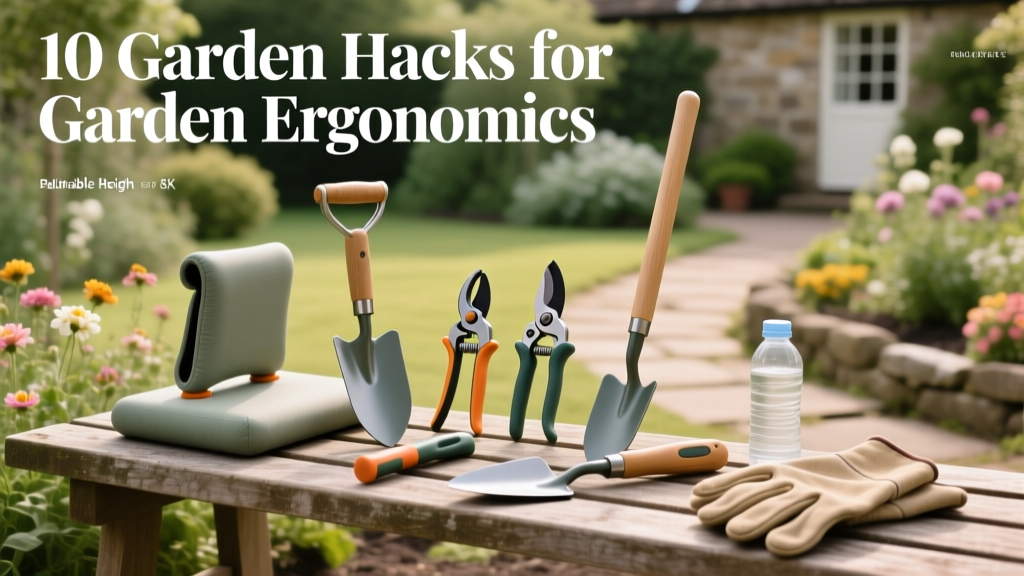
10 Garden Hacks for Garden Ergonomics
Most sore backs in the garden don’t come from “hard work”—they come from repeating the same tiny mistake hundreds of times: working at the wrong height. A few inches too low on a bed edge or a tool handle that’s slightly short can turn a 20-minute weeding session into a two-day ache-fest. The good news: you don’t need a gym membership or fancy gear to garden more comfortably—you need smarter setups.
Ergonomics sounds technical, but it’s basically “make the garden fit your body.” The hacks below are the ones that actually move the needle: height changes, leverage tricks, rolling systems, and quick modifications that save your wrists, knees, and lower back—without slowing you down.
Set the Garden Up to Meet You (Not the Other Way Around)
1) Raise your work zone to 28–36 inches (and stop gardening from a squat)
If you’re constantly bending at the waist, you’re borrowing pain from your future self. A raised bed height of 28–36 inches puts planting and weeding closer to hand level for many adults, which reduces the “hinge-and-reach” motion that torches your low back. If you can’t raise the entire bed, raise the edge—that’s where you sit, lean, and brace.
Real-world example: A 4' x 8' bed topped with a 12-inch add-on frame (stacked boards or blocks) can turn a back-breaking bed into one you can tend while sitting on the edge. In one weekend, you can retrofit existing beds instead of rebuilding from scratch.
2) Use a 24-inch kneeling “runway” instead of kneeling directly on soil
Kneeling on uneven ground forces your hips and spine to twist to compensate. A simple hack is a dedicated kneeling runway: a 24-inch wide strip of dense foam (or an old yoga mat doubled up) that you slide along the bed as you work. It spreads pressure across both knees and gives you a stable base so your upper body doesn’t wobble and overcorrect.
DIY alternative: Cut a $15 closed-cell camping pad into two long strips and glue them side-by-side with contact cement. Add a loop of webbing so you can drag it along with one hand.
3) Build “no-reach” beds: keep width to 3–4 feet max
If you have to reach more than an arm’s length, your body cheats by rounding your back and craning your neck. Keep in-ground or raised beds to 3 feet wide if you can access from one side, or 4 feet wide if you can reach from both sides. That one design choice eliminates dozens of awkward stretches every session.
Scenario: A community garden plot that’s 5 feet wide seems harmless—until you’re trying to weed the center row. One gardener I worked with reduced bed width to 4 feet the next season and cut their “mid-bed weeding dread” in half because every spot was reachable without climbing in.
4) Put the most-used tools within a 2-step radius (a small change with big payoff)
Most garden fatigue comes from micro-walking and constant up/down motion: drop tool, step away, stand up, pick up, repeat. Set up a small “tool dock” within 2 steps of where you’re working: a bucket, garden tote, or a 5-gallon pail with a tool organizer sleeve. Your knees will notice the difference before your brain does.
Cost hack: A basic bucket organizer is often $12–$20. DIY it by drilling holes in a scrap of 2x6 and zip-tying it to the bucket rim to hold pruners, trowel, and a hori-hori.
Tool Tweaks That Save Your Wrists and Back
5) Match handle length to your body: the “knuckle test” for long tools
Using a shovel or hoe that’s too short forces you to hunch. A quick rule: when the tool is standing upright on the ground, the top of the handle should land around your wrist/knuckle area when your arm hangs naturally. Many gardeners do better with handles in the 54–60 inch range, especially for hoes and rakes.
Real-world example: If your leaf rake is 48 inches and you’re tall, you end up bending on every pull. Swapping to a 60-inch handle (or adding a 12-inch extension—see tip 6) often makes raking feel like an upper-body task instead of a spine task.
6) Extend tool handles with a $3–$8 DIY sleeve (no need to buy new tools)
Before you replace a perfectly good tool, extend it. A section of PVC pipe (often 1.25–1.5 inch diameter) can slide over many wooden handles as a sleeve; secure with two screws or a bolt and washer. This adds length and increases grip diameter, which can reduce hand strain if you cramp easily.
Cost comparison: A new long-handled hoe might run $35–$60. A PVC sleeve + hardware is typically under $10 if you’re not picky about looks.
7) Switch to ratcheting pruners for repetitive cuts (especially for arthritis-prone hands)
Ratcheting pruners turn one hard squeeze into a few easier squeezes, reducing peak grip force—huge if you prune roses, grapes, or shrubs for more than 10 minutes at a time. Look for a model that fits your hand and has a smooth ratchet (no jerky clicking that can irritate your wrist). Keep the blade clean and sharp; a sticky blade makes your hand do more work than it should.
Scenario: A gardener pruning a 30-foot raspberry row can easily make 150–300 cuts. Switching from basic bypass pruners to a ratcheting pair often turns the job from “I can’t open my hand later” to “fine, let’s do one more row.”
8) Use a stand-up weeder on taproots; save kneeling for detail work
Taproot weeds (dandelion, dock, plantain) are brutal if you dig them from a crouch. A stand-up weeder lets you stay upright and pop the root with a foot press and lever action. Use it for the “big offenders,” then do a quick, short kneeling pass for small seedlings—your knees shouldn’t be doing the heavy work for deep roots.
Timing hack: Weed 24–48 hours after a rain or deep watering. Soil is softer, roots slide out easier, and the tool needs less force—meaning your joints do too.
Move Less, Carry Smarter (The Sneaky Ergonomic Wins)
9) Convert hauling into rolling: the right wheel setup matters
Carrying bags of soil, mulch, or compost is a fast track to tweaks and strains. Swap “carry” for “roll” whenever possible: a two-wheel hand truck is great for stairs and tight spots, while a garden cart shines on flat ground. If your yard is bumpy or soft, prioritize larger wheels—10-inch pneumatic tires roll over ruts and roots with less jarring than hard plastic.
| Hauling Method | Best For | Typical Load Comfort | Approx. Cost (USD) | DIY Option |
|---|---|---|---|---|
| 5-gallon bucket carry | Short distances, small loads | 20–40 lb (but hard on grip/back) | $5–$12 | Add rope handle wrap for comfort |
| Wheelbarrow (single wheel) | Loose mulch/soil, turning in tight spaces | 60–100 lb (balance-sensitive) | $80–$200 | Upgrade tire to pneumatic for $20–$35 |
| Garden cart (4 wheels) | Heavy loads, stable hauling | 100–200+ lb (less tipping) | $120–$300 | Use a used jogging stroller for light tools |
| Hand truck (2 wheels) | Bags, pavers, steps | 75–150 lb (good leverage) | $60–$180 | Strap a milk crate to it for tool runs |
Real-world example: If you’re moving ten 40-lb bags of mulch, that’s 400 lb handled. Rolling it once on a cart instead of carrying each bag across the yard is the difference between “done in an hour” and “why does my shoulder hurt on Tuesday?”
10) Stage materials in “micro-piles” every 6–8 feet to eliminate long tosses
Long tosses with mulch and compost look efficient, but they’re a shoulder and back trap—especially when you twist to throw. Instead, drop small micro-piles every 6–8 feet along the bed, then spread with a rake using short, controlled pulls. It’s the same total volume moved, but your body stays square and the work becomes steady instead of spiky.
Scenario: On a 20-foot bed, that’s 3–4 staging piles. You’ll take a few extra steps upfront, but you’ll save strain from repeated twisting throws—especially if you’re working solo.
Timing and Technique Hacks (Because Your Body Isn’t a Machine)
Bonus: The 20/20 reset rule for repetitive tasks
If you only steal one habit, make it this: every 20 minutes, change your position for 20 seconds. Stand up, roll your shoulders, switch hands, or walk to refill your water. It keeps repetitive strain from building quietly, especially during pruning, deadheading, or hand-weeding marathons.
Real-world example: Set a phone timer when you start thinning seedlings. It’s shocking how fast “just five minutes” turns into 45 minutes in the same hunched posture.
“Keeping loads close to the body and avoiding twisting while lifting are two of the simplest ways to reduce strain during garden tasks.” — National Institute for Occupational Safety and Health (NIOSH), ergonomic lifting guidance (reaffirmed in multiple publications; see NIOSH, 1997)
That quote is workplace-focused, but it’s painfully relevant in a backyard: twisting while lifting a half-full bucket of wet weeds is the classic “I didn’t even do that much” injury moment. Square your feet, keep the load close, and pivot your whole body instead of twisting your spine.
Three Common Pain Points (and the Ergonomic Fixes That Actually Work)
Scenario 1: The weekend warrior mulch day. You buy 2 cubic yards of mulch, then spend Saturday hauling and Sunday regretting it. Use the rolling + micro-pile combo: cart the mulch to the bed line, drop piles every 6–8 feet, and spread with short pulls; your back stays neutral and your shoulders stop doing ballistic throws.
Scenario 2: The spring pruning spree. Shrubs, roses, fruit trees—so many cuts in a short window. Ratcheting pruners for the repetitive stuff, and a tool dock so you’re not constantly bending to pick up loppers; add a 20/20 reset timer so your grip and forearm get mini-breaks.
Scenario 3: The “why is weeding so hard?” bed. It’s usually width + soil moisture. Keep beds 3–4 feet wide, weed 24–48 hours after rain, and use a stand-up weeder for taproots so kneeling is only for detail work (the stuff that truly needs hand precision).
Credible Notes (Because Ergonomics Isn’t Just Vibes)
Ergonomic advice is most useful when it lines up with what research and extension pros teach about strain reduction: neutral posture, reduced twisting, and minimizing heavy lifts. The NIOSH lifting guidance (1997) is one widely cited foundation for safe lifting concepts like keeping loads close and avoiding twisting under load.
For gardening-specific best practices, many Cooperative Extension programs recommend raised beds and accessible layouts to reduce bending and improve comfort—especially for older adults and gardeners with mobility limitations. For example, University of Maryland Extension (2018) and other extension services have published accessibility/raised bed guidance emphasizing reachable bed widths and workable heights for reduced strain.
If you want the fastest ergonomic payoff, start with the “big three” that change body position immediately: raise the work surface, shorten the reach, and stop carrying what you can roll. Those upgrades don’t just feel better—they usually make you faster, because you’re not constantly resetting your posture or recovering between tasks.
One last insider trick: take one photo of yourself gardening from the side. If your back looks like a candy cane, something needs to come up (bed/edge), come closer (narrower reach), or get longer (tool handle). Fixing that one photo posture often fixes 80% of the soreness.