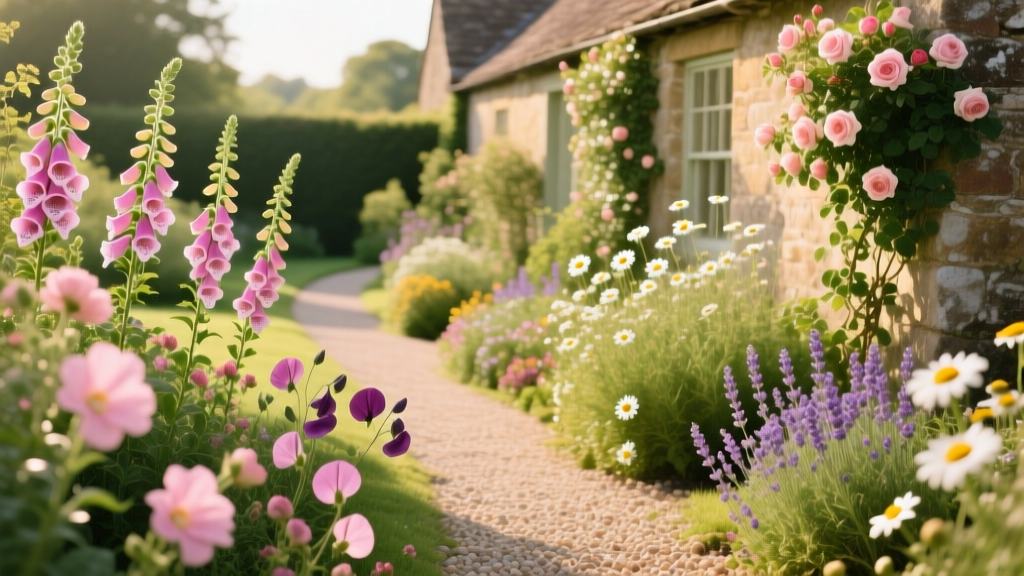
Cottage Garden Design: 15 Flowers for a Romantic English-Style Landscape
What Defines a Cottage Garden?
A cottage garden is dense, informal, and abundant. Unlike structured formal gardens, cottage gardens embrace "organized chaos" — flowers spill over paths, mix freely with herbs and vegetables, and create a romantic, lived-in feel. The key principles are:
- Density: Plants grow close together, filling every gap
- Layering: Tall in back, medium in middle, short at front — but with deliberate "rule-breaking"
- Mixing: Flowers, herbs, and edibles interplanted freely
- Self-seeding: Plants that naturalize and spread on their own
- Structure: Arbors, picket fences, and garden paths as bones
The 15 Essential Cottage Garden Flowers
1. Foxglove (Digitalis purpurea)
Height: 3-5 feet. Biennial that self-seeds freely. Dramatic tall spires in pink, purple, white. Plant in back borders. Toxic — keep away from children and pets.
2. Hollyhock (Alcea rosea)
Height: 5-8 feet. Classic cottage backdrop plant. Single or double blooms in every color. Susceptible to rust — choose resistant varieties like 'Halo' series.
3. Delphinium
Height: 3-6 feet. The quintessential English garden spire. True blue is unmatched. Stake tall varieties. Perennial in zones 3-7, treat as annual in warm climates.
4. Roses (Old Garden varieties)
Height: 3-6 feet. Choose David Austin English roses or heirloom varieties for fragrance and form. 'Gertrude Jekyll', 'Mary Rose', and 'Graham Thomas' are cottage garden staples.
5. Lavender (Lavandula)
Height: 1-3 feet. The backbone of cottage garden edges. English lavender (L. angustifolia) is most cold-hardy. 'Hidcote' and 'Munstead' are compact varieties ideal for paths.
6. Sweet Pea (Lathyrus odoratus)
Height: 6-8 feet (climbing). Annual climber with intoxicating fragrance. Plant on trellises, obelisks, or fences. More you pick, more they bloom.
7. Peony (Paeonia)
Height: 2-4 feet. The queen of late spring. Herbaceous peonies live 50+ years. 'Sarah Bernhardt' (pink) and 'Festiva Maxima' (white) are classics. Support heavy blooms with rings.
8. Catmint (Nepeta)
Height: 1-3 feet. Reliable lavender-blue clouds from early summer to fall. 'Walker's Low' is the gold standard. Cut back after first flush for reblooming.
9. Columbine (Aquilegia)
Height: 1-3 feet. Delicate spurred flowers in every color. Self-seeds prolifically with delightful color variations. Short-lived perennial (2-3 years) but replacements appear naturally.
10. Phlox (Phlox paniculata)
Height: 2-4 feet. Midsummer bloomer with fragrant clusters. 'David' (white, mildew-resistant) and 'Bright Eyes' (pink) are top picks. Essential for the midseason gap.
11. Hollyhock Mallow (Malva alcea)
Height: 2-4 feet. Underrated cottage perennial with pink saucer-shaped flowers from June to September. Self-seeds but not aggressively.
12. Bleeding Heart (Dicentra spectabilis)
Height: 2-3 feet. Early spring showstopper with arching stems of heart-shaped flowers. Goes dormant by midsummer — plant late bloomers nearby to fill the gap.
13. Cosmos (Cosmos bipinnatus)
Height: 3-5 feet. Airy annual with daisy-like flowers. 'Sensation' mix gives pink, white, and magenta. Self-seeds reliably. Perfect filler between perennials.
14. Verbena bonariensis
Height: 3-4 feet. Tall, see-through stems topped with purple clusters. Butterflies love it. See-through habit means it can be placed anywhere without blocking views.
15. Foxglove Beardtongue (Penstemon digitalis)
Height: 2-4 feet. Native wildflower with white tubular flowers. 'Husker Red' has dark foliage for contrast. Attracts hummingbirds. Drought-tolerant once established.
Cottage Garden Color Schemes
- Romantic: Pink, lavender, white, and silver (roses, lavender, foxglove, catmint)
- Sunset: Orange, red, yellow, and gold (cosmos, hollyhock, coreopsis, daylily)
- Blue paradise: Blues, purples, and whites (delphinium, catmint, phlox, lobelia)
Final Thoughts
The beauty of a cottage garden is that it's forgiving. Plants self-seed, colors mix, and "mistakes" become happy accidents. Start with these 15 classics, let them naturalize, and your garden will evolve into something uniquely beautiful over 3-5 years.