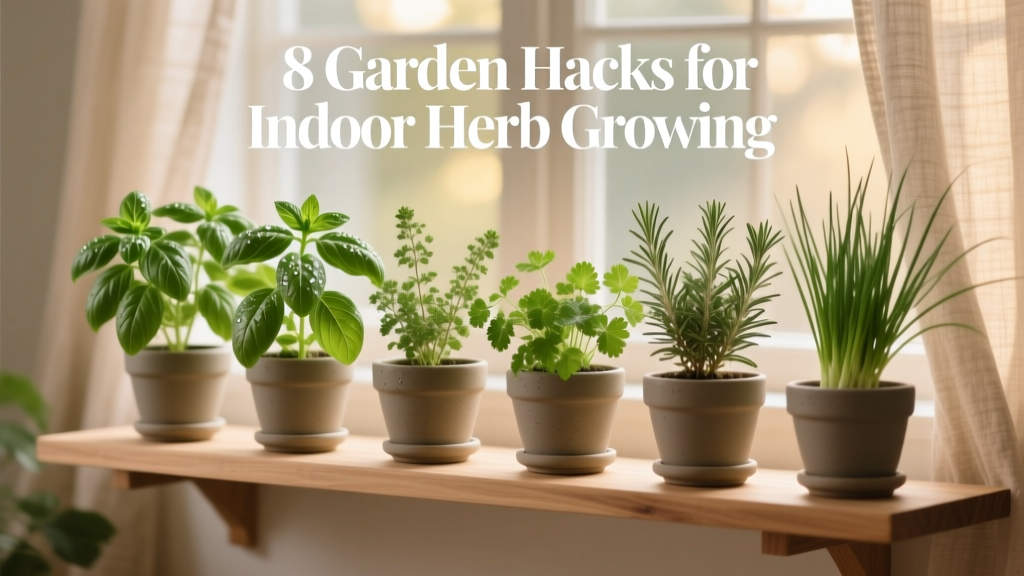
8 Garden Hacks for Indoor Herb Growing
The most common indoor-herb mistake isn’t “forgetting to water.” It’s growing herbs in a cute pot with no exit plan for water—so the roots sit in a swamp and the plant slowly quits on you. Indoors, evaporation is lower, airflow is weaker, and light is usually dimmer than you think, so tiny problems (like one extra ounce of water) snowball fast.
The good news: indoor herbs are ridiculously hackable. A few small tweaks—better drainage, smarter light placement, and one or two cheap DIY upgrades—can turn a sad grocery-store basil into a countertop jungle you’re actually cutting from every week.
Light Hacks: Get the Most Growth from the Least Sun
1) Use the “Hand-Shadow Test” to Place Herbs (It’s Faster Than Guessing)
Before you buy a grow light, test your window. Hold your hand 6 inches above the herb’s spot at midday: if the shadow is crisp, you’ve got strong light; if it’s fuzzy, you’re in medium light; if you can barely see it, it’s low light. Most culinary herbs (basil, rosemary, thyme) want strong light for stocky, flavorful growth.
Real-world example: In a north-facing apartment, moving basil from “bright room” to a south window (same room, different sill) can cut legginess within 7–10 days because the plant stops stretching for photons.
2) Turn One Grow Bulb into a Mini “Herb Station” with a Clamp Lamp
You don’t need a fancy panel. A $12–$20 clamp lamp plus a 9–15W LED grow bulb can outperform weak window light, especially in winter. Hang the bulb 8–12 inches above the herb tops and run it 14–16 hours/day on a $8 timer—shorter hours often mean slow growth and long, floppy stems.
Cost hack: One 10W LED running 16 hours/day is about 4.8 kWh/month. At $0.15/kWh, that’s roughly $0.72/month—cheaper than replacing one dead basil.
3) Rotate Pots on a Schedule (Not When You Remember)
Indoor herbs lean hard toward the light source, which can create weak, sideways stems that snap the first time you harvest. Rotate pots 90° every 2 days (set a phone reminder) so growth stays centered. This is especially useful for mint and basil on windowsills where light comes from one direction.
Scenario: If you’re growing on a kitchen windowsill that only gets sun from 10 a.m.–2 p.m., rotation keeps parsley from “spooning” toward the glass and shading its own center.
Water & Drainage Hacks: Stop Root Rot Before It Starts
4) Do the “Pot Weight” Check + Water by Ounces
Skip finger-poking (it lies in peat-heavy mixes). Instead, lift the pot right after watering and again when it’s near-dry—you’ll feel the difference instantly. For a 4-inch pot, start with a measured 2–3 oz of water per session and only increase if the pot dries within 24–36 hours; indoor conditions vary wildly, so dosing beats flooding.
Real-world example: A basil in a warm apartment near a radiator might need 3 oz every 2 days; the same plant in a cool office might only need 2 oz every 4 days.
5) Convert Any Cute Pot into a Safe Herb Pot with a “Hidden Drain Tray”
If you love decorative pots with no holes, treat them like cachepots: keep the herb in a nursery pot with drainage, then set that inside the decorative container. Add a DIY spacer (3–5 bottle caps or a ring of pebbles) under the nursery pot so it never sits in runoff. Empty the outer pot 10 minutes after watering—set a timer so you don’t forget.
Money-saver: This lets you reuse free nursery pots instead of buying “self-watering” planters that often cost $25–$40 each.
“Good drainage is not optional for container plants—overwatering damage is really oxygen deprivation at the roots.” — University of Minnesota Extension (2020)
Soil & Containers: Fast Fixes That Make Herbs Taste Better
6) Upgrade Grocery-Store Herbs by Splitting Them into 3–4 Pots
Those lush supermarket basil clumps are usually 10–20 seedlings crammed into one pot, competing until they collapse. Gently tease the root ball apart and replant into 3–4 containers (4-inch pots work well) using fresh mix; water in with a light soak and keep out of harsh sun for 48 hours. You’ll get sturdier plants and a much longer harvest window.
Scenario: You buy a $4 basil pot on Friday, split it into four pots the same day, and by the next weekend you’ve got four plants that recover and start pushing new growth instead of one plant that melts down.
7) Mix a “Herb-Ready” Potting Blend: 3:1 Potting Mix to Perlite
Indoor herbs hate soggy soil, and many bagged potting mixes hold too much water inside a calm, low-airflow home. A reliable blend is 3 parts potting mix : 1 part perlite (by volume) for basil, cilantro, parsley, and chives. For woody herbs (rosemary, thyme, oregano), go even sharper: 2:1 potting mix : perlite to reduce the risk of root rot.
DIY alternative: If you don’t have perlite, use pumice or coarse horticultural sand; avoid beach sand (salts + compaction).
| Setup | Best for | Watering forgiveness | Typical cost (per pot) | Common failure |
|---|---|---|---|---|
| Bagged potting mix (straight) | Fast starts, leafy herbs | Low indoors (stays wet) | $1–$2 (soil portion) | Root rot, fungus gnats |
| 3:1 potting mix : perlite | Basil, parsley, cilantro | Medium-high | $1.50–$2.50 | Dries faster if near heat vents |
| 2:1 potting mix : perlite | Rosemary, thyme, oregano | High (harder to overwater) | $1.75–$3 | Needs regular feeding after 6–8 weeks |
Source note: Container-drainage and overwatering risks are widely emphasized in extension guidance for houseplants and container herbs, including University of Minnesota Extension (2020) and Penn State Extension (2019) recommendations on container drainage and watering practices.
Harvest & Growth Tricks: Make Herbs Branch Instead of Sulk
8) Harvest Like a Pruner, Not Like a Chef (The “Top-Third Rule”)
Most indoor herb plants fail because people “pick a leaf here and there,” which leaves stems long and bare. Instead, snip stems just above a node (where two leaves emerge) and take up to the top third of the plant at once; that forces branching and doubles future harvest points. For basil, start this when the plant is 6–8 inches tall; for mint, when stems hit 4–6 inches.
Real-world example: If your basil has 6 stems, take 2 inches off the top of each stem every 7–10 days. You’ll get a compact plant that keeps producing instead of a lanky one with 3 sad leaves at the top.
Bonus Mini-Hacks (Use These With Any of the Tips Above)
Airflow fix for stronger stems: Run a small desk fan on low for 15–30 minutes/day, aimed past (not directly at) the herbs. This reduces fungal issues and encourages sturdier growth—especially helpful for cilantro and basil that get floppy indoors.
Gnats? Don’t nuke the plant—dry the top layer: Fungus gnats love consistently damp soil surfaces. Let the top 1 inch dry before watering again, and top-dress with a 1/2-inch layer of coarse sand or fine gravel to discourage egg-laying. Sticky traps near the pots catch adults within a week.
Fertilizer timing that won’t backfire: Many potting mixes feed plants for about 4–8 weeks. After that, use a half-strength liquid fertilizer (for example, 1/2 tsp per gallon if the label says 1 tsp) every 2 weeks for leafy herbs; go lighter for rosemary and thyme to avoid soft, weak growth.
Three Indoor Herb Setups That Actually Work (Pick One)
Scenario A: The “No-Sun Kitchen” setup (fastest win). Use a clamp lamp with a 9–15W LED grow bulb 10 inches above basil + parsley. Keep them in 4–6 inch nursery pots inside cachepots, rotate every 2 days, and harvest weekly using the top-third rule. Expect usable cutting harvests in about 3–4 weeks even without a bright window.
Scenario B: The “Sunny Window Minimalist” setup (lowest cost). Put rosemary and thyme in 2:1 potting mix:perlite in terracotta (dries faster and helps prevent overwatering). Water by pot weight, not by schedule, and keep plants 2–3 inches away from cold window glass in winter to avoid chilling the roots overnight. This setup is cheap and tough, but only works with a crisp hand-shadow window.
Scenario C: The “Grocery Basil Rescue” setup (highest yield per dollar). Buy one $4 supermarket basil, split into four pots, and put two under a grow bulb and two in your brightest window. Within 2 weeks, you’ll see which spot produces thicker stems and tighter leaf spacing; keep the best two and gift the others. You’ll learn your home’s real light levels without guessing.
One last insider move: keep notes like a chef, not a botanist. Write three things on a sticky note near your herbs—light hours, watering ounces, and last harvest date. Indoor herbs reward tiny adjustments, and once you find your numbers, you can repeat the same setup all year with almost no drama.
Citations: University of Minnesota Extension (2020) on container drainage and overwatering/root oxygen issues; Penn State Extension (2019) on watering container plants and the importance of drainage/avoiding saturated media.