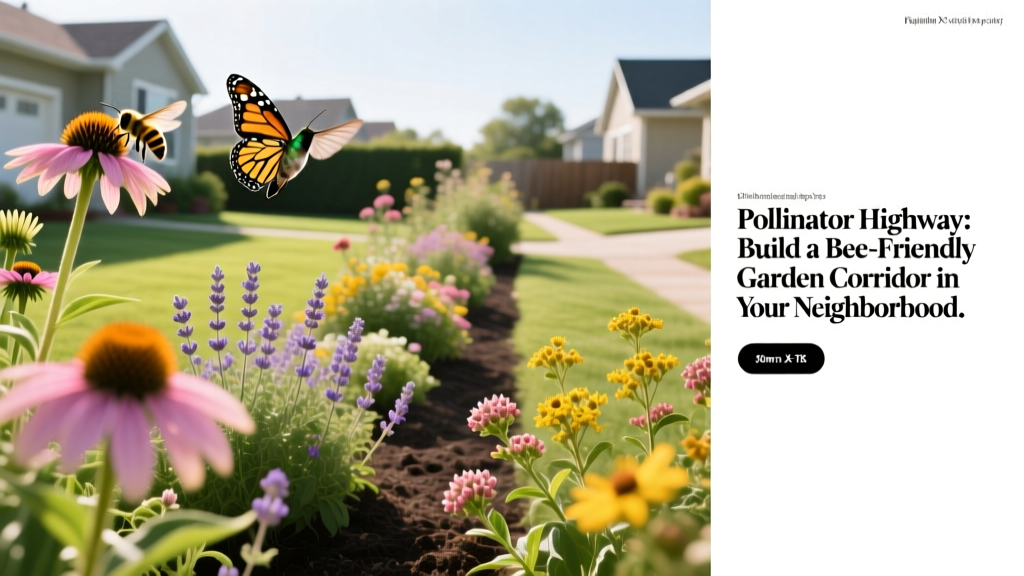
Pollinator Highway: Build a Bee-Friendly Garden Corridor in Your Neighborhood
What Is a Pollinator Highway?
A pollinator highway is a connected corridor of gardens that allows bees, butterflies, and other pollinators to travel safely across urban and suburban landscapes. Individual gardens are like islands — but connected gardens become a network that supports entire pollinator populations.
Why It Matters
Native bee populations have declined 30-50% in the last decade. Habitat fragmentation is the #1 cause — isolated gardens are too small to sustain populations. Research shows that pollinator corridors increase bee diversity by 300% compared to isolated gardens.
Step 1: Map Your Neighborhood
Pollinators travel 100-800 meters from their nest. Identify:
- Existing gardens within 500 feet of yours
- Vacant lots or public spaces that could host plantings
- Roads or paved areas that create gaps
- Schools, churches, or community centers with green space
Step 2: Coordinate with Neighbors
Simple Conversation Starters:
- "I'm planting a pollinator garden this spring — want some free seedlings?"
- "Our neighborhood has great potential for a garden corridor. Interested in joining?"
- Share this article and offer to help plan their pollinator space
Group Action Ideas:
- Seed swap event (native wildflower seeds)
- Group purchase of native plants (bulk discount)
- Shared "no-mow" zones along property lines
Step 3: Choose Sequential Bloom Plants
Pollinators need food from early spring through late fall. Plan continuous bloom:
| Season | Native Plants | Pollinators Attracted |
|---|---|---|
| Early Spring | Crocus, lungwort, fruit tree blossoms | Queen bumblebees emerging from hibernation |
| Late Spring | Wild columbine, wild geranium, blueberry | Mason bees, sweat bees |
| Early Summer | Echinacea, bee balm, milkweed | Monarchs, honeybees, bumblebees |
| Late Summer | Black-eyed Susan, Joe-Pye weed, goldenrod | All species, especially migrating monarchs |
| Fall | Asters, sedum, witch hazel | Late-season foragers preparing for winter |
Step 4: Create Nesting Habitat
70% of native bees nest underground. The rest use hollow stems and wood cavities.
Ground Nesters:
- Leave patches of bare, undisturbed soil (no mulch, no tilling)
- South-facing slopes are preferred
- Sandy or well-drained soil works best
Stem Nesters:
- Leave dead flower stems standing through winter (cut in spring)
- Bundle hollow bamboo stems (6-8 inches long) into bee hotels
- Drill holes (3/16 to 5/16 inch diameter, 4-6 inches deep) in untreated wood blocks
Step 5: Eliminate Pesticide Use
Even "organic" pesticides like neem oil and pyrethrin kill bees. In a pollinator corridor:
- Replace pesticides with companion planting and hand-picking
- If spraying is necessary, apply at dusk when bees are inactive
- Never spray blooming flowers
- Encourage neighbors to reduce or eliminate pesticide use
Final Thoughts
One garden helps a few bees. A connected corridor sustains entire populations. Start with your own yard, inspire one neighbor, then grow the network. Within 2-3 years, you'll see butterfly and bee diversity you never imagined possible in a suburban setting.